Redox Reaction Calculator
Balancing oxidation-reduction reactions • Half-reaction method
Half-Reaction Method for Balancing Redox Reactions:
Show CalculatorThe half-reaction method balances redox reactions by treating oxidation and reduction separately:
1. Identify oxidized and reduced species
2. Write separate half-reactions
3. Balance atoms other than O and H
4. Balance oxygen with H₂O
5. Balance hydrogen with H⁺ (acidic) or OH⁻ (basic)
6. Balance charge with electrons
7. Equalize electrons in both half-reactions
8. Combine and simplify
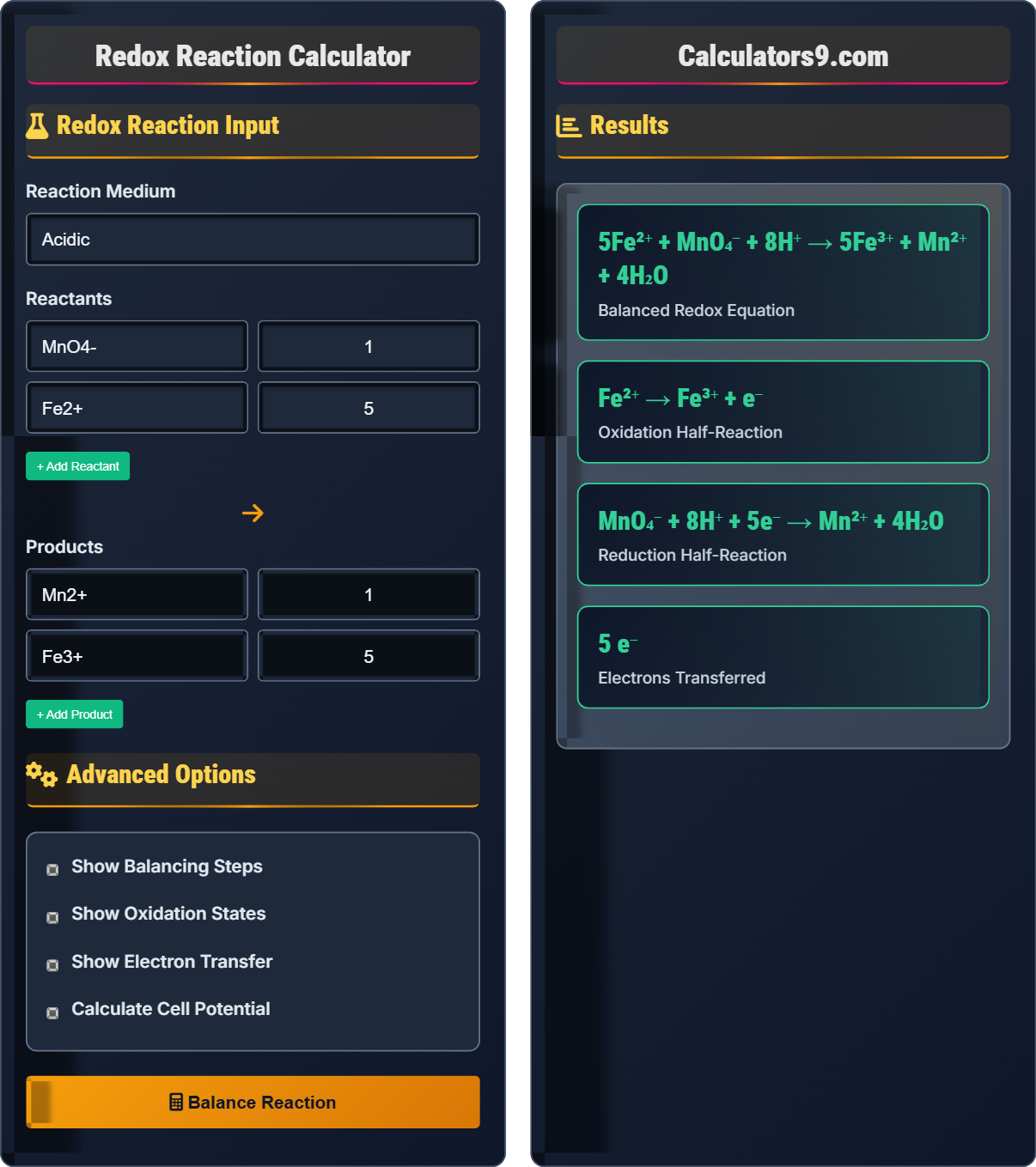
Example: Balancing MnO₄⁻ + Fe²⁺ → Mn²⁺ + Fe³⁺ in acidic solution:
Oxidation: Fe²⁺ → Fe³⁺ + e⁻
Reduction: MnO₄⁻ + 8H⁺ + 5e⁻ → Mn²⁺ + 4H₂O
Combined: 5Fe²⁺ + MnO₄⁻ + 8H⁺ → 5Fe³⁺ + Mn²⁺ + 4H₂O
Redox Reaction Input
Advanced Options
Results
Redox Reaction Fundamentals
A redox (oxidation-reduction) reaction involves the transfer of electrons between chemical species. Oxidation is the loss of electrons, while reduction is the gain of electrons. These processes always occur simultaneously - what is oxidized must be reduced by something else.
The systematic approach to balancing redox reactions:
- Separate the reaction into oxidation and reduction half-reactions
- Balance all atoms except H and O
- Balance oxygen atoms by adding H₂O
- Balance hydrogen atoms by adding H⁺ (acidic) or H₂O/OH⁻ (basic)
- Balance charges by adding electrons
- Multiply half-reactions to equalize electrons
- Add half-reactions and simplify
- Oxidation state of free elements is zero
- Oxygen usually has oxidation state of -2
- Hydrogen usually has oxidation state of +1
- Sum of oxidation states equals the charge of the species
Electrochemical Applications
The standard cell potential (E°cell) determines the spontaneity of a redox reaction: E°cell = E°cathode - E°anode. If E°cell > 0, the reaction is spontaneous under standard conditions.
For non-standard conditions: Ecell = E°cell - (RT/nF)lnQ, where Q is the reaction quotient. This allows calculation of cell potential at any concentration.
- Electroplating and metal purification
- Battery design and fuel cells
- Corrosion prevention
- Quantitative analytical chemistry
Redox Reaction Learning Quiz
Balance the following redox reaction in acidic solution: Cr₂O₇²⁻ + C₂O₄²⁻ → Cr³⁺ + CO₂. Show all steps of the half-reaction method and explain the reasoning behind each step.
Step 1: Identify oxidation and reduction:
Cr₂O₇²⁻ → Cr³⁺ (reduction, Cr changes from +6 to +3)
C₂O₄²⁻ → CO₂ (oxidation, C changes from +3 to +4)
Step 2: Write unbalanced half-reactions:
Oxidation: C₂O₄²⁻ → CO₂
Reduction: Cr₂O₇²⁻ → Cr³⁺
Step 3: Balance atoms other than O and H:
Oxidation: C₂O₄²⁻ → 2CO₂
Reduction: Cr₂O₇²⁻ → 2Cr³⁺
Step 4: Balance oxygen with H₂O:
Oxidation: C₂O₄²⁻ → 2CO₂
Reduction: Cr₂O₇²⁻ → 2Cr³⁺ + 7H₂O
Step 5: Balance hydrogen with H⁺:
Oxidation: C₂O₄²⁻ → 2CO₂
Reduction: Cr₂O₇²⁻ + 14H⁺ → 2Cr³⁺ + 7H₂O
Step 6: Balance charge with electrons:
Oxidation: C₂O₄²⁻ → 2CO₂ + 2e⁻
Reduction: Cr₂O₇²⁻ + 14H⁺ + 6e⁻ → 2Cr³⁺ + 7H₂O
Step 7: Equalize electrons (multiply oxidation by 3):
Oxidation: 3C₂O₄²⁻ → 6CO₂ + 6e⁻
Reduction: Cr₂O₇²⁻ + 14H⁺ + 6e⁻ → 2Cr³⁺ + 7H₂O
Step 8: Combine and simplify:
3C₂O₄²⁻ + Cr₂O₇²⁻ + 14H⁺ → 6CO₂ + 2Cr³⁺ + 7H₂O
This problem demonstrates the systematic approach to balancing complex redox reactions. The key insight is recognizing that the dichromate ion (Cr₂O₇²⁻) contains two chromium atoms, each changing from +6 to +3, requiring 3 electrons per Cr atom.
The oxalate ion (C₂O₄²⁻) contains two carbon atoms, each changing from +3 to +4, losing 1 electron per C atom. Since there are 2 C atoms, 2 electrons are lost per oxalate ion.
The half-reaction method works because the number of electrons lost in oxidation must equal the number gained in reduction. This ensures charge conservation in the balanced equation.
Oxidation: Loss of electrons, increase in oxidation state
Reduction: Gain of electrons, decrease in oxidation state
Oxidizing Agent: Species that gets reduced, causing oxidation
Reducing Agent: Species that gets oxidized, causing reduction
• Always balance atoms before balancing charges
• In acidic solutions, use H⁺ and H₂O to balance H and O
• In basic solutions, use OH⁻ and H₂O, then neutralize excess H⁺
• Electrons must cancel when combining half-reactions
• Remember "OIL RIG": Oxidation Is Loss, Reduction Is Gain (of electrons)
• Start by identifying which species is oxidized and which is reduced
• Always verify that charge and mass are balanced in the final equation
• Forgetting to balance oxygen and hydrogen atoms
• Incorrectly assigning oxidation states
• Not equalizing electrons before combining half-reactions
• Mixing acidic and basic balancing methods
A galvanic cell is constructed using the half-reactions: Zn²⁺ + 2e⁻ → Zn (E° = -0.76 V) and Cu²⁺ + 2e⁻ → Cu (E° = +0.34 V). Which metal serves as the anode? Calculate the standard cell potential. Is the reaction spontaneous?
Determining the anode:
The half-reaction with the lower (more negative) standard reduction potential will be reversed to become the oxidation reaction at the anode.
Zn²⁺ + 2e⁻ → Zn (E° = -0.76 V) has the lower potential
So Zn will be oxidized: Zn → Zn²⁺ + 2e⁻ (anode reaction)
Cu²⁺ + 2e⁻ → Cu (E° = +0.34 V) occurs as reduction (cathode reaction)
Calculating cell potential:
E°cell = E°cathode - E°anode
E°cell = 0.34 V - (-0.76 V) = 0.34 V + 0.76 V = 1.10 V
Spontaneity:
Since E°cell > 0 (1.10 V > 0), the reaction is spontaneous under standard conditions.
Overall reaction:
Zn(s) + Cu²⁺(aq) → Zn²⁺(aq) + Cu(s)
This problem connects redox reactions to electrochemistry. In a galvanic cell, the half-reaction with the lower reduction potential occurs as oxidation (anode), while the half-reaction with the higher reduction potential occurs as reduction (cathode).
The standard cell potential is calculated as the difference between the cathode and anode potentials. A positive E°cell indicates a spontaneous reaction that can do work.
The direction of electron flow is from the anode (where oxidation occurs) to the cathode (where reduction occurs) through the external circuit.
Anode: Electrode where oxidation occurs, electrons leave
Cathode: Electrode where reduction occurs, electrons enter
Galvanic Cell: Device that converts chemical energy to electrical energy
Standard Reduction Potential: Tendency of a species to gain electrons under standard conditions
• Higher reduction potential species is reduced (cathode)
• Lower reduction potential species is oxidized (anode)
• E°cell = E°cathode - E°anode
• Positive E°cell indicates spontaneous reaction
• Remember: "An Ox - Red Cat" (Anode = Oxidation, Reduction = Cathode)
• The species with the higher reduction potential gets reduced
• Always subtract anode potential from cathode potential
• Confusing which electrode is anode vs cathode
• Subtracting in wrong order (E°anode - E°cathode)
• Forgetting to reverse the sign for oxidation half-reaction
• Misinterpreting spontaneity based on negative cell potential
Chemistry FAQ
Q: How do I determine the oxidation state of atoms in complex ions like Cr₂O₇²⁻ or MnO₄⁻?
A: To determine oxidation states in polyatomic ions, follow these rules:
For Cr₂O₇²⁻ (dichromate ion):
1. Oxygen typically has an oxidation state of -2
2. There are 7 oxygen atoms: 7 × (-2) = -14
3. The total charge of the ion is -2
4. So: 2 × (Cr oxidation state) + (-14) = -2
5. 2 × (Cr oxidation state) = +12
6. Cr oxidation state = +6
For MnO₄⁻ (permanganate ion):
1. Oxygen has oxidation state of -2
2. There are 4 oxygen atoms: 4 × (-2) = -8
3. The total charge of the ion is -1
4. So: (Mn oxidation state) + (-8) = -1
5. Mn oxidation state = +7
Remember: the sum of oxidation states equals the overall charge of the species.
Q: What's the difference between balancing redox reactions in acidic vs basic solutions?
A: The main difference lies in how you balance hydrogen and oxygen atoms:
In Acidic Solution:
• Balance oxygen with H₂O
• Balance hydrogen with H⁺
• Final equation contains H⁺ ions
In Basic Solution:
• First balance as if in acidic solution
• Then add OH⁻ to both sides to neutralize all H⁺
• Combine H⁺ and OH⁻ to form H₂O
• Cancel excess water molecules
• Final equation contains OH⁻ ions instead of H⁺
Example: If you have 14H⁺ on one side in acidic balancing, you would add 14OH⁻ to both sides in basic solution:
14H⁺ + 14OH⁻ → 14H₂O
This converts H⁺ to H₂O in the final basic equation.