Stoichiometry Calculator
Chemical Reactions • Limiting Reagents • Yields
Stoichiometry Formula:
Show the calculator\( aA + bB \rightarrow cC + dD \)
Where:
- \( a, b, c, d \) = Stoichiometric coefficients
- \( A, B \) = Reactants
- \( C, D \) = Products
This fundamental equation shows molar ratios in chemical reactions.
Key Relationships:
\( \frac{n_A}{a} = \frac{n_B}{b} = \frac{n_C}{c} = \frac{n_D}{d} \)
Limiting Reagent:
\( \text{LR} = \min\left(\frac{n_{available}}{coefficient}\right) \)
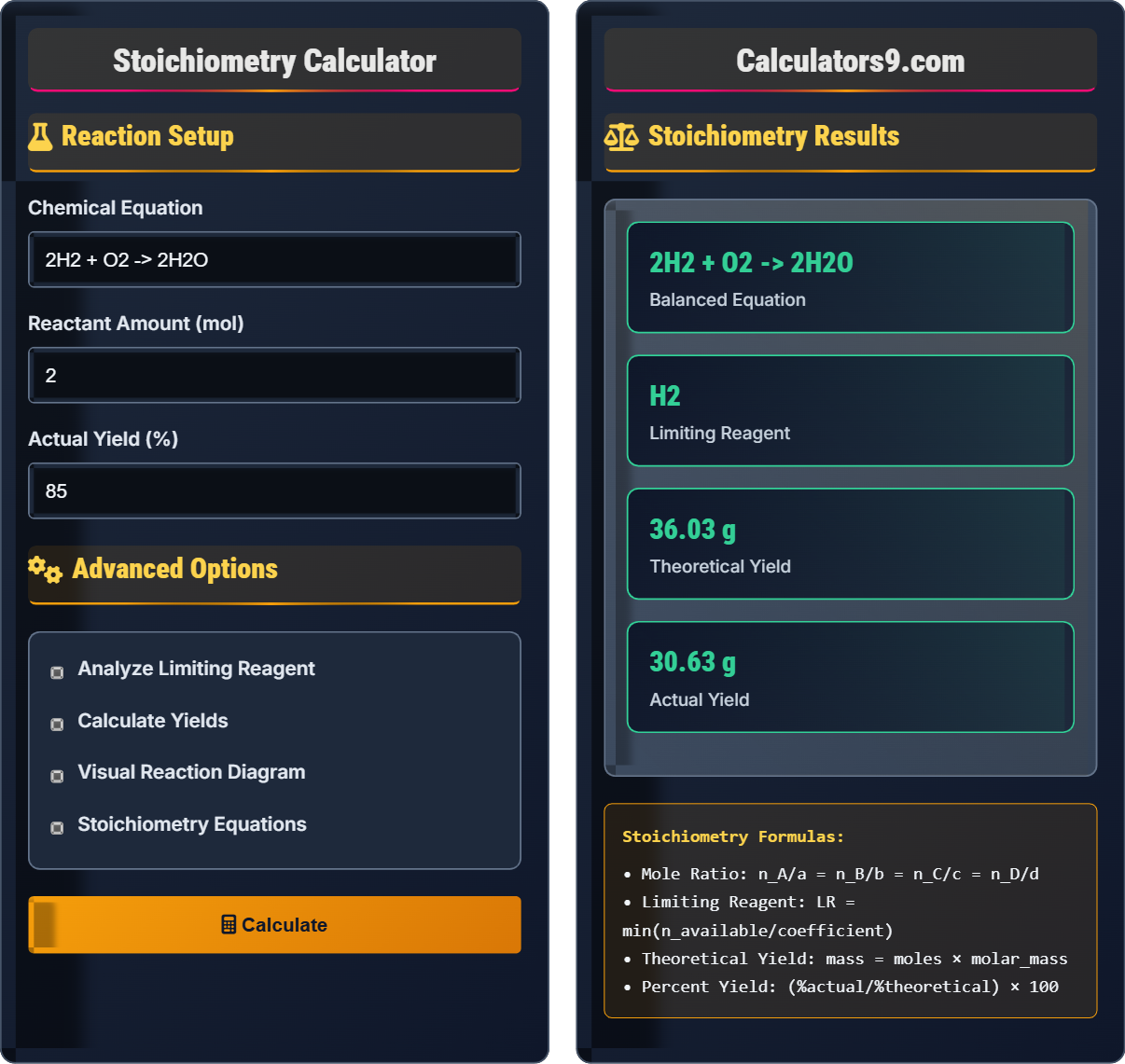
Example: 2H₂ + O₂ → 2H₂O
2 moles H₂ react with 1 mole O₂ to produce 2 moles H₂O.
Reaction Setup
Advanced Options
Stoichiometry Results
Comprehensive Stoichiometry Chemistry Guide
Stoichiometry is the quantitative study of reactants and products in chemical reactions. It involves using balanced chemical equations to determine the amounts of substances consumed and produced in reactions. The word comes from Greek "stoicheion" (element) and "metron" (measure). Stoichiometry is based on the law of conservation of mass and balanced chemical equations.
The fundamental stoichiometry equations:
Stoichiometry calculations are essential in various fields:
- Manufacturing: Production optimization and cost control
- Pharmaceuticals: Drug synthesis and dosage calculations
- Environmental: Pollution control and waste management
- Food Science: Nutritional analysis and food production
- Definition: Reactant that gets completely consumed first
- Identification: Calculate n_available/coefficient for each reactant
- Impact: Determines maximum amount of product formed
- Excess: Reactant remaining after reaction completes
Stoichiometry Concepts
Chemical equation with equal atoms on both sides
Ratio of coefficients in balanced equation
- Always balance equation first
- Mole ratios come from coefficients
- Mass must be converted to moles
Reaction Calculations
Theoretical = maximum possible, Actual = obtained in experiment
- Balance the chemical equation
- Convert masses to moles
- Identify limiting reagent
- Calculate theoretical yield
- Percent yield ≤ 100% always
- Excess reagent remains after reaction
- Conservation of mass applies
Chemistry Stoichiometry Learning Quiz
In the reaction 2Al + 3Cl₂ → 2AlCl₃, if you start with 4 moles of Al and 4 moles of Cl₂, which is the limiting reagent?
The answer is B) Cl₂ (chlorine). To identify the limiting reagent, divide moles available by coefficient: Al: 4/2 = 2, Cl₂: 4/3 = 1.33. Since 1.33 < 2, Cl₂ is the limiting reagent.
To find the limiting reagent, calculate moles available divided by coefficient for each reactant. The smallest value indicates the limiting reagent. In this case, 4 moles of Al could theoretically produce 4 moles of AlCl₃ (4/2 × 2), but 4 moles of Cl₂ can only produce 2.67 moles of AlCl₃ (4/3 × 2). Since Cl₂ runs out first, it limits the reaction.
Limiting Reagent: Reactant that gets consumed first
Excess Reagent: Reactant remaining after reaction
Stoichiometric Ratio: Mole ratio from balanced equation
• Calculate moles_available/coefficient for each reactant
• Smallest value indicates limiting reagent
• Limiting reagent determines maximum product yield
• Always divide moles by coefficient
• Smallest result = limiting reagent
• Use limiting reagent for product calculations
• Forgetting to divide by coefficients
• Using largest value instead of smallest
• Not converting to moles first
For the reaction 2H₂ + O₂ → 2H₂O, if 4.0 g of H₂ reacts with excess O₂ and produces 30.0 g of H₂O, calculate: a) the theoretical yield of H₂O, b) the percent yield, and c) explain why the actual yield might be less than theoretical.
a) Theoretical yield: Moles of H₂ = 4.0g ÷ 2.016g/mol = 1.98 mol. From equation, 2 mol H₂ produces 2 mol H₂O, so 1.98 mol H₂ produces 1.98 mol H₂O. Theoretical mass = 1.98 mol × 18.015g/mol = 35.7 g.
b) Percent yield: % yield = (30.0g/35.7g) × 100% = 84.0%.
c) Reasons for lower yield: Side reactions, incomplete reaction, loss during purification, measurement errors, or equilibrium limitations.
This problem combines multiple stoichiometry concepts: mass-to-mole conversion, mole-to-mole ratios from the balanced equation, and yield calculations. The key is to always work in moles when using stoichiometric ratios, then convert back to mass if needed. Percent yield compares actual to theoretical, revealing reaction efficiency.
Theoretical Yield: Maximum product possible from limiting reagent
Actual Yield: Product obtained in experiment
Percent Yield: (Actual/Theoretical) × 100%
• Always convert to moles for stoichiometry
• Use balanced equation coefficients as ratios
• Percent yield cannot exceed 100%
• Balance equation first
• Work in moles for ratios
• Convert back to desired units at end
• Forgetting to balance equation
• Using mass ratios instead of mole ratios
• Not identifying limiting reagent properly
FAQ
Q: Why do we need to balance chemical equations before doing stoichiometry? Can't we just use the unbalanced equation?
A: Balancing chemical equations is essential because it reflects the law of conservation of mass - matter cannot be created or destroyed in chemical reactions. Unbalanced equations give incorrect mole ratios between reactants and products.
For example, if you wrote H₂ + O₂ → H₂O without balancing, you'd predict 1 mole of H₂ reacts with 1 mole of O₂ to make 1 mole of H₂O. But this is impossible because it suggests 2 oxygen atoms become 1 oxygen atom. The balanced equation (2H₂ + O₂ → 2H₂O) correctly shows 2:1:2 mole ratios.
Q: What's the difference between theoretical yield and actual yield? Why is actual yield usually lower?
A: Theoretical yield is the maximum amount of product predicted by stoichiometry from the limiting reagent. Actual yield is what you obtain in the laboratory.
Actual yield is usually lower due to: incomplete reactions, side reactions producing unwanted products, loss during purification steps, measurement errors, and equilibrium limitations. Sometimes actual yield can appear higher due to impurities or solvent inclusion, but true pure product yield is always ≤ theoretical yield.