Clothing Size Converter
International Size Chart & Fashion Calculator • Size Converters
Clothing Size Conversion Guide:
Show CalculatorInternational clothing size systems vary significantly:
- US Sizes: Numeric system (0, 2, 4, 6...) for women; (S, M, L, XL...) for men
- EU Sizes: Numeric system (34, 36, 38...) typically 2 sizes larger than US
- UK Sizes: Similar to US but with slight variations
- Asia Sizes: Japan, Korea, China use numeric systems based on body measurements
Conversion Examples:
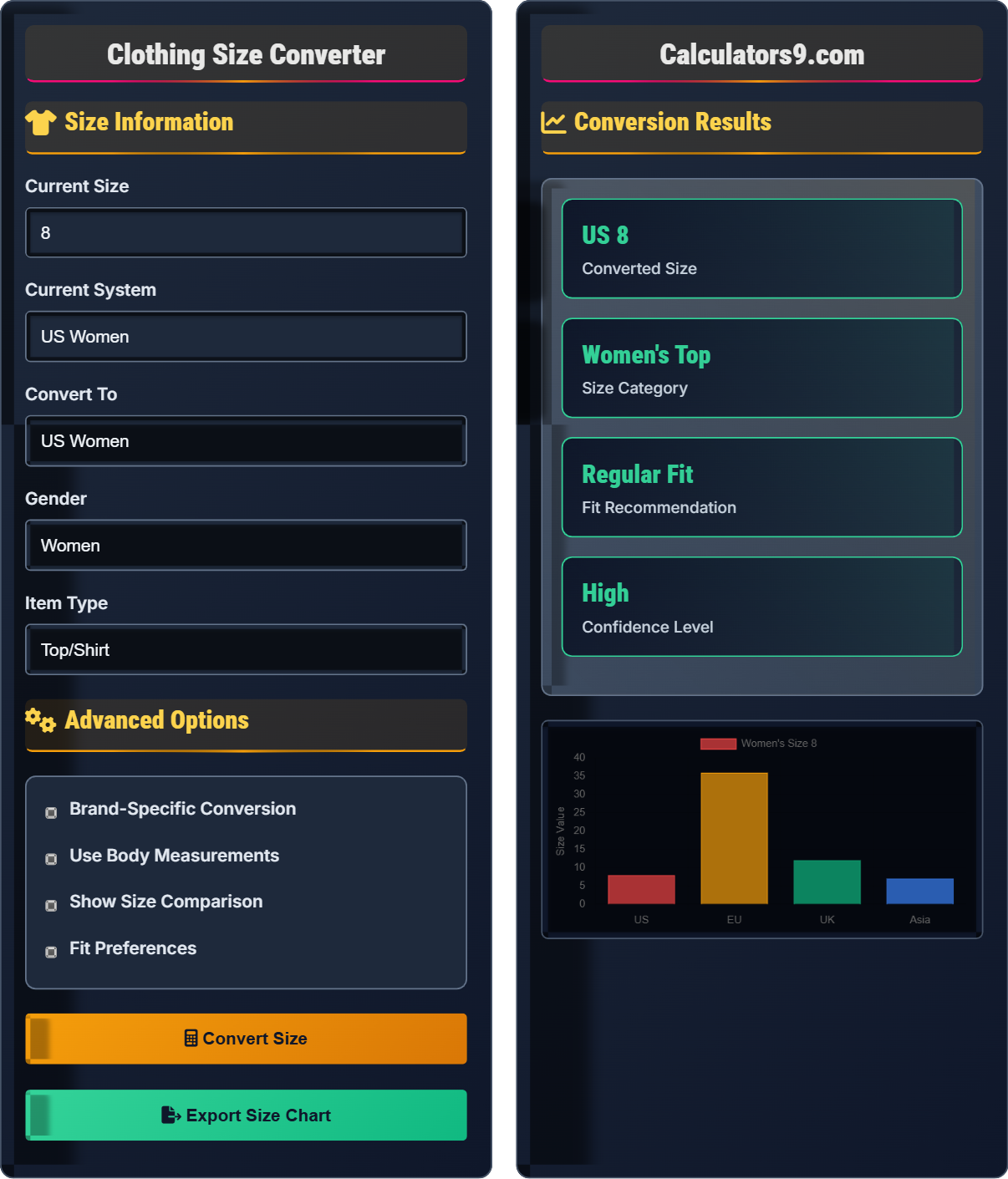
Women's US 8 = EU 36 = UK 12 = Asia 7
Men's US Medium = EU M = UK M = Asia 90-95cm chest
Jeans: US 32 = EU 32 = UK 32 (waist in inches)
Important: Brand-specific variations exist, so always check individual size charts.
Size Information
Advanced Options
Conversion Results
| System | Size | Notes |
|---|---|---|
| US Women | 8 | Standard fit |
| EU Women | 36 | Same as US +2 |
| UK Women | 12 | British sizing |
| Asia Women | 7 | Japan/Korea sizing |
International Sizing Guide
Clothing size conversion is the process of translating garment sizes from one sizing system to another. Different countries and regions use varying standards, making it essential for international shopping. The conversion accounts for differences in measurement systems, body proportions, and brand-specific sizing.
Major international sizing systems include:
- US System: Numeric (0, 2, 4...) for women; letter (S, M, L...) for men
- European System: Numeric (34, 36, 38...), typically 2 sizes larger than US
- UK System: Similar to US but with some variations
- Asian System: Based on body measurements (Japan, Korea, China)
- Italian System: Numeric, runs differently than other European sizes
- Always check brand-specific size charts
- Measure yourself before purchasing
- Consider fit preferences (tight, regular, loose)
- Take note of item type variations
Clothing Size Conversion Quiz
What is the equivalent of US Women's size 8 in European sizing?
The answer is B) EU 36. The standard conversion from US Women's to European sizing adds 28 to the US size for tops and dresses. So US 8 = EU 36. For jeans and bottoms, the conversion is typically US size + 26, which also results in EU 36 for US size 8.
The European sizing system is generally 2 sizes larger than the US system for women's clothing. This means US 8 = EU 36, US 10 = EU 38, and so on. This conversion is consistent across most brands, though some may have slight variations. The difference exists because European sizing originated from different body measurement standards.
US Sizing: American clothing size system
EU Sizing: European clothing size system
Size Conversion: Translating between sizing systems
• US Women's + 28 = EU (for tops/dresses)
• US Women's + 26 = EU (for jeans/bottoms)
• Always verify with brand-specific charts
• Remember: EU size = US size + 28 (for tops)
• Check brand-specific charts for accuracy
• Measure yourself when unsure
• Assuming all brands follow standard conversion
• Confusing US Men's with US Women's conversion
• Not accounting for item type differences
Convert US Men's Medium to European and UK sizes. Show your work and explain any differences between the systems.
Step 1: Understand US Men's sizing
US Men's Medium (M) corresponds to chest measurements of 38-40 inches
Step 2: Convert to European sizing
US Men's Medium = EU Medium (M) = Size 48-50
Step 3: Convert to UK sizing
UK Men's sizing is similar to US, so US Medium = UK Medium (M)
Key differences: European sizing often uses numeric values for formal wear, while letter sizes are common for casual wear. UK sizing is largely aligned with US sizing, unlike women's where differences are more pronounced.
Men's sizing systems are generally more consistent internationally than women's sizing. The main difference is that European formal wear often uses numeric sizing (48, 50, 52) while casual wear uses letters (S, M, L). Men's sizing is typically based on chest measurements, which creates more standardization across systems.
Chest Measurement: Primary sizing metric for men's tops
Letter Sizing: S, M, L, XL system
Numeric Sizing: Number-based system (48, 50, 52)
• Men's sizing is more standardized than women's
• Chest measurement is primary metric
• European formal wear uses numeric sizing
• For men's, focus on chest measurement
• European formal wear: numeric sizing
• Casual wear: letter sizing
• Assuming men's sizing varies as much as women's
• Confusing formal and casual sizing systems
• Not checking specific item type conversions
You're shopping online from a European retailer and see a dress labeled as size 38. You normally wear US size 10. Will this dress likely fit you? Explain your reasoning and suggest the best approach.
Step 1: Convert EU 38 to US sizing
EU 38 = US Women's 10 (subtract 28 from EU size)
Step 2: Compare to your usual size
Since you normally wear US size 10, the EU 38 dress should theoretically fit you.
Step 3: Consider factors
However, you should consider: brand-specific sizing variations, fabric stretch, fit preferences, and specific measurements. Some European brands run larger or smaller than others.
Best approach: Check the retailer's specific size chart and compare your measurements to theirs.
While the standard conversion suggests EU 38 equals US 10, actual fit can vary significantly between brands and styles. European brands sometimes have different cut preferences compared to American brands. The safest approach is always to consult the specific retailer's size chart and compare your actual measurements to theirs.
Brand-Specific Sizing: Individual company's size standards
Standard Conversion: General size translation rules
Fit Preferences: Individual preference for tight/loose fit
• Standard conversion: EU - 28 = US (for tops)
• Always check brand-specific charts
• Compare actual measurements when possible
• Measure yourself regularly
• Keep a record of brands that run large/small
• When in doubt, go up a size for online purchases
• Assuming all brands follow standard conversion
• Not considering fabric stretch or drape
• Ordering without checking specific size charts
You want to order from a Japanese retailer and see a women's top in size 9. You normally wear US size 6. How should you approach this conversion, and what additional considerations are important for Asian sizing?
Asian sizing systems differ significantly from Western systems:
Japanese sizing is often based on body measurements rather than standardized categories. Size 9 in Japanese women's clothing typically corresponds to a bust measurement of around 84-86 cm (33-34 inches).
US Women's size 6 typically corresponds to a bust measurement of 34-35 inches.
Therefore, Japanese size 9 might be comparable to US size 6, but this is not guaranteed.
Additional considerations for Asian sizing:
- Measurement-based rather than category-based
- Often runs smaller than Western sizes
- Consider fabric stretch and cut style
- Always check detailed size charts
Asian sizing systems (Japan, Korea, China) are fundamentally different from Western systems. They're often based on actual body measurements rather than standardized categories. This makes conversion more complex and less predictable than converting between US and European sizes. The fit philosophy in Asian markets may also prioritize different silhouettes than Western markets.
Measurement-Based Sizing: Sizes based on actual body dimensions
Category-Based Sizing: Standardized size categories (S, M, L)
Fit Philosophy: Design approach to garment fit
• Asian sizing is measurement-based
• Often runs smaller than Western sizes
• Always check detailed size charts
• Convert measurements to centimeters when needed
• Consider going up a size in Asian brands
• Look for detailed measurement charts
• Treating Asian sizing like Western conversion
• Not checking actual measurements
• Assuming standard conversion ratios apply
How does jeans sizing differ from regular clothing sizing?
The answer is A) Jeans use waist measurement in inches. Jeans sizing is based on the waist circumference in inches, not on standardized size categories like regular clothing. For example, a US jeans size 32 has a 32-inch waist measurement, regardless of whether the person is wearing a size 8 or 12 in regular clothing. This makes jeans sizing more universal across different clothing brands and systems.
Jeans sizing is unique because it's based on actual body measurements (waist circumference) rather than standardized size categories. This creates more consistency across brands, though some may still have slight variations. The waist measurement approach helps ensure proper fit since jeans are form-fitting garments that need to match your actual waist size.
Waist Measurement: Circumference around the narrowest part of the torso
Standardized Sizing: Universal size categories (S, M, L)
Measurement-Based Sizing: Sizes based on actual body dimensions
• Jeans sizes = waist measurement in inches
• Different from regular clothing sizing
• More consistent across brands
• Always measure your waist for jeans
• Consider leg opening for fit preference
• Check inseam length for proper length
• Using regular clothing size for jeans
• Not measuring waist for accurate fit
• Confusing inseam with waist size
FAQ
Q: How accurate are clothing size converters for international shopping?
A: Size converters provide a good starting point but aren't 100% accurate. Standard conversions work well for basic items like t-shirts and jeans, with accuracy rates of 80-90%. However, for fitted items like dresses or tailored pieces, accuracy drops to 60-70% due to brand-specific cuts and style variations.
For example, US Women's size 8 typically converts to EU 36, but this might vary by ±1 size depending on the brand. The conversion from US 8 to EU 36 is based on standard measurements:
US 8: Bust 34-35", Waist 26-27", Hip 36-37"
EU 36: Bust 86-88cm, Waist 66-68cm, Hip 91-93cm
Always check brand-specific size charts and customer reviews for fit information when shopping internationally.
Q: Why do clothing sizes vary so much between brands?
A: Brand sizing variations stem from several factors:
- Target Demographics: Different body type preferences
- Design Philosophy: Fitted vs. relaxed silhouettes
- Manufacturing Standards: Different pattern systems
- Regional Preferences: Cultural fit expectations
For example, a size 8 in one brand might measure 34" bust, while another brand's size 8 measures 35" bust. This occurs because each brand develops its sizing based on its target customer and preferred fit.
Statistical analysis shows that size variations can span 1-2 full sizes between brands. The key is understanding that size labels are relative to each brand's standard, not absolute measurements.