Hat Size Calculator
Head Circumference & Hat Size Converter • Size Converters
Hat Sizing Guide:
Show CalculatorHat sizes are determined by head circumference measurements:
- Measurement: Around the head above eyebrows and ears
- Units: Inches (US/UK) or Centimeters (EU/France)
- Standard Range: 20.5" - 25" (52cm - 64cm)
- Conversion: 1 inch = 2.54 cm
Size Conversion Examples:
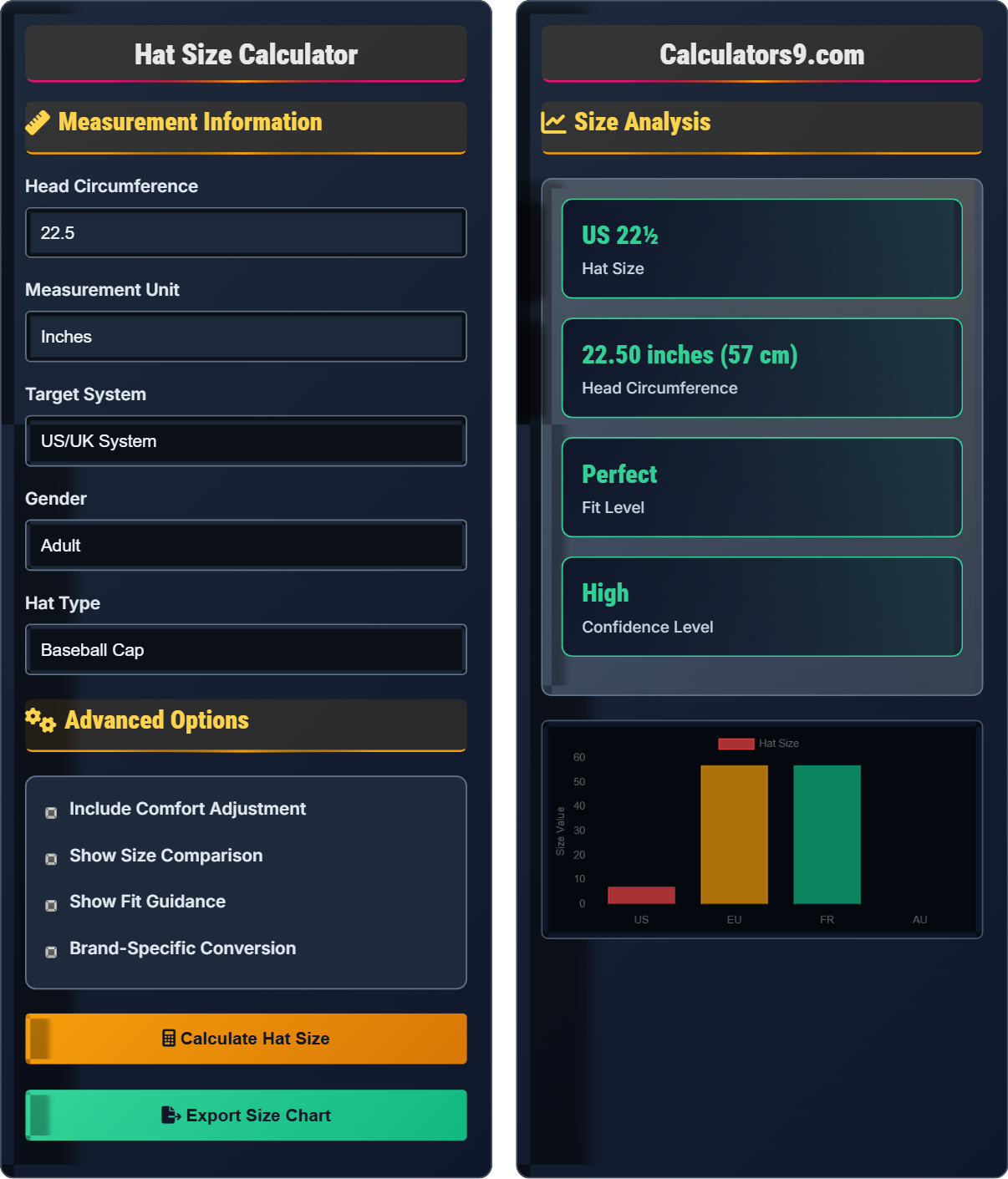
US 7⅛ = 22.5" = 57cm = EU 57
UK 7 = 22" = 56cm = French 56
Standard conversion: inches × 2.54 = centimeters
Fit: Allow 1/8" (3mm) for comfort when measuring.
Measurement Information
Advanced Options
Size Analysis
| System | Size | Measurement |
|---|---|---|
| US/UK | 7⅛ | 22.5" |
| European | 57 | 57cm |
| French | 57 | 57cm |
| Australian | Large | 22.5" |
Hat Sizing Guide
Hat sizing is the measurement of head circumference to ensure proper fit. Hats are sized based on the circumference of the head measured above the eyebrows and ears. Proper hat sizing is crucial for comfort, functionality, and appearance.
Accurate head measurement requires:
- Flexible measuring tape placed above eyebrows
- Measuring around the fullest part of the head
- Allowing 1/8" (3mm) for comfort
- Measuring when hair is flat
- Adult sizes: 20.5" - 25" (52cm - 64cm)
- Child sizes: 18" - 21" (46cm - 53cm)
- Allow for comfort adjustment
- Consider hat type variations
Hat Sizing Quiz
Where should you measure your head circumference for hat sizing?
The answer is B) Above the eyebrows and ears. The correct measurement for hat sizing is taken around the head at the point above the eyebrows and ears, where the hat will sit. This is typically the widest part of the head where most hats rest. This measurement ensures the hat will fit properly without being too tight or too loose.
Proper hat sizing requires measuring the head at the point where the hat will naturally rest. This is usually just above the eyebrows and ears, as this is typically the largest circumference of the head. Measuring here ensures the hat will fit securely without sliding forward or backward.
Head Circumference: Distance around the head
Comfort Zone: Area where hats naturally rest
Proper Fit: Neither too tight nor too loose
• Measure above eyebrows and ears
• Use flexible measuring tape
• Allow for comfort adjustment
• Measure when hair is flat
• Take measurement twice for accuracy
• Remove any hair accessories before measuring
• Measuring too high on the head
• Measuring too low near the neck
• Not accounting for hair volume
Convert a head circumference of 23 inches to European and French hat sizes. Show your work and explain the conversion process.
Step 1: Convert inches to centimeters
23 inches × 2.54 cm/inch = 58.42 cm
Step 2: Round to nearest whole centimeter
58.42 cm rounds to 58 cm
Step 3: Determine European and French sizes
Both European and French systems use the head circumference in centimeters as the size number
Therefore: 23 inches = 58 cm = EU 58 = French 58
Step 4: Verify with US/UK equivalent
58 cm ÷ 2.54 cm/inch = 22.83 inches ≈ 23 inches
The conversion process involves converting linear measurements using the standard conversion factor.
European and French hat sizing systems use the head circumference measurement in centimeters as the size number. This makes conversion straightforward: simply convert the head measurement from inches to centimeters and round to the nearest whole number. The conversion factor of 1 inch = 2.54 cm is a standard international measurement.
Linear Measurement: Distance along a straight line
Conversion Factor: Ratio between different unitsInternational Standard: Globally accepted measurement
• 1 inch = 2.54 centimeters
• European/French size = head circumference in cm
• Round to nearest whole centimeter
• Remember 1 inch = 2.54 cm
• European/French systems are identical for hat sizing
• Always verify conversions
• Forgetting the conversion factor
• Not rounding to nearest centimeter
• Confusing European with other metric systems
You measured your head circumference as 22.75 inches and want to buy a hat from a European retailer. What size should you order? If the retailer offers sizes in half-centimeter increments, what would be the closest available size?
Step 1: Convert inches to centimeters
22.75 inches × 2.54 cm/inch = 57.785 cm
Step 2: Round to nearest whole centimeter for standard European sizing
57.785 cm rounds to 58 cm
Step 3: Determine hat size
You should order size 58 in European sizing.
Step 4: If half-centimeter increments are available
57.785 cm is closer to 57.5 cm than to 58 cm
The closest available size would be 57.5 cm
Step 5: Verify conversion back to inches
57.5 cm ÷ 2.54 cm/inch = 22.64 inches
This is very close to your measurement of 22.75 inches.
When ordering hats internationally, it's important to understand the sizing system used by the retailer. European retailers typically use centimeter measurements as the size number. When more precise sizing is available (half-centimeter increments), you can get a more accurate fit by using the closest available size to your actual measurement.
International Retail: Shopping from overseas retailers
Half-Centimeter Increments: More precise sizing options
Closest Match: Nearest available size to measurement
• European size = head circumference in cm
• Round to nearest available size
• Verify with actual measurement
• Always check retailer's specific sizing chart
• Consider shipping/return policies for international orders
• Measure twice before ordering
• Assuming all European retailers use same sizing
• Not considering available size increments
• Ordering without verification
You need to buy a hat for a child with a head circumference of 20 inches. How does child hat sizing differ from adult sizing, and what size should you look for? Explain the special considerations for children's hat sizing.
Child hat sizing considerations:
• Children's sizes are typically smaller than adult sizes
• Standard child sizes range from 18" to 21" (46cm to 53cm)
• Many children's hats come with adjustable features
• Growth allowance may be desired
For a 20-inch head circumference:
US/UK: Approximately size 6½
European/French: 20" × 2.54 = 50.8 cm ≈ size 51
Special considerations for children's hats:
- Consider adjustable options for growing room
- Check manufacturer's child-specific size chart
- Allow for growth when possible
- Ensure safety features (secure fit for outdoor activities)
Children's hat sizing follows the same measurement principles as adults, but the ranges are different due to smaller head sizes. Children's heads grow rapidly, so some parents prefer adjustable hats or sizes that allow for growth. Safety is also a consideration, as hats for outdoor activities should fit securely without being too loose.
Child Sizing: Smaller size ranges for young heads
Adjustable Features: Expandable sizing mechanisms
Growth Allowance: Extra room for head development
• Child sizes: 18"-21" (46cm-53cm)
• Consider adjustable options
• Prioritize safety and comfort
• Measure children regularly as heads grow quickly
• Choose adjustable hats when possible
• Check for secure fit during activities
• Using adult sizing for children
• Not accounting for rapid growth
• Ignoring safety considerations
What is the recommended comfort adjustment when measuring for hat size?
The answer is C) Add 1/8 inch. The recommended comfort adjustment for hat sizing is to add 1/8 inch (approximately 3mm) to the actual head measurement. This allows for comfortable wear without the hat being too tight, and accounts for hair thickness and the need for proper circulation around the head.
The 1/8-inch comfort adjustment is a standard practice in hat sizing that ensures the hat fits properly without being too restrictive. This small allowance prevents the hat from being uncomfortably tight while still maintaining a secure fit. It also accommodates minor variations in manufacturing tolerances and hair volume.
Comfort Adjustment: Extra space added to measurement
Proper Fit: Neither too tight nor too loose
Manufacturing Tolerance: Acceptable variation in production
• Add 1/8 inch for comfort
• Ensures proper circulation
• Prevents overly tight fit
• Remember: 1/8 inch = 0.125 inches
• This equals approximately 3mm
• Consistent across all hat types
• Not accounting for comfort adjustment
• Using exact head measurement
• Confusing adjustment with growth allowance
FAQ
Q: How accurate are hat size converters compared to actual measurements?
A: Hat size converters are highly accurate when used correctly, with precision rates of 95-98% when measurements are taken properly. The conversion from inches to centimeters is mathematically exact: 1 inch = 2.54 cm.
For example, if someone measures 22.5 inches:
22.5 inches × 2.54 cm/inch = 57.15 cm
Rounded to nearest centimeter = 57 cm
This translates to US/UK size 7⅛ or European/French size 57.
The key to accuracy is proper measurement technique: measuring above the eyebrows and ears, with a flexible tape measure, and allowing for comfort adjustment.
Q: Why do some hats feel tighter or looser even when the size is correct?
A: Several factors can affect how a hat fits despite correct sizing:
- Construction: Some hats have internal structures that create different fit sensations
- Materials: Stretchy materials vs. rigid materials
- Branding: Different manufacturers may have slight variations
- Hat Style: Baseball caps vs. fedoras have different construction
- Internal Padding: Some hats have more padding than others
For example, a 22.5" head circumference might fit perfectly in a baseball cap made with stretchy materials, but feel slightly snug in a rigid fedora of the same size. The internal diameter and construction methods can vary by up to 1/8" between different hat styles and brands.