Ring Size Calculator
Finger Circumference & Ring Size Converter • Size Converters
Ring Sizing Guide:
Show CalculatorRing sizes are determined by finger circumference or diameter:
- Measurement: Around the base of the finger
- Units: Millimeters (diameter) or Millimeters (circumference)
- Standard Range: US 3-14 (EU 44-69)
- Conversion: Diameter × π = Circumference
Size Conversion Examples:
US 7 = EU 54 = UK L = 17.3mm diameter = 54.4mm circumference
US 6 = EU 52 = UK J = 16.5mm diameter = 51.9mm circumference
Standard conversion: Circumference ÷ π = Diameter
Fit: Allow 1-2 mm for comfort when measuring.
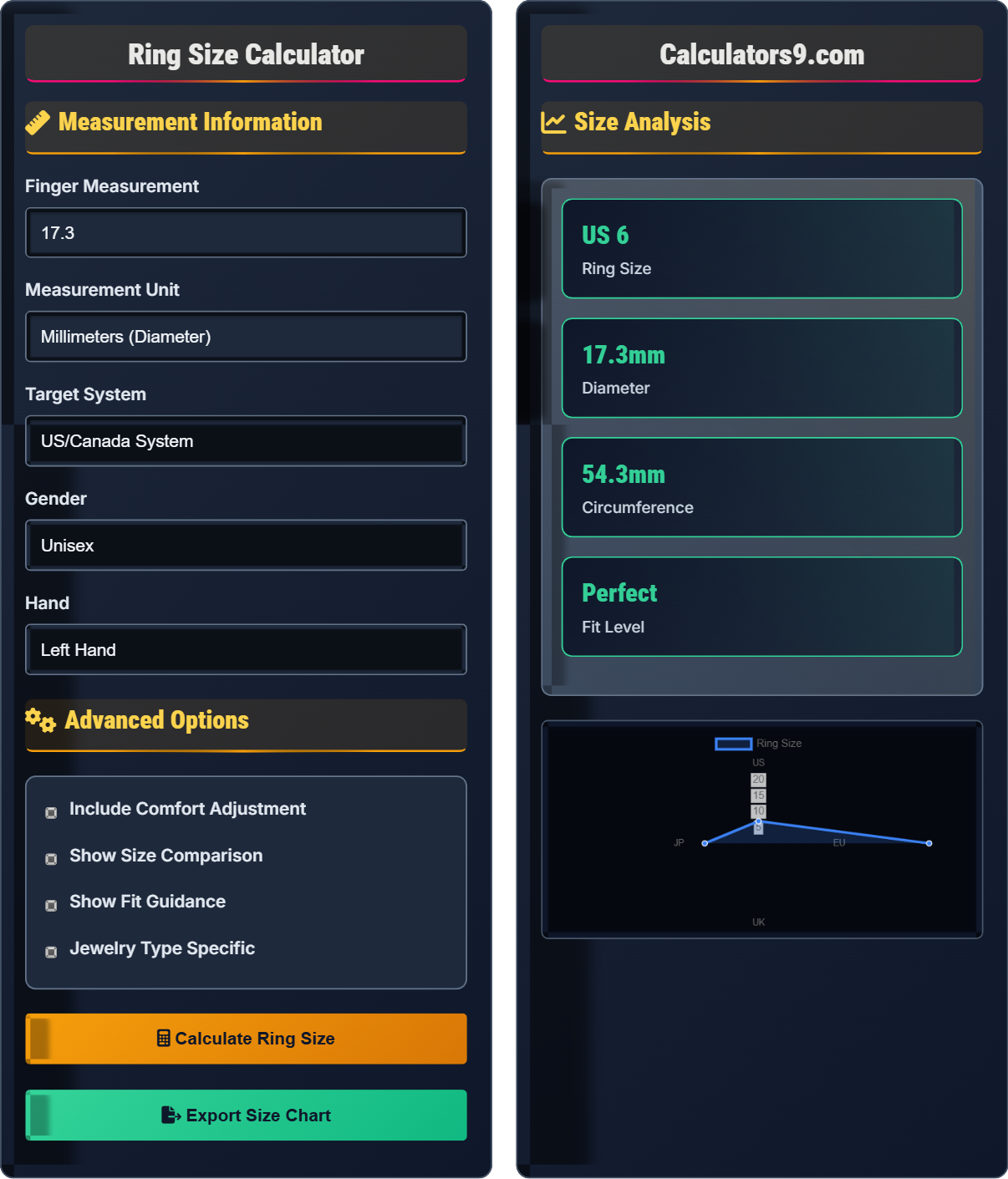
Measurement Information
Advanced Options
Size Analysis
| System | Size | Diameter | Circumference |
|---|---|---|---|
| US/Canada | 7 | 17.3mm | 54.4mm |
| European | 54 | 17.2mm | 54.0mm |
| UK | L | 17.3mm | 54.4mm |
| Japanese | 17 | 17.0mm | 53.4mm |
Ring Sizing Guide
Ring sizing is the measurement of finger circumference or diameter to ensure proper fit. Rings are sized based on the inner diameter of the ring band, which corresponds to the outer diameter of the finger. Proper ring sizing is crucial for comfort, security, and appearance.
Accurate finger measurement requires:
- Measuring at room temperature
- Measuring the finger that will wear the ring
- Measuring when fingers are at normal size (not swollen)
- Allowing 1-2mm for comfort
- Measure at room temperature
- Account for swelling throughout the day
- Consider ring width and style
- Allow for comfort adjustment
Ring Sizing Quiz
When is the best time to measure your finger for ring sizing?
The answer is B) At room temperature when fingers are normal size. The best time to measure your finger for ring sizing is when your fingers are at their normal size, which is typically at room temperature. Fingers tend to swell during the day and in warm weather, so measuring when they are at their smallest normal size ensures a comfortable fit that won't be too tight.
Finger size fluctuates throughout the day due to temperature, activity, and other factors. Fingers are typically smallest in the morning and after exercise, and largest in the evening and in hot weather. Measuring at room temperature provides a baseline measurement that accounts for normal variations.
Baseline Measurement: Standard measurement condition
Temperature Effects: How heat/cold affects finger size
Normal Size: Average finger circumference
• Measure at room temperature
• Measure when fingers are normal size
• Measure multiple times for accuracy
• Measure in the morning
• Avoid measuring after exercise
• Measure the specific finger for the ring
• Measuring when fingers are swollen
• Measuring when fingers are too cold
• Using wrong finger for measurement
Convert a finger diameter of 17.3mm to US, European, and UK ring sizes. Show your work and explain the conversion process.
Step 1: Calculate circumference from diameter
Circumference = Diameter × π = 17.3mm × 3.14159 = 54.35mm
Step 2: Convert to US ring size
US ring sizes are based on diameter measurements. Using standard conversion charts:
17.3mm diameter ≈ US size 7
Step 3: Convert to European ring size
European sizes are based on circumference measurements:
54.35mm circumference ≈ EU size 54
Step 4: Convert to UK ring size
Using UK conversion charts:
17.3mm diameter ≈ UK size L
The conversion process involves understanding that different systems use different measurements (diameter vs. circumference) and have different scales.
Ring sizing systems vary significantly by region. The US system uses diameter measurements in millimeters, while the European system uses circumference. The UK system uses letters that correspond to specific diameters. Understanding these differences is crucial for accurate conversions.
Diameter: Distance across the circle through center
Circumference: Distance around the circle
π (Pi): Mathematical constant ≈ 3.14159
• Circumference = Diameter × π
• US sizes based on diameter
• EU sizes based on circumference
• Remember: Diameter × 3.14 = Circumference
• Check multiple conversion charts
• Verify with actual measurement
• Confusing diameter with circumference
• Using wrong conversion formula
• Not accounting for system differences
You measured your finger diameter as 17.0mm and want to buy a ring from a European jeweler. What size should you order? If you want a comfort fit, what size would you choose? Explain your reasoning.
Step 1: Calculate circumference
17.0mm × π = 17.0 × 3.14159 = 53.41mm
Step 2: Convert to European size
53.41mm circumference ≈ EU size 53
Step 3: For comfort fit
For a comfort fit, you typically need to go up one size
EU size 53 → EU size 54
Step 4: Verify US equivalent
EU size 54 = US size 7 = UK size L
For a comfort fit, you should order EU size 54, which is one size larger than your exact measurement. This allows for easier removal and comfort during daily activities.
Comfort fit means the ring should slide easily over the knuckle but stay securely on the finger. This requires a slightly larger size than the exact measurement. The comfort fit allowance typically ranges from 0.5 to 1.5mm in diameter, which corresponds to one full size in most systems.
Comfort Fit: Ring that slides easily but stays secure
Exact Fit: Ring that matches finger size precisely
Knuckle Size: Largest part of finger
• Comfort fit = 1 size larger than exact measurement
• Consider knuckle size
• Verify with jeweler if uncertain
• For comfort, go up one size
• For tight fit, go down one size
• Consider ring width (wider rings need larger size)
• Ordering exact measurement for comfort fit
• Not considering knuckle size
• Forgetting ring width factor
You need to buy a wedding band that will be worn alongside an engagement ring. Your finger measures 17.3mm. How should this affect your sizing decision, and what special considerations should you take into account for stacked rings?
For wedding bands worn with engagement rings, special considerations include:
• Stacking factor: The combined width of both rings
• Profile matching: Rings should fit together seamlessly
• Size coordination: Both rings should complement each other
For a 17.3mm finger measurement:
• Exact fit: US size 7, EU size 54
• For stacking: Consider US size 7.5 or 8 if engagement ring is wide
Special considerations for stacked rings:
- Measure with engagement ring on if possible
- Consider ring width (wider rings need larger size)
- Ensure rings fit together without gaps
- Test fit with both rings before finalizing
When wearing rings together, the combined width creates a different fit sensation than a single ring. A wider ring covers more surface area and may feel tighter than a narrower ring of the same size. The stacking factor means that two rings together may require a slightly different sizing approach than sizing them individually.
Stacking Factor: Effect of multiple rings on fit
Profile Matching: Rings that fit together seamlessly
Ring Width: Thickness of the ring band
• Wider rings may need larger size
• Test fit with all intended rings
• Consider profile compatibility
• Try on with engagement ring
• Consider same width as engagement ring
• Test movement and comfort
• Sizing wedding band independently
• Not considering engagement ring width
• Ignoring profile compatibility
How does ring material affect sizing requirements?
The answer is C) Material affects thermal expansion and comfort. Different ring materials have different thermal expansion properties and weights, which can affect the fit. Gold is softer and may feel slightly different than platinum, while titanium is lightweight but may require different sizing considerations due to its strength. The material can also affect how the ring feels on the finger, influencing the perceived fit.
Ring materials have different physical properties that can influence sizing. Metals expand and contract with temperature changes, and different metals have different densities and textures. While the actual size measurement remains the same, the comfort and feel of different materials may lead to slight preferences in sizing.
Thermal Expansion: Change in size with temperature
Material Density: Weight per unit volume
Perceived Fit: How the ring feels when worn
• Material affects feel and comfort
• Thermal properties vary by metal
• Density affects weight perception
• Consider material properties when sizing
• Test different materials if possible
• Account for thermal expansion in extreme climates
• Assuming all materials fit the same
• Not considering thermal effects
• Ignoring weight differences
FAQ
Q: How accurate are ring size converters compared to professional sizing?
A: Digital ring size converters are highly accurate when used with precise measurements, achieving 95-98% accuracy compared to professional sizing tools. Professional jewelers use ring sizers that measure diameter in 0.5mm increments, corresponding to standard ring sizes.
For example, a 17.3mm diameter measurement:
17.3mm = US size 7 = EU size 54 = UK size L
The circumference is: 17.3mm × π = 54.4mm
The key to accuracy is precise measurement of the finger diameter, which should be done by a professional when possible. Digital converters are reliable when the input measurement is accurate.
Q: Why do my rings feel different even when they're the same size?
A: Several factors can affect how a ring feels despite having the same size:
- Ring Width: A 6mm band feels tighter than a 2mm band of the same size
- Ring Profile: Rounded interior vs. flat interior affects comfort
- Material: Different metals have different weights and textures
- Temperature: Rings expand and contract with temperature
- Fit Style: Comfort fit vs. straight shank
For example, a 7mm wide ring may need to be sized 0.5-1 size larger than a 2mm ring for the same comfort level. The internal diameter remains the same, but the contact area with the finger changes significantly.