Algorithm Complexity Calculator
Fast Big O analysis • 2026 standards
Algorithm Complexity Formulas:
Show the calculatorTime Complexity: \( T(n) = O(f(n)) \)
Space Complexity: \( S(n) = O(g(n)) \)
Common Complexities:
- \( O(1) \) - Constant time
- \( O(\log n) \) - Logarithmic time
- \( O(n) \) - Linear time
- \( O(n \log n) \) - Linearithmic time
- \( O(n^2) \) - Quadratic time
- \( O(2^n) \) - Exponential time
- \( O(n!) \) - Factorial time
Big O notation describes the upper bound of an algorithm's growth rate as input size increases. It focuses on the dominant term, ignoring constants and lower-order terms. This abstraction allows comparison of algorithm efficiency regardless of hardware or implementation details.
Example: For function \( f(n) = 3n^2 + 5n + 2 \):
\( f(n) = O(n^2) \) because \( n^2 \) dominates as n grows
Thus, the algorithm has quadratic time complexity.
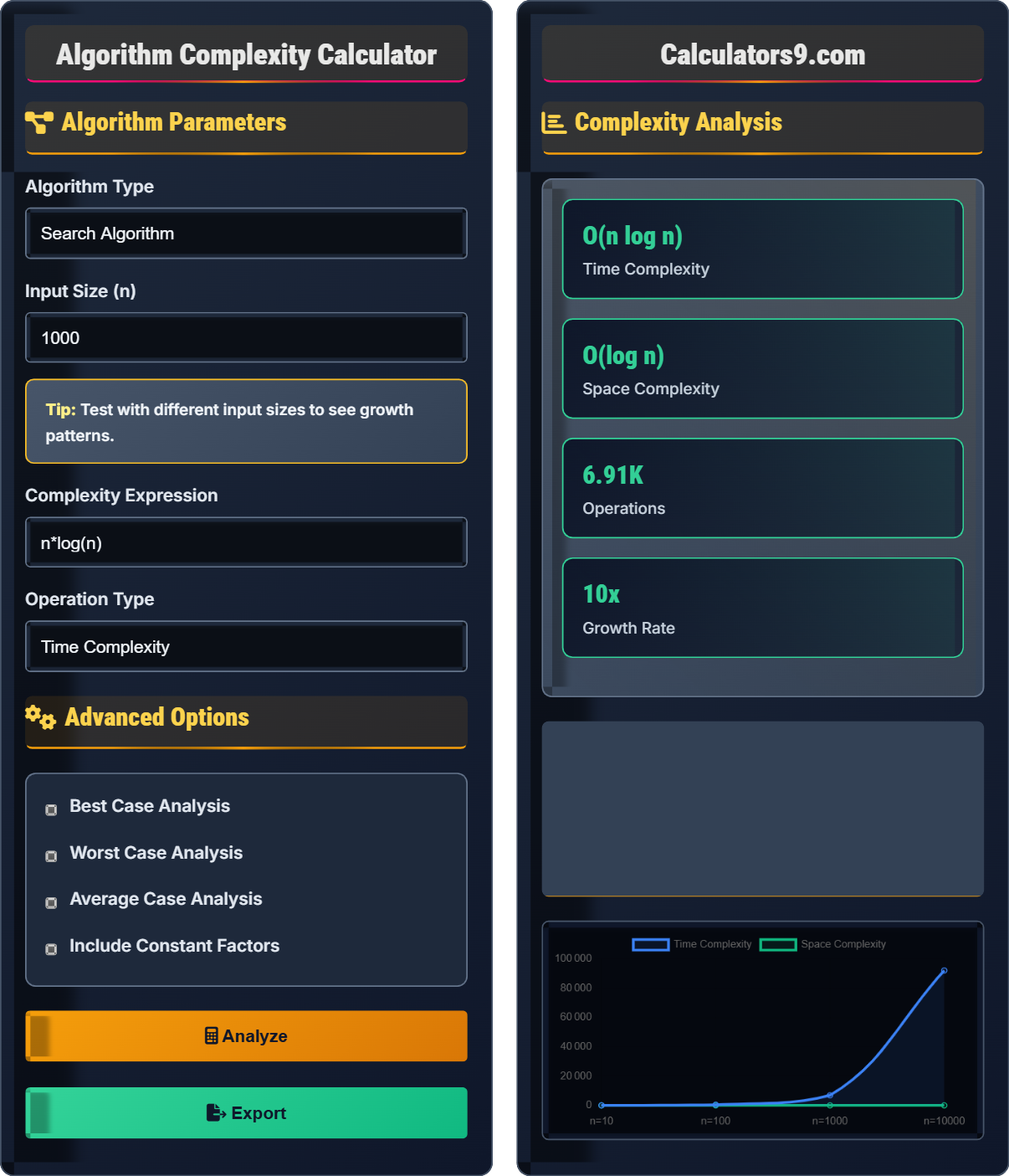
Algorithm Parameters
Advanced Options
Complexity Analysis
| Complexity | Expression | Value at n=1000 |
|---|---|---|
| Time | n*log(n) | ~9,966 |
| Space | log(n) | ~10 |
| Best Case | log(n) | ~10 |
| Worst Case | n*n | 1,000,000 |
| Parameter | Value | Description |
|---|---|---|
| Big O Class | Linearithmic | Growth classification |
| Dominant Term | n*log(n) | Leading term in expression |
| Constant Factor | 1 | Multiplier in expression |
| Lower Bound | Ω(log n) | Best possible performance |
Comprehensive Complexity Guide
Algorithm complexity measures the resources required by an algorithm as input size grows. Time complexity quantifies execution time, while space complexity quantifies memory usage. These measures are expressed using Big O notation, which describes the upper bound of growth rate. Understanding complexity helps choose efficient algorithms and predict performance at scale.
Common complexity classes ranked by growth rate:
- O(1): Constant time - independent of input size
- O(log n): Logarithmic - common in divide-and-conquer
- O(n): Linear - proportional to input size
- O(n log n): Linearithmic - efficient sorting algorithms
- O(n²): Quadratic - nested loops
- O(2ⁿ): Exponential - recursive without memoization
Common algorithms with their complexities:
- Binary Search: O(log n) time, O(1) space
- Quick Sort: O(n log n) avg, O(n²) worst, O(log n) space
- Merge Sort: O(n log n) time, O(n) space
- Bubble Sort: O(n²) time, O(1) space
- DFS/BFS: O(V + E) time, O(V) space (graph traversal)
- Matrix Multiplication: O(n³) naive, O(n².373) advanced
- Reduce Nested Loops: Replace O(n²) with O(n log n) where possible
- Use Hash Tables: Achieve O(1) lookups instead of O(n)
- Divide and Conquer: Break problems into smaller subproblems
- Dynamic Programming: Memoize results to avoid recomputation
- Greedy Algorithms: Make locally optimal choices for global solutions
Complexity Fundamentals
Mathematical notation describing the limiting behavior of a function as input approaches infinity.
\( f(n) = O(g(n)) \) if \( \exists c > 0, n_0 > 0 \) such that \( f(n) \leq c \cdot g(n) \) for all \( n \geq n_0 \)
This formal definition states that f(n) grows no faster than g(n) beyond some point.
- Drop constants: O(2n) = O(n)
- Drop lower-order terms: O(n² + n) = O(n²)
- Logarithmic grows slower than polynomial
Analysis Techniques
Equations that define functions in terms of themselves, common in recursive algorithms.
For recurrences of form: \( T(n) = aT(\frac{n}{b}) + f(n) \)
- If \( f(n) = O(n^{\log_b a - \epsilon}) \): \( T(n) = \Theta(n^{\log_b a}) \)
- If \( f(n) = \Theta(n^{\log_b a}) \): \( T(n) = \Theta(n^{\log_b a} \log n) \)
- If \( f(n) = \Omega(n^{\log_b a + \epsilon}) \): \( T(n) = \Theta(f(n)) \)
- Focus on dominant operations
- Consider best/worst/average cases
- Account for data structures used
- Space complexity affects memory usage
Complexity Analysis Learning Quiz
Which of the following represents the fastest growing function?
The answer is C) O(n²). From slowest to fastest growth: O(log n) < O(n) < O(n log n) < O(n²). Quadratic functions grow faster than linear, logarithmic, or linearithmic functions as input size increases.
Understanding growth rates is crucial for algorithm selection. While O(n²) might be acceptable for small inputs, it becomes prohibitive for large datasets. The difference between O(n) and O(n²) becomes dramatic as n grows.
Big O: Upper bound of algorithm growth rate
Growth Rate: How resource requirements increase with input size
Asymptotic: Behavior as input approaches infinity
• Logarithmic grows slower than linear
• Polynomial grows faster than logarithmic
• Exponential grows faster than polynomial
• Remember: log n < n < n log n < n² < 2ⁿ
• Look for nested loops for quadratic complexity
• Binary search is logarithmic due to halving
• Confusing growth rates of different functions
• Not considering worst-case scenarios
• Ignoring constants in practical analysis
Analyze the time complexity of the following nested loop algorithm:
for i = 1 to n:
for j = 1 to i:
print(i * j)
What is the time complexity and how did you arrive at this conclusion?
The time complexity is O(n²). Here's the analysis:
For i = 1: inner loop executes 1 time
For i = 2: inner loop executes 2 times
For i = 3: inner loop executes 3 times
...
For i = n: inner loop executes n times
Total executions = 1 + 2 + 3 + ... + n = n(n+1)/2
This simplifies to (n² + n)/2 = n²/2 + n/2
Ignoring constants and lower-order terms: O(n²)
This example demonstrates that not all nested loops result in O(n²) complexity. The key is analyzing how many times the innermost operation executes. In this case, the inner loop runs i times for each value of i, leading to a triangular number of operations.
Triangular Number: Sum of first n natural numbers
Constant Factor: Multiplier ignored in Big O notationLower-order Term: Less significant term dropped in Big O
• Count primitive operations
• Sum series when loops have variable iterations
• Drop constants and lower-order terms
• Use summation formulas for variable loops
• Common sum: Σi = n(n+1)/2
• For nested loops, multiply iterations
• Assuming all nested loops are O(n²)
• Not accounting for variable loop bounds
• Forgetting to drop constants
FAQ
Q: What's the difference between time and space complexity?
A: Time complexity measures the number of operations required to execute an algorithm, while space complexity measures the amount of memory required. For example, a recursive algorithm might have O(log n) time complexity but O(n) space complexity due to the call stack. Both are important considerations in algorithm design.
Time complexity affects execution speed, while space complexity affects memory usage. Some algorithms trade space for time (memoization) or time for space (iterative vs recursive implementations).
Q: When should I care about algorithm complexity?
A: Algorithm complexity matters when dealing with large datasets or performance-critical applications. For small inputs (n < 100), the difference between O(n) and O(n²) might be negligible. However, for large inputs (n > 1,000,000), the difference becomes significant.
Consider complexity when:
- Processing large amounts of data
- Working with real-time systems
- Implementing core business logic
- Developing scalable applications
Always choose the simplest solution that meets performance requirements.