Password Strength Calculator
Secure password analysis • 2026 standards
Password Strength Formulas:
Show the calculatorEntropy: \( H = L \times \log_2(N) \)
Brute Force Time: \( T = \frac{N^L}{2 \times R} \)
Crack Probability: \( P = 1 - e^{-\frac{T}{\tau}} \)
Where:
- \( H \) = password entropy (bits)
- \( L \) = password length
- \( N \) = size of character set
- \( T \) = time to crack
- \( R \) = guesses per second
- \( P \) = probability of cracking
- \( \tau \) = characteristic time
Password strength depends on length, complexity, and unpredictability. Entropy measures randomness in bits. A higher entropy value indicates a stronger password. The formula shows that length contributes linearly to entropy while character set size contributes logarithmically.
Example: For a 12-character password using mixed case letters, digits, and symbols (N=95):
\( H = 12 \times \log_2(95) = 12 \times 6.57 = 78.84 \) bits
With 1 billion guesses per second, the expected crack time would be \( \frac{95^{12}}{2 \times 10^9} \) seconds.
Password Analysis
Advanced Options
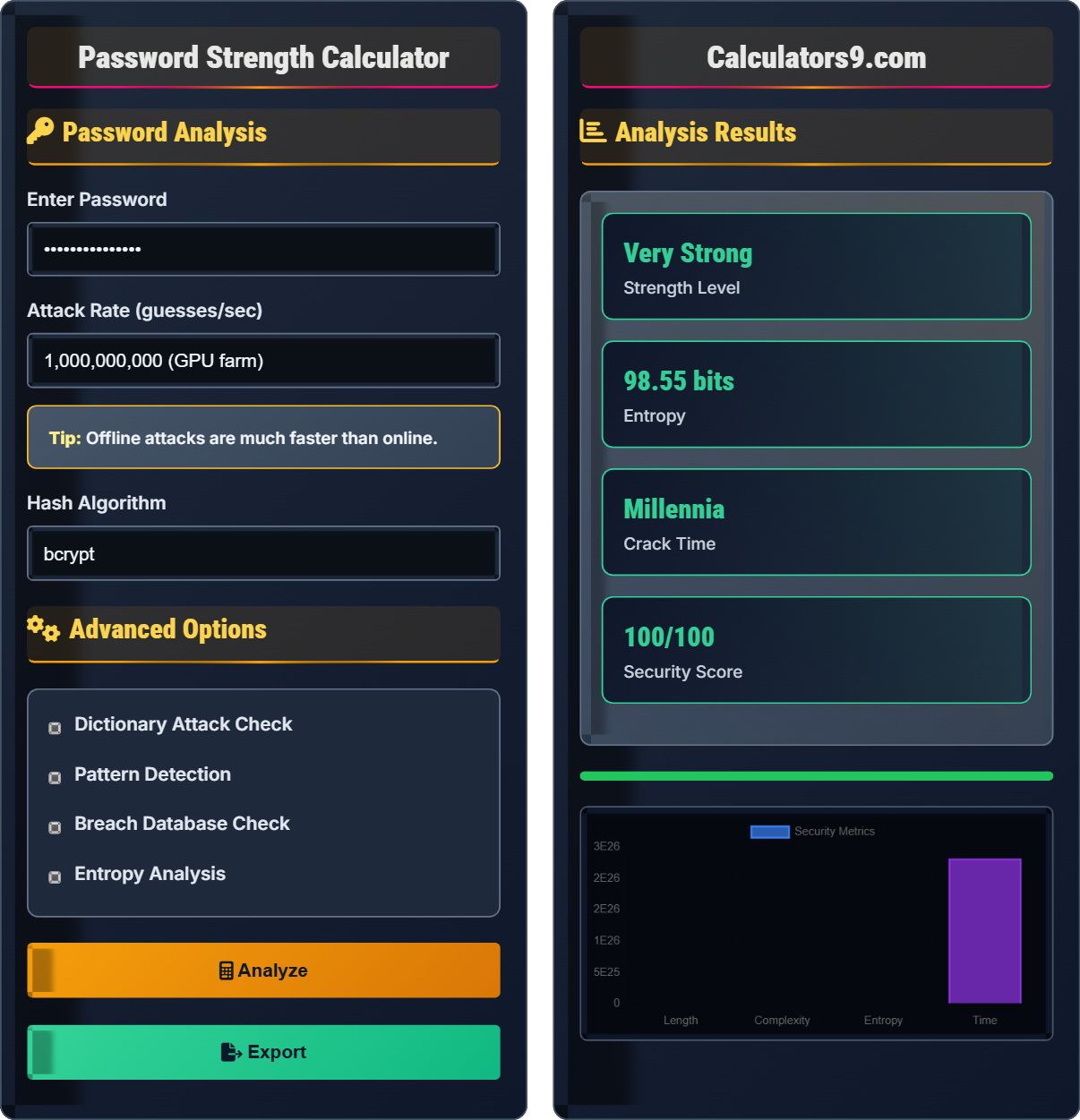
Analysis Results
| Metric | Value | Recommendation |
|---|---|---|
| Password Length | 15 | ≥12 characters |
| Character Types | 4/4 | All 4 types used |
| Guesses Required | 1.27e+23 | Higher is better |
| Brute Force Time | Millennia | Longer is better |
| Parameter | Value | Details |
|---|---|---|
| Character Set Size | 95 | Mixed case + digits + symbols |
| Pattern Score | 8/10 | Sequential chars penalized |
| Dictionary Risk | Low | Not in common lists |
| Entropy per Char | 5.26 | Randomness per character |
Comprehensive Password Security Guide
Password strength measures how resistant a password is to guessing and brute-force attacks. It depends on length, complexity, and unpredictability. Strong passwords combine multiple character types and avoid common patterns or dictionary words. Modern security standards recommend minimum 12-character passwords with mixed case, numbers, and symbols.
Key metrics for evaluating password strength:
- Entropy: Measure of randomness in bits
- Crack Time: Estimated time to guess the password
- Complexity Score: Points based on character variety
- Dictionary Risk: Likelihood of appearing in wordlists
The entropy formula: \( H = L \times \log_2(N) \) where L is length and N is character set size.
Essential practices for password security:
- Multi-Factor Authentication: Add extra layer beyond passwords
- Password Managers: Generate and store complex passwords
- Regular Updates: Change passwords periodically
- Monitoring: Check if accounts appear in breaches
- Education: Train users on security awareness
- Short Passwords: Less than 12 characters are vulnerable
- Dictionary Words: Common words are easily guessed
- Personal Info: Birthdays, names, etc. are predictable
- Simple Substitutions: Replacing 'o' with '0' offers little protection
- Password Reuse: One breach compromises multiple accounts
Password Strength Fundamentals
Measure of password randomness expressed in bits. Higher entropy means stronger passwords.
\( H = L \times \log_2(N) \)
Where L=length and N=character set size. Each bit doubles the keyspace.
- Length contributes linearly to entropy
- Character set contributes logarithmically
- 80+ bits considered cryptographically secure
Security Recommendations
Using diverse character sets exponentially increases password strength.
- Lowercase only: 26 characters
- + Uppercase: 52 characters
- + Digits: 62 characters
- + Symbols: 95 characters
- Focus on length over complexity
- Memorable passwords are often stronger
- Use password managers for complex generation
- Implement MFA wherever possible
Password Security Learning Quiz
Which password has the highest entropy assuming all are 8 characters long?
The answer is D) P@ssw0rd. Entropy is calculated as H = L × log₂(N) where L is length and N is the character set size. With all 4 character types (uppercase, lowercase, digits, symbols), the character set is largest (N≈95), giving the highest entropy despite equal length.
Entropy measures the randomness of a password. Even with equal length, using a larger character set dramatically increases security. The formula shows that while length has a linear effect on entropy, character set size has a logarithmic effect, but still significantly impacts security.
Entropy: Measure of password randomness in bits
Character Set: Available characters for password creation
Keyspace: Total possible combinations
• More character types = higher entropy
• Longer passwords = linear entropy increase
• Avoid predictable patterns
• Use passphrases instead of complex passwords
• Focus on length over complexity
• Use password managers for generation
• Believing simple substitutions are secure
• Using personal information
• Reusing passwords across sites
A password consists of 6 lowercase letters. If an attacker can make 1 million guesses per second, how long would it take to crack this password on average? Show your work.
For 6 lowercase letters:
Character set size (N) = 26 letters
Password length (L) = 6
Total possible combinations = N^L = 26^6 = 308,915,776
Average attempts needed = (N^L)/2 = 154,457,888
Time to crack = Attempts ÷ Guesses per second
Time = 154,457,888 ÷ 1,000,000 = 154.46 seconds ≈ 2.6 minutes
On average, it would take about 2.6 minutes to crack this password.
This calculation demonstrates why longer passwords are exponentially more secure. Adding just one more character (making it 7 lowercase letters) would increase the time to over 1 hour at the same rate. This exponential growth in keyspace with length is fundamental to password security.
Brute Force Attack: Trying all possible combinations
Keyspace: Total possible password combinations
Average Time: Half the maximum possible attempts
• Average = Maximum/2 attempts needed
• Keyspace grows exponentially with length
• Character set size affects security
• Add just 2 more characters to double security
• Use 12+ character passwords minimum
• Combine length with complexity
• Underestimating impact of length
• Forgetting to calculate average time
• Not considering character set size
FAQ
Q: How does password hashing affect crack time calculations?
A: Password hashing significantly increases crack time by adding computational overhead. Secure hashing algorithms like bcrypt, scrypt, and Argon2 are intentionally slow, requiring thousands of CPU cycles per hash.
For example, bcrypt might take 0.1 seconds per hash, reducing the effective guess rate from billions to just 10 per second. This transforms a password that might be cracked in hours to one that takes years.
Modern algorithms also include salting to prevent rainbow table attacks and adjustable cost factors to stay ahead of hardware improvements.
Q: Are passphrases better than complex passwords?
A: Yes, passphrases are generally superior to complex passwords. A passphrase like "correct horse battery staple" (25 characters) has higher entropy than "Tr0ub4dor&3" (11 characters) while being easier to remember.
Passphrases achieve security through length rather than complexity, making them both stronger and more memorable. The key is using random words rather than common phrases or song lyrics that might appear in dictionaries.
Studies show that users create stronger passphrases than complex passwords because they don't feel constrained by difficult character requirements.