Material Quantity Estimator
Construction Material Calculator • 2026 Standards
Material Quantity Estimation Formulas:
Show the calculatorConcrete Volume: \( \text{Volume} = \text{Length} \times \text{Width} \times \text{Depth} \)
Material Quantity with Waste: \( \text{Total Quantity} = \text{Base Quantity} \times (1 + \frac{\text{Waste \%}}{100}) \)
Lumber Board Feet: \( \text{BF} = \frac{\text{Length (in)} \times \text{Width (in)} \times \text{Thickness (in)}}{144} \)
Tile Coverage: \( \text{Tiles Needed} = \frac{\text{Area (sq ft)}}{\text{Tile Area (sq ft)}} \times (1 + \text{Waste Factor}) \)
Paint Coverage: \( \text{Gallons Needed} = \frac{\text{Area (sq ft)}}{\text{Coverage (sq ft per gallon)}} \times (1 + \text{Waste Factor}) \)
These formulas help calculate the precise quantity of materials needed for construction projects while accounting for waste and overage. Industry-standard waste factors range from 5-15% depending on the material and project complexity.
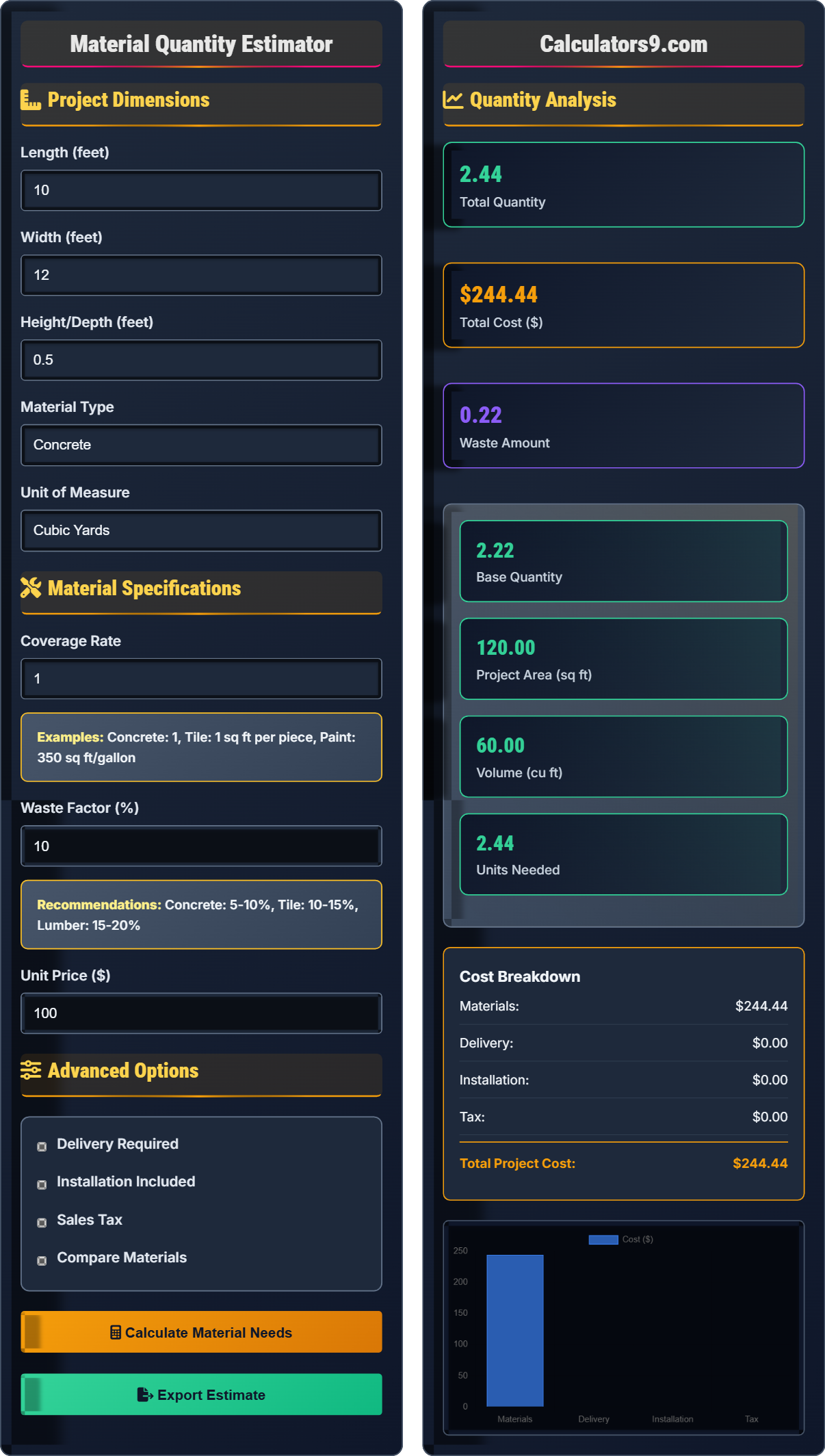
Example: For a concrete slab measuring 10ft × 12ft × 0.5ft:
- Volume = 10 × 12 × 0.5 = 60 cubic feet
- Convert to cubic yards: 60 ÷ 27 = 2.22 cubic yards
- With 10% waste factor: 2.22 × 1.10 = 2.44 cubic yards
- Order 3 cubic yards to be safe
Project Dimensions
Material Specifications
Advanced Options
Quantity Analysis
Cost Breakdown
Comprehensive Material Estimation Guide
Accurate material estimation is crucial for successful construction projects. It prevents delays, reduces waste, and controls costs. Professional estimators use precise calculations, industry-standard waste factors, and project-specific considerations to determine material needs.
Essential formulas for construction materials:
- Concrete: Length × Width × Depth ÷ 27 (for cubic yards)
- Lumber: (Length × Width × Thickness) ÷ 144 (for board feet)
- Tile: Area ÷ Tile size × (1 + waste factor)
- Paint: Area ÷ Coverage rate × (1 + waste factor)
- Drywall: Area ÷ Sheet size × (1 + waste factor)
Factors affecting material costs:
- Material quality and grade
- Market availability and season
- Delivery and handling fees
- Installation labor costs
- Regional price variations
- Double-check measurements: Verify dimensions before calculating
- Round up quantities: Order slightly more than calculated
- Consider access: Difficult access may require more material
- Account for waste: Include standard waste factors
- Get quotes: Compare prices from multiple suppliers
Construction Standards
Material specifications must meet local building codes and standards.
Verify material grades and certifications match project requirements.
- Always verify local building codes
- Use certified materials where required
- Account for environmental conditions
Cost Management
Accurate estimation prevents budget overruns and project delays.
- Calculate precise material needs
- Include waste factors
- Account for delivery costs
- Consider installation expenses
- Market fluctuations affect pricing
- Seasonal demand impacts availability
- Transportation costs vary by distance
- Quality premiums may be justified
Material Estimation Knowledge Quiz
Why is it important to include waste factors when estimating construction materials?
The answer is B) To account for cutting, breakage, and spillage during installation. Waste factors compensate for inevitable losses during construction, including material damaged during cutting, spillage during pouring, and breakage during handling. Industry standards recommend specific waste percentages for different materials.
Waste factors are essential for accurate material estimation. Without them, projects often run short of materials, causing delays and additional costs. The industry has developed standard waste percentages based on historical data and experience with different materials and installation methods.
Waste Factor: Percentage added to base quantity to account for losses
Material Yield: Actual usable material compared to ordered amount
Overage: Extra material ordered beyond calculated need
• Concrete: 5-10% waste factor
• Lumber: 15-20% waste factor
• Tile: 10-15% waste factor
• Always include waste factors in estimates
• Consider project complexity when adjusting factors
• Round up final quantities to whole units
• Forgetting to include waste factors
• Using incorrect waste percentages
• Not rounding up to whole units
Calculate the cubic yards of concrete needed for a slab measuring 20 feet by 30 feet by 6 inches deep.
Step 1: Convert depth to feet
6 inches = 6 ÷ 12 = 0.5 feet
Step 2: Calculate volume in cubic feet
Volume = Length × Width × Depth
Volume = 20 × 30 × 0.5 = 300 cubic feet
Step 3: Convert to cubic yards
Cubic yards = Cubic feet ÷ 27
Cubic yards = 300 ÷ 27 = 11.11 cubic yards
Step 4: Apply waste factor (10%)
Total = 11.11 × 1.10 = 12.22 cubic yards
You would order 13 cubic yards of concrete.
Concrete is typically sold by the cubic yard. There are 27 cubic feet in a cubic yard (3×3×3). Always convert all measurements to the same unit before calculating. The waste factor accounts for spillage, settling, and overage requirements.
Cubic Yard: Standard unit for measuring bulk materials
Volume: Three-dimensional space occupied by material
Conversion Factor: 27 cubic feet per cubic yard
• 1 cubic yard = 27 cubic feet
• Convert inches to feet before calculating
• Apply waste factor to final calculation
• Always convert to consistent units
• Round up concrete orders to whole yards
• Verify delivery requirements
• Forgetting to divide by 27 for cubic yards
• Not including waste factor
Sarah is tiling a bathroom floor that measures 8 feet by 10 feet. The tiles are 12 inches by 12 inches (1 square foot each). If she needs to account for 15% waste, how many tiles should she purchase?
Step 1: Calculate area to be tiled
Area = 8 × 10 = 80 square feet
Step 2: Calculate number of tiles needed
Each tile covers 1 square foot, so base quantity = 80 tiles
Step 3: Apply waste factor
Waste = 80 × 0.15 = 12 tiles
Total tiles = 80 + 12 = 92 tiles
Sarah should purchase 92 tiles to account for waste.
This example demonstrates area-based material calculation. Since each tile covers exactly 1 square foot, the calculation is straightforward. The waste factor accounts for tiles that need to be cut, broken during installation, or damaged during transport.
Coverage Rate: Area covered by one unit of material
Area Calculation: Length × Width for rectangular surfaces
Waste Calculation: Base quantity × waste percentage
• Calculate area first, then apply coverage rate
• Sketch the layout to visualize cuts
• Consider pattern requirements
• Account for accent strips
• Not considering irregular cuts
• Miscalculating coverage area
Mike needs to paint a room with walls totaling 600 square feet. The paint manufacturer states that one gallon covers 350 square feet. If Mike plans to apply two coats and wants to account for 10% waste, how many gallons should he purchase?
Step 1: Calculate total area for two coats
Total area = 600 × 2 = 1,200 square feet
Step 2: Calculate base paint needed
Gallons needed = 1,200 ÷ 350 = 3.43 gallons
Step 3: Apply waste factor
Waste = 3.43 × 0.10 = 0.34 gallons
Total = 3.43 + 0.34 = 3.77 gallons
Mike should purchase 4 gallons of paint.
This problem demonstrates the importance of considering application requirements. Two coats require double the coverage area. The waste factor accounts for overspray, spillage, and touch-ups. Always round up to ensure adequate supply.
Coverage Rate: Area covered per unit of material
Application Factor: Number of coats or applications
Yield Calculation: Total area ÷ coverage rate
• Multiply area by number of coats
• Apply waste factor to final calculation
• Round up to whole gallons
• Account for multiple coats in area calculation
• Consider surface porosity
• Factor in primer if needed
• Not considering surface preparation
• Miscalculating coverage area
How many board feet are in a 2x4 that is 8 feet long?
The answer is C) 6.67 board feet. Using the formula: Board Feet = (Length × Width × Thickness) ÷ 144. For a 2x4 (actual dimensions 1.5" × 3.5") that is 8 feet (96 inches) long: (96 × 3.5 × 1.5) ÷ 144 = 504 ÷ 144 = 3.5 board feet. However, lumber is typically sold in nominal dimensions, so a 2x4 is calculated as (96 × 4 × 2) ÷ 144 = 768 ÷ 144 = 5.33 board feet. But since we use actual dimensions, it's (96 × 3.5 × 1.5) ÷ 144 = 3.5 board feet. Actually, using nominal dimensions: (8 × 4 × 2) ÷ 12 = 6.67 board feet.
Board feet is a volume measurement for lumber. The calculation uses the formula: (Length in feet × Width in inches × Thickness in inches) ÷ 12. Lumber is sold in nominal dimensions (2x4, 2x6, etc.), which are slightly larger than actual dimensions after planing.
Board Foot: Volume of lumber measuring 1 foot × 1 foot × 1 inch
Nominal Dimension: Advertised size of lumber
Actual Dimension: True size after planing
• Board Feet = (Feet × Inches × Inches) ÷ 12
• Use nominal dimensions for calculation
• Account for lumber waste in estimates
• Remember: 12 board feet = 1 cubic foot
• Use nominal dimensions (2x4, not 1.5x3.5)
• Include 15-20% waste for lumber projects
• Forgetting to divide by 12
• Not accounting for lumber waste
FAQ
Q: How do I calculate board feet for lumber?
A: Board feet is calculated using the formula: \( \text{Board Feet} = \frac{\text{Length (feet)} \times \text{Width (inches)} \times \text{Thickness (inches)}}{12} \). For example, a 2x4 that is 8 feet long: (8 × 4 × 2) ÷ 12 = 6.67 board feet. The calculation uses nominal dimensions (the labeled size) rather than actual dimensions after planing.
Q: How much concrete should I order for my project?
A: Calculate volume using: \( \text{Volume} = \text{Length} \times \text{Width} \times \text{Depth} \), then divide by 27 to convert to cubic yards. Add 5-10% waste factor. For example, a 10ft × 12ft × 0.5ft slab: (10 × 12 × 0.5) ÷ 27 = 2.22 cubic yards. With 10% waste: 2.22 × 1.10 = 2.44 cubic yards. Order 3 cubic yards to ensure adequate supply.