Window Replacement Cost Calculator
Professional cost estimator • 2026 pricing
Window Replacement Cost Formula:
Show the calculator\( C = (N \times P_w) + (N \times L_c) + (N \times I_c) + F \)
Where:
- \( C \) = Total replacement cost
- \( N \) = Number of windows
- \( P_w \) = Price per window
- \( L_c \) = Labor cost per window
- \( I_c \) = Installation cost per window
- \( F \) = Fixed fees (permits, disposal, etc.)
This formula calculates the total cost of window replacement, including materials, labor, installation, and additional fees.
Example: For 10 windows, each costing $400, with $150 labor and $50 installation per window, plus $200 fixed fees:
\( C = (10 \times 400) + (10 \times 150) + (10 \times 50) + 200 \)
\( C = 4000 + 1500 + 500 + 200 = 6200 \)
Therefore, the total replacement cost would be $6,200.
Window Specifications
Advanced Options
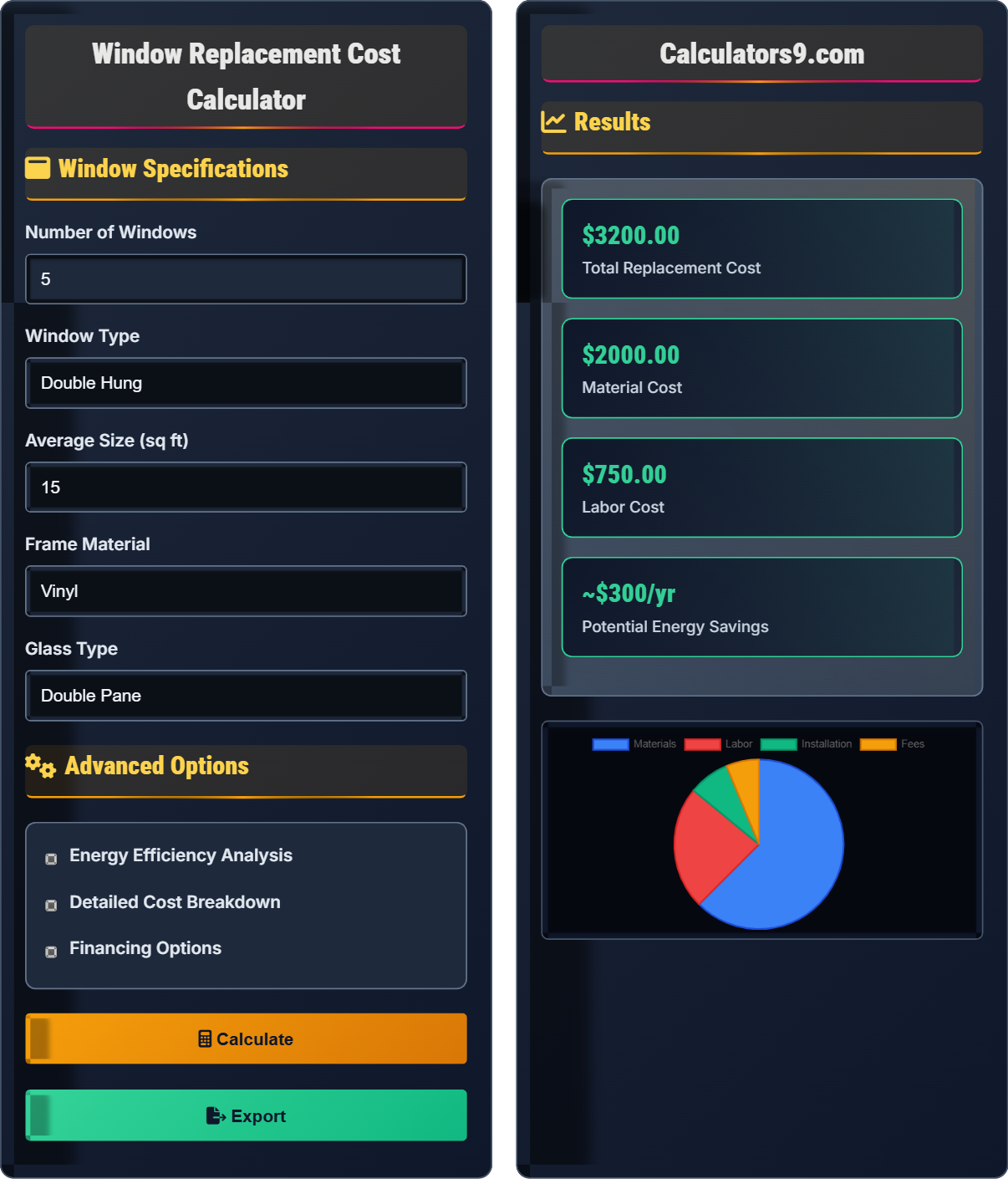
Results
| Component | Quantity | Unit Cost | Total |
|---|
| Feature | Value | Impact |
|---|
Comprehensive Window Replacement Guide
Window replacement is a significant home improvement project that can improve energy efficiency, security, and aesthetics. Modern windows offer superior insulation compared to older models, potentially reducing heating and cooling costs by 12-25%.
Window replacement costs include several components:
Materials typically represent 60-70% of total costs, while labor and installation account for the remainder.
Window frame materials affect durability, maintenance, and cost:
- Vinyl: Low maintenance, good insulation, cost-effective
- Wood: Traditional look, good insulation, requires maintenance
- Fiberglass: Durable, energy efficient, premium price
- Aluminum: Strong, modern appearance, conducts heat
- Composite: Combines materials for optimal performance
- Measure accurately: Order windows based on rough opening dimensions
- Weather considerations: Avoid installation during extreme weather
- Professional installation: Ensures proper fit and warranty coverage
- Insulation: Seal gaps properly to maximize energy savings
- Permits: Check local requirements before starting
Window Basics
Various designs for different functions and aesthetics.
\( C = (N \times P_w) + (N \times L_c) + (N \times I_c) + F \)
Where C=total cost, N=number of windows, Pw=price per window, Lc=labor, Ic=installation, F=fees.
- Quality installation crucial
- Energy efficiency varies by type
- Material affects maintenance
Strategies
Choose windows with proper ratings for your climate zone.
- Assess needs and budget
- Research materials
- Get multiple quotes
- Verify contractor credentials
- ENERGY STAR certification
- Local climate requirements
- Warranty terms
- Installation quality
Window Replacement Learning Quiz
Which of the following statements about window types is TRUE?
The answer is B) Double hung windows have both sashes operable. Double hung windows feature two sashes that slide vertically, allowing both the top and bottom sections to open. This provides better ventilation control compared to single hung windows where only one sash moves.
Understanding window types is essential for proper selection. Double hung windows are popular because they offer flexible ventilation options - you can open just the top for privacy while still getting air circulation, or open both for maximum airflow. Each window type has specific advantages depending on the application and desired functionality.
Sash: The frame that holds the glass in a window
Operable: Window that can be opened and closed
Ventilation: The process of exchanging air in a space
• Double hung: Both sashes move vertically
• Remember: Double hung = double vertical movement
• Casement windows are good for hard-to-reach areas
• Sliding windows work well where space is limited
• Confusing window operation directions
• Not considering ventilation needs
• Forgetting to account for operational space
Calculate the total cost for replacing 8 windows. Each window costs $450, labor is $150 per window, and installation is $50 per window. There's also a $300 permit fee. Show your work.
Using the window replacement cost formula: C = (N × Pw) + (N × Lc) + (N × Ic) + F
Given:
- N = 8 windows
- Pw = $450 per window
- Lc = $150 per window
- Ic = $50 per window
- F = $300 fixed fee
Step 1: Material cost = N × Pw = 8 × $450 = $3,600
Step 2: Labor cost = N × Lc = 8 × $150 = $1,200
Step 3: Installation cost = N × Ic = 8 × $50 = $400
Step 4: Total cost = $3,600 + $1,200 + $400 + $300 = $5,500
This problem demonstrates the importance of accounting for all cost components in window replacement projects. The material cost is often the largest component, but labor and installation can add 30-50% to the total. Fixed fees like permits and disposal costs should also be included in the budget.
Material Cost: Cost of the physical windows
Labor Cost: Cost for professional installation work
Fixed Fees: One-time costs like permits or disposal
• Always include all cost components in estimates
• Labor costs vary by region and complexity
• Fixed fees can add 5-10% to total cost
• Get multiple quotes to compare labor costs
• Ask about permit requirements upfront
• Consider timing to avoid rush premiums
• Forgetting to include labor costs in total
• Not accounting for disposal fees
• Missing permit costs in budget
Sarah is replacing 10 old single-pane windows with ENERGY STAR certified double-pane vinyl windows. The old windows had a U-factor of 1.2, and the new ones have a U-factor of 0.30. If her heating cost is $2,400 annually and cooling cost is $1,200, what are her approximate annual energy savings?
Step 1: Calculate the U-factor improvement = Old U-factor - New U-factor = 1.2 - 0.30 = 0.90
Step 2: Calculate improvement ratio = 0.90 ÷ 1.2 = 0.75 (75% improvement)
Step 3: Calculate heating savings = $2,400 × 0.75 = $1,800
Step 4: Calculate cooling savings = $1,200 × 0.75 = $900
Step 5: Total annual savings = $1,800 + $900 = $2,700
Therefore, Sarah will save approximately $2,700 annually in energy costs.
This example shows the significant energy savings achievable by upgrading from single-pane to double-pane windows. The U-factor measures heat transfer - lower values indicate better insulation. By improving from U-1.2 to U-0.30, Sarah is reducing heat transfer by 75%, resulting in substantial energy savings. These savings help offset the initial investment over time.
U-Factor: Measure of heat transfer through a window
ENERGY STAR: Certification for energy-efficient products
Payback Period: Time to recover investment through savings
• Lower U-factor = Better energy efficiency
• Energy savings can offset replacement costs
• Climate affects actual savings amounts
• Look for ENERGY STAR certification for guaranteed savings
• Calculate payback period before investing
• Consider utility rebates for window upgrades
• Not considering energy savings in cost analysis
• Forgetting to verify ENERGY STAR certification
• Not accounting for climate-specific savings
Mike lives in a coastal area with high humidity and salt exposure. He needs to replace 12 windows and has three options: vinyl ($350/window), wood ($500/window), or fiberglass ($650/window). Considering the environment, which material offers the best long-term value, and what would be the total cost difference compared to vinyl?
Step 1: In coastal environments, vinyl and fiberglass are preferred over wood due to moisture and salt resistance
Step 2: Vinyl total cost = 12 × $350 = $4,200
Step 3: Fiberglass total cost = 12 × $650 = $7,800
Step 4: Wood total cost = 12 × $500 = $6,000
Step 5: Difference between fiberglass and vinyl = $7,800 - $4,200 = $3,600
Fiberglass offers the best long-term value in coastal areas due to superior durability against salt and moisture, despite higher initial cost.
This demonstrates how environmental factors influence material selection. In coastal areas, salt and humidity accelerate deterioration of certain materials. While vinyl is initially cheaper, fiberglass's longevity and minimal maintenance requirements often justify the higher upfront investment. Wood requires frequent maintenance in such environments, making it less practical despite moderate initial cost.
Long-term Value: Total cost of ownership including maintenance
Environmental Resistance: Material's ability to withstand local conditions
Life Cycle Cost: Initial cost plus ongoing maintenance and replacement
• Environmental conditions affect material durability
• Long-term value considers maintenance costs
• Higher initial cost may offer better value
• Research local environmental challenges
• Choosing materials without considering local conditions
• Focusing only on initial cost
• Not evaluating long-term maintenance requirements
Which of the following is TRUE regarding window replacement financing?
The answer is B) ENERGY STAR windows may qualify for rebates. Many utility companies and state governments offer rebates for ENERGY STAR certified windows due to their energy-saving benefits. Federal tax credits have expired but some states still offer incentives for energy-efficient home improvements.
Financing window replacement can be done through various options, including rebates, tax credits, and loans. ENERGY STAR certification often qualifies for utility rebates ranging from $50-200 per window. Homeowners should research local incentives before making decisions, as these can significantly reduce net costs.
ENERGY STAR: Certification for energy-efficient products
Rebate: Partial refund for purchasing qualifying items
Tax Credit: Direct reduction in tax liability
• Rebates vary by location and utility company
• ENERGY STAR certification required for most incentives
• Timing matters - apply before installation
• Check utility company websites for current rebates
• Verify contractor participation in rebate programs
• Apply for rebates promptly after installation
• Missing rebate deadlines
• Not verifying contractor eligibility
• Assuming all energy-efficient products qualify
FAQ
Q: How much do window replacements typically cost?
A: Window replacement costs vary significantly based on type, size, and material. On average, expect $300-$800 per window installed, with the formula:
\( C = (N \times P_w) + (N \times L_c) + (N \times I_c) + F \)
Where N is the number of windows, Pw is the price per window, Lc is labor cost per window, Ic is installation cost per window, and F represents fixed fees like permits.
For example, replacing 10 double-hung vinyl windows at $400 each with $150 labor and $50 installation per window plus $200 in fees:
\( C = (10 \times 400) + (10 \times 150) + (10 \times 50) + 200 = 6,200 \)
So the total would be approximately $6,200.
Q: Should I choose vinyl, wood, or fiberglass windows?
A: The choice depends on your priorities and environment.
- Vinyl: Cost-effective ($300-600), low maintenance, good insulation. Lifespan: 20-40 years.
- Wood: Traditional appearance ($500-800), requires maintenance, excellent insulation. Lifespan: 15-30 years.
- Fiberglass: Durable ($600-1000), minimal expansion, superior energy efficiency. Lifespan: 30-50 years.
For a 10-window project:
- Vinyl: ~$3,000-$6,000
- Wood: ~$5,000-$8,000
- Fiberglass: ~$6,000-$10,000
Fiberglass offers the best long-term value in harsh climates, while vinyl provides the best initial value in moderate climates.