Brick Calculator
Fast quantity calculator • 2026 rates
Brick Quantity Formula:
Show the calculator\( N = \frac{A}{(L + J) \times (H + J)} \)
Where:
- \( N \) = number of bricks needed
- \( A \) = wall area in square feet
- \( L \) = length of brick
- \( H \) = height of brick
- \( J \) = joint thickness (mortar gap)
This formula calculates the number of bricks required per square foot, then multiplies by the total wall area. Standard modular bricks are 7.625" × 2.25" with 3/8" mortar joints, yielding approximately 7 bricks per square foot.
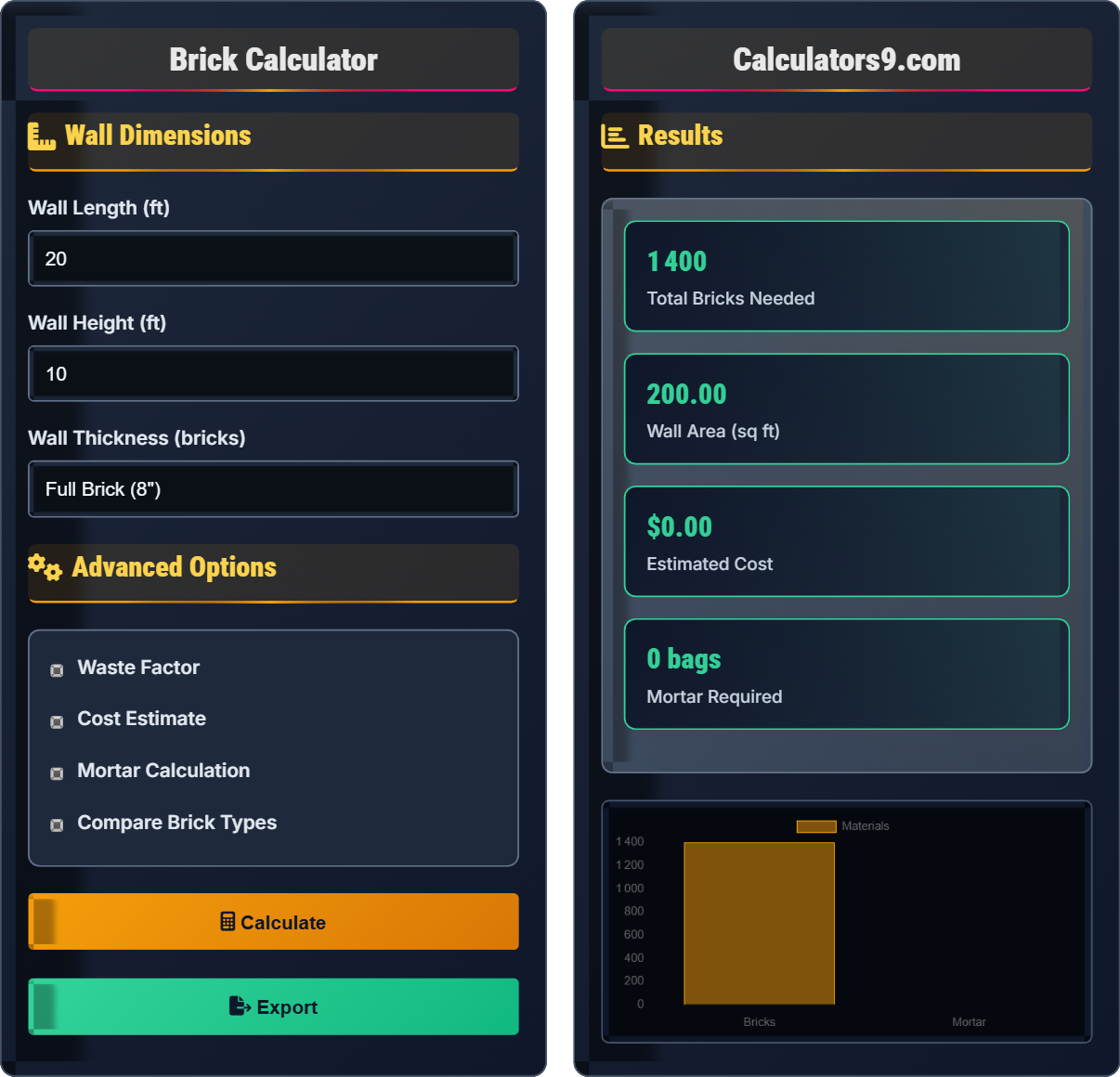
Example: For a wall 20 ft long and 10 ft high (200 sq ft) using standard bricks:
Bricks per sq ft = 7
Total bricks = 200 × 7 = 1,400 bricks
Adding 5% waste factor: 1,400 × 1.05 = 1,470 bricks needed.
Wall Dimensions
Advanced Options
Results
| Measurement | Value |
|---|
| Component | Value |
|---|
Comprehensive Masonry Guide
Bricks are rectangular blocks of clay fired at high temperatures to create a durable building material. Standard modular bricks measure 7.625" × 3.5" × 2.25" and weigh approximately 4.2 pounds each. They are manufactured to strict tolerances and provide excellent compressive strength, fire resistance, and thermal mass. Proper bricklaying requires attention to bond patterns, mortar joints, and structural considerations.
The standard brick quantity calculation uses the following formula:
Where:
- \(N\) = Number of bricks needed
- \(A\) = Wall area in square feet
- \(BPF\) = Bricks per square foot (typically 7 for standard modular)
For standard modular bricks with 3/8" joints, BPF ≈ 7. For engineered bricks, BPF may vary based on dimensions.
Brick costs vary based on several factors:
- Type: Standard modular bricks average $600 per 1000
- Color: Specialty colors add 10-20% to base cost
- Texture: Smooth vs. rough textures affect pricing
- Quantity: Larger orders often receive bulk discounts
- Delivery: Local suppliers typically charge $100-200 per truckload
- Add waste factor: Order 5-10% more than calculated to account for cuts and breakage
- Plan for openings: Deduct doors, windows from total area
- Consider bond pattern: Running bond, Flemish, English affect brick count
- Mortar considerations: One bag covers approximately 70-100 bricks
- Foundation requirements: Proper footing is essential for brick walls
Brick Fundamentals
Rectangular clay blocks fired at high temperatures for durability and strength.
\(N = A \times BPF\)
Where N=number of bricks, A=wall area, BPF=bricks per square foot (typically 7 for modular).
- Always measure area in square feet
- Add 5-10% waste factor to calculated quantity
- Standard modular: 7 bricks per sq ft
Masonry Guidelines
Half Brick: 4", Full Brick: 8", One and Half: 12", Double: 16"
- Standard mortar: 1 bag per 70-100 bricks
- Typical joint: 3/8" thickness
- Allow extra for waste and cleanup
- Bricks weigh ~4.2 lbs each (standard)
- Proper curing takes 28 days for full strength
- Expansion joints needed every 20-30 feet
Brick Calculation Learning Quiz
Which of the following measurements is NOT required to calculate the number of bricks needed for a wall?
The answer is D) Brick Color. To calculate the number of bricks needed, you need the wall dimensions (length and height to determine area) and thickness to determine if it's a single or double wythe wall. Brick color is an aesthetic choice that doesn't affect the quantity calculation. The standard formula is based on area and brick size, not color.
Understanding which measurements are essential for brick calculations is fundamental in masonry. The calculation requires dimensional measurements to determine the total area to be covered. Color is a surface characteristic that doesn't impact material quantity. Students should distinguish between physical requirements and aesthetic choices when planning projects.
Wythe: A continuous vertical section of masonry one unit thick
Modular Brick: Standardized brick size for construction
Masonry Unit: Individual brick, block, or stone used in construction
• Brick quantity calculations require area measurements
• Wall thickness affects whether it's single or double coverage
• Aesthetic choices don't impact material quantity
• Calculate area first: Length × Height
• Multiply by bricks per square foot (typically 7)
• Add 5-10% waste factor for cuts and breakage
• Including irrelevant parameters in quantity calculations
• Forgetting to account for wall thickness in double walls
• Not adding waste factor for cuts and breakage
Calculate the number of standard modular bricks needed for a wall that is 25 feet long and 8 feet high. Assume 7 bricks per square foot and add a 5% waste factor.
Step 1: Calculate wall area: 25 × 8 = 200 square feet
Step 2: Calculate bricks needed: 200 × 7 = 1,400 bricks
Step 3: Add 5% waste factor: 1,400 × 1.05 = 1,470 bricks
Therefore, you need 1,470 bricks for the wall.
This problem demonstrates the standard approach to brick calculations. The area method is preferred because it accounts for all variables including mortar joints. Standard modular bricks with 3/8" joints yield approximately 7 bricks per square foot. The waste factor accounts for cutting bricks to fit around openings and breakage during handling.
Standard Modular: Brick size of 7.625" × 3.5" × 2.25"
Bricks Per Square Foot: Coverage rate for a given brick size
Waste Factor: Additional percentage for cuts and breakage
• Area method accounts for mortar joints automatically
• Standard modular bricks: 7 per sq ft
• Waste factor typically 5-10%
• Remember: 7 bricks per sq ft for modular
• Multiply area by BPF to get quantity
• Add 5-10% for waste and cuts
• Forgetting to add waste factor to calculations
• Using linear measurements instead of area
• Not accounting for mortar joints in calculations
A mason needs to build a brick wall that is 30 feet long and 12 feet high. If bricks cost $550 per thousand and the mason adds a 7% waste factor, what is the total estimated cost for the bricks?
Step 1: Calculate wall area: 30 × 12 = 360 square feet
Step 2: Calculate bricks needed: 360 × 7 = 2,520 bricks
Step 3: Add 7% waste factor: 2,520 × 1.07 = 2,696.4 ≈ 2,700 bricks
Step 4: Calculate cost: (2,700 ÷ 1,000) × $550 = 2.7 × $550 = $1,485
Therefore, the total estimated cost is $1,485.
This example demonstrates real-world application of brick calculations. Contractors always add a waste factor to account for cutting, breakage, and damaged units. The waste factor is applied to the quantity before calculating cost. This ensures adequate material while accounting for real-world variations in actual vs. theoretical quantities.
Waste Factor: Additional percentage added to calculated quantity to account for losses
Cost Per Thousand: Price of 1000 bricks (common pricing unit)
Contractor Markup: Additional cost beyond material price
• Waste factor is typically 5-10% of calculated quantity
• Apply waste factor to quantity before calculating cost
• Brick costs are typically quoted per thousand units
• Standard waste factor is 5-7% for most projects
• Round up brick quantities to nearest 100 for ordering
• Get quotes from multiple suppliers for best pricing
• Forgetting to add waste factor to calculations
• Applying waste factor to cost instead of quantity
• Ordering exact calculated amount without buffer
A retaining wall requires 5,000 standard modular bricks. If each standard brick weighs 4.2 pounds, calculate the total weight of the bricks. Why is this calculation important for construction planning?
Step 1: Calculate total weight: 5,000 × 4.2 = 21,000 pounds
Step 2: Convert to tons: 21,000 ÷ 2,000 = 10.5 tons
This calculation is important because engineers need to ensure the foundation and supporting structures can bear the load. It also affects transportation logistics, equipment requirements, and structural design considerations.
This demonstrates the practical importance of understanding brick weight in construction. At 4.2 lbs per brick, the total weight becomes significant, which impacts structural design, foundation requirements, and safety measures. Engineers use these calculations to ensure structures can safely support the brick load without failure.
Density: Mass per unit volume of a substance
Load Bearing: Structural capacity to support weight
Structural Integrity: Ability of a structure to maintain stability
• Standard brick weight is approximately 4.2 lbs
• Weight affects structural design and foundation requirements
• Transportation equipment must handle brick weight safely
• Remember: 1 ton = 2,000 pounds
• Consult structural engineer for loads exceeding normal limits
• Consider ground bearing capacity for heavy walls
• Underestimating the weight of bricks and its impact
• Not considering structural capacity in planning
• Forgetting to account for live loads in addition to brick weight
Which of the following statements about brick bond patterns is CORRECT?
The answer is C) English bond alternates headers and stretchers in courses. English bond features alternating rows of headers (ends of bricks) and stretchers (long faces of bricks). Running bond (all stretchers) is the most common in modern construction. Flemish bond typically uses more bricks than running bond. Stack bond (aligned joints) is not commonly used in structural walls.
Understanding bond patterns is crucial for both structural integrity and aesthetics. Different patterns serve various purposes: structural strength, appearance, and material efficiency. English bond provides good structural strength through the alternating header and stretcher pattern, which ties the wall together. Students should understand how patterns affect both functionality and appearance.
Header: Brick laid with its end facing out
Stretcher: Brick laid with its long face facing out
Bond Pattern: Arrangement of bricks in a wall
• English bond alternates headers and stretchers
• Running bond is most common in modern construction
• Bond patterns affect structural strength and appearance
• Running bond: all stretchers (most common)
• English bond: alternating header/stretcher rows
• Flemish bond: header and stretcher in same row
• Confusing different bond patterns and their characteristics
• Not understanding structural implications of patterns
• Misidentifying patterns in existing construction
FAQ
Q: How do I account for waste when ordering bricks?
A: Masons typically add a waste factor of 5-10% to calculated brick quantities. This accounts for cutting bricks to fit around openings, breakage during handling, and damaged units.
For example, if you calculate needing 1,000 bricks, you would order:
With 7% waste factor: 1,000 × 1.07 = 1,070 bricks
Mathematically, if \( Q_c \) is the calculated quantity and \( W \) is the waste percentage:
\( Q_o = Q_c \times (1 + W/100) \)
Where \( Q_o \) is the ordered quantity. This formula ensures you have enough bricks to complete the job without running short.
Q: What's the difference between running bond and Flemish bond?
A: The main differences are in their arrangement patterns:
- Running Bond: All bricks are stretchers (long face showing) with joints aligned vertically in each course
- Flemish Bond: Each course contains alternating headers (ends) and stretchers (faces)
- English Bond: Alternating courses of all headers and all stretchers
Running bond is most common today due to speed of construction. Flemish bond offers good structural strength and attractive appearance but requires more bricks and skill to lay properly.