Drywall Calculator
Fast panel quantity calculator • 2026 rates
Drywall Panel Formula:
Show the calculator\( N = \frac{A}{P} \)
Where:
- \( N \) = number of panels needed
- \( A \) = wall/ceiling area in square feet
- \( P \) = area of one panel in square feet
This formula calculates the number of drywall panels required to cover a given area. Standard 4' × 8' panels cover 32 square feet each. 4' × 12' panels cover 48 square feet. Always add 10-15% waste factor for cuts and damage.
Example: For a room with 800 sq ft of wall and ceiling area using 4' × 8' panels:
Panels needed = 800 ÷ 32 = 25 panels
Adding 10% waste factor: 25 × 1.10 = 27.5 ≈ 28 panels
Therefore, you would need 28 panels for the project.
Room Dimensions
Advanced Options
Results
| Measurement | Value |
|---|
| Component | Value |
|---|
Comprehensive Drywall Guide
Drywall, also known as sheetrock or gypsum board, consists of gypsum plaster sandwiched between two sheets of paper. Standard panels measure 4' × 8' and weigh approximately 60 pounds each for 1/2" thickness. Drywall provides a smooth surface for painting or wallpapering and offers fire resistance, sound dampening, and thermal insulation. Proper installation requires attention to framing, panel orientation, and finishing techniques.
The standard drywall panel calculation uses the following formula:
Where:
- \(N\) = Number of panels needed
- \(A\) = Wall/ceiling area in square feet
- \(P\) = Area of one panel in square feet
For standard 4' × 8' panels, P = 32 square feet. Always add 10-15% for waste and cuts.
Drywall installation requires several materials:
- Panels: Standard 1/2" panels cost $10-20 each
- Joint Compound: One 4.5-gallon bucket covers ~350 sq ft
- Joint Tape: Paper tape needed for all seams
- Screws: Approximately 1 lb per 100 sq ft
- Corner Beads: Metal or plastic for outside corners
- Add waste factor: Order 10-15% more than calculated to account for cuts and damage
- Panel orientation: Install horizontally for walls, vertically for ceilings
- Seam placement: Offset seams between layers for stronger joints
- Screw spacing: 6-8 inches along edges, 12 inches in field
- Finishing: Allow proper drying time between coats
Drywall Fundamentals
Gypsum plaster between two paper sheets, used for interior wall/ceiling surfaces.
\(N = \frac{A}{P}\)
Where N=panels needed, A=area to cover, P=panel area (typically 32 sq ft for 4'×8').
- Always measure area in square feet
- Add 10-15% waste factor to calculated quantity
- Standard panels: 4' × 8' (32 sq ft)
Installation Guidelines
Standard: 4'×8', Large: 4'×12', Small: 4'×6', Custom: Various sizes available
- Standard panels: 1 panel per 32 sq ft
- Joint compound: 1 bucket per 350 sq ft
- Joint tape: Length of all seams
- Panels weigh ~60 lbs each (1/2")
- Proper framing spacing: 16" or 24" on center
- Expansion gaps needed at floor and ceiling
Drywall Calculation Learning Quiz
Which of the following measurements is NOT required to calculate the number of drywall panels needed for a room?
The answer is D) Panel Color. To calculate the number of drywall panels needed, you need the room dimensions to determine the total wall and ceiling area to be covered. Panel color is an aesthetic choice that doesn't affect the quantity calculation. The standard formula is based on area and panel size, not color.
Understanding which measurements are essential for drywall calculations is fundamental in construction. The calculation requires dimensional measurements to determine the total area to be covered. Color is a surface characteristic that doesn't impact material quantity. Students should distinguish between physical requirements and aesthetic choices when planning projects.
Gypsum Board: Another name for drywall
Sheetrock: Trademarked brand name for drywall
Panel: Individual piece of drywall material
• Drywall quantity calculations require area measurements
• Wall and ceiling areas both contribute to total
• Aesthetic choices don't impact material quantity
• Calculate wall area: 2×(L×H) + 2×(W×H)
• Add ceiling area: L×W
• Divide total area by panel size (32 sq ft)
• Including irrelevant parameters in quantity calculations
• Forgetting to include ceiling area in total
• Not adding waste factor for cuts and damage
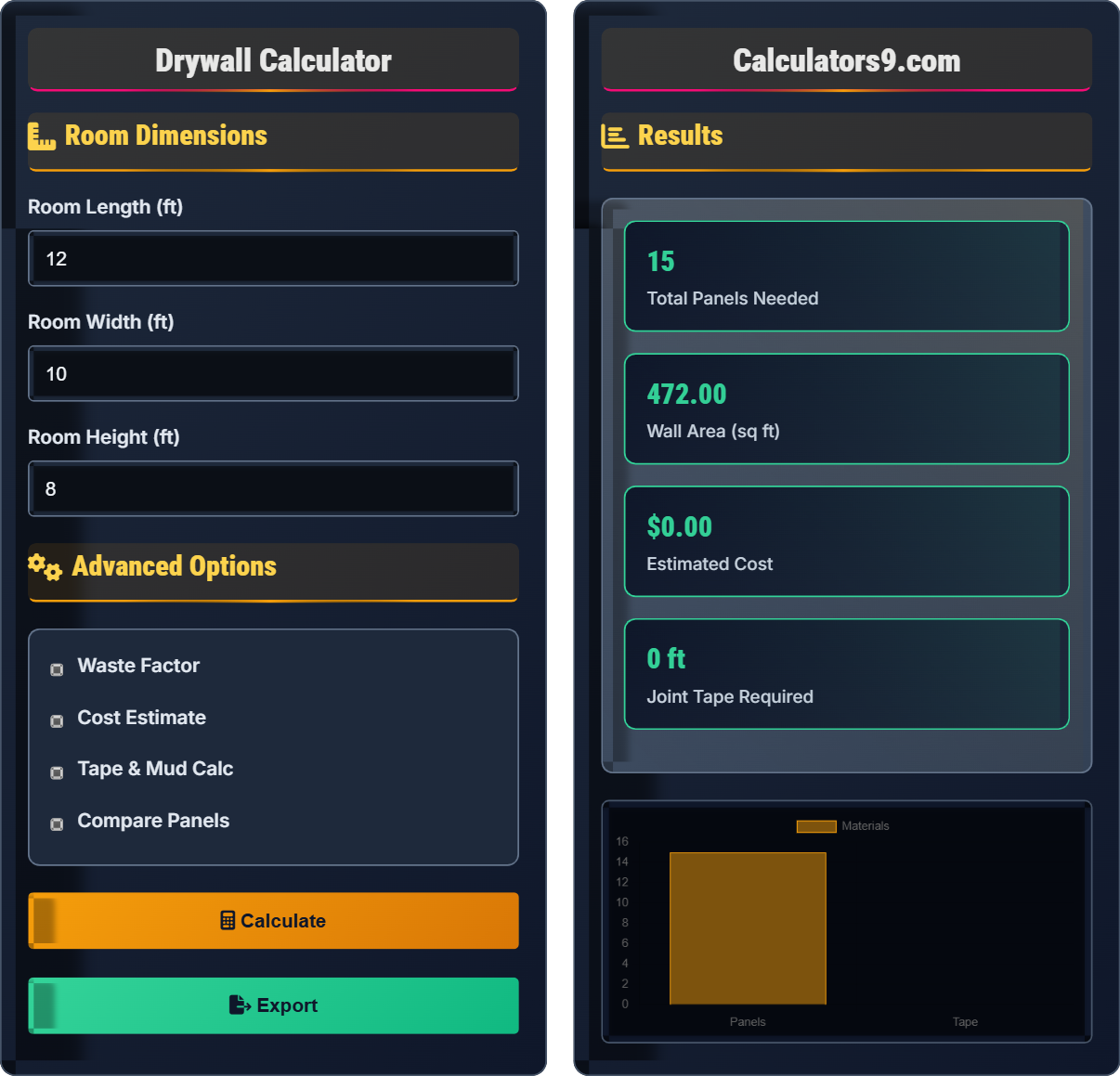
Calculate the number of standard 4' × 8' panels needed for a room that is 12 feet long, 10 feet wide, and 8 feet high. Include a 12% waste factor.
Step 1: Calculate wall area: 2×(12×8) + 2×(10×8) = 192 + 160 = 352 sq ft
Step 2: Calculate ceiling area: 12×10 = 120 sq ft
Step 3: Calculate total area: 352 + 120 = 472 sq ft
Step 4: Calculate panels needed: 472 ÷ 32 = 14.75 ≈ 15 panels
Step 5: Add 12% waste factor: 15 × 1.12 = 16.8 ≈ 17 panels
Therefore, you need 17 panels for the room.
This problem demonstrates the standard approach to drywall calculations. First, calculate the area of all walls and ceiling separately, then add them together. Standard 4' × 8' panels cover 32 square feet each. The waste factor accounts for cutting panels to fit around openings and breakage during handling.
Standard Panel: 4' × 8' drywall sheet covering 32 sq ft
Waste Factor: Additional percentage for cuts and damage
Joint: Connection point between panels
• Calculate wall and ceiling areas separately
• Standard panels: 4' × 8' (32 sq ft)
• Waste factor typically 10-15%
• Wall area: 2×(L×H) + 2×(W×H)
• Ceiling area: L×W
• Add 10-15% for waste and cuts
• Forgetting to add waste factor to calculations
• Not including ceiling area in total
• Using incorrect panel area in calculations
A contractor needs to install drywall in a basement that is 20 feet long, 15 feet wide, and 8 feet high. If drywall panels cost $18 each and the contractor adds a 10% waste factor, what is the total estimated cost for the panels?
Step 1: Calculate wall area: 2×(20×8) + 2×(15×8) = 320 + 240 = 560 sq ft
Step 2: Calculate ceiling area: 20×15 = 300 sq ft
Step 3: Calculate total area: 560 + 300 = 860 sq ft
Step 4: Calculate panels needed: 860 ÷ 32 = 26.875 ≈ 27 panels
Step 5: Add 10% waste factor: 27 × 1.10 = 29.7 ≈ 30 panels
Step 6: Calculate cost: 30 × $18 = $540
Therefore, the total estimated cost is $540.
This example demonstrates real-world application of drywall calculations. Contractors always add a waste factor to account for cutting, breakage, and damaged panels. The waste factor is applied to the quantity before calculating cost. This ensures adequate material while accounting for real-world variations in actual vs. theoretical quantities.
Waste Factor: Additional percentage added to calculated quantity to account for losses
Joint Compound: Material used to fill gaps and cover screws
Taping: Process of covering joints between panels
• Waste factor is typically 10-15% of calculated quantity
• Apply waste factor to quantity before calculating cost
• Drywall costs are typically quoted per panel
• Standard waste factor is 10-12% for most projects
• Round up panel quantities to nearest 5 for ordering
• Get quotes from multiple suppliers for best pricing
• Forgetting to add waste factor to calculations
• Applying waste factor to cost instead of quantity
• Ordering exact calculated amount without buffer
A large conference room requires 80 standard 4' × 8' drywall panels. If each standard 1/2" panel weighs 60 pounds, calculate the total weight of the panels. Why is this calculation important for construction planning?
Step 1: Calculate total weight: 80 × 60 = 4,800 pounds
Step 2: Convert to tons: 4,800 ÷ 2,000 = 2.4 tons
This calculation is important because engineers need to ensure the structure can bear the additional load. It also affects transportation logistics, equipment requirements, and handling considerations during installation.
This demonstrates the practical importance of understanding drywall weight in construction. At 60 lbs per panel, the total weight becomes significant, which impacts structural design, especially for ceiling installations. Engineers use these calculations to ensure structures can safely support the drywall load without deflection.
Density: Mass per unit volume of a substance
Load Bearing: Structural capacity to support weightDeflection: Bending or sagging under load
• Standard 1/2" panel weight is approximately 60 lbs
• Weight affects structural design and ceiling joist requirements
• Transportation equipment must handle panel weight safely
• Remember: 1 ton = 2,000 pounds
• Consult structural engineer for heavy installations
• Consider ceiling joist spacing for panel weight
• Underestimating the weight of drywall and its impact
• Not considering structural capacity in planning
• Forgetting to account for ceiling installations
Which of the following statements about drywall panel sizes is CORRECT?
The answer is C) 4' × 12' panels cover 48 sq ft. Standard drywall panels come in various sizes: 4' × 8' (32 sq ft), 4' × 10' (40 sq ft), and 4' × 12' (48 sq ft). While larger panels can reduce the number of joints, they are actually harder to handle due to increased weight. Standard 4' × 8' panels are most common because they balance coverage with manageability.
Understanding panel sizes is crucial for efficient drywall installation. Different sizes serve various purposes: standard panels for most applications, longer panels for high ceilings, and smaller panels for tight spaces. Students should understand how panel size affects both installation efficiency and handling requirements.
Standard Panel: 4' × 8' drywall sheet (32 sq ft)
Large Panel: 4' × 10' or 4' × 12' for efficiency
Panel Orientation: Direction panels are installed
• Standard panels: 4' × 8' (32 sq ft)
• Large panels: 4' × 12' (48 sq ft)
• Larger panels reduce joints but increase weight
• Use 4' × 8' for most applications
• Use 4' × 12' for high ceilings (10'+)
• Consider team lifting for large panels
• Confusing panel dimensions and coverage area
• Not considering weight implications of large panels
• Using incorrect panel size in calculations
FAQ
Q: How do I account for waste when ordering drywall panels?
A: Contractors typically add a waste factor of 10-15% to calculated drywall quantities. This accounts for cutting panels to fit around outlets, windows, doors, and irregular areas, plus breakage during handling.
For example, if you calculate needing 20 panels, you would order:
With 12% waste factor: 20 × 1.12 = 22.4 ≈ 23 panels
Mathematically, if \( P_c \) is the calculated quantity and \( W \) is the waste percentage:
\( P_o = P_c \times (1 + W/100) \)
Where \( P_o \) is the ordered quantity. This formula ensures you have enough panels to complete the job without running short.
Q: What's the difference between 1/2" and 5/8" drywall panels?
A: The main differences are in thickness, weight, and application:
- 1/2" Standard: Most common for residential walls and ceilings. Weighs ~60 lbs per 4'×8' panel
- 5/8" Type X: Enhanced fire resistance. Weighs ~70 lbs per 4'×8' panel. Required in some commercial applications
- Strength: 5/8" panels are stiffer and less prone to deflection
- Cost: 5/8" panels typically cost 15-25% more than 1/2"
5/8" panels are often required in hallways, utility rooms, and where fire ratings are needed.