Excavation Volume Calculator
Fast dirt & soil calculator • 2026 rates
Excavation Volume Formula:
Show the calculator\( V = L \times W \times D \)
Where:
- \( V \) = volume of excavation in cubic feet
- \( L \) = length of excavation
- \( W \) = width of excavation
- \( D \) = depth of excavation
For sloped excavations: \( V = \frac{D}{6} \times (A_1 + 4 \times A_m + A_2) \) (Prismoidal formula)
After excavation, soil expands (swell factor). Volume of loose soil = Excavated volume × (1 + Swell Factor).
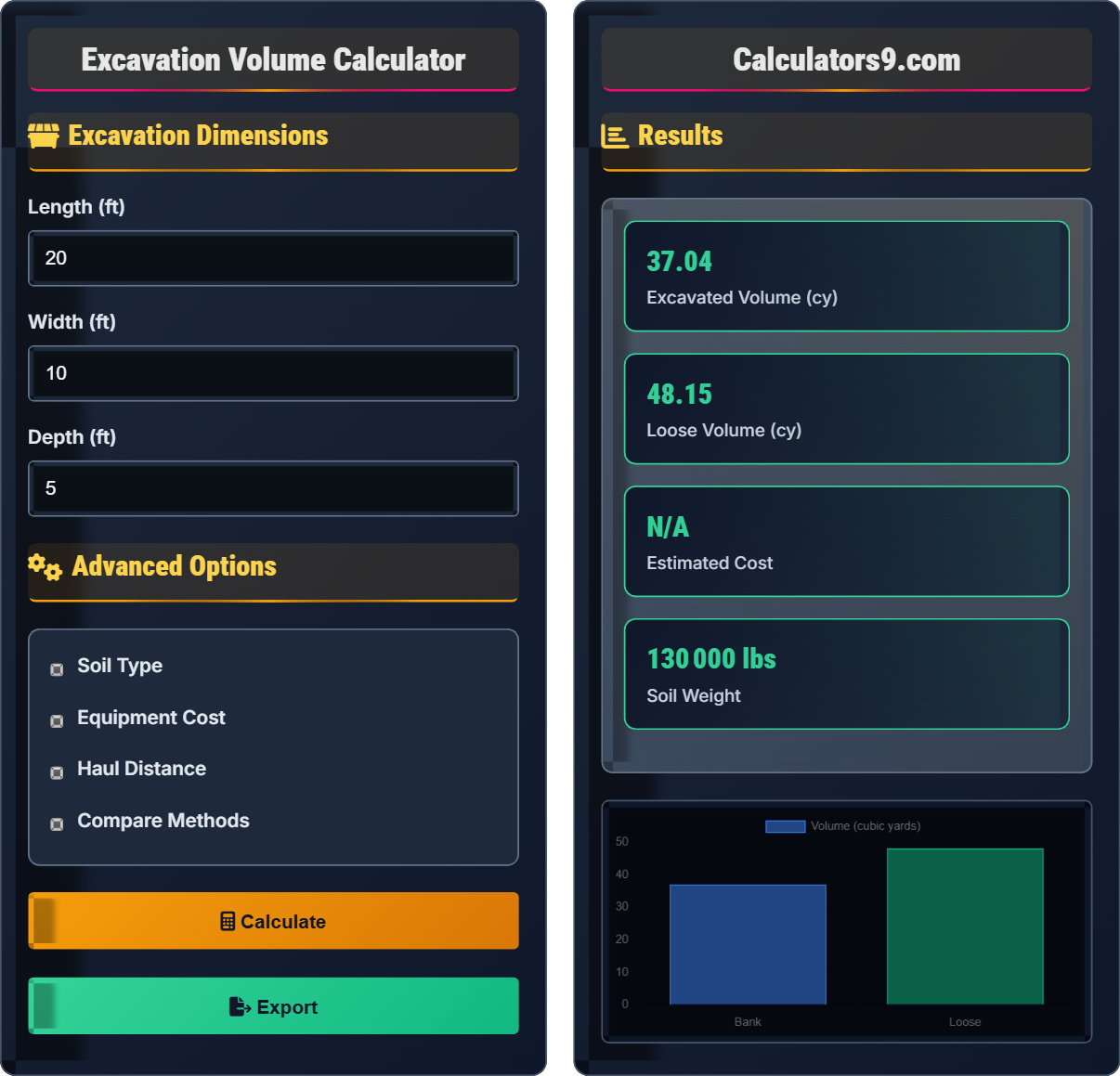
Example: For an excavation 20 ft long, 10 ft wide, and 5 ft deep:
Volume = 20 × 10 × 5 = 1,000 cubic feet
Convert to cubic yards: 1,000 ÷ 27 = 37.04 cubic yards
With 25% swell factor: 37.04 × 1.25 = 46.3 cubic yards loose
Therefore, you would need to remove approximately 46.3 cubic yards of loose soil.
Excavation Dimensions
Advanced Options
Results
| Dimension | Value |
|---|
| Component | Value |
|---|
Comprehensive Excavation Guide
Excavation involves removing earth, rock, or other materials from a site to create cuttings or foundations. Proper excavation requires understanding soil properties, safety requirements, and volume calculations. Soil classification affects excavation difficulty, stability, and disposal requirements. Safety is paramount in excavation work due to cave-in risks and underground utilities.
The basic excavation volume calculation uses the following formula:
Where:
- \(V\) = Volume of excavation in cubic feet
- \(L\) = Length in feet
- \(W\) = Width in feet
- \(D\) = Depth in feet
For sloped excavations, use the prismoidal formula: \(V = \frac{D}{6} \times (A_1 + 4 \times A_m + A_2)\)
Excavation equipment and costs vary by project size:
- Mini Excavator: $80-150/hour, 1-4 cy capacity
- Standard Excavator: $120-200/hour, 4-10 cy capacity
- Large Excavator: $200-350/hour, 10+ cy capacity
- Dump Truck: $50-100/hour, 10-20 cy capacity
- Disposal Cost: $20-50 per cubic yard
- Call 811: Locate underground utilities before digging
- Slope requirements: 1:1 slope for unstable soil, 1:0.5 for stable
- Shoring: Required for deep excavations near structures
- Water management: Pump out groundwater during excavation
- Access: Plan for equipment entry/exit routes
Excavation Fundamentals
Volume increase when soil is excavated and loosened, expressed as percentage.
\(V_{loose} = V_{excavated} \times (1 + Swell Factor)\)
Where Vloose=loose volume, Vexcavated=excavated volume, Swell Factor=decimal value.
- Always account for swell factor in disposal planning
- Soil weighs ~2,000 lbs per cubic yard
- Call 811 before any excavation
Safety Guidelines
Stable Rock: No shoring, Compacted: 1:0.5 slope, Unstable: 1:1 slope required
- Identify all utilities before excavation
- Provide safe egress from excavation
- Monitor for atmospheric hazards
- Protect workers from falling objects
- Excavations deeper than 4 ft require safety measures
- Soil stability affects slope requirements
- Weather affects excavation conditions
Excavation Calculation Learning Quiz
What is the purpose of applying a swell factor in excavation calculations?
The answer is B) To account for volume increase when soil is excavated. When soil is excavated, it becomes loosened and occupies more space than when it was compacted in the ground. This is called the swell factor. For example, if you excavate 10 cubic yards of compacted soil with a 30% swell factor, you will have 13 cubic yards of loose soil to dispose of or relocate.
Understanding swell factor is crucial for proper excavation planning. Students must recognize that excavated soil takes up more space than it did when in the ground. This affects trucking requirements, disposal planning, and staging areas. The swell factor varies by soil type, with clay having higher swell factors than sandy soils.
Swell Factor: Volume increase when soil is excavated and loosened
Bank Volume: Volume of soil in its natural state
Loose Volume: Volume of excavated, uncompacted soil
• Excavated soil always has greater volume than bank volume
• Swell factor is expressed as a percentage
• Different soil types have different swell factors
• Remember: Excavated volume > Bank volume
• Typical range: 20-75% swell factor
• Clay has higher swell factor than sand
• Forgetting to account for swell factor
• Assuming excavated volume equals bank volume
• Using same factor for all soil types
Calculate the volume of excavation in cubic yards for a trench that is 30 feet long, 4 feet wide, and 6 feet deep. Then calculate the loose volume with a 30% swell factor.
Step 1: Calculate volume in cubic feet: 30 × 4 × 6 = 720 cubic feet
Step 2: Convert to cubic yards: 720 ÷ 27 = 26.67 cubic yards
Step 3: Calculate loose volume with 30% swell factor: 26.67 × 1.30 = 34.67 cubic yards
Therefore, the excavation volume is 26.67 cubic yards bank volume and 34.67 cubic yards loose volume.
This problem demonstrates the fundamental volume calculation followed by the swell factor adjustment. The conversion from cubic feet to cubic yards (dividing by 27) is essential since excavation volumes are typically measured in cubic yards. The swell factor calculation is critical for planning disposal and trucking requirements.
Cubic Yard: Volume of a cube with 3-foot sides (27 cubic feet)
Bank Volume: Volume of soil in its natural state
Loose Volume: Volume after excavation
• 1 cubic yard = 27 cubic feet
• Loose volume = Bank volume × (1 + swell factor)
• Always convert to same units before calculating
• Remember: 3×3×3 = 27 cubic feet per cubic yard
• Add swell factor as decimal (30% = 0.30)
• Plan disposal based on loose volume
• Forgetting to convert cubic feet to cubic yards
• Not accounting for swell factor in disposal planning
• Mixing up bank and loose volume calculations
An excavator can dig 25 cubic yards per hour and a dump truck can haul 15 cubic yards per trip. If you need to excavate 200 cubic yards with a 25% swell factor, how many dump truck loads are needed and how long will the excavation take?
Step 1: Calculate loose volume: 200 × 1.25 = 250 cubic yards
Step 2: Calculate excavation time: 200 ÷ 25 = 8 hours
Step 3: Calculate dump truck loads: 250 ÷ 15 = 16.67 → 17 loads (round up)
Therefore, the excavation will take 8 hours and require 17 dump truck loads.
This example demonstrates how to plan excavation operations using equipment capacities. The calculation distinguishes between bank volume (what needs to be excavated) and loose volume (what needs to be hauled). Students learn to account for equipment limitations and round up fractional truck loads.
Bank Volume: Volume to be excavated
Loose Volume: Volume to be hauled away
Equipment Capacity: Rate of work for machinery
• Excavation time based on bank volume
• Hauling based on loose volume
• Always round up truck loads
• Excavation rate: bank volume per hour
• Hauling rate: loose volume per trip
• Plan extra capacity for delays
• Using loose volume for excavation time calculation
• Using bank volume for hauling requirements
• Not rounding up fractional truck loads
A contractor excavates 50 cubic yards of compacted earth with a 30% swell factor. If typical soil weighs 2,700 pounds per cubic yard when loose, calculate the total weight of the excavated soil. Why is this calculation important for construction planning?
Step 1: Calculate loose volume: 50 × 1.30 = 65 cubic yards
Step 2: Calculate total weight: 65 × 2,700 = 175,500 pounds
Step 3: Convert to tons: 175,500 ÷ 2,000 = 87.75 tons
This calculation is important for determining truck capacity, bridge/load restrictions, and disposal site acceptance limits.
This demonstrates the practical importance of understanding soil weight in construction planning. Weight calculations affect transportation logistics, legal load limits, and disposal regulations. Students learn how mathematical calculations translate to real-world operational constraints.
Soil Density: Weight per unit volume of soil
Legal Load Limit: Maximum weight allowed on roads
Bridge Rating: Maximum weight a bridge can support
• Standard soil density: ~2,700 lbs/cy loose
• Legal road limit: typically 80,000 lbs gross
• Weight affects transportation planning
• Remember: 1 ton = 2,000 pounds
• Check local weight restrictions
• Consider multiple trucks for heavy loads
• Underestimating total weight of excavated material
• Not considering transportation weight limits
• Forgetting to account for swell factor in weight calculations
According to OSHA standards, when is protective equipment required in excavations?
The answer is B) For all excavations deeper than 4 feet. OSHA requires protective systems (shoring, sloping, or trench boxes) for excavations deeper than 5 feet, and sometimes for shallower excavations if soil conditions are hazardous. Additionally, atmospheric testing is required for excavations deeper than 4 feet where hazardous atmospheres may exist.
Safety regulations are non-negotiable in excavation work. Students must understand that soil can cave in with tremendous force, making protective systems essential. The 4-5 foot threshold is based on research showing significant risk at these depths. Safety measures must be planned before excavation begins.
OSHA: Occupational Safety and Health Administration
Shoring: Support system to prevent cave-ins
Sloping: Angling excavation walls to prevent collapse
• OSHA protection required for excavations >5 ft
• Call 811 before any excavation
• Always call 811 before digging (811-USA)
• Plan escape routes for workers
• Monitor weather conditions
• Not following OSHA safety requirements
• Skipping utility location calls
• Underestimating cave-in risks
FAQ
Q: How do I calculate the swell factor for different soil types?
A: Swell factor varies by soil type and conditions:
- Loose Earth: 20-30% swell factor
- Compacted Earth: 25-35% swell factor
- Clay: 35-45% swell factor
- Sand: 20-30% swell factor
- Rock: 40-75% swell factor
The swell factor calculation is: \(SF = \frac{V_{loose} - V_{bank}}{V_{bank}} \times 100\%\)
For example, if 10 cubic yards of bank soil becomes 13 cubic yards when excavated:
\(SF = \frac{13 - 10}{10} \times 100\% = 30\%\)
Q: What's the difference between bank volume and loose volume?
A: The main differences are:
- Bank Volume: Volume of soil in its natural, undisturbed state in the ground
- Loose Volume: Volume of soil after excavation when it becomes uncompacted
- Relationship: Loose volume = Bank volume × (1 + swell factor)
- Practical Use: Bank volume for excavation planning, loose volume for hauling/disposal
For example, 10 cubic yards of bank clay might become 14 cubic yards of loose clay after excavation.