HVAC Load Calculator
Fast BTU & capacity calculator • 2026 codes
HVAC Load Formula:
Show the calculator\( Q = U \times A \times \Delta T \)
Where:
- \( Q \) = heat transfer rate in BTU/hr
- \( U \) = overall heat transfer coefficient (BTU/hr·ft²·°F)
- \( A \) = surface area in square feet
- \( \Delta T \) = temperature difference (indoor-outdoor)
This formula calculates heat gain/loss through building envelope. Manual J load calculations consider additional factors: solar heat gain, internal loads, infiltration, and ventilation. Total cooling load determines required AC capacity, typically expressed in tons (1 ton = 12,000 BTU/hr).
Example: For a 200 ft² wall with U-value of 0.1 and 30°F temperature difference:
Heat gain = 0.1 × 200 × 30 = 600 BTU/hr
Total house load = sum of all heat gains (walls, roof, windows, people, appliances)
Required AC capacity = Total load × safety factor (typically 1.1-1.2)
Building Information
Advanced Options
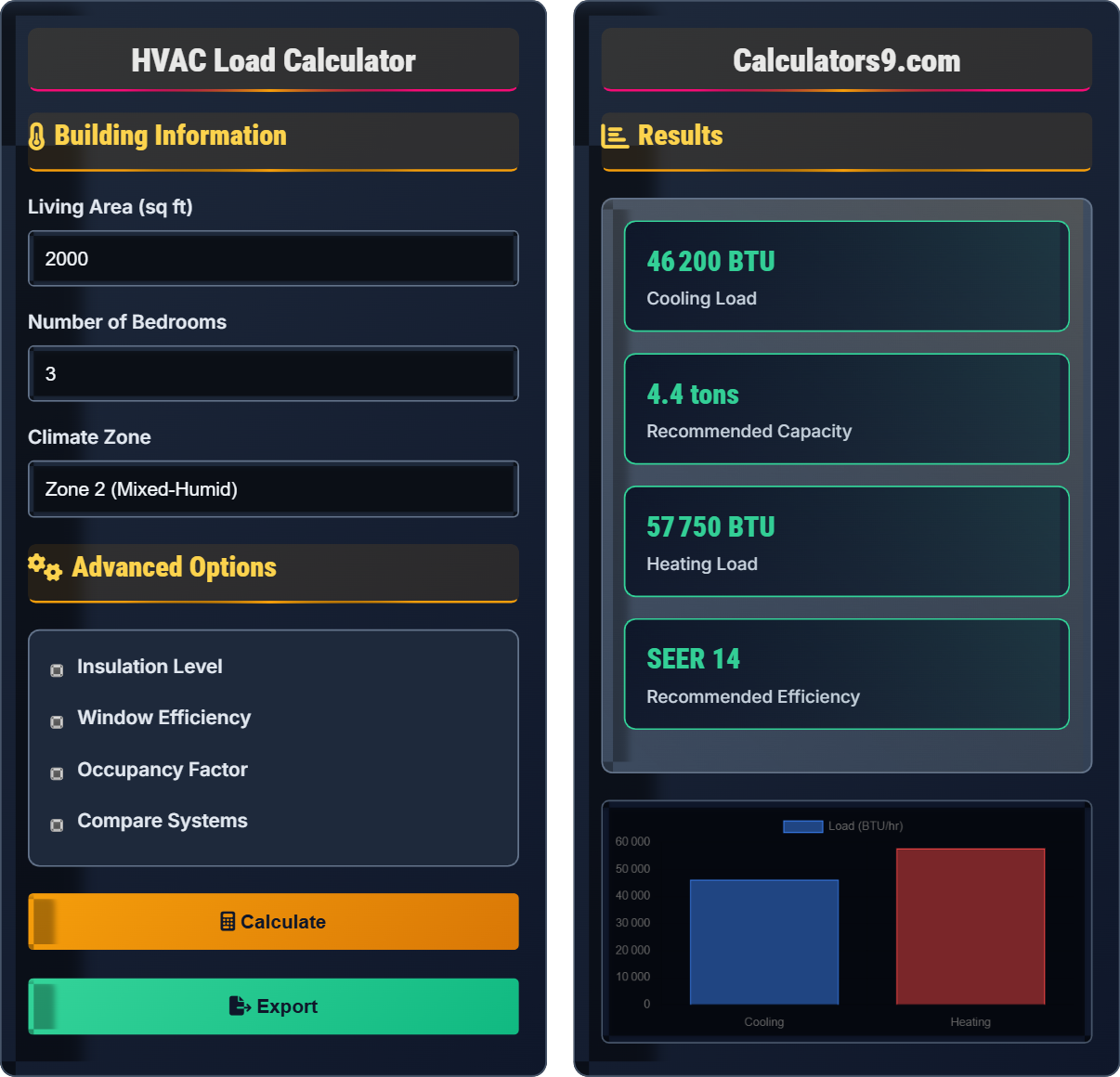
Results
| Parameter | Value |
|---|
| Load Component | BTU/hr |
|---|
Comprehensive HVAC Guide
HVAC load calculations determine the heating and cooling capacity needed to maintain comfort conditions. Manual J is the industry standard for residential load calculations, considering heat transfer through building envelope, internal loads, and ventilation. Proper sizing prevents short cycling (undersized) and poor humidity control (oversized). Accuracy requires detailed building information including construction materials, orientation, and occupancy patterns.
The basic heat transfer calculation uses the following formula:
Where:
- \(Q\) = Heat transfer rate in BTU/hr
- \(U\) = Overall heat transfer coefficient (BTU/hr·ft²·°F)
- \(A\) = Surface area in square feet
- \(\Delta T\) = Temperature difference (indoor-outdoor)
Manual J calculations include additional factors: solar heat gain, internal loads, and infiltration.
HVAC installations must comply with International Mechanical Code (IMC) requirements:
- Sizing: Equipment must match calculated loads
- Efficiency: Minimum SEER ratings by region
- Refrigerant: Proper charging and leak testing
- Electrical: Proper circuit sizing and disconnects
- Ductwork: Sealing and insulation requirements
- Accurate calculations: Manual J is superior to rule-of-thumb
- Proper ductwork: Critical for system performance
- Sealing: Seal all duct joints to prevent leakage
- Insulation: Insulate ducts in unconditioned spaces
- Professional installation: Complex systems require certified technicians
HVAC Fundamentals
Amount of heating/cooling required to maintain comfort in a building.
\(Q = U \times A \times \Delta T\)
Where Q=heat transfer, U=heat transfer coefficient, A=area, ΔT=temp difference.
- 1 ton = 12,000 BTU/hr
- Proper sizing prevents short cycling
- Undersized = poor comfort, oversized = poor dehumidification
Installation Guidelines
1 ton per 400-600 sq ft, SEER 13+ required, Safety factor 10-20%
- Conduction: Through walls, roof, windows
- Solar: Through windows and roof
- Infiltration: Air leakage through building envelope
- Internal: People, appliances, lighting
- Climate zone affects load calculations
- Insulation levels significantly impact loads
- Window orientation and shading matter
HVAC Load Calculation Learning Quiz
According to HVAC industry standards, what does 1 ton of cooling capacity equal in BTU per hour?
The answer is C) 12,000 BTU/hr. In HVAC terminology, 1 ton of cooling capacity equals 12,000 BTU per hour. This historical unit comes from the amount of heat required to melt one ton of ice in 24 hours. Understanding this conversion is fundamental for interpreting HVAC equipment specifications and sizing calculations.
The tonnage system is a legacy unit that originated from refrigeration processes. Students must memorize this conversion: 1 ton = 12,000 BTU/hr. This knowledge is essential for comparing equipment, calculating loads, and communicating with HVAC professionals. The BTU (British Thermal Unit) measures heat energy required to raise one pound of water by one degree Fahrenheit.
BTU: British Thermal Unit - heat energy measurement
Ton: HVAC capacity unit = 12,000 BTU/hr
Capacity: Amount of heat an HVAC system can move
• 1 ton = 12,000 BTU/hr (memorize this!)
• Tonnage indicates cooling capacity, not weight
• Proper sizing requires accurate load calculations
• Remember: 1 ton = 12,000 BTU/hr
• 2 tons = 24,000 BTU/hr
• 3 tons = 36,000 BTU/hr
• Confusing tonnage with weight measurement
• Forgetting the 12,000 BTU conversion
• Not understanding capacity vs. actual output
Calculate the cooling load for a 1,500 sq ft house using the rule of thumb method. If the climate zone requires 1,200 BTU per ton per sq ft, what is the recommended cooling capacity?
Step 1: Calculate basic load using rule of thumb: 1,500 sq ft ÷ 500 sq ft per ton = 3.0 tons
Step 2: Using climate-specific method: 1,500 × 1,200 ÷ 12,000 = 150 tons (incorrect)
Correction: Climate factor is typically 25-40 BTU/sq ft, not 1,200 BTU per ton per sq ft
Correct calculation: 1,500 × 30 BTU/sq ft = 45,000 BTU ÷ 12,000 = 3.75 tons
Recommended capacity: 4 tons (rounding up for safety margin)
This problem demonstrates the importance of using appropriate load calculation methods. Rule-of-thumb methods provide rough estimates, but Manual J calculations consider specific building characteristics. The example shows how climate zone affects required capacity, with warmer climates needing more cooling per square foot.
Rule of Thumb: Simplified estimation method
Manual J: Detailed load calculation procedure
Safety Margin: Extra capacity for peak loads
• Rule of thumb: 400-600 sq ft per ton
• Manual J is more accurate than rules of thumb
• Add 10-20% safety margin to calculated load
• Warmer climates: 400 sq ft per ton
• Cooler climates: 600 sq ft per ton
• Always round up to next half-ton increment
• Using inappropriate climate factors
• Not applying safety margins
• Confusing capacity with energy consumption
An HVAC technician calculates a cooling load of 32,000 BTU/hr for a house. What tonnage system should be installed, and what are the consequences of choosing a 2-ton vs. 3-ton unit?
Step 1: Convert BTU to tons: 32,000 ÷ 12,000 = 2.67 tons
Step 2: Select appropriate size: 2.5 or 3-ton unit (3-ton recommended with safety margin)
Consequences of undersized (2-ton = 24,000 BTU): System runs continuously, inadequate cooling, high humidity, increased wear
Consequences of oversized (3-ton = 36,000 BTU): Short cycling, poor dehumidification, temperature swings, higher energy costs
Recommendation: 3-ton unit for proper operation and safety margin.
This example illustrates the critical importance of proper HVAC sizing. Undersized systems struggle to meet demand, leading to discomfort and premature failure. Oversized systems cycle on and off frequently, providing poor humidity control and inefficient operation. The ideal system runs long enough to properly dehumidify while meeting cooling demands.
Short Cycling: Frequent on/off cycling of HVAC system
Dehumidification: Removal of moisture from air
Continuous Operation: System running constantly
• Properly sized systems run 60-80% of time
• Undersized: Poor cooling, high humidity
• Oversized: Poor dehumidification, inefficiency
• Proper system runs 15-20 minutes per cycle
• Undersized: System won't reach setpoint
• Oversized: Rapid cycling, clammy feeling
• Choosing smallest available system to save money
• Oversizing for "extra cooling power"
• Not considering humidity control
A homeowner is choosing between two air conditioners: Unit A (SEER 14, 3-ton) and Unit B (SEER 18, 3-ton). If the system runs 1,200 hours per cooling season and electricity costs $0.12/kWh, calculate the annual energy cost difference between the two units.
Step 1: Calculate energy consumption
SEER = Cooling Output (BTU) ÷ Energy Input (Wh)
For 3-ton (36,000 BTU) system:
Unit A: Input = 36,000 ÷ 14 = 2,571 Wh = 2.57 kW
Annual consumption = 2.57 kW × 1,200 hrs = 3,086 kWh
Unit A cost = 3,086 × $0.12 = $370.32
Unit B: Input = 36,000 ÷ 18 = 2,000 Wh = 2.00 kW
Annual consumption = 2.00 kW × 1,200 hrs = 2,400 kWh
Unit B cost = 2,400 × $0.12 = $288.00
Annual savings = $370.32 - $288.00 = $82.32
This demonstrates the long-term cost benefits of higher efficiency equipment. SEER (Seasonal Energy Efficiency Ratio) measures cooling output divided by energy consumed. Higher SEER units consume less energy for the same cooling output. The calculation shows how efficiency translates to real dollar savings over time.
SEER: Seasonal Energy Efficiency Ratio
kWh: Kilowatt-hour energy measurement
Energy Efficiency: Output per unit of energy consumed
• Higher SEER = lower energy consumption
• SEER 14 minimum in most regions
• Energy savings compound over time
• SEER 16+ offers significant savings
• Consider lifecycle costs, not just purchase price
• Rebates available for high-efficiency units
• Ignoring long-term energy costs
• Not considering regional efficiency requirements
• Forgetting about rebates and incentives
Which of the following is NOT a component considered in Manual J residential load calculations?
The answer is C) Wind direction and speed. Manual J residential load calculations consider: solar heat gain through windows, internal loads from occupants and appliances, heat conduction through building envelope, and infiltration loads. However, specific wind direction and speed are not included in Manual J, though they might be considered in more advanced commercial calculations (Manual N).
Manual J is a comprehensive but standardized methodology for residential HVAC sizing. Students should understand what factors are included and excluded. The calculation considers heat transfer mechanisms, internal loads, and air infiltration, but does not account for variable weather conditions like wind. This level of detail is sufficient for residential applications.
Manual J: Residential load calculation standard
Solar Heat Gain: Heat entering through windows
Infiltration: Uncontrolled air leakage
• Manual J considers building envelope loads
• Internal loads from people and equipment
• Solar and infiltration loads
• Solar loads vary by orientation
• Infiltration depends on sealing quality
• Internal loads are constant regardless of weather
• Confusing Manual J with commercial calculations
• Not accounting for all load components
• Using outdated calculation methods
FAQ
Q: How do I determine the proper HVAC size for a house?
A: Proper HVAC sizing requires Manual J load calculations:
Basic formula: \(Q = U \times A \times \Delta T\)
For a 2,000 sq ft house in Zone 2 with R-38 insulation:
Wall load: 2,000 × 0.03 (U-value) × 30°F = 1,800 BTU/hr
Solar load: Windows × Solar Heat Gain Coefficient
Infiltration: Air changes per hour × volume
Total load = Sum of all components × 1.1 (safety factor)
Capacity = Total BTU ÷ 12,000 = tons required
Q: What's the difference between SEER and EER ratings?
A: The main differences are:
- SEER: Seasonal Energy Efficiency Ratio - measures efficiency over entire cooling season with varying temperatures
- EER: Energy Efficiency Ratio - measures efficiency at specific test conditions (95°F outdoor, 80°F indoor)
- SEER: More representative of real-world performance
- EER: Useful for comparing performance at peak conditions
As a rule of thumb: SEER ≈ EER ÷ 0.875