Lumber Board Foot Calculator
Fast measurement tool • 2026 standards
Board Foot Formula:
Show the calculator\( \text{Board Feet} = \frac{\text{Length (in)} \times \text{Width (in)} \times \text{Thickness (in)}}{144} \)
Where:
- Length = length of lumber piece in inches
- Width = width of lumber piece in inches
- Thickness = thickness of lumber piece in inches
- 144 = conversion factor (12 inches × 12 inches = 144 square inches per foot)
This formula calculates the volume of lumber in board feet, a standard unit of measurement in the lumber industry. One board foot equals 144 cubic inches of wood.
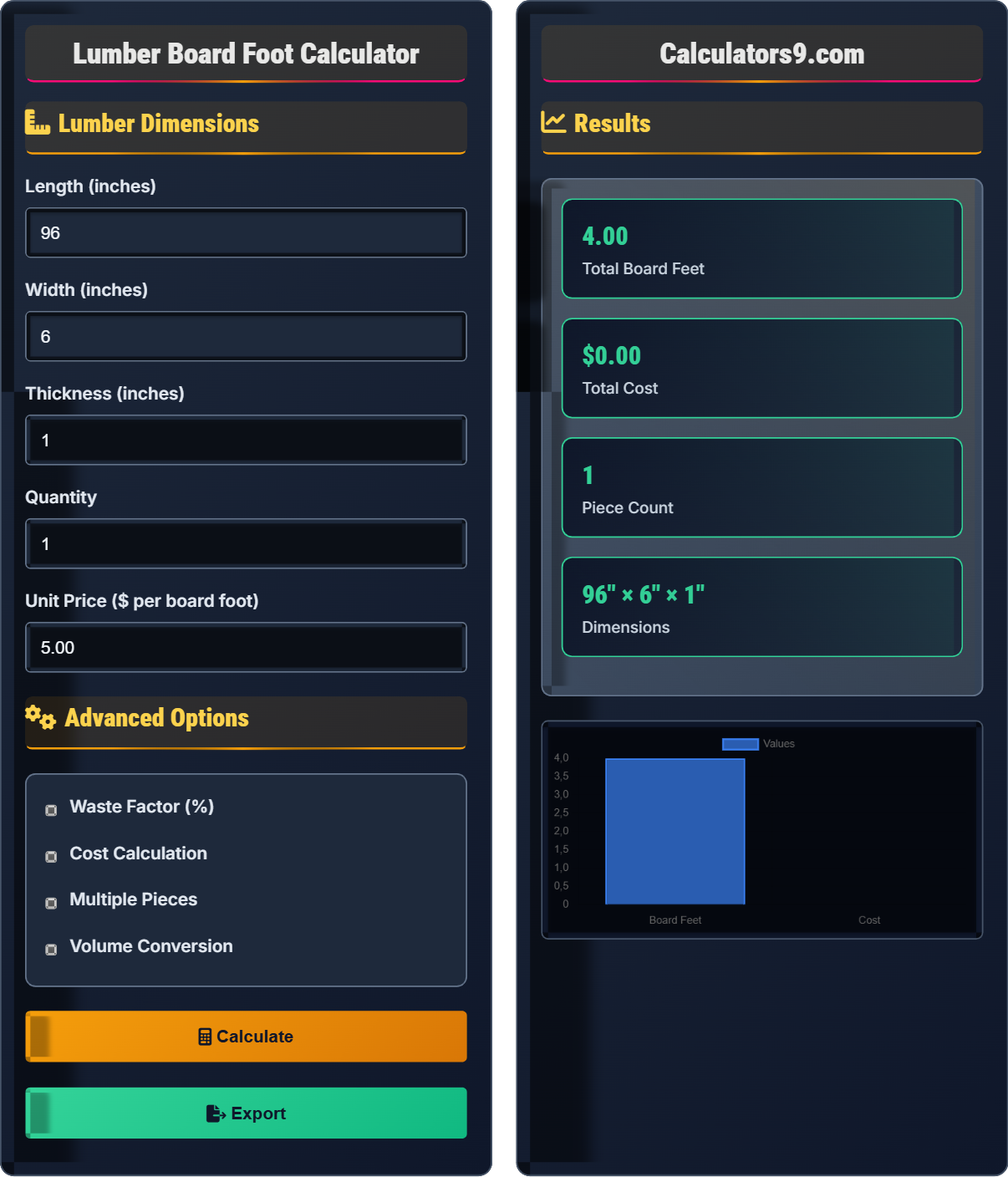
Example: For a piece of lumber measuring 96" long × 6" wide × 1" thick:
\( \text{Board Feet} = \frac{96 \times 6 \times 1}{144} = \frac{576}{144} = 4 \)
Thus, the piece contains 4 board feet.
Lumber Dimensions
Advanced Options
Results
| Measurement | Value |
|---|---|
| Length | 96 inches |
| Width | 6 inches |
| Thickness | 1 inch |
| Quantity | 1 |
| Item | Amount |
|---|---|
| Base Board Feet | 4.00 |
| Waste Factor | 0.00 |
| Total Board Feet | 4.00 |
| Unit Price | $5.00 |
| Total Cost | $20.00 |
Comprehensive Lumber Guide
A board foot is a unit of measurement for lumber representing a piece of wood 12 inches long, 12 inches wide, and 1 inch thick (or equivalent volume). It equals 144 cubic inches of wood. This standard unit allows contractors and suppliers to accurately measure and price lumber regardless of its actual dimensions.
The standard board foot calculation uses the following formula:
Where:
- \(BF\) = Board Feet
- \(L\) = Length in inches
- \(W\) = Width in inches
- \(T\) = Thickness in inches
- 144 = conversion factor (cubic inches per board foot)
Standard lumber dimensions include:
- Thickness: 1" (actual: 0.75"), 2" (actual: 1.5"), 4" (actual: 3.5")
- Width: 4", 6", 8", 10", 12" (actual: 3.5", 5.5", 7.25", 9.25", 11.25")
- Length: 6', 8', 10', 12', 14', 16', 18', 20', 24'
- Specialty: 1×2, 1×3, 1×4, 1×6, 1×8, 1×10, 1×12
- Plan ahead: Calculate exact lumber needs before ordering to minimize waste
- Order extras: Purchase 10-20% extra for waste and mistakes
- Check grades: Match lumber grade to project requirements
- Proper storage: Store lumber flat and protected from moisture
- Inspect delivery: Check for damage before accepting delivery
Lumber Basics
Standard unit of measurement equal to 144 cubic inches of wood.
\(BF = \frac{L \times W \times T}{144}\)
Where BF=board feet, L=length, W=width, T=thickness in inches.
- Measure in inches before dividing by 144
- Account for actual vs. nominal dimensions
- Include waste factors in calculations
Strategies
Accurate measurements prevent over-ordering and waste.
- Calculate exact needs
- Consider alternative materials
- Buy in bulk when possible
- Reuse scrap pieces
- Actual vs. nominal dimensions
- Moisture content affects weight
- Grade affects quality and price
- Species affects workability
Lumber Learning Quiz
What is the board footage of a piece of lumber measuring 8 feet long, 6 inches wide, and 1 inch thick?
The answer is B) 4 board feet. Using the board foot formula: BF = (Length × Width × Thickness) ÷ 144. First, convert 8 feet to inches: 8 × 12 = 96 inches. Then calculate: (96 × 6 × 1) ÷ 144 = 576 ÷ 144 = 4 board feet.
Understanding board foot calculations is crucial for accurate lumber estimation. The key is ensuring all measurements are in inches before applying the formula. Since lumber is often measured in feet for length, conversion is necessary. The division by 144 converts cubic inches to board feet, since one board foot equals 144 cubic inches (12" × 12" × 1").
Board Foot: Unit of lumber measurement equal to 144 cubic inches
Nominal Size: Standard designation (e.g., 2×4) versus actual size
Actual Size: True dimensions after surfacing (e.g., 1.5" × 3.5")
• Convert all measurements to inches before calculating
• Divide by 144 to get board feet
• Account for actual vs. nominal dimensions
• Remember: 12" × 12" × 1" = 144 cubic inches = 1 board foot
• Use the formula: (L × W × T) ÷ 144
• Always verify actual dimensions vs. nominal sizes
• Forgetting to convert feet to inches
• Using nominal instead of actual dimensions
• Miscounting decimal places in calculations
A contractor needs 100 board feet of lumber for a project. If they want to order 15% extra for waste, how much lumber should they order in total? Show your calculation steps.
Step 1: Calculate the waste amount: 100 board feet × 0.15 = 15 board feet
Step 2: Add waste to base amount: 100 + 15 = 115 board feet
Step 3: The contractor should order 115 board feet total.
Alternative method: 100 × 1.15 = 115 board feet
In construction projects, waste factors are essential to account for cutting errors, damaged materials, and unusable scraps. A 10-20% waste factor is standard practice. The calculation involves finding the percentage of the base amount and adding it to the original requirement. Understanding percentages and multiplication is crucial for accurate material estimation.
Waste Factor: Additional percentage added to base material needs
Material Estimation: Process of calculating required quantities
Overage: Extra material ordered beyond minimum requirements
• Standard waste factor: 10-20% for lumber projects
• Multiply base amount by (1 + waste percentage)
• Consider project complexity when setting waste factor
• For 15% waste: multiply by 1.15
• For complex cuts: consider higher waste factor
• Round up to nearest whole board foot for practical ordering
• Adding percentage as whole number instead of decimal
• Forgetting to include waste in final calculation
• Using too low or too high waste factor for project type
FAQ
Q: Why do lumber dimensions differ from their nominal sizes?
A: Lumber dimensions differ from nominal sizes due to the surfacing process. When lumber is initially cut, it has rough surfaces and irregular dimensions. To create smooth, uniform pieces, manufacturers plane and sand the lumber, removing approximately ¼ inch from each dimension. For example, a nominal 2×4 is actually 1.5" × 3.5" after surfacing.
The surfacing process serves multiple purposes:
- Creates uniform dimensions for consistent construction
- Removes splinters and rough edges for safety
- Improves appearance and finish acceptance
- Reduces warping and twisting during drying
Understanding this difference is crucial for accurate material calculations. When calculating board feet, use the actual dimensions (1.5" × 3.5") rather than nominal dimensions (2" × 4") for precise results.
Q: How do I calculate board feet for lumber with non-standard thickness like 5/4 or 6/4?
A: Non-standard lumber thicknesses like 5/4 and 6/4 refer to fractions of inches. These are common in hardwood lumber:
- 5/4 = 5 quarters of an inch = 1.25 inches thick
- 6/4 = 6 quarters of an inch = 1.5 inches thick
- 8/4 = 8 quarters of an inch = 2 inches thick
For board foot calculation, simply use the decimal equivalent in your formula: \(BF = \frac{L \times W \times T}{144}\).
For example, a 10-foot long, 6-inch wide piece of 5/4 lumber:
\(BF = \frac{120 \times 6 \times 1.25}{144} = \frac{900}{144} = 6.25\) board feet
This system originated from traditional lumber grading where thickness was measured in quarters of an inch. Hardwoods are often sold in these fractional thicknesses to provide options between standard construction lumber dimensions.