Plumbing Pipe Calculator
Fast flow & pressure calculator • 2026 codes
Plumbing Flow Formula:
Show the calculator\( Q = A \times v \)
Where:
- \( Q \) = flow rate in gallons per minute (GPM)
- \( A \) = cross-sectional area of pipe in square feet
- \( v \) = velocity of water in feet per second (fps)
This formula calculates water flow based on pipe size and velocity. For residential plumbing, maximum recommended velocity is 8 fps to prevent noise and erosion. Pressure drop calculations use Hazen-Williams equation for water flow in pipes.
Example: For 1/2" copper pipe (0.6" ID) with water velocity of 5 fps:
Area = π × (0.3)² = 0.283 sq in = 0.00197 sq ft
Flow rate = 0.00197 × 5 × 448.8 = 4.4 GPM
(Multiply by 448.8 to convert cfs to GPM)
Therefore, the pipe can deliver approximately 4.4 GPM.
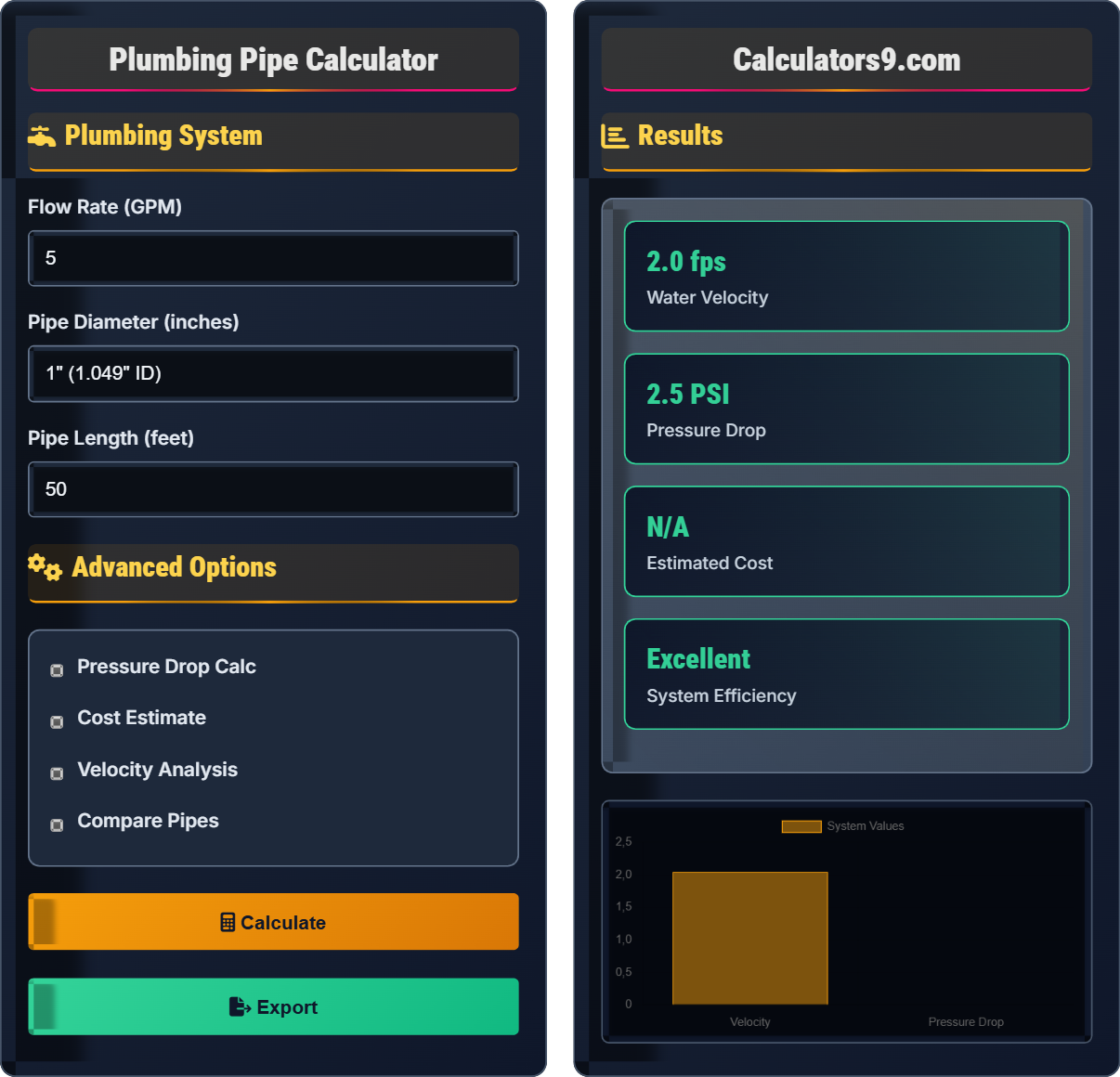
Plumbing System
Advanced Options
Results
| Parameter | Value |
|---|
| Specification | Value |
|---|
Comprehensive Plumbing Guide
Plumbing systems rely on properly sized pipes to deliver water efficiently. Common materials include copper, PEX, PVC, and galvanized steel. Copper pipes are available in Type K (heaviest), Type L (medium), and Type M (lightest). PEX is flexible and easier to install. Proper pipe sizing balances flow rate, pressure, and velocity to prevent noise and erosion while maintaining adequate supply.
The fundamental flow rate calculation uses the following formula:
Where:
- \(Q\) = Flow rate in gallons per minute (GPM)
- \(A\) = Cross-sectional area in square feet
- \(v\) = Water velocity in feet per second (fps)
For pressure drop calculations, the Hazen-Williams equation is used: \(P_d = 4.52 \times \frac{Q^{1.85} \times L}{C^{1.85} \times d^{4.87}}\)
Plumbing installations must comply with International Plumbing Code (IPC) requirements:
- Velocity: Maximum 8 fps to prevent noise and erosion
- Pressure: Minimum 20 PSI at fixtures, maximum 80 PSI
- Fixture Units: Proper sizing based on fixture demand
- Backflow: Prevention devices where required
- Support: Proper pipe support spacing
- Conservative sizing: Use larger pipe when in doubt
- Future expansion: Plan for additional fixtures
- Pressure considerations: Account for elevation changes
- Support spacing: Follow manufacturer recommendations
- Professional consultation: Complex systems require licensed plumber
Plumbing Fundamentals
Volume of water passing through a pipe per unit time, measured in GPM.
\(Q = A \times v\)
Where Q=flow rate, A=cross-sectional area, v=velocity.
- Max velocity: 8 fps for noise control
- Min pressure: 20 PSI at fixtures
- Proper pipe sizing prevents pressure loss
Installation Guidelines
1/2": 6 GPM, 3/4": 12 GPM, 1": 18 GPM, 1-1/4": 27 GPM, 2": 40 GPM
- Main supply: 5 PSI max drop
- Branch lines: 3 PSI max drop
- Fixture connections: 2 PSI max drop
- Larger pipes reduce velocity and pressure loss
- Elevation changes affect pressure
- Fittings create additional pressure drops
Plumbing Pipe Calculation Learning Quiz
According to plumbing best practices, what is the maximum recommended water velocity in residential piping to prevent noise and erosion?
The answer is B) 8 feet per second. Plumbing professionals recommend a maximum velocity of 8 fps in residential systems to prevent noise (water hammer), erosion of pipe walls, and excessive pressure drops. Velocities above 8 fps can cause turbulent flow, leading to pipe wear and annoying sounds in the system.
Understanding water velocity limitations is crucial for proper pipe sizing. When water flows too quickly through pipes, it creates turbulence and noise. The 8 fps limit balances adequate flow rates with system longevity and quiet operation. Students should remember that larger pipes allow the same flow rate at lower velocities.
Velocity: Speed of water flow in feet per second
Turbulent Flow: Chaotic water movement causing noise
Water Hammer: Loud noise from rapid valve closure• Max velocity: 8 fps for residential systems
• Higher velocity causes noise and erosion
• Larger pipes reduce velocity for same flow
• Remember: 8 fps maximum for quiet operation
• Larger pipe = lower velocity = less noise
• Consider future fixture additions when sizing
• Oversizing pipes for flow rate (unnecessary cost)
• Undersizing pipes causing high velocity
• Not considering noise implications of high velocity
Calculate the flow rate in GPM for water flowing at 6 fps through a 1/2" copper pipe (0.6" internal diameter). Use the formula Q = A × v × 448.8.
Step 1: Calculate cross-sectional area: A = π × r²
Radius = 0.6 ÷ 2 = 0.3 inches
A = π × (0.3)² = π × 0.09 = 0.283 square inches
Step 2: Convert area to square feet: 0.283 ÷ 144 = 0.00197 sq ft
Step 3: Apply flow rate formula: Q = A × v × 448.8
Q = 0.00197 × 6 × 448.8 = 5.3 GPM
Therefore, the flow rate is 5.3 GPM.
This problem demonstrates the fundamental relationship between pipe size, velocity, and flow rate. The factor 448.8 converts from cubic feet per second to gallons per minute. The calculation shows how pipe diameter dramatically affects flow capacity. A small increase in diameter results in a significant increase in cross-sectional area and flow capacity.
Cross-sectional Area: Area of pipe opening in square units
Flow Rate: Volume of water passing per unit time
GPM: Gallons per minute flow rate measurement
• Area = π × radius²
• Convert area to square feet for formula
• Multiply by 448.8 to get GPM from cfs
• Remember: Area = π × r² (not diameter)
• Convert square inches to square feet (÷144)
• 448.8 converts cfs to GPM
• Using diameter instead of radius in area calculation
• Forgetting unit conversions
• Not accounting for internal pipe diameter
A bathroom has a shower (2.5 GPM), sink (1.5 GPM), and toilet (3.0 GPM). If all fixtures operate simultaneously, what is the minimum pipe size needed to maintain velocity below 8 fps? What would be the velocity in the chosen pipe?
Step 1: Calculate total flow: 2.5 + 1.5 + 3.0 = 7.0 GPM
Step 2: Find minimum area needed: Q = A × v × 448.8
7.0 = A × 8 × 448.8
A = 7.0 ÷ (8 × 448.8) = 0.00196 sq ft
Step 3: Convert to square inches: 0.00196 × 144 = 0.282 sq in
Step 4: Find required diameter: A = π × r²
0.282 = π × r²
r² = 0.282 ÷ π = 0.0898
r = 0.30 inches, diameter = 0.60 inches
Step 5: Use 3/4" pipe (0.824" ID) for safety margin
Actual velocity: v = Q ÷ (A × 448.8) = 7.0 ÷ (0.531 × 448.8) = 2.9 fps
Therefore, 3/4" pipe is needed with 2.9 fps velocity.
This example demonstrates how to size pipes based on fixture demands. The calculation works backward from required flow rate to find the minimum pipe area needed to stay under the velocity limit. Using 3/4" pipe provides a safety margin and accounts for friction losses.
Fixture Unit: Measure of water demand for sizing
Simultaneous Flow: All fixtures running at once
Safety Margin: Extra capacity beyond minimum
• Sum all fixture flows for simultaneous demand
• Size pipe for max anticipated flow
• Include safety margin in pipe selection
• Add 20% safety margin to calculated flow
• Consider peak usage times
• Account for future fixture additions
• Not accounting for simultaneous fixture use
• Using nominal pipe size instead of ID
• Forgetting to include safety margins
A 100-foot run of 1/2" copper pipe carries 5 GPM of water. Using the Hazen-Williams equation (simplified), estimate the pressure drop if the C-factor for copper is 130. What is the significance of this pressure drop?
Using simplified Hazen-Williams: \(P_d = 0.0667 \times \frac{Q^{1.85} \times L}{d^{4.87}}\)
Where Q=flow rate (GPM), L=length (ft), d=diameter (in)
Substituting: \(P_d = 0.0667 \times \frac{5^{1.85} \times 100}{0.6^{4.87}}\)
Step 1: Calculate 5^1.85 = 17.1
Step 2: Calculate 0.6^4.87 = 0.079
Step 3: \(P_d = 0.0667 \times \frac{17.1 \times 100}{0.079} = 0.0667 \times 21,646 = 14.4\) PSI
This pressure drop represents energy lost to friction, reducing available pressure at fixtures.
This demonstrates how friction causes pressure loss in pipes. The Hazen-Williams equation accounts for pipe roughness (C-factor), flow rate, pipe length, and diameter. Pressure losses accumulate throughout the system, so proper pipe sizing minimizes these losses while maintaining adequate fixture pressures.
Friction Loss: Pressure drop due to pipe resistance
Hazen-Williams: Formula for water flow in pipes
C-factor: Roughness coefficient for pipe material
• Longer pipes = higher pressure loss
• Higher flow rate = exponentially higher pressure loss
• Pressure drop increases with flow rate^1.85
• Minimize pipe length when possible
• Use larger pipes for longer runs
• Ignoring pressure losses in system design
• Not accounting for fitting losses
• Using incorrect C-factor for pipe material
Which of the following statements about common plumbing pipe materials is CORRECT?
The answer is D) PEX is flexible and reduces fitting requirements. PEX (cross-linked polyethylene) is a flexible tubing that can be routed in long runs with fewer fittings than rigid materials. Copper pipe comes in Type K (heaviest), Type L (medium), and Type M (lightest). PVC is generally not approved for potable water in residential systems, though CPVC is approved for hot water.
Understanding pipe materials is crucial for proper system design. Each material has advantages: copper offers proven durability, PEX provides installation flexibility, and PVC is economical for drainage. Students should know the characteristics and applications of each material to make appropriate selections.
PEX: Cross-linked polyethylene flexible tubing
Type K: Heaviest copper pipe wall thickness
CPVC: Chlorinated polyvinyl chloride for water
• PEX is flexible, reducing fittings needed
• Copper: K > L > M in wall thickness
• Use appropriate material for application
• PEX: Flexible, fewer fittings, easier installation
• Copper: Durable, proven performance
• Always verify local code approvals
• Using PVC for potable water (where not approved)
• Confusing copper pipe types
• Not verifying local code requirements
FAQ
Q: How do I determine the proper pipe size for a fixture?
A: Proper pipe sizing involves multiple factors:
First, determine fixture demand in GPM. A lavatory sink typically requires 1.5 GPM, shower 2.5 GPM, and kitchen sink 2.2 GPM.
Then apply the flow rate formula: \(Q = A \times v \times 448.8\)
For a 2.5 GPM fixture with 6 fps velocity:
\(A = \frac{Q}{v \times 448.8} = \frac{2.5}{6 \times 448.8} = 0.00093\) sq ft
Convert to square inches: 0.00093 × 144 = 0.134 sq in
This corresponds to approximately 0.41" diameter, so 1/2" pipe (0.6" ID) is appropriate.
Q: What's the difference between 1/2" and 3/4" copper pipe?
A: The main differences are in capacity, pressure drop, and applications:
- 1/2" Copper: Internal diameter 0.600", handles up to 6 GPM, for individual fixtures
- 3/4" Copper: Internal diameter 0.824", handles up to 12 GPM, for branch lines
- Capacity: 3/4" pipe has 1.9 times the cross-sectional area of 1/2"
- Cost: 3/4" is typically 50-70% more expensive per foot than 1/2"
3/4" pipe allows more flow with lower pressure drop and velocity compared to 1/2".