Roof Pitch Calculator
Calculate roof angles and measurements • Construction tool
Roof Pitch Formulas:
Show Calculator\( \text{Pitch Ratio} = \frac{\text{Rise}}{\text{Run}} \)
\( \text{Angle} = \arctan(\frac{\text{Rise}}{\text{Run}}) \times \frac{180}{\pi} \)
\( \text{Rafter Length} = \sqrt{\text{Rise}^2 + \text{Run}^2} \)
Where Rise is the vertical height and Run is the horizontal distance. These formulas determine the slope of a roof, which is critical for structural integrity, drainage, and material requirements.
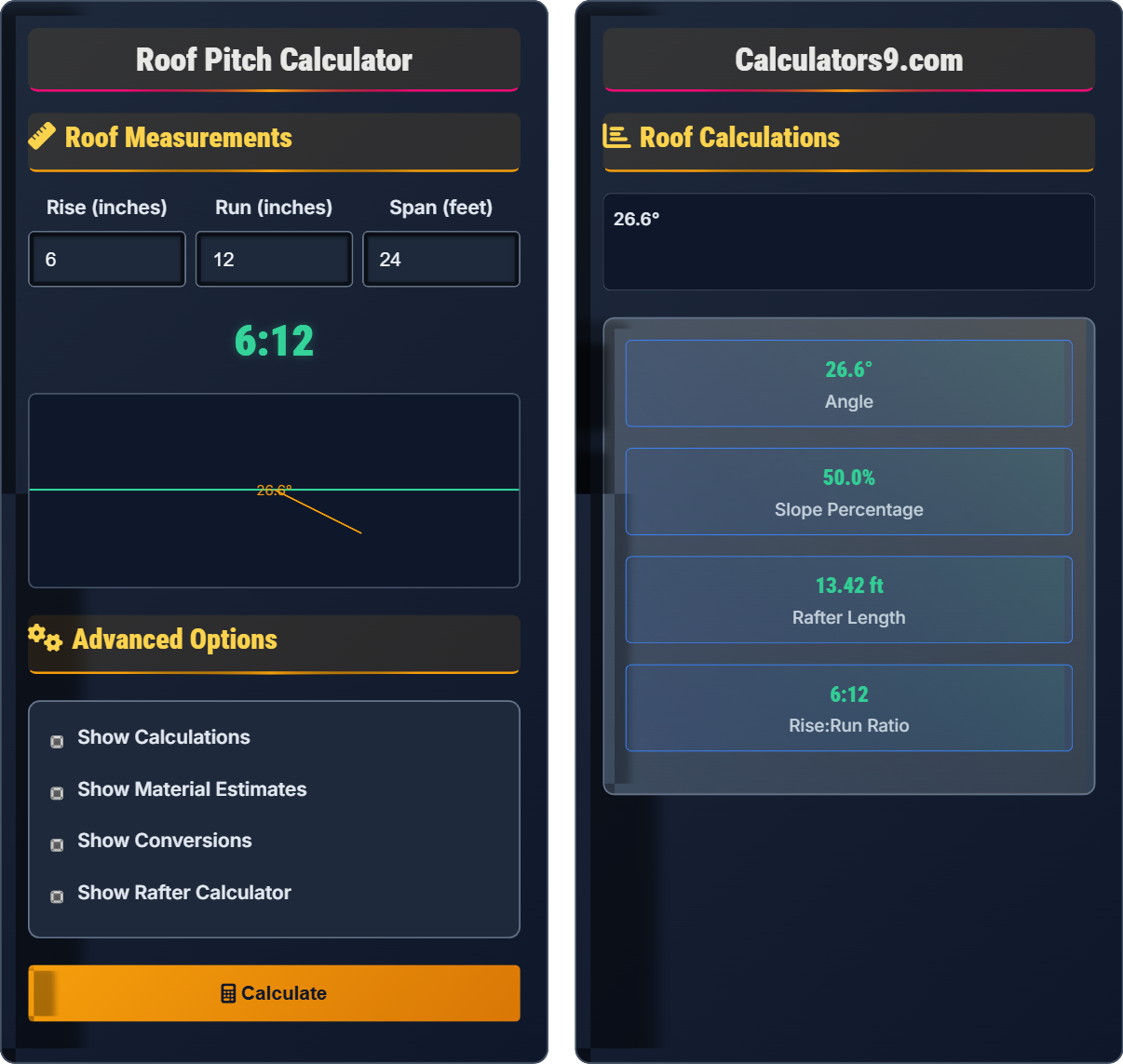
Roof Measurements
Advanced Options
Roof Calculations
Roof Pitch Fundamentals
Roof pitch is the measure of the steepness of a roof, expressed as the ratio of vertical rise to horizontal run, typically in inches per foot. It affects drainage, structural requirements, and material needs.
Pitch Ratio: \( \frac{\text{Rise}}{\text{Run}} \)
Angle: \( \arctan(\frac{\text{Rise}}{\text{Run}}) \times \frac{180}{\pi} \)
Rafter Length: \( \sqrt{\text{Rise}^2 + \text{Run}^2} \)
Slope Percentage: \( \frac{\text{Rise}}{\text{Run}} \times 100 \)
- Standard residential: 4:12 to 12:12
- Minimum for shingles: 2:12
- Steep roofs: 9:12+
- Flat roofs: <2:12
Applications in Construction
Roof pitch calculations are essential for structural design, material estimation, drainage planning, and ensuring code compliance in residential and commercial construction.
- Structural framing
- Material ordering
- Drainage planning
- Cost estimation
- Code compliance
- Local building codes
- Climate factors
- Material limitations
- Structural requirements
Roof Pitch Learning Quiz
What does a 6:12 roof pitch mean?
The answer is C) 6 inches rise in 12 feet of run. Roof pitch is expressed as the vertical rise in inches over a horizontal distance of 12 inches (1 foot). So a 6:12 pitch means the roof rises 6 inches for every 12 inches of horizontal distance.
Roof pitch is always expressed as rise over run with a standard run of 12 inches. This standardized measurement allows builders to compare roof steepness regardless of building size. Understanding this ratio is fundamental to all roof calculations.
Rise: Vertical height of the roof
Run: Horizontal distance (standard: 12 inches)
Pitch: Steepness ratio of roof
• Standard run is always 12 inches
• Pitch = Rise:12
• Higher numbers = steeper roof
• Remember: Pitch = Rise per 12" of run
• 6:12 = 6" rise over 12" run
• Standard residential range: 4:12-12:12
• Confusing inches with feet
• Forgetting the standard 12-inch run
• Mixing up rise and run order
Calculate the angle of a 4:12 roof pitch. Show your work.
Using the angle formula: \( \text{Angle} = \arctan(\frac{\text{Rise}}{\text{Run}}) \times \frac{180}{\pi} \)
Given: Rise = 4 inches, Run = 12 inches
Step 1: Calculate the ratio: \( \frac{4}{12} = 0.333 \)
Step 2: Calculate arctan: \( \arctan(0.333) = 0.322 \) radians
Step 3: Convert to degrees: \( 0.322 \times \frac{180}{\pi} = 18.4° \)
Therefore, a 4:12 roof pitch has an angle of 18.4°.
This calculation demonstrates the relationship between the roof pitch ratio and the actual angle. The arctangent function converts the rise/run ratio to an angle in degrees. This is important for cutting rafters and understanding roof geometry.
Arctangent: Inverse of tangent function
Radians: Angular measurement unit
Roof Angle: Inclination in degrees
• Angle = arctan(Rise/Run) × (180/π)
• Calculator may need degree/radian mode
• Higher pitch = steeper angle
• Use calculator with arctan function
• Remember: 12:12 = 45°
• 6:12 ≈ 26.6° (common reference)
• Forgetting to convert radians to degrees
• Using sine instead of tangent
• Calculation errors with inverse functions
A builder needs to calculate the rafter length for a 6:12 roof with a span of 24 feet. What is the rafter length from the ridge to the eave?
Step 1: Calculate the run (half the span)
Run = 24 ft ÷ 2 = 12 ft
Step 2: Calculate the rise using the pitch ratio
For 6:12 pitch: Rise = Run × (6/12) = 12 × 0.5 = 6 ft
Step 3: Use the Pythagorean theorem to find rafter length
Rafter Length = √(Rise² + Run²) = √(6² + 12²) = √(36 + 144) = √180 = 13.42 ft
Therefore, the rafter length is 13.42 feet.
This problem combines multiple concepts: pitch ratio, roof geometry, and the Pythagorean theorem. The rafter forms the hypotenuse of a right triangle with the rise and run as the other two sides. This calculation is essential for purchasing lumber and cutting rafters.
Rafter: Structural member supporting roof
Span: Total width of building
Run: Horizontal distance from center to edge
• Run = Span ÷ 2
• Rise = Run × (Pitch Ratio)
• Rafter = √(Rise² + Run²)
• Always use half-span for run
• Check with rafter tables
• Add overhang allowance
• Using full span instead of half-span
• Forgetting the Pythagorean theorem
• Not accounting for overhangs
A contractor is estimating materials for a 6:12 roof with a plan area of 1,200 sq ft. The roof factor for 6:12 pitch is 1.12. How many squares of shingles are needed, and what additional materials should be considered?
Step 1: Calculate actual roof area
Actual Area = Plan Area × Roof Factor = 1,200 × 1.12 = 1,344 sq ft
Step 2: Calculate number of squares
1 square = 100 sq ft
Number of squares = 1,344 ÷ 100 = 13.44 squares
Step 3: Add waste factor (typically 10%)
Total squares needed = 13.44 × 1.1 = 14.78 squares ≈ 15 squares
Additional materials: Underlayment, flashing, drip edge, nails, ridge cap shingles.
The roof factor accounts for the increased surface area due to the slope. A flat roof would have a factor of 1.0, but sloped roofs have more surface area than their footprint. Contractors always add waste factor for cuts, overlaps, and mistakes.
Roof Factor: Multiplier for slope compensation
Square: 100 sq ft of roofing material
Plan Area: Footprint of building
• Actual Area = Plan Area × Roof Factor
• Add 10% waste factor
• Always round up for materials
• Keep extra material for repairs
• Check manufacturer specifications
• Consider complex roof features
• Forgetting roof factor
• Not adding waste allowance
• Calculating based on plan area only
What is the minimum roof pitch required for asphalt shingles according to most building codes?
The answer is A) 2:12. Most building codes require a minimum pitch of 2:12 for asphalt shingles. Below this pitch, special roofing systems like built-up roofing or modified bitumen are typically required. Some manufacturers may specify a minimum of 4:12 for certain shingle types.
Building codes specify minimum roof pitches based on the roofing material's ability to shed water effectively. Asphalt shingles can function at low slopes due to their overlapping design, but very low slopes may require special installation techniques or alternative materials.
Building Code: Regulations for construction
Minimum Pitch: Lowest allowed slope
Water Shedding: Ability to drain water
• Minimum 2:12 for asphalt shingles
• Check local codes and manufacturer specs
• Different materials have different requirements
• Always verify local building codes
• Check manufacturer installation guides
• Consider climate factors
• Installing shingles on too-low pitch
• Not checking local code variations
• Ignoring manufacturer requirements
FAQ
Q: What's the difference between roof pitch and roof slope?
A: Roof pitch and slope are related but different measurements:
Pitch: The ratio of rise to span (horizontal distance from eave to ridge), expressed as a fraction or ratio (e.g., 6:12).
Slope: The incline of the roof expressed as a percentage or angle (degrees).
For example, a 6:12 pitch roof has a 50% slope and a 26.6° angle. The terms are sometimes used interchangeably in casual conversation, but they have distinct technical meanings.
Q: How do I measure my roof pitch safely?
A: The safest way to measure roof pitch is from inside the attic:
1. Measure the horizontal distance (run) from a rafter mark to the center of the house (typically 12 inches)
2. Measure the vertical height (rise) from that point straight up to the rafter peak
3. Express as rise:12 (e.g., 6 inches rise over 12 inches run = 6:12)
Alternatively, use a pitch gauge on an accessible rake board or gable end. Never climb onto a steep roof without proper safety equipment.