Baking Conversion Calculator
Convert measurements for baking • 2026 edition
Baking Conversion Formulas:
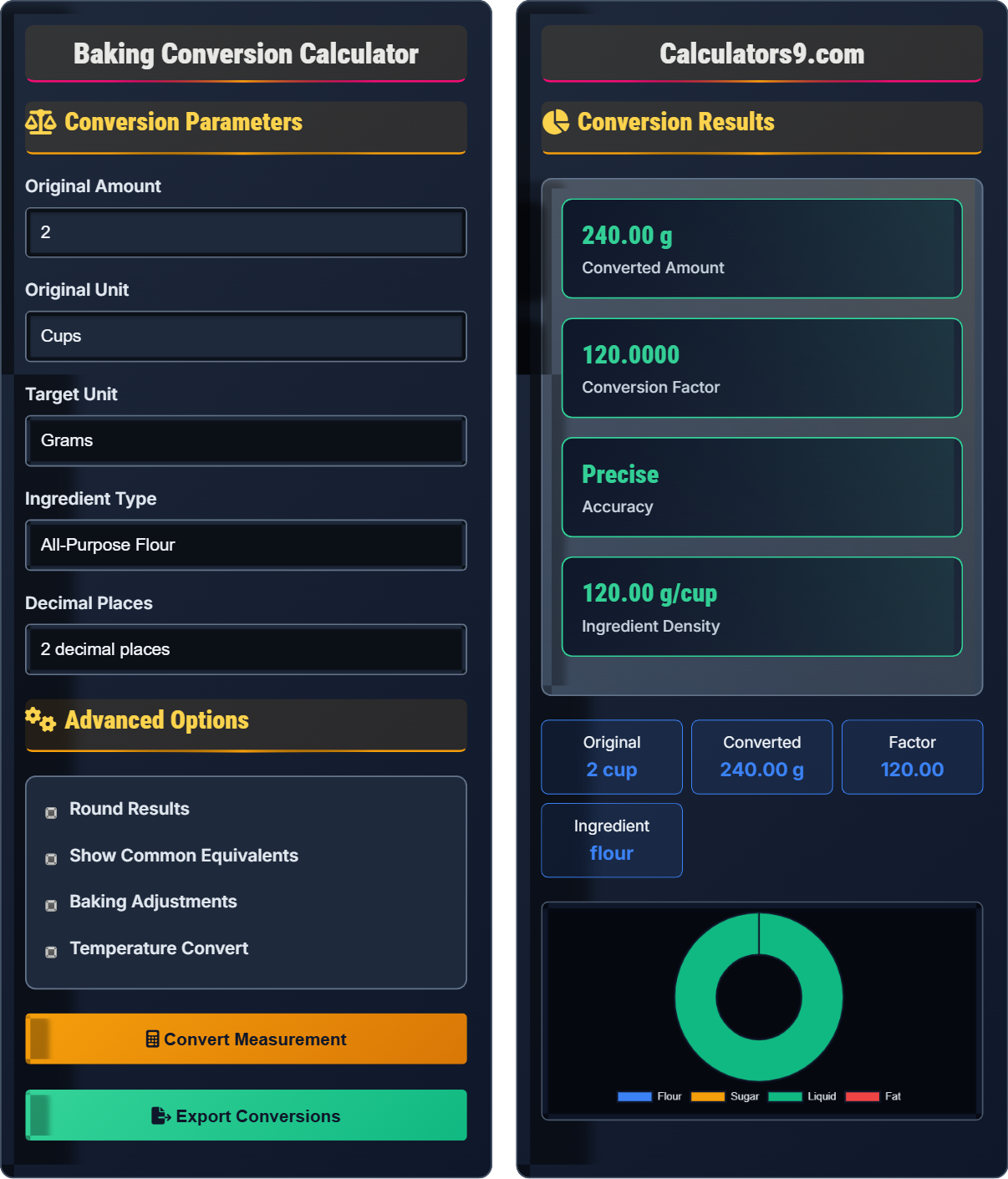
Show the calculator\( \text{Converted Amount} = \text{Original Amount} \times \text{Conversion Factor} \)
Common conversion factors:
- \( \text{Cups to Grams:} \) All-purpose flour: 1 cup = 120g
- \( \text{Cups to Milliliters:} \) 1 cup = 240ml
- \( \text{Ounces to Grams:} \) 1 oz = 28.35g
- \( \text{Pounds to Kilograms:} \) 1 lb = 0.45kg
- \( \text{Teaspoons to Milliliters:} \) 1 tsp = 5ml
These formulas help convert between different measurement systems commonly used in baking.
Example: Converting 2 cups of flour to grams:
Grams: \( 2 \times 120 = 240 \) grams
Thus, 240 grams of flour equals 2 cups.
Conversion Parameters
Advanced Options
Conversion Results
- 1 cup all-purpose flour = 120g
- 1 cup bread flour = 125g
- 1 cup cake flour = 115g
- 1 cup whole wheat flour = 130g
- Use weight measurements for precision
- Flour density varies by type
- Compacting affects volume
- Temperature affects volume
- Humidity affects flour weight
- Spoon flour into cup, don't pack
- Level with straight edge
- Use liquid measuring cups for liquids
- Use dry measuring cups for solids
- Tap to settle before leveling
Baking Conversion Guide
Weight measurements (grams, ounces) are more accurate than volume measurements (cups, tablespoons) for baking ingredients. Weight remains consistent regardless of packing or settling.
Conversion Factor = Target Unit Value ÷ Original Unit Value. Multiply original amount by conversion factor to get target amount. Use ingredient-specific densities for weight conversions.
- Use weight for precision
- Consider ingredient density
- Account for packing differences
- Verify critical conversions
Conversion Tables
Volume: 1 cup = 16 tbsp = 48 tsp = 8 oz = 240 ml. Weight: 1 lb = 16 oz = 454 g. Temperature: °C = (°F - 32) × 5/9.
- Dry ingredients: Use weight when possible
- Liquid ingredients: Volume is acceptable
- Leavening agents: Use precise measurements
- Spices: Use weight for consistency
- Humidity affects flour weight
- Altitude affects baking
- Ingredient temperature matters
- Equipment calibration important
Baking Conversion Quiz
How many grams are in 1 cup of all-purpose flour?
The answer is B) 120g. Standard all-purpose flour weighs approximately 120 grams per cup when measured using the spoon-and-level method. This is a fundamental baking conversion that ensures consistent results.
The weight of flour per cup is critical for baking success. Different measurement techniques (packing vs. spoon-and-level) can result in significant weight differences. The standard 120g per cup is based on the spoon-and-level method, which is the most reliable for consistent results.
Spoon-and-Level: Method of measuring flour by spooning into cup and leveling off
Weight Measurement: Using a scale to measure mass
Volume Measurement: Using measuring cups for space occupied
• 1 cup AP flour = 120g
• Use consistent measuring method
• Weight is more accurate than volume
• Use a kitchen scale for precision
• Spoon flour into cup, don't scoop
• Level with straight edge
• Scooping flour directly from bag
• Packing flour into measuring cup
• Using volume for critical ingredients
Convert 3 cups of all-purpose flour to grams. Show your work and explain why this conversion is important in baking.
Step 1: Identify the conversion factor
1 cup all-purpose flour = 120 grams (standard measurement)
Step 2: Apply the conversion formula
Converted amount = Original amount × Conversion factor
Converted amount = 3 cups × 120g/cup = 360 grams
Step 3: Verification
360g ÷ 120g/cup = 3 cups ✓
Step 4: Importance in baking
This conversion is crucial because flour weight can vary significantly based on measurement technique. Using weight ensures consistency and reproducible results in baking.
Therefore, 3 cups of all-purpose flour equals 360 grams.
This conversion demonstrates the importance of standardized measurements in baking. Volume measurements can vary by 20-30% depending on how flour is measured, while weight measurements remain consistent. This consistency is essential for chemical reactions in baking.
Conversion Factor: Ratio used to convert between units
Standard Measurement: Widely accepted reference value
Consistency: Repeatability of results
• Formula: Amount × Factor = Converted amount
• Verify calculations
• Use standard references
• Keep conversion chart handy
• Use kitchen scale for accuracy
• Verify critical measurements
• Using incorrect conversion factors
• Not accounting for ingredient density
• Forgetting to verify calculations
Sarah needs to convert 2.5 cups of milk to milliliters for a recipe. She also wants to know how many fluid ounces this equals. Calculate both conversions and explain why liquid measurements are more consistent than dry measurements.
Step 1: Convert cups to milliliters
1 cup = 240 milliliters (standard conversion)
2.5 cups × 240 ml/cup = 600 milliliters
Step 2: Convert cups to fluid ounces
1 cup = 8 fluid ounces
2.5 cups × 8 fl oz/cup = 20 fluid ounces
Step 3: Verify conversions
600 ml ÷ 240 ml/cup = 2.5 cups ✓
20 fl oz ÷ 8 fl oz/cup = 2.5 cups ✓
Step 4: Explanation of consistency
Liquid measurements are more consistent because liquids maintain their volume regardless of how they're poured or settled. Dry ingredients like flour can be compacted or aerated, affecting volume measurements significantly.
Therefore, 2.5 cups of milk equals 600 milliliters or 20 fluid ounces.
This problem demonstrates liquid conversion consistency. Liquids have a fixed volume that doesn't change with handling, unlike dry ingredients that can be compressed or aerated. This makes volume measurements more reliable for liquids than for dry ingredients.
Liquid Volume: Fixed space occupied by liquid
Density: Mass per unit volume
Consistency: Reproducibility of measurements
• Liquids: Volume measurements are reliable
• Solids: Weight measurements preferred
• Always verify calculations
• Use liquid measuring cups for liquids
• Use dry measuring cups for solids
• Read liquid measurements at eye level
• Using dry cups for liquids
• Not reading at eye level
• Confusing liquid and dry ounces
Mike found a European recipe that calls for baking at 180°C, but his oven is calibrated in Fahrenheit. Convert this temperature and explain how temperature conversion affects baking outcomes.
Step 1: Apply the temperature conversion formula
°F = (°C × 9/5) + 32
°F = (180 × 9/5) + 32
°F = (324) + 32 = 356°F
Step 2: Round to standard oven temperature
356°F rounds to 350°F or 360°F
Step 3: Alternative conversion formula
°C = (°F - 32) × 5/9
Verification: (356 - 32) × 5/9 = 180°C ✓
Step 4: Effect on baking outcomes
Temperature affects protein coagulation, starch gelatinization, and Maillard reactions. Even 10-15°F differences can affect texture, browning, and doneness. Precise temperature control is essential for successful baking.
Therefore, 180°C equals approximately 356°F (use 350°F setting).
Temperature conversion is critical in baking because chemical reactions occur at specific temperatures. The Maillard reaction, caramelization, and protein denaturation all depend on reaching the correct temperature. Even small differences can dramatically affect the final product.
Maillard Reaction: Browning reaction between amino acids and sugars
Protein Denaturation: Unfolding of protein structure
Starch Gelatinization: Absorption of water by starch granules
• °F = (°C × 9/5) + 32
• °C = (°F - 32) × 5/9
• Temperature affects chemistry
• Use oven thermometer for accuracy
• Allow preheating time
• Adjust time if temperature differs
• Using incorrect conversion formula
• Not accounting for oven accuracy
• Ignoring temperature effects on chemistry
Which ingredient has the highest density (weight per cup) among these common baking ingredients?
The answer is D) Butter (227g/cup). Butter has the highest density among these common baking ingredients, weighing approximately 227 grams per cup. This is because butter is a fat with a dense molecular structure, while flour and sugar have more air space between particles.
Ingredient density varies significantly based on molecular structure and particle size. Fats like butter are denser than granulated substances like flour or sugar. Understanding these differences is crucial for accurate conversions and successful baking outcomes.
Density: Mass per unit volume
Molecular Structure: Arrangement of atoms/molecules
Particle Size: Physical dimensions of substance
• Different ingredients have different densities
• Fat is denser than granulated ingredients
• Always use ingredient-specific conversions
• Keep ingredient density chart
• Use weight for dense ingredients
• Pack brown sugar when measuring
• Using same conversion for all ingredients
• Not accounting for density differences
• Packing flour like sugar
FAQ
Q: Why is weight more accurate than volume for baking ingredients?
A: Weight is more accurate because:
- Consistency: Same amount every time
- No packing: Independent of how ingredient is handled
- Humidity: Unaffected by moisture content
- Density: Accounts for ingredient-specific variations
Volume measurements can vary by 20-30% depending on how ingredients are packed or settled.
Q: How do I properly measure flour for accurate conversions?
A: Proper flour measuring technique:
- Fluff: Stir flour in container to aerate
- Scoop: Use dry measuring cup, spoon flour in
- Level: Use straight edge to level off
- Don't pack: Never shake or compress
This method ensures consistent 120g per cup measurement.