Brine Calculator
Fast brining calculator • 2026 standards
Brine Calculation Formula:
Show the calculator\( Salt (g) = W \times R_s \)
\( Sugar (g) = W \times R_s \)
Where:
- \( W \) = Weight of protein (kg)
- \( R_s \) = Salt ratio (typically 0.05-0.10 for 5-10%)
- \( R_g \) = Sugar ratio (typically 0.02-0.05 for 2-5%)
Standard brine concentrations:
- Mild brine: 5-6% salt (50-60g per kg protein)
- Standard brine: 6-8% salt (60-80g per kg protein)
- Strong brine: 8-10% salt (80-100g per kg protein)
This formula calculates the amount of salt and sugar needed for a brine based on the weight of protein being brined. The salt draws moisture out initially, then reabsorbs it along with flavors, resulting in juicier meat.
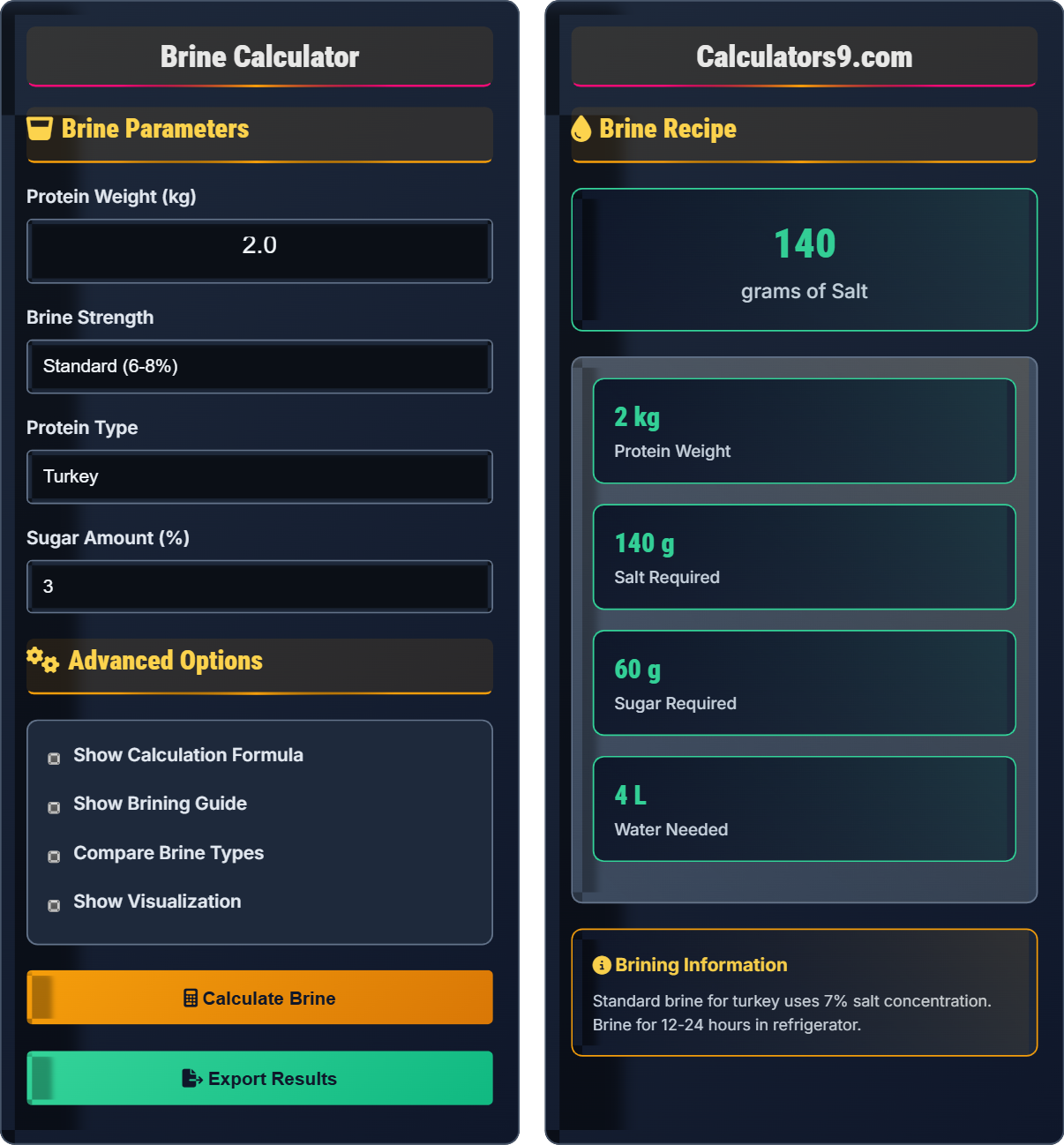
Example: For a 2kg turkey with standard 7% brine:
Salt needed = 2kg × 0.07 = 0.14kg = 140g salt
Sugar needed = 2kg × 0.03 = 0.06kg = 60g sugar
Therefore, for 2kg turkey, use 140g salt and 60g sugar in sufficient water to cover.
Brine Parameters
Advanced Options
Brine Recipe
| Strength | Salt % | Sugar % | Use Case |
|---|
| Protein | Weight | Time | Notes |
|---|
Brining Guide & Kitchen Tools
Brining works through osmosis and diffusion. Salt denatures proteins, allowing them to hold more moisture. The salt and sugar solution penetrates the meat, seasoning it throughout and improving tenderness. Standard brine uses 6-8% salt concentration.
The standard brine calculation formula is:
Where:
- \(Salt (g)\) = Grams of salt needed
- \(W\) = Weight of protein in kilograms
- \(R_s\) = Salt ratio (percentage as decimal)
Sugar follows same formula: \(Sugar (g) = W \times R_g\)
Recommended brining durations for optimal results:
- Chicken breasts: 2-4 hours
- Whole chicken: 4-12 hours
- Turkey: 12-24 hours
- Pork chops: 4-12 hours
- Fish fillets: 30 minutes to 2 hours
- Beef: 6-24 hours depending on cut
- Use kosher or sea salt: Avoid iodized salt which can impart off-flavors
- Temperature control: Keep brine at safe temperatures (below 40°F)
- Don't over-brine: Excessive time can make meat mushy
- Add aromatics: Herbs, spices, and citrus enhance flavor
- Double brining: Never brine twice - meat holds maximum moisture
Brining Basics
Soaking protein in salt solution to improve moisture retention and flavor.
\(Salt (g) = W \times R_s\)
Where W=protein weight, Rs=salt ratio.
- Standard: 6-8% salt
- Sugar: 2-5% of weight
- Water: 2L per kg protein
Brining Applications
Different proteins require different brining approaches and times.
- Chicken: 4-12 hours
- Turkey: 12-24 hours
- Fish: 30 min-2 hours
- Pork: 6-12 hours
- Smaller proteins need less time
- Stronger brines need less time
- Always refrigerate during brining
- Pat dry before cooking
Brining Knowledge Quiz
What is the recommended salt concentration for a standard brine?
The answer is B) 6-8% salt. This concentration provides optimal moisture retention and flavor enhancement without making the meat overly salty. Below 5% is considered mild, while above 10% is considered strong and may require shorter brining times.
The 6-8% range is considered standard because it achieves the desired effects of brining without negative consequences. At this concentration, salt effectively denatures proteins to allow moisture retention while not overwhelming the flavor. This concentration works well for most proteins including poultry, pork, and fish.
Brine Concentration: Percentage of salt by weight in the brine solution
Protein Denaturation: Structural change allowing better moisture retention
Moisture Retention: Ability of meat to hold water during cooking
• Standard brine: 6-8% salt
• Mild brine: 5-6% salt
• Strong brine: 8-10% salt
• 1% = 10g salt per liter of water
• Use kitchen scale for accuracy
• Dissolve salt completely before cooling
• Using too high concentration
• Not dissolving salt completely
• Measuring by volume instead of weight
How much salt would you need to make a standard 7% brine for 3kg of turkey? Show your work.
Using the formula: Salt (g) = W × R_s
Step 1: Identify values
- W = 3kg (weight of turkey)
- R_s = 0.07 (7% as decimal)
Step 2: Apply formula
Salt (g) = 3kg × 0.07 = 0.21kg
Step 3: Convert to grams
0.21kg × 1000g/kg = 210g salt
Therefore, you need 210g of salt for a 7% brine for 3kg of turkey.
This calculation demonstrates the direct proportionality between protein weight and salt requirement. The formula Salt (g) = W × R_s shows that doubling the protein weight doubles the salt needed for the same concentration. This linear relationship is fundamental to proper brining.
Linear Relationship: Direct proportion between two variables
Weight-Based Calculation: Using mass rather than volume for accuracyDecimal Conversion: Converting percentage to decimal for calculations
• Convert percentage to decimal (7% = 0.07)
• Use consistent units (kg for weight)
• Final answer in grams for kitchen use
• Remember: 1% = 10g per liter of water
• Always use kitchen scale for salt measurement
• Round to practical measurements
• Forgetting to convert percentage to decimal
• Using inconsistent units
• Not converting final result to grams
You want to brine 1.5kg of salmon with a 5% brine solution. How much salt and sugar (using 3% sugar) would you need? How much water should you use if the standard is 2 liters per kg of protein?
Step 1: Calculate salt needed
Salt = 1.5kg × 0.05 = 0.075kg = 75g salt
Step 2: Calculate sugar needed
Sugar = 1.5kg × 0.03 = 0.045kg = 45g sugar
Step 3: Calculate water needed
Water = 1.5kg × 2L/kg = 3L water
Therefore, for 1.5kg salmon with 5% brine and 3% sugar:
- 75g salt
- 45g sugar
- 3L water
This problem demonstrates multiple calculations in sequence. Each component (salt, sugar, water) uses the same basic formula but with different ratios. For fish, milder brines (5%) are often preferred to avoid overpowering the delicate flavor. The water calculation uses a different standard ratio (2L/kg).
Sequential Calculations: Multiple related calculations in order
Component Ratios: Different percentages for salt vs sugar
Volume-to-Weight Ratio: Water amount per unit of protein weight
• Calculate each component separately
• Use appropriate ratios for protein type
• Fish often requires milder brines
• Fish: Use 5% or less for delicate flavors
• Poultry: 6-8% is standard
• Red meat: 8-10% for stronger flavors
• Using same ratios for all protein types
• Forgetting to calculate water amount
• Not considering protein delicacy
You're preparing to brine a 5kg turkey for Thanksgiving. You've made a 7% brine solution. What safety precautions must you take during the brining process, and why is temperature control critical?
Safety precautions for brining a 5kg turkey:
Temperature Control:
- Keep brine temperature below 40°F (4°C) at all times
- Refrigerate during entire brining process
- Use ice packs if refrigerator isn't cold enough
Why temperature is critical:
The Danger Zone for bacterial growth is 40-140°F (4-60°C). At these temperatures, bacteria multiply rapidly, potentially causing foodborne illness. The salt in brine doesn't eliminate this risk; it only enhances flavor and texture.
Additional safety measures:
- Sanitize all containers and utensils
- Use food-safe containers
- Don't reuse brine after contact with raw meat
- Pat turkey dry before cooking to ensure proper browning
Temperature control is paramount in food safety. The salt concentration in brine, while preserving in some contexts, does not prevent bacterial growth at unsafe temperatures. Large proteins like a 5kg turkey require special attention because they take longer to cool, potentially spending more time in the danger zone.
Danger Zone: Temperature range where bacteria multiply rapidly
Food Safety: Preventing contamination and bacterial growth
Temperature Control: Maintaining safe food temperatures
• Keep brine below 40°F (4°C)
• Never leave at room temperature
• Use food-safe containers
• Use large container that fits in refrigerator
• Consider thawing turkey in brine solution
• Monitor temperature with thermometer
• Brining at room temperature
• Using non-food-safe containers
• Reusing brine after contact with raw meat
What is the primary mechanism by which brining improves meat texture and moisture retention?
The answer is B) Salt denatures proteins, allowing water binding. Salt molecules interact with protein structures, causing them to unwind (denature). This creates spaces where water molecules can bind, increasing the meat's ability to hold moisture during cooking. The process also seasons the meat throughout, not just on the surface.
The science of brining involves molecular interactions between salt, proteins, and water. Salt ions disrupt protein bonds, causing structural changes that create more space for water molecules to bind. This is different from marination, which primarily affects surface layers. The denaturation is partial and doesn't cook the protein.
Protein Denaturation: Structural change without breaking peptide bonds
Water Binding Capacity: Ability of proteins to hold water
Osmosis: Movement of water across membrane barriers
• Salt denatures proteins for water retention
• Effects penetrate throughout the meat
• Does not fully cook the protein
• Effects are most noticeable in lean meats
• Works better with larger cuts
• Pat dry before cooking for better browning
• Thinking brining cooks the meat
• Believing it only affects surface
• Not understanding the science behind it
FAQ
Q: Can I reuse brine after brining a turkey?
A: No, you should never reuse brine that has been in contact with raw meat due to food safety concerns. Once brine contacts raw poultry, it can harbor harmful bacteria like Salmonella and Campylobacter.
The formula for safe brining is: \(Brine + Raw\ Meat \rightarrow Contaminated\ Solution\), which cannot be safely reused. The salt concentration in brine does not eliminate pathogenic bacteria.
However, you can make a fresh batch of the same brine recipe for future use. Some people do pasteurize used brine by bringing it to a rolling boil for several minutes, then cooling quickly, but this is not recommended for beginners due to the risk of improper sterilization.
Always prepare fresh brine for each use to ensure food safety.
Q: How do I know if I've brined too long?
A: Signs of over-brining include:
- Mushy texture: Excessive salt breaks down protein structure
- Excessively salty taste: Penetrates throughout the meat
- Soft skin: Particularly noticeable in poultry
- Gummy appearance: Surface proteins become over-denatured
The brining time formula is: \(T_{max} = T_{optimal} + 25\%\), beyond which quality deteriorates. For example, if optimal time for a cut is 12 hours, don't exceed 15 hours.
Over-brining occurs because prolonged salt exposure continues the denaturing process beyond the optimal point. The salt-water equilibrium shifts too far toward water absorption, disrupting protein structure.
Always follow recommended times: poultry (4-24 hours), fish (30min-2 hours), red meat (6-24 hours).