Calories per Serving Calculator
Fast nutrition tracking • 2026 standards
Calories per Serving Formula:
Show the calculator\( CPS = \frac{\sum_{i=1}^{n} (Q_i \times C_i)}{S} \)
Where:
- \( CPS \) = Calories per serving
- \( Q_i \) = Quantity of ingredient i
- \( C_i \) = Calories per unit of ingredient i
- \( n \) = Total number of ingredients
- \( S \) = Number of servings
Macronutrient calculations:
- Protein: 4 cal/g
- Carbohydrates: 4 cal/g
- Fat: 9 cal/g
This formula calculates the total calories of all ingredients in a recipe, then divides by the number of servings to determine calories per serving.
Example: For a recipe with 3 ingredients:
- Ingredient 1: 2 cups at 120 cal/cup = 240 cal
- Ingredient 2: 1 lb at 500 cal/lb = 500 cal
- Ingredient 3: 0.5 tsp at 20 cal/tsp = 10 cal
Total calories: \( TC = 240 + 500 + 10 = 750 \) cal
If the recipe serves 4 people: \( CPS = \frac{750}{4} = 187.5 \) cal per serving
Thus, the recipe has 750 total calories and 187.5 calories per serving.
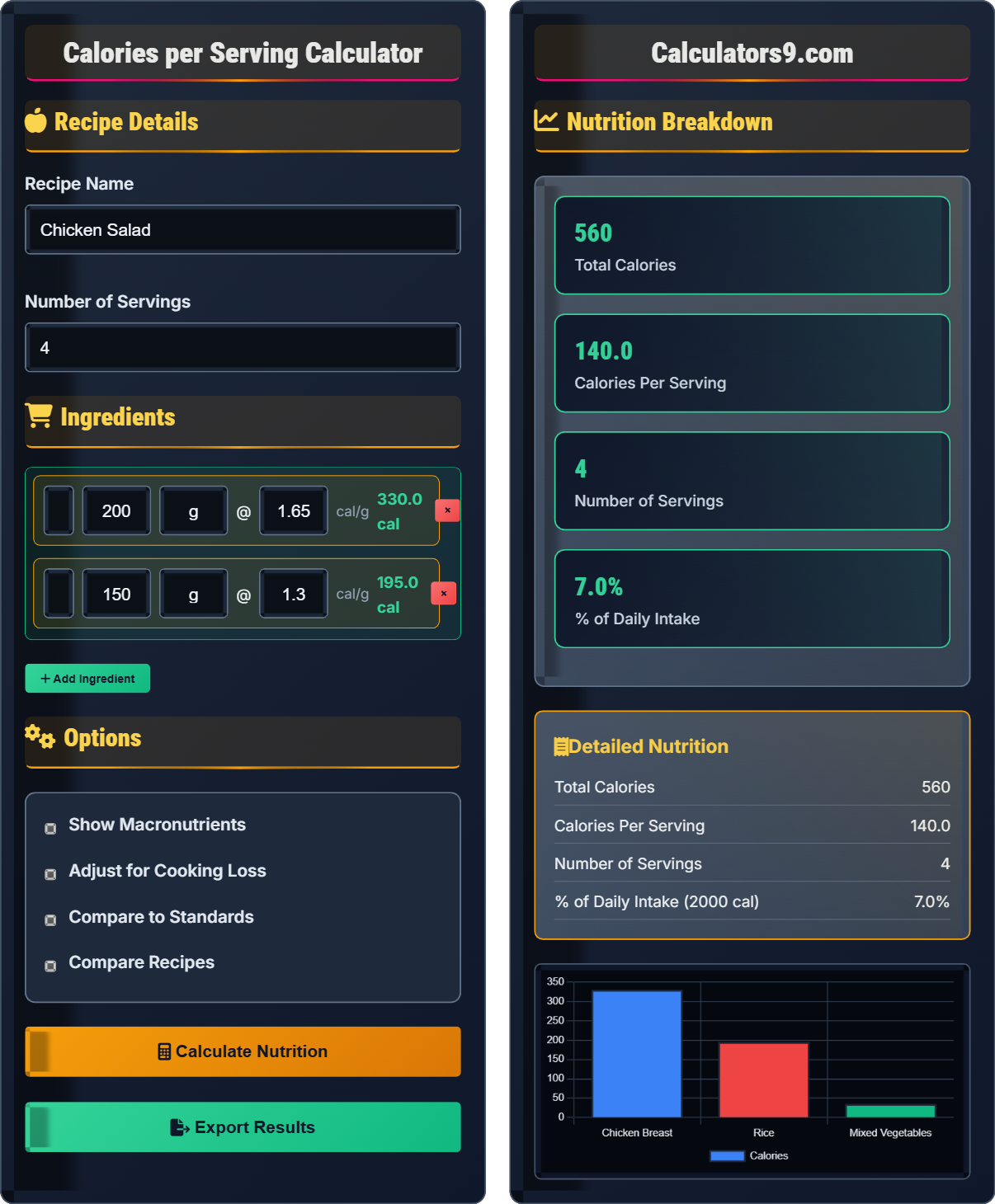
Recipe Details
Ingredients
Options
Nutrition Breakdown
| Ingredient | Qty | Unit | Cal/Unit | Calories |
|---|
| Nutrient | Amount | % of Serving |
|---|
Nutrition & Kitchen Tools Guide
Accurate nutrition tracking requires knowledge of macronutrient values. Protein and carbohydrates contain 4 calories per gram, while fat contains 9 calories per gram. Alcohol contains 7 calories per gram. These values are standardized and form the basis of all nutrition calculations.
The standard calories per serving calculation uses the following formula:
Where:
- \(CPS\) = Calories per serving
- \(Q_i\) = Quantity of ingredient i
- \(C_i\) = Calories per unit of ingredient i
- \(n\) = Total number of ingredients
- \(S\) = Number of servings
Macronutrient conversions: Protein = 4 cal/g, Carbs = 4 cal/g, Fat = 9 cal/g
Based on a 2000-calorie diet, recommended daily intakes are:
- Protein: 50-175g (10-35% of calories)
- Carbohydrates: 225-325g (45-65% of calories)
- Fat: 44-78g (20-35% of calories)
- Fiber: 25-35g
- Sodium: Less than 2,300mg
- Batch cook: Prepare multiple servings at once to streamline tracking
- Create templates: Save commonly prepared recipes for quick reference
- Use kitchen tools: Digital scales and measuring devices improve accuracy
- Plan meals: Schedule meals in advance to avoid impulsive eating
- Read labels: Verify nutrition facts on packaged foods
Nutrition Basics
Tracking the energy content of food consumed to manage dietary intake.
\(CPS = \frac{\sum_{i=1}^{n} (Q_i \times C_i)}{S}\)
Where CPS=calories per serving, Q=quantity, C=calories per unit, S=servings.
- Protein = 4 cal/g
- Carbs = 4 cal/g
- Fat = 9 cal/g
Macronutrients
Optimal ratios for health and performance.
- Carbohydrates: 45-65% of calories
- Protein: 10-35% of calories
- Fat: 20-35% of calories
- Individual needs vary
- Activity level affects requirements
- Health conditions matter
- Age impacts metabolism
Nutrition Learning Quiz
How many calories per gram does each macronutrient provide?
The answer is A) Protein: 4, Carbs: 4, Fat: 9. These values are standardized by the FDA and other health organizations. Protein and carbohydrates each provide 4 calories per gram, while fat provides 9 calories per gram. Alcohol, though not a macronutrient, provides 7 calories per gram.
Memorizing these values is fundamental to nutrition calculations. The higher caloric density of fats explains why fatty foods are more calorie-dense than protein or carbohydrate-rich foods. Understanding these values allows for accurate calculations of recipe nutrition and helps in making informed dietary choices.
Caloric Density: Amount of energy per unit weight of food
Macronutrients: Nutrients required in large amounts (proteins, carbs, fats)
Kilocalorie (kcal): Unit of energy equal to 1000 calories
• Protein = 4 cal/g
• Carbohydrates = 4 cal/g
• Fat = 9 cal/g
• Remember: Fat has more than double the calories of protein/carbs
• Use the 4-4-9 rule for quick mental calculations
• High-fat foods are calorie-dense
• Confusing the caloric values of macronutrients
• Forgetting that alcohol also provides calories
• Misapplying values when calculating nutrition
Calculate the total calories and calories per serving for a smoothie recipe containing: 1 banana (120 cal), 1 cup milk (150 cal), 2 tbsp peanut butter (190 cal), and 1 cup spinach (7 cal). The recipe serves 2 people. Show your work.
Step 1: Calculate individual ingredient calories
- Banana: 1 × 120 cal = 120 cal
- Milk: 1 cup × 150 cal/cup = 150 cal
- Peanut butter: 2 tbsp × 95 cal/tbsp = 190 cal
- Spinach: 1 cup × 7 cal/cup = 7 cal
Step 2: Calculate total calories
Total calories = 120 + 150 + 190 + 7 = 467 cal
Step 3: Calculate calories per serving
Calories per serving = 467 cal ÷ 2 servings = 233.5 cal per serving
Therefore, the total calories are 467 and calories per serving are 233.5.
This problem demonstrates the additive nature of calorie calculations. Each ingredient contributes its individual calories to the total. The division by servings shows how batch preparation affects per-serving values. Note how the calorie-dense peanut butter contributes nearly 40% of the total calories despite being a small volume.
Total Calories: Sum of calories from all ingredients
Calories per Serving: Total calories divided by number of servings
Calorie-Dense: Foods with high calories relative to volume/weight
• Sum all ingredient calories for total
• Divide total by servings for per-serving value
• Use consistent units for accurate calculations
• Identify high-calorie ingredients first
• Round to nearest whole number for simplicity
• Track calories per volume for recipe planning
• Forgetting to convert measurements to consistent units
• Adding serving counts instead of dividing for per-serving calories
• Miscounting the number of servings
A serving of trail mix contains 8g protein, 25g carbohydrates, and 12g fat. How many total calories does this serving contain? What percentage of calories comes from fat?
Step 1: Calculate calories from each macronutrient
- Protein: 8g × 4 cal/g = 32 cal
- Carbs: 25g × 4 cal/g = 100 cal
- Fat: 12g × 9 cal/g = 108 cal
Step 2: Calculate total calories
Total calories = 32 + 100 + 108 = 240 cal
Step 3: Calculate percentage from fat
% calories from fat = (108 ÷ 240) × 100 = 45%
Therefore, the serving contains 240 total calories with 45% coming from fat.
This example demonstrates how to calculate total calories from known macronutrient amounts. The higher caloric density of fat (9 cal/g vs 4 cal/g for protein and carbs) means that even moderate amounts of fat can contribute significantly to total calories. In this case, fat provides 45% of calories despite contributing only 12g out of 45g total macronutrients.
Caloric Contribution: Percentage of total calories from each macronutrient
Macronutrient Ratio: Proportional distribution of protein, carbs, and fat
Energy Density: Calories per gram of food
• Protein: 4 cal/g
• Carbs: 4 cal/g
• Fat: 9 cal/g
• Percentage = (part ÷ whole) × 100
• Calculate each macronutrient separately first
• Double-check that parts add up to whole
• Fat has more than double the calories of protein/carbs
• Using wrong caloric values for macronutrients
• Forgetting to multiply by 9 for fat calories
• Dividing instead of multiplying for percentage calculations
You're preparing 500g of raw chicken breast (165 cal/100g) for a recipe. During cooking, 15% of the weight is lost to moisture and fat. If the final dish serves 4 people, how many calories per serving does the chicken contribute after cooking loss?
Step 1: Calculate calories in raw chicken
Raw calories = 500g × (165 cal/100g) = 825 cal
Step 2: Calculate post-cooking weight
Post-cook weight = 500g × (1 - 0.15) = 500g × 0.85 = 425g
Step 3: Calculate calories per serving
Calories per serving = 825 cal ÷ 4 servings = 206.25 cal per serving
Note: Cooking loss affects weight but not calories (energy is conserved). Therefore, the chicken still contributes 206.25 calories per serving.
This demonstrates an important principle: cooking loss typically affects weight/volume but not calories. When food loses moisture during cooking, the total caloric content remains the same, but it's concentrated in a smaller mass. This means calories per gram increase, but total calories remain constant. For nutrition calculations, we track the original caloric content.
Cooking Loss: Reduction in food weight during preparation
Energy Conservation: Calories remain constant during cooking
Concentration Effect: Calories per unit weight increases with moisture loss
• Cooking typically doesn't change total calories
• Weight loss concentrates calories in smaller mass
• Track original caloric content for accuracy
• Weigh ingredients before cooking for accurate calculations
• Account for added fats during cooking
• Consider absorption of cooking liquids
• Adjusting calorie content for cooking weight loss
• Forgetting to account for added oils/butters
• Misunderstanding energy conservation in cooking
According to dietary guidelines, what percentage of daily calories should come from carbohydrates for a healthy adult?
The answer is C) 45-65%. According to the Dietary Guidelines for Americans, carbohydrates should comprise 45-65% of total daily calories for healthy adults. Protein should be 10-35% and fat should be 20-35% of total calories. These ranges allow for individual variation based on activity level, health status, and personal preferences.
These ranges represent evidence-based recommendations for macronutrient distribution. The wide ranges accommodate different dietary approaches and individual needs. Carbohydrates are emphasized as the primary fuel source for the brain and muscles, which is why they have the highest recommended percentage. These guidelines help ensure adequate nutrition while allowing flexibility in dietary choices.
Dietary Guidelines: Evidence-based recommendations for healthy eating
Macronutrient Distribution: Percentage of calories from each macronutrient
Acceptable Macronutrient Distribution Range (AMDR): Recommended ranges for optimal health
• Carbs: 45-65% of calories
• Protein: 10-35% of calories
• Fat: 20-35% of calories
• Use the 40-30-30 rule as a starting point (carbs-protein-fat)
• Adjust based on activity level and health goals
• Focus on quality of each macronutrient
• Following extreme diets outside AMDR ranges
• Eliminating entire macronutrient groups
• Not considering individual metabolic differences
FAQ
Q: How accurate are calories per serving calculations when cooking from scratch?
A: Calories per serving calculations for homemade food can be quite accurate when done properly, typically within 5-10% of actual values. Accuracy depends on:
- Precise measurements: Use digital scales (grams) for best accuracy
- Reliable ingredient data: Use USDA food composition database values
- Proper cooking adjustments: Account for moisture loss/gain
- Consistent portioning: Use measuring tools when plating
Example calculation accuracy: For a recipe with 5 ingredients totaling 600 calories, if each measurement has ±5% uncertainty, the total uncertainty is approximately ±11.2% (square root of sum of squares: √(5² + 5² + 5² + 5² + 5²)).
For critical applications like medical nutrition therapy, laboratory analysis would be needed, but for general purposes, careful calculation provides sufficient accuracy.
Q: What's the best approach for calculating nutrition of mixed dishes with multiple components?
A: For mixed dishes, the most accurate approach is to calculate nutrition for each component separately:
- Disaggregate complex ingredients: Break down sauces, spice blends, and composite ingredients
- Measure by weight: 1 cup flour ≠ 1 cup sugar in weight or calories
- Account for cooking changes: Meat loses ~20-25% weight when cooked, but calories remain constant
- Track additions: Include oils, butter, and seasonings in calculations
Example: A stir-fry with 200g chicken (165 cal/100g), 150g vegetables (30 cal/100g), 100g rice (130 cal/100g), and 10g oil (800 cal/100g) would have:
- Chicken: 200g × 1.65 = 330 cal
- Vegetables: 150g × 0.30 = 45 cal
- Rice: 100g × 1.30 = 130 cal
- Oil: 10g × 8.00 = 80 cal
- Total: 585 cal for the dish
This component-by-component method ensures accuracy and identifies major calorie contributors.