Oven Temperature Converter
Fast heat conversion • 2026 standards
Temperature Conversion Formulas:
Show the calculator\( °F = (°C \times \frac{9}{5}) + 32 \)
\( °C = (°F - 32) \times \frac{5}{9} \)
Where:
- \( °F \) = Temperature in Fahrenheit
- \( °C \) = Temperature in Celsius
These formulas convert temperatures between the Fahrenheit and Celsius scales. Fahrenheit is commonly used in the United States, while Celsius is used in most other countries and scientific contexts.
Example: Converting 180°C to Fahrenheit:
\( °F = (180 \times \frac{9}{5}) + 32 = 324 + 32 = 356°F \)
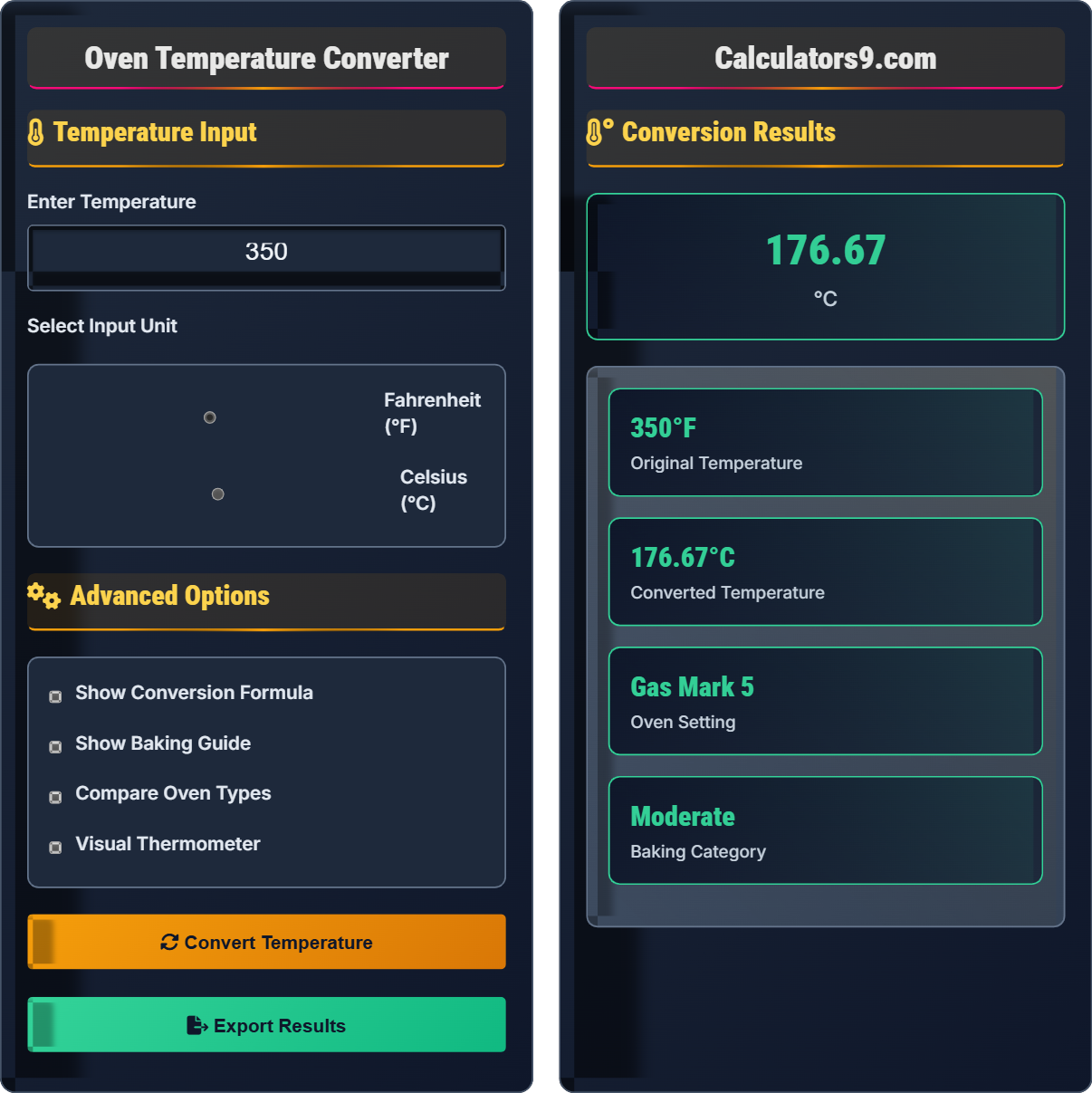
Example: Converting 350°F to Celsius:
\( °C = (350 - 32) \times \frac{5}{9} = 318 \times \frac{5}{9} = 176.67°C \)
Thus, 180°C equals 356°F and 350°F equals 176.67°C.
Temperature Input
Advanced Options
Conversion Results
| Description | °F | °C |
|---|
| Gas Mark | °F | °C | Usage |
|---|
Oven Temperature Guide & Kitchen Tools
Temperature conversion between Fahrenheit and Celsius is essential for international recipes. The formulas are: °F = (°C × 9/5) + 32 and °C = (°F - 32) × 5/9. Gas mark is a British system where 1 = 275°F (140°C) and each mark increases by 25°F (14°C).
The standard temperature conversion formulas are:
\(°C = (°F - 32) \times \frac{5}{9}\)
Where:
- \(°F\) = Temperature in Fahrenheit
- \(°C\) = Temperature in Celsius
For gas mark conversions: Gas Mark = (°F - 225) ÷ 25
Different ovens require different temperature approaches:
- Conventional: Standard heating elements, may have hot spots
- Convection: Circulated air, cooks faster, reduce temp by 25°F
- Electric: Precise temperature control, slower recovery
- Gas: Humid environment, may brown differently
- Toaster: Smaller space, cook faster, monitor closely
- Use an oven thermometer: Built-in thermometers can be inaccurate
- Preheat properly: Wait for the oven to reach temperature
- Position correctly: Middle rack for even cooking
- Don't overcrowd: Allow air circulation around food
- Check early: Times are guidelines; start checking before stated time
Temperature Basics
Fahrenheit and Celsius scales measure thermal energy differently.
\(°F = (°C \times \frac{9}{5}) + 32\)
\(°C = (°F - 32) \times \frac{5}{9}\)
- Water freezes at 32°F (0°C)
- Water boils at 212°F (100°C)
- Absolute zero is -459.67°F (-273.15°C)
Baking Temperatures
Range-based classifications for different cooking needs.
- Very Low: 200-250°F
- Low: 250-300°F
- Moderate: 300-375°F
- Hot: 375-425°F
- Very Hot: 425-500°F
- Altitude affects boiling point
- Humidity affects baking
- Convection ovens cook faster
- Gas ovens may have uneven heat
Temperature Conversion Quiz
What is the formula to convert Celsius to Fahrenheit?
The answer is B) °F = (°C × 9/5) + 32. This is the standard formula for converting Celsius to Fahrenheit. The process involves multiplying the Celsius temperature by 9/5 (or 1.8) and then adding 32 to account for the offset between the two scales.
The conversion formula reflects the mathematical relationship between the two temperature scales. The 9/5 factor accounts for the different size of degree increments between scales (Celsius degrees are larger than Fahrenheit degrees), while the addition of 32 accounts for the different zero points of the scales.
Fahrenheit: Temperature scale with 32°F as freezing point of water
Celsius: Temperature scale with 0°C as freezing point of water
Conversion Factor: Mathematical multiplier to change between scales
• °F = (°C × 9/5) + 32
• °C = (°F - 32) × 5/9
• Always perform multiplication before addition
• Remember: "Five over nine plus thirty-two" for C to F
• Use the 9/5 ratio (1.8) for the conversion factor
• Check your answer makes sense (higher C = higher F)
• Forgetting to add or subtract 32
• Using the wrong fraction (5/9 vs 9/5)
• Performing operations in wrong order
Convert 180°C to Fahrenheit. Show your work.
Using the formula: °F = (°C × 9/5) + 32
Step 1: Multiply 180 by 9/5
180 × 9/5 = 180 × 1.8 = 324
Step 2: Add 32
324 + 32 = 356°F
Therefore, 180°C = 356°F
This calculation demonstrates the exact application of the conversion formula. The key steps are: 1) Multiply by the conversion factor (9/5 or 1.8), 2) Add the offset (32). This systematic approach ensures accuracy in temperature conversions.
Conversion Factor: The ratio between degree sizes in different scales
Offset: The difference in zero points between scales
Systematic Approach: Following a consistent sequence of operations
• Follow order of operations (multiply before add)
• Use exact fractions when possible (9/5 not 1.8)
• Verify answer is reasonable
• Remember: C to F involves multiplication and addition
• Fahrenheit values are generally higher than Celsius
• Round to appropriate precision for context
• Forgetting to add 32 after multiplication
• Mixing up the order of operations
• Using incorrect conversion factor
A European recipe calls for baking at 175°C, but your oven is calibrated in Fahrenheit. What temperature should you set your oven to? If you accidentally set it to 350°F instead, how much hotter is that in Celsius?
Part 1: Convert 175°C to Fahrenheit
°F = (175 × 9/5) + 32 = (175 × 1.8) + 32 = 315 + 32 = 347°F
You should set your oven to 347°F (approximately 350°F).
Part 2: Find how much hotter 350°F is than 347°F
First, convert 350°F back to Celsius
°C = (350 - 32) × 5/9 = 318 × 5/9 = 176.67°C
Difference: 176.67°C - 175°C = 1.67°C
So 350°F is approximately 1.67°C hotter than the required 175°C.
This problem combines both conversion directions and emphasizes the practical importance of accurate temperature conversion in baking. Small temperature differences can affect baking outcomes, making precise conversions important for successful results.
Practical Conversion: Applying formulas to real-world scenarios
Baking Precision: Importance of accurate temperature control
Two-Way Conversion: Converting in both directions for verification
• Small temperature differences matter in baking
• Always verify conversions when possible
• Round appropriately for equipment limitations
• For baking, round to nearest 5°F for conventional ovens
• Use an oven thermometer to verify accuracy
• Note that convection ovens may require temperature adjustment
• Not accounting for oven thermometer accuracy
• Forgetting that small temperature differences matter
• Not considering oven type differences
You're converting a recipe from a European cookbook that calls for 180°C, but you have a convection oven. Convection ovens cook 25°F hotter due to air circulation. What Fahrenheit temperature should you set your convection oven to? Show your work.
Step 1: Convert 180°C to Fahrenheit (standard oven)
°F = (180 × 9/5) + 32 = 324 + 32 = 356°F
Step 2: Adjust for convection oven
Convection ovens cook 25°F hotter, so subtract 25°F
Convection setting = 356°F - 25°F = 331°F
Step 3: Convert back to Celsius if needed
°C = (331 - 32) × 5/9 = 299 × 5/9 = 166.11°C
Therefore, set your convection oven to 331°F (approximately 325°F) or 166°C.
This problem demonstrates the additional complexity of oven-specific considerations beyond simple temperature conversion. Convection ovens require temperature adjustments because the circulating air transfers heat more efficiently, essentially making the oven "hotter" than the set temperature.
Convection Oven: Uses fans to circulate hot air for faster cooking
Heat Transfer Efficiency: How effectively heat moves to food
Equipment Adjustment: Modifying settings for different appliances
• Reduce convection oven temperature by 25°F
• Reduce cooking time by 25% in convection ovens
• Check food earlier than recipe indicates
• Many convection ovens have automatic adjustment settings
• Use bakeware with low sides for best convection results
• Don't overcrowd pans in convection ovens
• Not adjusting for convection oven differences
• Using the same temperature for convection as conventional
• Not monitoring food closely in convection mode
What is the gas mark equivalent of 350°F?
The answer is A) Gas Mark 4. The gas mark system is a British standard where Gas Mark 1 = 275°F, and each mark increases by 25°F. So: Gas Mark 4 = 275 + (3 × 25) = 275 + 75 = 350°F. The formula is: Gas Mark = (°F - 225) ÷ 25.
The gas mark system provides a simplified way to indicate oven temperatures in British recipes. Each gas mark represents a 25°F increment starting from 275°F for Gas Mark 1. This system was historically tied to gas oven settings but is now used more broadly in British cooking.
Gas Mark: British temperature scale for ovens
Standard Increment: Fixed temperature difference between marks
Historical Context: Originally tied to gas oven controls
• Gas Mark 1 = 275°F (140°C)
• Each mark = 25°F (14°C) increase
• Formula: Gas Mark = (°F - 225) ÷ 25
• Remember: Gas Mark 4 = 350°F (common baking temp)
• Gas Mark 6 = 400°F (roasting temp)
• Use conversion chart for reference
• Confusing gas mark with other temperature systems
• Forgetting the starting point (275°F for Mark 1)
• Not knowing the 25°F increment pattern
FAQ
Q: Why do my baked goods come out different when I convert temperatures?
A: Temperature conversion is mathematically precise, but baking results can vary due to several factors:
- Oven accuracy: Built-in thermometers can be off by 10-20°F
- Heat distribution: Ovens have hot spots that affect baking
- Altitude: Boiling point changes at higher elevations
- Humidity: Affects crust formation and rising
- Recipe proportions: Ingredients behave differently at various temperatures
Always use an oven thermometer to verify temperature accuracy. The conversion formula \(°F = (°C \times \frac{9}{5}) + 32\) is exact, but environmental factors can affect outcomes.
Example: At sea level, water boils at 212°F (100°C), but at 5,000 feet elevation, it boils at approximately 203°F (95°C), which can significantly affect baking times and results.
Q: How do I know if my oven temperature is accurate?
A: The most reliable method is using an independent oven thermometer. Place it in the center of the oven and preheat to a known temperature (like 350°F). After 15 minutes, check the reading:
- If the reading matches the set temperature ±10°F, your oven is accurate
- If it's off by more than 20°F, consider calibration or replacement
- Check multiple locations in the oven to identify hot spots
Temperature accuracy is crucial for baking success. A 25°F difference can affect rise, texture, and doneness timing.
For calibration, if your oven reads consistently high or low, many models allow adjustment. For example, if your oven reads 375°F when set to 350°F, you'd adjust it to read 325°F when set to 350°F to correct the +25°F error.