Sous Vide Time Calculator
Precision cooking calculator • 2026 standards
Sous Vide Time Calculation Formula:
Show the calculator\( T = k \times d^2 \)
Where:
- \( T \) = Cooking time (hours)
- \( d \) = Thickness of food (inches)
- \( k \) = Time constant (varies by protein and temperature)
Approximate time constants (k) for common proteins at 131°F:
- Beef: k ≈ 1.5
- Pork: k ≈ 1.8
- Chicken: k ≈ 2.0
- Fish: k ≈ 1.2
This formula approximates the time needed for the center of food to reach target temperature based on thickness. The quadratic relationship means doubling thickness quadruples cooking time.
Example: For 1-inch thick beef at 131°F:
\( T = 1.5 \times 1^2 = 1.5 \) hours
Example: For 2-inch thick beef at 131°F:
\( T = 1.5 \times 2^2 = 6 \) hours
Thus, a 1-inch piece takes 1.5 hours while a 2-inch piece takes 6 hours.
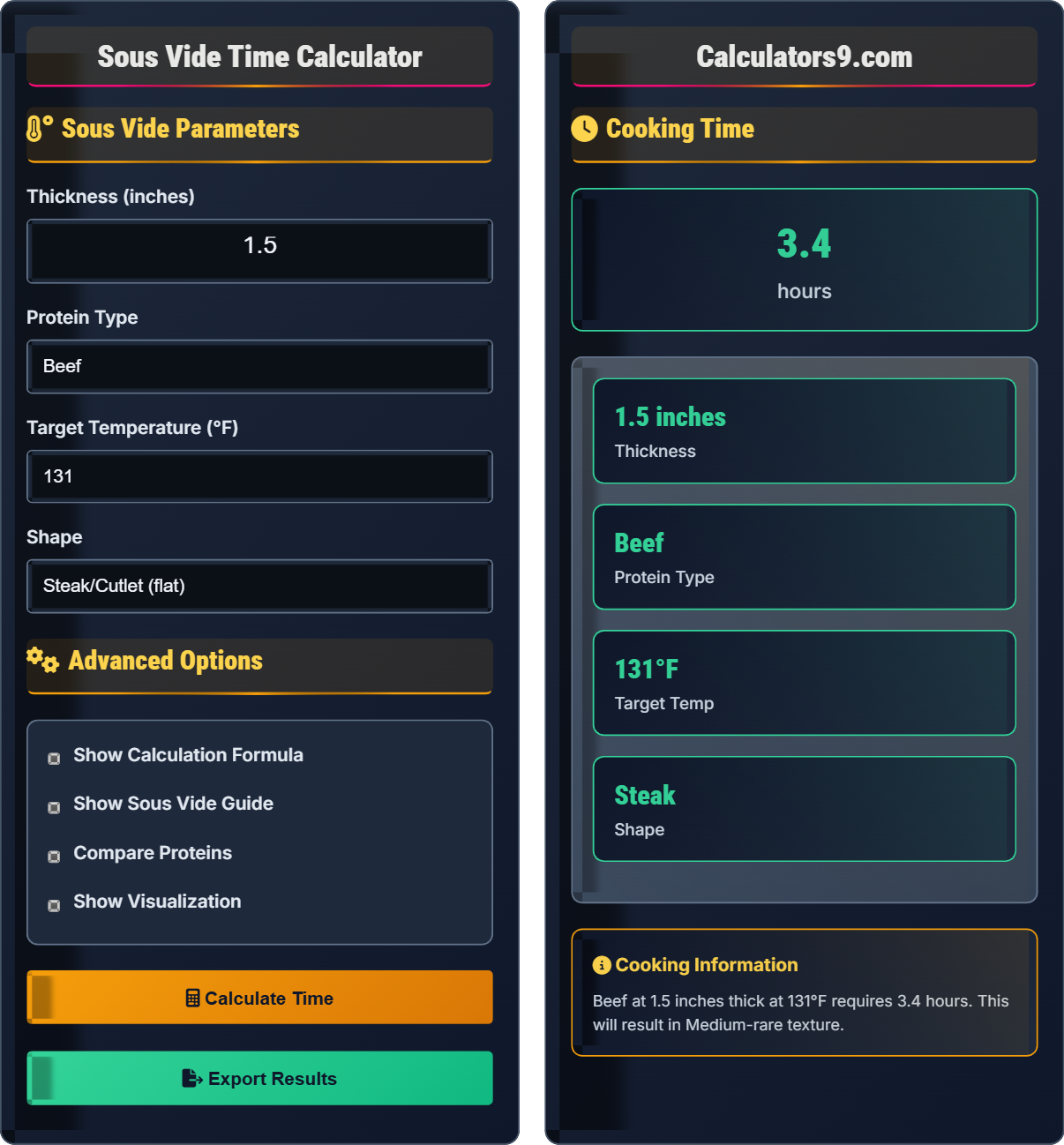
Sous Vide Parameters
Advanced Options
Cooking Time
| Thickness | Time (Beef) | Time (Chicken) | Time (Fish) |
|---|
| Protein | Safe Temp | Desired Temp | Texture |
|---|
Sous Vide Guide & Kitchen Tools
Sous vide cooking involves vacuum-sealing food and cooking it in a precisely controlled water bath. The time calculation follows a quadratic relationship with thickness: \(T = k \times d^2\). This ensures the center reaches target temperature safely and predictably.
The standard sous vide time calculation formula is:
Where:
- \(T\) = Cooking time in hours
- \(k\) = Time constant (varies by protein and temp)
- \(d\) = Thickness in inches
Time constants vary: Beef ~1.5, Chicken ~2.0, Fish ~1.2
Minimum safe temperatures for sous vide cooking:
- Beef/Pork: 130°F (54°C) minimum
- Chicken: 140°F (60°C) minimum
- Fish: 122°F (50°C) minimum
- Lamb: 130°F (54°C) minimum
- Duck: 135°F (57°C) minimum
- Thickness matters: Cooking time increases quadratically with thickness
- Seal properly: Use chamber vacuum sealer for best results
- Water displacement: Use water to push air out if no vacuum sealer
- Rest time: Food can rest in bath for hours after reaching temperature
- Finishing: Quick sear with blowtorch or hot pan for texture
Sous Vide Basics
Vacuum-sealed cooking in precisely controlled water bath for consistent results.
\(T = k \times d^2\)
Where T=time, k=constant, d=thickness.
- Beef: k ≈ 1.5
- Chicken: k ≈ 2.0
- Fish: k ≈ 1.2
Sous Vide Applications
Different proteins require different temperatures and timing for optimal results.
- Beef: 130-134°F (medium-rare)
- Chicken: 140-145°F (safe)
- Fish: 122-128°F (flaky)
- Pork: 135-140°F (safe)
- Thickness affects cooking time quadratically
- Food remains safe at temperature indefinitely
- Texture changes with extended cooking
- Always finish with sear for appearance
Sous Vide Knowledge Quiz
According to the sous vide time formula, if you double the thickness of a piece of meat, how does the cooking time change?
The answer is C) Quadruples. The sous vide time formula is \(T = k \times d^2\), where time is proportional to the square of thickness. If thickness doubles (2d), time becomes \(T = k \times (2d)^2 = 4kd^2\), which is four times the original time.
The quadratic relationship in the formula \(T = k \times d^2\) means that cooking time increases exponentially with thickness. This is because heat must travel through more material to reach the center, and the distance affects the time exponentially. Understanding this relationship is crucial for proper sous vide planning.
Quadratic Relationship: When one variable changes by the square of another
Heat Transfer: Movement of thermal energy through material
Core Temperature: Internal temperature of the food
• Time ∝ thickness²
• Doubling thickness quadruples time
• Tripling thickness increases time 9×
• Cut thicker pieces in half to reduce time
• Plan cooking schedule based on thickness
• Use thinner cuts for faster results
• Assuming linear relationship between thickness and time
• Not accounting for exponential increase
• Underestimating time for thick cuts
Using the formula \(T = k \times d^2\), calculate the cooking time for a 2-inch thick piece of beef with a time constant of 1.5. Show your work.
Given:
- d = 2 inches (thickness)
- k = 1.5 (time constant for beef)
- Formula: T = k × d²
Step 1: Apply the formula
T = 1.5 × (2)²
Step 2: Calculate the square of thickness
(2)² = 4
Step 3: Multiply by the constant
T = 1.5 × 4 = 6
Therefore, the cooking time is 6 hours.
This calculation demonstrates the quadratic relationship between thickness and cooking time. The formula \(T = k \times d^2\) shows that when thickness doubles from 1 inch to 2 inches, the time increases from 1.5 hours to 6 hours (quadrupling). This is because the area that heat must penetrate increases exponentially with thickness.
Time Constant: Factor that accounts for protein type and temperature
Quadratic Formula: Equation where variable is squaredExponential Increase: Growth by powers of the variable
• Always square the thickness first
• Use correct time constant for protein
• Units must be consistent
• Remember: T = k × d² (not k × d)
• Use calculator for complex calculations
• Double-check thickness measurements
• Forgetting to square the thickness
• Using linear instead of quadratic formula
• Incorrect time constant for protein
You have two steaks: one is 1 inch thick and another is 3 inches thick. Using the beef time constant of 1.5, how much longer will the thicker steak take to cook compared to the thinner one?
Step 1: Calculate time for 1-inch steak
T₁ = 1.5 × (1)² = 1.5 × 1 = 1.5 hours
Step 2: Calculate time for 3-inch steak
T₃ = 1.5 × (3)² = 1.5 × 9 = 13.5 hours
Step 3: Calculate the difference
Time difference = 13.5 - 1.5 = 12 hours
Step 4: Calculate how many times longer
Times longer = 13.5 ÷ 1.5 = 9 times longer
Therefore, the 3-inch steak will take 12 hours longer (9 times longer) than the 1-inch steak.
This problem demonstrates the dramatic effect of thickness on sous vide cooking time. While the thickness only tripled (1 to 3 inches), the cooking time increased ninefold (1.5 to 13.5 hours). This exponential relationship is why sous vide cooking of thick cuts requires careful planning and patience.
Exponential Scaling: Relationship where changes are multiplicative
Time Differential: Difference in cooking times
Thickness Factor: Impact of thickness on cooking duration
• Time increases quadratically with thickness
• 3× thickness = 9× cooking time
• Plan accordingly for thick cuts
• Cut thick steaks to uniform thickness
• Start thick cuts earlier in the day
• Consider reverse searing for thick cuts
• Assuming linear relationship between thickness and time
• Not accounting for exponential increase
• Starting thick cuts too late
You're preparing chicken for sous vide cooking. The FDA requires chicken to reach 165°F for immediate consumption, but sous vide allows for lower temperatures with extended time. What is the minimum safe temperature for sous vide chicken, and why is this possible?
The minimum safe temperature for sous vide chicken is 140°F (60°C) for at least 35 minutes. This is possible due to the combined effect of time and temperature in killing pathogens.
Traditional cooking relies on high temperature alone to kill bacteria instantly. In sous vide, the precise, consistent low temperature over extended time achieves the same safety outcome. The relationship follows the principle: \(Time \times Temperature = Safety\).
At 140°F, the time required to pasteurize chicken is about 35 minutes. As temperature increases, the required time decreases exponentially. For example:
- 140°F: 35 minutes
- 145°F: 12 minutes
- 150°F: 3 minutes
- 165°F: Instantaneous (traditional method)
The safety of sous vide cooking lies in the time-temperature relationship. Pathogen destruction follows first-order kinetics, meaning both temperature and time contribute to lethality. Lower temperatures require longer exposure times, but the result is the same level of safety. This allows for precise control over texture while maintaining safety.
Pasteurization: Process of eliminating harmful bacteria
Time-Temperature Relationship: Combined effect of heat and duration
First-Order Kinetics: Rate of reaction dependent on concentration
• Lower temp = longer time for safety
• Minimum 140°F for chicken
• Always verify with thermometer
• Use precise thermometer for verification
• Follow tested time-temperature charts
• Consider food safety guidelines
• Using traditional temperature requirements for sous vide
• Not understanding time-temperature relationship
• Ignoring minimum safe temperatures
How does extended cooking time in sous vide affect the texture of tough cuts of meat?
The answer is C) Makes them more tender by breaking down collagen. Extended sous vide cooking at low temperatures (130-140°F) allows enzymes to break down tough connective tissue (collagen) into gelatin without overcooking the muscle fibers. This results in incredibly tender meat while maintaining moisture.
The unique advantage of sous vide for tough cuts is the ability to cook at low temperatures for extended periods. Traditional cooking would overcook the exterior trying to tenderize the interior. In sous vide, the temperature remains constant throughout, allowing connective tissues to break down slowly without overcooking proteins.
Collagen: Connective tissue protein that breaks down to gelatin
Enzymatic Breakdown: Chemical process that softens tough cuts
Temperature Control: Maintaining consistent heat for texture
• Low temp + long time = tender meat
• Collagen converts to gelatin
• Muscle fibers don't overcook
• Use 48-72 hours for very tough cuts
• 131°F ideal for tenderizing
• Don't rush the process
• Using high temperatures for tough cuts
• Not cooking long enough for tenderization
• Confusing texture changes with doneness
FAQ
Q: Can I leave food in the sous vide bath longer than the recommended time?
A: Yes, sous vide food can remain in the water bath well beyond the minimum time required to reach temperature, but texture changes may occur. The time formula \(T = k \times d^2\) gives the minimum time to reach core temperature, but food remains safe and at target temperature indefinitely.
However, texture changes occur over time:
- Tender cuts: May become mushy with extended cooking
- Tough cuts: Become increasingly tender with longer cooking
- Fish: Degrades more quickly than other proteins
- Poultry: Texture changes after 4-6 hours
For example, chicken breast can remain in the bath for up to 4 hours past the minimum time without significant texture changes, while a tough chuck roast benefits from 48-72 hours of cooking time.
Q: How do I measure the thickness of irregular-shaped cuts?
A: For irregular-shaped cuts, measure the thinnest section of the meat, as this determines the minimum time needed for the entire piece to reach temperature. The formula \(T = k \times d^2\) assumes the thickest part as the controlling dimension.
Measuring techniques:
- Calipers: Most accurate for precise measurements
- Ruler: Good for flat surfaces
- Finger-width: Rough estimate (1 finger ≈ 0.75")
For a ribeye steak with varying thickness, measure the thickest part. If one side is 1.5" and another is 1", use 1.5" for calculations. The thinner parts will be adequately cooked while the thicker parts reach temperature.
Alternatively, pound the meat to uniform thickness for consistent results.