Yeast Conversion Calculator
Fast baking conversion • 2026 standards
Yeast Conversion Formula:
Show the calculator\( Y_2 = Y_1 \times R \)
Where:
- \( Y_1 \) = Original yeast amount
- \( Y_2 \) = Converted yeast amount
- \( R \) = Conversion ratio
Standard conversion ratios:
- Active Dry Yeast → Instant Yeast: 0.75 (use 75% of ADY amount)
- Instant Yeast → Active Dry Yeast: 1.33 (use 133% of IY amount)
- Fresh Yeast → Active Dry Yeast: 0.33 (use 33% of FY amount)
- Active Dry Yeast → Fresh Yeast: 3.0 (use 3x ADY amount)
This formula converts yeast quantities between different types based on their activity levels. Active dry yeast has larger granules and slower activation than instant yeast, requiring more quantity for equivalent rise.
Example: Converting 1 packet (2¼ tsp) active dry yeast to instant yeast:
\( Y_2 = 2.25 \times 0.75 = 1.69 \) tsp instant yeast
Example: Converting 1 tsp instant yeast to active dry yeast:
\( Y_2 = 1 \times 1.33 = 1.33 \) tsp active dry yeast
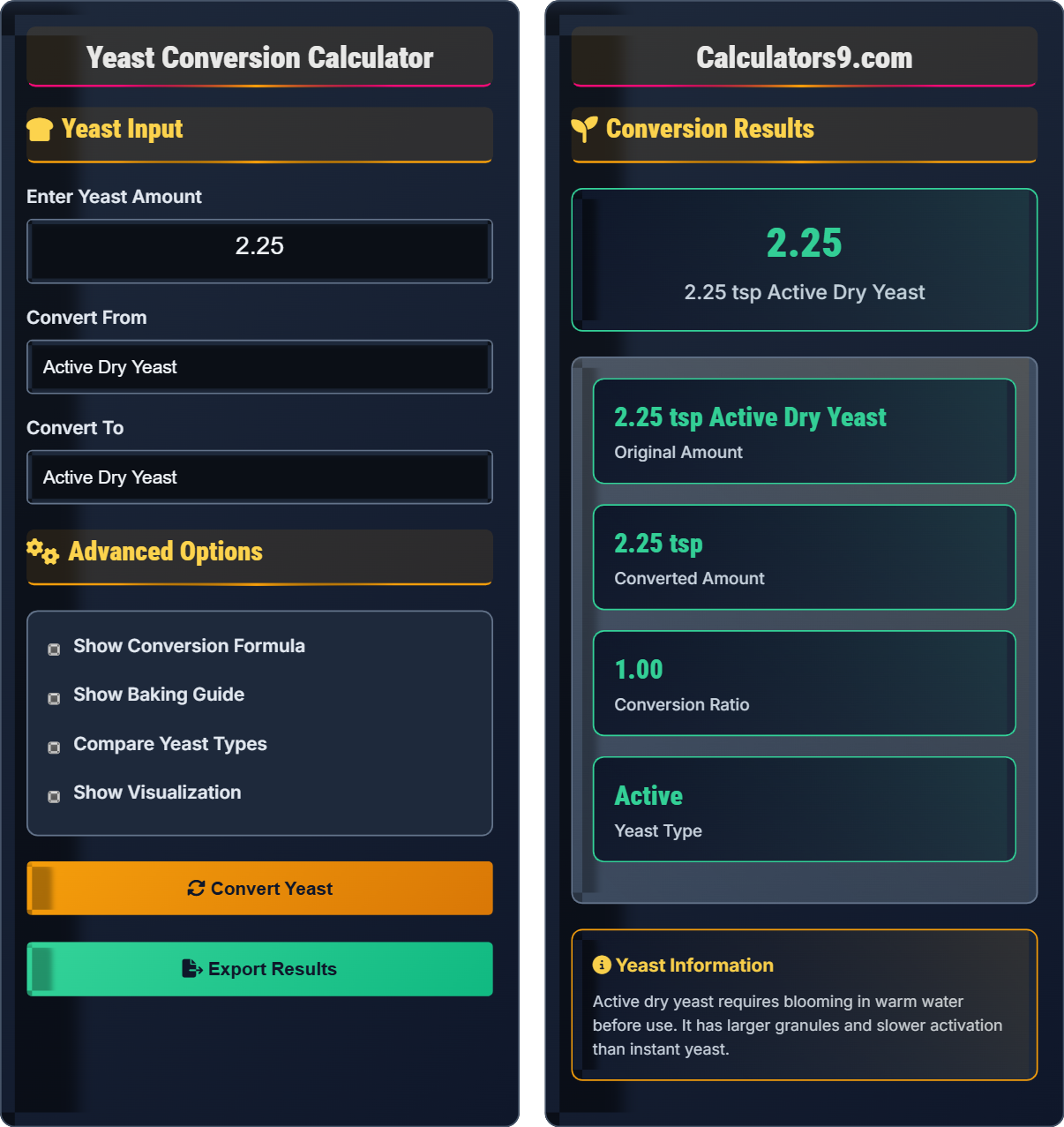
Thus, 2.25 tsp active dry yeast equals 1.69 tsp instant yeast.
Yeast Input
Advanced Options
Conversion Results
| Type | Conversion Factor | Characteristics |
|---|
| Recipe Type | Yeast Amount | Notes |
|---|
Yeast Conversion Guide & Kitchen Tools
Yeast conversion is essential for successful baking when substituting between different types. Active dry yeast (ADY) has larger granules and slower activation than instant yeast (IY), requiring 25% more quantity for equivalent rise. Fresh yeast is 3x more active than ADY by weight.
The standard yeast conversion formula is:
Where:
- \(Y_2\) = Converted yeast amount
- \(Y_1\) = Original yeast amount
- \(R\) = Conversion ratio
Common ratios: ADY→IY: 0.75, IY→ADY: 1.33, Fresh→ADY: 0.33
Common yeast measurements and equivalents:
- 1 packet: 2¼ tsp active dry yeast (7g)
- 1 tsp ADY: 0.75 tsp instant yeast
- 1 tsp instant: 1.33 tsp active dry yeast
- 1 oz fresh: 0.33 oz active dry yeast
- 1 cake fresh: 2/3 oz (22g), equivalent to 2 packets ADY
- Test viability: Dissolve yeast in warm water with sugar to test activation
- Temperature matters: Water too hot kills yeast (above 130°F)
- Storage: Refrigerate opened yeast in airtight container
- Altitude: Higher altitudes may require less yeast due to increased rise
- Timing: Adjust rising times based on room temperature
Yeast Conversion Basics
Different forms of baker's yeast with varying characteristics.
\(Y_2 = Y_1 \times R\)
Where Y₂=converted amount, Y₁=original amount, R=ratio.
- ADY → IY: 0.75
- IY → ADY: 1.33
- Fresh → ADY: 0.33
Baking Applications
Amounts needed for different bread types and recipes.
- 1 packet ADY = 2¼ tsp
- 1 tsp ADY = 0.75 tsp IY
- 1 cake fresh = 2/3 oz
- Standard: 1 packet per 4 cups flour
- Room temperature affects rise time
- Higher altitude = less yeast needed
- Fresh yeast is more active
- Store properly for effectiveness
Yeast Conversion Quiz
What is the conversion ratio when substituting instant yeast for active dry yeast?
The answer is B) 0.75 (use 75% of ADY amount). Instant yeast is more active than active dry yeast, so you need less of it. The conversion ratio is 0.75, meaning if a recipe calls for 1 tsp of active dry yeast, you would use 0.75 tsp of instant yeast.
Instant yeast has smaller granules and more active yeast cells per unit volume compared to active dry yeast. This makes it more potent, requiring less quantity for the same leavening effect. Understanding this ratio prevents under- or over-leavening of bread.
Leavening: Process of adding air bubbles to dough through yeast fermentation
Yeast Activity: Potency of yeast in producing CO₂ gas for rising
Conversion Ratio: Mathematical multiplier for equivalent measurements
• Instant yeast is 25% more active than ADY
• Use 0.75 ratio: ADY → IY
• Use 1.33 ratio: IY → ADY
• Remember: IY is stronger, so use less
• IY can be added directly to dry ingredients
• ADY should be bloomed in warm water first
• Using same amount for both yeast types
• Not accounting for potency differences
• Blooming instant yeast unnecessarily
If a recipe calls for 2 packets of active dry yeast (2¼ tsp each), how much instant yeast should you use? Show your work.
Step 1: Calculate total active dry yeast amount
2 packets × 2¼ tsp/packet = 4.5 tsp active dry yeast
Step 2: Apply conversion ratio (ADY → IY = 0.75)
Instant yeast needed = 4.5 tsp × 0.75 = 3.375 tsp
Step 3: Convert to practical measurement
3.375 tsp = 3⅜ tsp instant yeast
Therefore, you need 3⅜ tsp (or approximately 3⅓ tsp) of instant yeast.
This calculation demonstrates the practical application of the conversion ratio. The key is to first determine the total amount of the original yeast type, then apply the appropriate conversion factor. The result should be rounded to a practical measurement for kitchen use.
Packet Measurement: Standard amount (2¼ tsp) of active dry yeast
Conversion Factor: Multiplier to achieve equivalent leavening
Practical Measurement: Rounded amounts suitable for kitchen use
• Always calculate total amount first
• Apply conversion ratio to total amount
• Round to practical measurements
• 1 packet ADY = 2¼ tsp = 7g
• 0.75 tsp IY ≈ 1 tsp ADY
• Use measuring spoons for precision
• Converting each packet separately instead of total
• Forgetting to apply the conversion ratio
• Using incorrect conversion direction
You have a European recipe that calls for 20g of fresh yeast, but you only have active dry yeast. How much active dry yeast should you use? (Note: 1g fresh yeast ≈ 0.33g active dry yeast)
Using the conversion ratio: Fresh → Active Dry = 0.33
Step 1: Apply conversion ratio
Active dry yeast needed = 20g fresh × 0.33 = 6.6g
Step 2: Convert grams to teaspoons (1 tsp ADY ≈ 3.3g)
Teaspoons needed = 6.6g ÷ 3.3g/tsp = 2 tsp
Therefore, you need 6.6g (or approximately 2 tsp) of active dry yeast.
Fresh yeast is more active than active dry yeast, so significantly less active dry yeast is needed to achieve the same leavening effect. The conversion factor of 0.33 means that fresh yeast is about 3 times more active than active dry yeast by weight.
Fresh Yeast: Compressed cake yeast, very active and perishable
Active Dry Yeast: Dehydrated granules with protective coating
Yeast Activity Level: Measure of fermentation power
• Fresh yeast is 3x more active than ADY
• Conversion: Fresh → ADY = 0.33
• Fresh yeast requires refrigeration
• 1 oz fresh yeast ≈ 0.33 oz ADY
• Fresh yeast dissolves easily in liquid
• Check expiration dates on fresh yeast
• Using equal amounts for fresh and dry yeast
• Forgetting that fresh yeast is more active
• Not storing fresh yeast properly
You're substituting instant yeast for active dry yeast in a bread recipe. If the original recipe says to let the dough rise for 1 hour with active dry yeast, how should you adjust the rising time when using instant yeast? Explain your reasoning.
When substituting instant yeast for active dry yeast, you should reduce the rising time by approximately 25%. Instead of 1 hour, the dough should rise for about 45 minutes.
Reasoning: Instant yeast is more active and acts faster than active dry yeast. It doesn't require blooming in warm water and begins fermenting immediately when mixed with flour. The smaller granules dissolve more quickly and distribute more evenly throughout the dough, leading to faster fermentation and rising.
Monitoring: Check the dough earlier than the original recipe suggests. The dough should double in size, which may happen sooner with instant yeast.
The difference in rising time is due to the physical and biological properties of the yeast types. Instant yeast's smaller particle size and lack of protective coating mean it becomes active immediately upon contact with moisture, whereas active dry yeast needs time to hydrate and activate. This kinetic difference affects not just quantity but also timing in baking processes.
Fermentation Kinetics: Speed of yeast activity in dough
Rising Time: Duration needed for dough expansion
Yeast Activation: Process of yeast becoming metabolically active
• Instant yeast rises 25% faster than ADY
• Check dough visually, not just by time
• Adjust timing when substituting yeast types
• Look for dough to double in size, not just time
• Warmer temperatures accelerate rising
• Cold temperatures slow rising significantly
• Keeping same rising time when switching yeast types
• Not monitoring dough development
• Over-rising due to faster action
Which of the following statements about yeast storage is TRUE?
The answer is D) All dried yeasts should be refrigerated after opening. Both active dry yeast and instant yeast benefit from refrigeration after opening to extend their shelf life. Fresh yeast must be refrigerated and has the shortest shelf life (2-4 weeks). Proper storage maintains yeast activity and prevents contamination.
Proper storage is crucial for maintaining yeast viability. Dried yeasts (both active dry and instant) have extended shelf lives due to the dehydration process, but exposure to air, moisture, and warmth after opening can reduce their effectiveness. Refrigeration slows degradation and maintains activity for longer periods.
Shelf Life: Duration yeast remains effective under proper storage
Viability: Ability of yeast to ferment and leaven dough
Storage Conditions: Environmental factors affecting yeast longevity
• Refrigerate opened dried yeasts
• Fresh yeast requires refrigeration
• Store in airtight containers
• Freeze opened yeast for longest storage
• Test yeast viability before use
• Write purchase date on packages
• Storing dried yeast at room temperature after opening
• Not testing expired yeast before use
• Leaving yeast containers open
FAQ
Q: Can I substitute instant yeast for active dry yeast without changing anything else in the recipe?
A: Yes, you can substitute instant yeast for active dry yeast, but you need to adjust both the quantity and the procedure:
- Quantity: Use 75% of the active dry yeast amount (multiply by 0.75)
- Procedure: Add instant yeast directly to dry ingredients (no blooming needed)
- Timing: Expect faster rising times (reduce by 25%)
For example, if a recipe calls for 2 tsp active dry yeast, use 1.5 tsp instant yeast and add it directly to the flour. The conversion formula is: \(Y_2 = Y_1 \times 0.75\), where \(Y_1\) is active dry yeast and \(Y_2\) is instant yeast.
Additionally, since instant yeast activates more quickly, you may notice the dough begins rising sooner, so monitor the process more closely.
Q: How do I test if my yeast is still active before using it?
A: Testing yeast viability is simple and ensures successful baking:
- For Active Dry Yeast: Dissolve 1 tsp yeast in ¼ cup warm water (110°F) with 1 tsp sugar. Wait 5-10 minutes. Active yeast will foam and bubble vigorously.
- For Instant Yeast: Mix 1 tsp yeast with ¼ cup warm water and 1 tsp sugar. It should become foamy within 5 minutes.
- For Fresh Yeast: Crumble ½ tsp into warm water with sugar. It should foam within 5 minutes.
If no foam appears after 10 minutes, the yeast is inactive and should be replaced. The chemical reaction formula is: Yeast + Sugar + Warm Water → CO₂ + Alcohol, causing the foaming action that indicates active fermentation.
Water temperature is critical: below 95°F is too cold, above 130°F will kill the yeast.