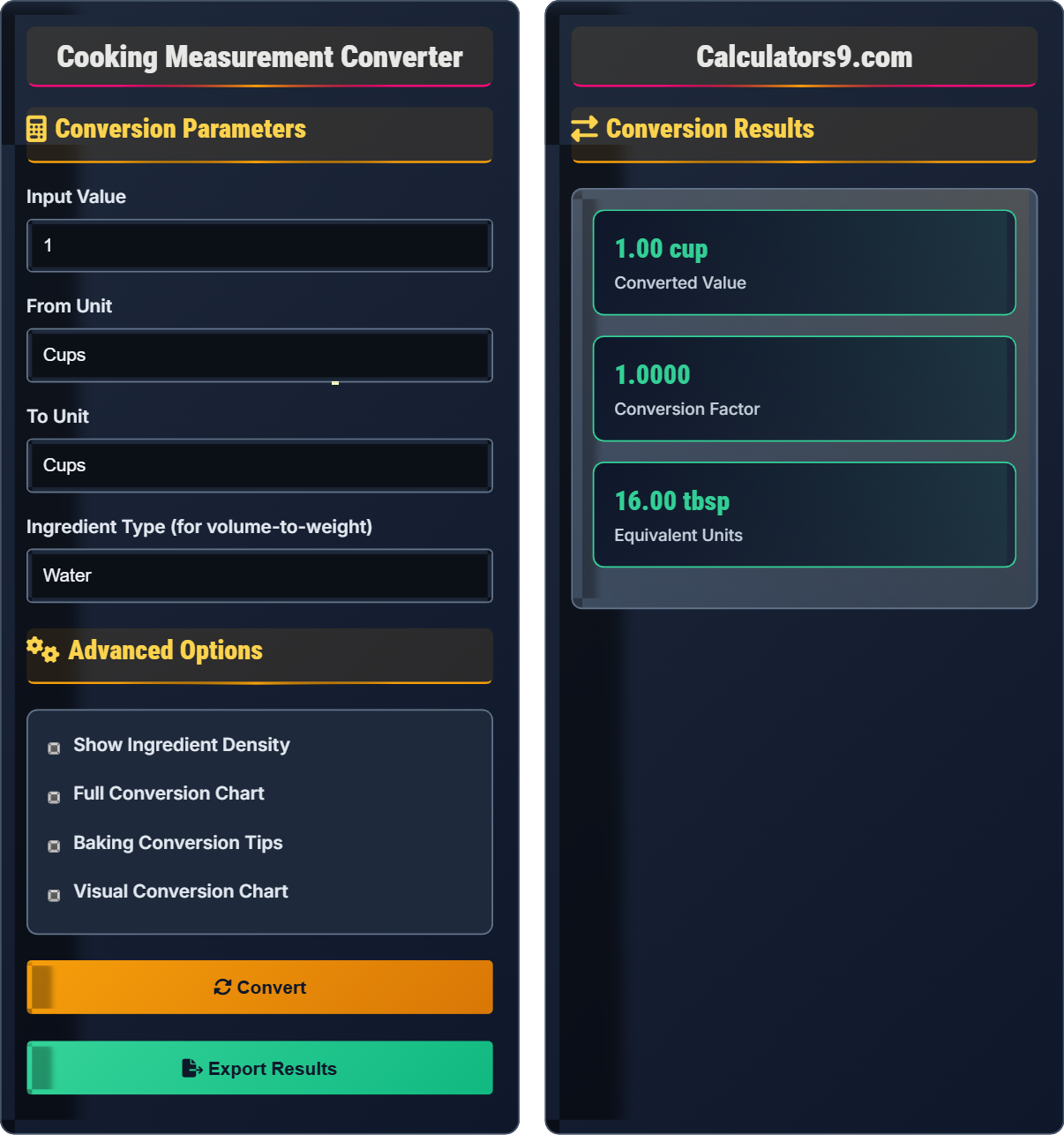
Cooking Measurement Converter
Kitchen conversion tool • Volume/weight • Imperial/Metric
Measurement Conversion Formulas:
Show ConverterVolume Conversions:
- 1 cup = 8.45 oz = 240 ml = 16 tbsp
- 1 tbsp = 3 tsp = 15 ml = 0.5 oz
- 1 pint = 2 cups = 16 oz = 473 ml
- 1 quart = 4 cups = 32 oz = 946 ml
- 1 gallon = 4 quarts = 128 oz = 3.785 liters
Weight Conversions:
- 1 lb = 16 oz = 454 g
- 1 oz = 28.35 g
- 1 kg = 1000 g = 2.2 lbs
For volume-to-weight conversions: Weight = Volume × Density
Example: 1 cup flour = 120-125g (density ≈ 0.5 oz/cup)
Conversion Parameters
Advanced Options
Conversion Results
Measurement Fundamentals
Volume measures space occupied (cups, tbsp, ml), while weight measures mass (oz, g, lb). Different ingredients have different densities, so 1 cup of flour weighs less than 1 cup of sugar.
- Volume: 1 cup = 16 tbsp = 48 tsp = 240 ml
- Weight: 1 lb = 16 oz = 454 g
- Liquid: 1 cup water = 8 oz = 240 g
- Dry: Varies by ingredient density
- Water: 1 ml = 1 g
- Flour: 1 cup ≈ 120-125 g
- Sugar: 1 cup ≈ 200 g
- Butter: 1 cup = 227 g
Baking Considerations
Baking requires precise measurements. Volume measurements can vary significantly based on technique, while weight measurements are consistent and accurate.
- Use dry measuring cups for dry ingredients
- Use liquid measuring cups for liquids
- Sift flour before measuring
- Level off with straight edge
- Use kitchen scale when possible
- All-purpose flour: 120 g/cup
- Granulated sugar: 200 g/cup
- Brown sugar: 220 g/cup (packed)
- Powdered sugar: 120 g/cup
- Butter: 227 g/cup
Measurement Conversion Learning Quiz
How many tablespoons are in 1 cup?
The answer is C) 16 tablespoons. The standard conversion is 1 cup = 16 tablespoons. This is a fundamental cooking measurement that forms the basis for many other conversions: 1 tablespoon = 3 teaspoons, so 1 cup = 48 teaspoons.
Understanding the basic measurement relationships is crucial for cooking. The US standard system builds upon itself: cups to tablespoons to teaspoons. Once you know 1 cup = 16 tbsp, you can derive other conversions. These relationships remain constant regardless of the ingredient being measured.
Volume Measurement: Measurement of space occupied by matter
Standard Conversion: Officially accepted measurement equivalencies
US Standard System: Measurement system used in American cooking
• 1 cup = 16 tablespoons
• 1 tablespoon = 3 teaspoons
• 1 cup = 48 teaspoons
• Remember: Cup-Tablespoon-Teaspoon is 1-16-48
• Use measuring spoons for precision
• Level off dry ingredients with a straight edge
• Confusing with metric measurements
• Estimating instead of measuring precisely
• Not knowing the standard relationships
Convert 2.5 cups of all-purpose flour to grams. Explain the conversion process and why weight measurements are more accurate than volume for flour.
Step 1: Identify the standard density for all-purpose flour
All-purpose flour typically weighs 120-125 grams per cup
Step 2: Apply the conversion
Using 120 g/cup: 2.5 cups × 120 g/cup = 300 grams
Using 125 g/cup: 2.5 cups × 125 g/cup = 312.5 grams
Step 3: State the result
2.5 cups of all-purpose flour = approximately 300-312 grams
Why weight is more accurate:
- Volume measurements vary based on how flour is scooped and packed
- Different scooping techniques can vary weight by 20-30%
- Weight measurements are consistent regardless of technique
- Humidity and storage conditions affect volume but not weight
- Baking requires precise ratios, making weight more reliable
The key to volume-to-weight conversions is knowing the ingredient's density. Different ingredients have vastly different densities. A cup of flour weighs much less than a cup of sugar due to the different particle sizes and packing densities. This is why weight measurements are preferred in professional baking.
Density: Mass per unit volume (g/ml or g/cup)
Volume Measurement: Measures space, not mass
Consistency: Reproducible results across different cooks
• Flour: 1 cup ≈ 120-125 g
• Weight is more precise than volume
• Different ingredients have different densities
• Use kitchen scale for baking ingredients
• Sift flour before measuring by volume
• Spoon flour into cup, don't scoop directly
• Assuming all ingredients have the same density as water
You have a European recipe that calls for 500 ml of milk, but your measuring cups are in US customary units. How many cups of milk do you need? What's the most accurate way to measure this?
Step 1: Use the standard conversion factor
1 cup = 240 ml (US standard approximation)
Step 2: Calculate the conversion
500 ml ÷ 240 ml/cup = 2.08 cups
Step 3: Express in practical terms
2.08 cups ≈ 2 cups + 1.3 tablespoons (since 0.08 × 16 tbsp = 1.28 tbsp)
Step 4: Determine the most accurate measurement method
The most accurate way is to use a liquid measuring cup with metric markings, or use a kitchen scale (500 ml water = 500 g). If using US cups, measure 2 full cups and add approximately 1.3 tablespoons.
Therefore, you need approximately 2.08 cups (2 cups + 1.3 tbsp) of milk.
This problem demonstrates the challenge of converting between measurement systems. The 240 ml per cup conversion is an approximation, and for precision work, it's better to use metric measuring tools or a kitchen scale. When converting, it's often necessary to express decimal portions in more familiar units.
US Customary Units: Standard measurement system in US (cups, tbsp, oz)
Metric System: Decimal-based system (liters, milliliters, grams)
Conversion Factor: Ratio used to convert between units
• 1 cup ≈ 240 ml (US standard)
• 1 liter = 1000 ml
• Use precise tools for accuracy
• Use measuring tools with both systems marked
• Kitchen scale eliminates conversion errors
• Round to practical measurements when possible
• Using exact conversion (236.6 ml) instead of standard (240 ml)
• Not accounting for measurement precision
• Guessing instead of using conversion tools
You're making bread and the recipe calls for 3 cups of bread flour. Your kitchen scale shows the flour weighs 380 grams. Is this correct? What should the weight be, and what does this discrepancy suggest about measuring techniques?
Step 1: Determine the standard weight for bread flour
Bread flour typically weighs 120-127 grams per cup (slightly denser than all-purpose)
Step 2: Calculate expected weight
3 cups × 120 g/cup = 360 grams (low end)
3 cups × 127 g/cup = 381 grams (high end)
Step 3: Compare with actual measurement
Actual: 380 grams
Expected: 360-381 grams
The measurement is very close to the upper end of the expected range.
Step 4: Analyze the discrepancy
The 380 grams is within the normal range for bread flour, suggesting careful measurement technique. If the weight were significantly higher (like 420g), it would indicate overpacking or scooping directly from the bag, which compresses the flour.
Therefore, the 380-gram measurement is accurate and indicates good measuring technique.
This example shows how weight measurements reveal the accuracy of volume measurements. Bread flour is slightly denser than all-purpose flour, so it weighs more per cup. The small variation in weight demonstrates how measuring technique affects volume measurements but not weight measurements.
Measurement Accuracy: How close measured value is to true value
Technique Variation: Differences caused by measuring method
Ingredient Density: Weight per unit volume
• Bread flour: 120-127 g/cup
• Weight measurements eliminate technique variation
• Consistent technique important for volume measurements
• Spoon flour into cup, don't scoop directly
• Level off with straight edge
• Use kitchen scale for best accuracy
• Scooping flour directly from container (compresses flour)
• Not leveling off measurements
• Assuming all flours have same density
Why is it important to use different measuring tools for liquids and dry ingredients?
The answer is B) Liquid measuring cups allow for accurate reading at eye level. Liquid measuring cups have spouts and measurement lines below the rim, allowing you to read measurements at eye level without parallax error. Dry measuring cups are designed to be filled to the brim and leveled off, which works best with dry ingredients that can be compacted.
Each measuring tool is designed for its specific purpose. Liquid measuring cups have measurement lines below the rim so you can place the cup on a flat surface and read the measurement at eye level, preventing parallax error. Dry measuring cups are meant to be filled to the top and leveled off with a straight edge for precise volume measurement.
Parallax Error: Measurement error due to viewing angle
Eye-Level Reading: Reading measurements at same level as eyes
Measurement Technique: Proper method for accurate results
• Use liquid measuring cups for liquids
• Use dry measuring cups for dry ingredients
• Read liquid measurements at eye level
• Place liquid cup on flat surface when measuring
• Read the bottom of the meniscus for liquids
• Level dry ingredients with straight edge
• Using dry cups for liquids (difficult to read accurately)
• Not reading at eye level for liquids
• Pouring from liquid measuring cups for dry ingredients
FAQ
Q: What's the difference between fluid ounces and ounces by weight?
A: Fluid ounces measure volume, while ounces by weight measure mass:
- Fluid ounce (fl oz): Measures volume of liquids (1 fl oz = 29.57 ml)
- Ounce (oz) by weight: Measures mass of ingredients (1 oz = 28.35 g)
- Water: 1 fl oz = 1 oz by weight (coincidence)
- Other ingredients: Differ based on density
For example, 1 cup of flour weighs about 4.25 oz but has a volume of 8 fl oz. This is why weight measurements are more accurate for cooking.
Q: How do I convert 2 cups of granulated sugar to grams?
A: Granulated sugar has a standard density:
- 1 cup granulated sugar = 200 grams
- Therefore: 2 cups = 2 × 200 = 400 grams
For precision baking, always use a kitchen scale. Volume measurements can vary by 10-15% depending on how the sugar is measured, but weight measurements are always consistent.