Recipe Scaler
Portion calculator • Nutritional scaling • Ingredient conversion
Scaling Formula:
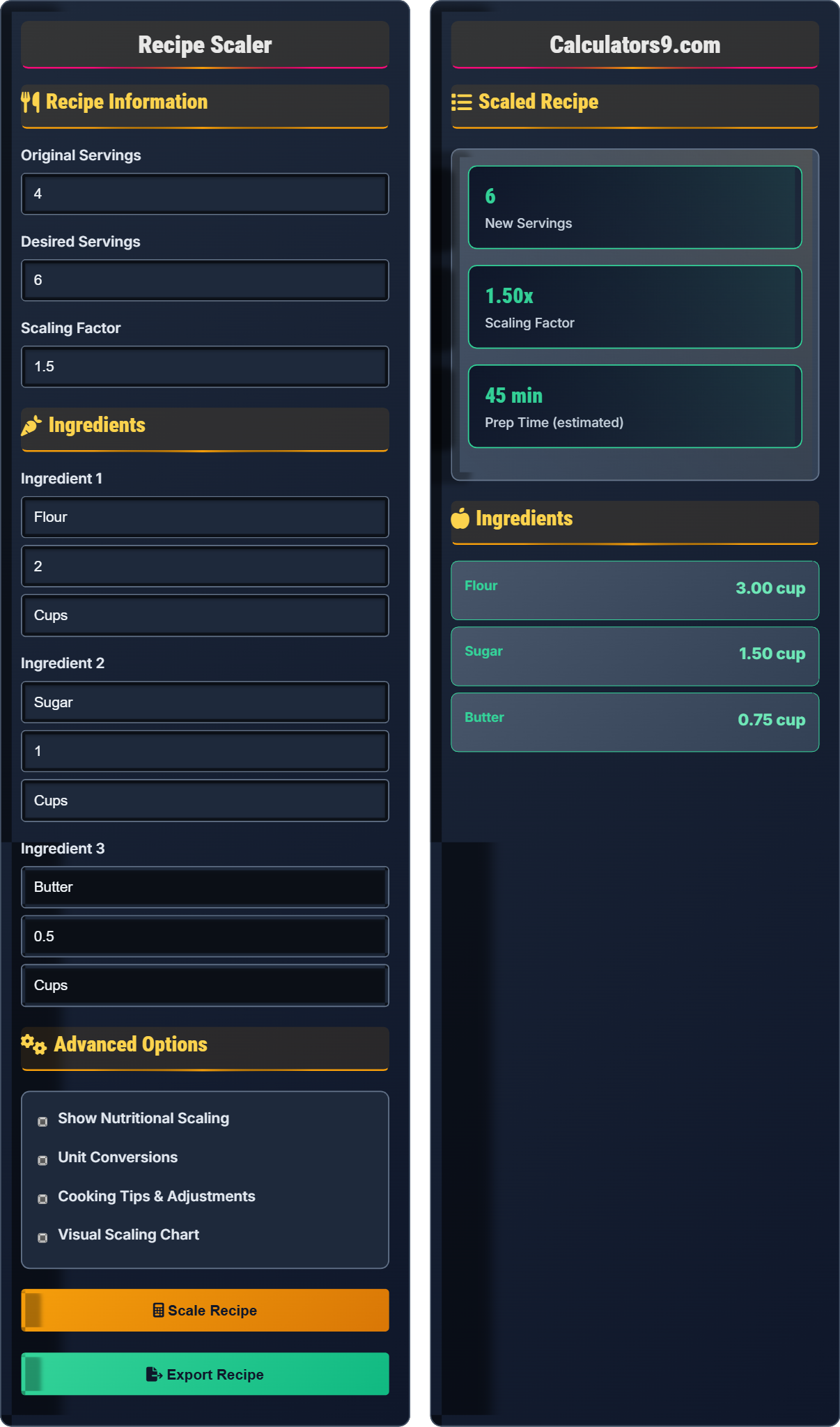
Show CalculatorNew Quantity = Original Quantity × (New Servings ÷ Original Servings)
For example, to scale a recipe from 4 servings to 6 servings:
If original calls for 2 cups flour: 2 × (6 ÷ 4) = 2 × 1.5 = 3 cups
Scaling factor = 1.5 (multiply all ingredients by 1.5)
Conversion Examples:
- 1 cup = 8.45 oz = 240 ml
- 1 tbsp = 3 tsp = 15 ml
- 1 lb = 16 oz = 454 g
- 1 gallon = 4 quarts = 3.785 liters
Recipe Information
Ingredients
Advanced Options
Scaled Recipe
Ingredients
Recipe Scaling Fundamentals
Recipe scaling is the process of adjusting ingredient quantities to produce a desired number of servings while maintaining the correct proportions and flavor balance. It's essential for cooking for different group sizes.
New Quantity = Original Quantity × (New Servings ÷ Original Servings)
- Calculate scaling factor: New ÷ Original
- Multiply each ingredient by the scaling factor
- Convert units if necessary
- Adjust for cooking method if needed
- Linear scaling works for most ingredients
- Seasonings may need adjustment
- Baking ingredients require special care
- Always verify converted measurements
Cooking Considerations
Certain ingredients don't scale linearly: leavening agents, spices, and seasonings may need adjustment to maintain proper flavor and texture balance.
- Spices: Reduce by 10-20% for large increases
- Leavening: Adjust by 10-15% for baking
- Salt: Scale linearly but taste-test
- Acids: May need slight adjustment
- Emulsifiers: Keep proportions exact
- 1 cup = 8.45 oz = 240 ml
- 1 tbsp = 3 tsp = 15 ml
- 1 lb = 16 oz = 454 g
- Use kitchen scale for accuracy
- Round to practical measurements
Recipe Scaling Learning Quiz
If a recipe serves 4 people and calls for 2 cups of flour, how much flour is needed to serve 6 people?
The answer is B) 3.0 cups. Using the scaling formula: New Quantity = Original Quantity × (New Servings ÷ Original Servings). So: 2 × (6 ÷ 4) = 2 × 1.5 = 3.0 cups of flour needed for 6 people.
Recipe scaling follows a simple multiplication principle. First, calculate the scaling factor by dividing the desired servings by the original servings (6 ÷ 4 = 1.5). Then multiply each ingredient by this factor (2 × 1.5 = 3). This maintains the same ratios and ensures consistent results.
Scaling Factor: The multiplier used to adjust all ingredients (New ÷ Original)
Proportional Scaling: Maintaining the same ratios between ingredients
Yield: The number of servings a recipe produces
• Scaling factor = New servings ÷ Original servings
• Multiply all ingredients by the same factor
• Maintain proportional relationships
• Calculate scaling factor first, then apply to all ingredients
• Use a calculator for complex fractions
• Round to practical measurements (nearest 1/4 cup)
• Adding instead of multiplying (2 + 1.5 = 3.5 cups)
• Calculating different factors for each ingredient
• Forgetting to convert units properly
A cookie recipe for 24 cookies requires 3/4 cup sugar, 1/2 cup butter, and 1 egg. How much of each ingredient is needed for 36 cookies? Show your work and explain any special considerations.
Step 1: Calculate scaling factor
Scaling Factor = New Servings ÷ Original Servings = 36 ÷ 24 = 1.5
Step 2: Scale each ingredient
Sugar: 3/4 cup × 1.5 = 1.125 cups = 1 1/8 cups
Butter: 1/2 cup × 1.5 = 0.75 cups = 3/4 cup
Eggs: 1 × 1.5 = 1.5 eggs (round to 2 eggs or use 1 whole + 1/2 egg)
Special Considerations:
- For eggs, round to nearest whole number or use equivalent liquid measure
- Cookie recipes may need slight flour adjustment if scaling significantly
- Baking time might need minor adjustment
- Spread dough evenly to maintain consistent size
When dealing with fractional ingredients, it's helpful to convert to decimal form for easier calculation (3/4 = 0.75). Some ingredients like eggs require practical adjustments since you can't use partial eggs easily. In baking, maintaining proper ratios is crucial for texture and structure.
Partial Ingredients: Ingredients that don't scale to whole units (eggs, cloves garlic)
Yield Adjustment: Changing recipe output while maintaining quality
Proportionality: Maintaining consistent ingredient ratios
• Convert fractions to decimals for easier calculation
• Handle partial ingredients practically
• Consider recipe type when scaling
• For eggs: use 1 whole egg + 2 tablespoons for 1.5 eggs
• Use kitchen scale for precise measurements
• Keep a conversion chart handy
• Not handling partial ingredients appropriately
• Forgetting to adjust for recipe-specific needs
• Calculating different factors for different ingredients
You're scaling a soup recipe from 6 servings to 12 servings. The original calls for 1 teaspoon of salt and 1/4 teaspoon of black pepper. How should you adjust these seasonings, and what considerations should you make for optimal flavor?
Step 1: Calculate scaling factor
Scaling Factor = 12 ÷ 6 = 2.0
Step 2: Calculate basic scaled amounts
Salt: 1 tsp × 2 = 2 tsp
Black Pepper: 1/4 tsp × 2 = 1/2 tsp
Step 3: Apply seasoning adjustment principles
For salt: Scale linearly (2 tsp), but taste and adjust as needed
For pepper: Scale linearly (1/2 tsp), but start with 3/8 tsp and add more if needed
Considerations:
- Start with scaled amounts but adjust to taste
- Strong seasonings like pepper may need less than linear scaling
- Other flavors may intensify with larger batches
- Season in layers throughout cooking process
- Always taste and adjust before serving
Therefore, start with 2 tsp salt and 3/8 tsp pepper, then adjust to taste.
While most ingredients scale linearly, seasonings require special attention. Salt typically scales linearly, but strong spices and herbs may need less than proportional increases to prevent overwhelming flavors. The intensity of flavors can change with batch size, so tasting and adjusting is crucial.
Linear Scaling: Multiplying by exact scaling factor
Seasoning Adjustment: Modifying spice quantities beyond strict math
Batch Scaling: Scaling recipes for larger groups
• Salt: Generally scale linearly
• Strong spices: Consider reducing by 10-20%
• Always taste and adjust final seasoning
• Season in layers throughout cooking
• Start with less and add more as needed
• Different palates prefer different seasoning levels
• Scaling all seasonings linearly without taste testing
• Not considering flavor concentration changes
• Adding all seasoning at the end without adjustment
You're scaling a cake recipe from 8 servings (two 9-inch rounds) to 20 servings using three 9-inch rounds. The original calls for 1 teaspoon baking powder. How should you adjust the baking powder, and what other baking considerations should you make?
Step 1: Calculate basic scaling factor
Basic Scaling Factor = 20 ÷ 8 = 2.5
Step 2: Calculate basic scaled amount
Basic Baking Powder = 1 tsp × 2.5 = 2.5 tsp
Step 3: Apply baking adjustment principles
For baking powder: Reduce by 10-15% for larger batches to prevent excessive rising
Adjusted Baking Powder = 2.5 tsp × 0.85 = 2.125 tsp ≈ 2 1/8 tsp
Additional Baking Considerations:
- Reduce oven temperature by 25°F to prevent over-browning
- Extend baking time by 10-15% due to increased volume
- Check doneness with toothpick starting at original time
- Rotate pans halfway through for even baking
- Let cool completely before removing from pans
Therefore, use approximately 2 1/8 tsp baking powder with adjusted baking parameters.
Baking is more sensitive to scaling than other cooking methods. Leavening agents like baking powder and baking soda can cause issues if scaled exactly linearly, as they may create too much rise or uneven texture. Temperature and timing adjustments are often necessary when changing batch sizes in baking.
Leavening Agents: Ingredients that cause baked goods to rise (baking powder, soda)
Batch Scaling: Increasing recipe yield while maintaining quality
Thermal Equilibrium: Even heating throughout larger volumes
• Reduce leavening by 10-15% for larger batches
• Lower oven temp by 25°F for larger volumes
• Extend baking time but monitor closely
• Use an oven thermometer to verify temperature
• Prepare pans in advance when scaling up
• Test with smaller increases first
• Scaling leavening agents linearly without adjustment
• Not adjusting oven temperature for larger batches
• Keeping same baking time regardless of volume
How many tablespoons are in 3/4 cup?
The answer is B) 12 tablespoons. The standard conversion is 1 cup = 16 tablespoons. Therefore, 3/4 cup = 3/4 × 16 = 12 tablespoons. This is a fundamental cooking conversion that every cook should know.
Knowing standard cooking conversions is essential for recipe scaling. The basic relationships are: 1 cup = 16 tablespoons, 1 tablespoon = 3 teaspoons, 1 pint = 2 cups, 1 quart = 4 cups. These form the foundation for all cooking measurements and scaling calculations.
Standard Conversion: Official measurement relationships
Volume Measurement: Measuring by space occupied (cups, tbsp, tsp)
Weight Measurement: Measuring by mass (ounces, grams)
• 1 cup = 16 tablespoons
• 1 tbsp = 3 teaspoons
• 1 pint = 2 cups = 32 tbsp
• Memorize: Cup-Tablespoon-Teaspoon progression (1-16-48)
• Use measuring spoons for precision
• Level off dry ingredients for accuracy
• Confusing volume and weight measurements
• Not knowing standard conversion factors
• Estimating instead of measuring precisely
FAQ
Q: Do I always multiply every ingredient by the same scaling factor?
A: For most ingredients, yes, you multiply by the same scaling factor. However, there are exceptions:
- Spices and seasonings: May need slight adjustment to taste
- Leavening agents: Sometimes reduced by 10-15% for baking
- Liquids: May need adjustment based on altitude or cooking method
- Coating agents: Like flour for dusting, may not need exact scaling
Always taste and adjust seasonings after scaling, as flavor perception can change with batch size.
Q: How do I convert 2.5 cups to metric measurements?
A: Standard conversions for common measurements:
- 1 cup = 240 ml = 240g (for water)
- 2.5 cups = 600 ml
- However, for dry ingredients, weight varies:
- All-purpose flour: 1 cup = 120-125g
- So 2.5 cups flour = 300-312g
- Granulated sugar: 1 cup = 200g
- So 2.5 cups sugar = 500g
For precision baking, always use a kitchen scale to weigh ingredients rather than relying on volume measurements.