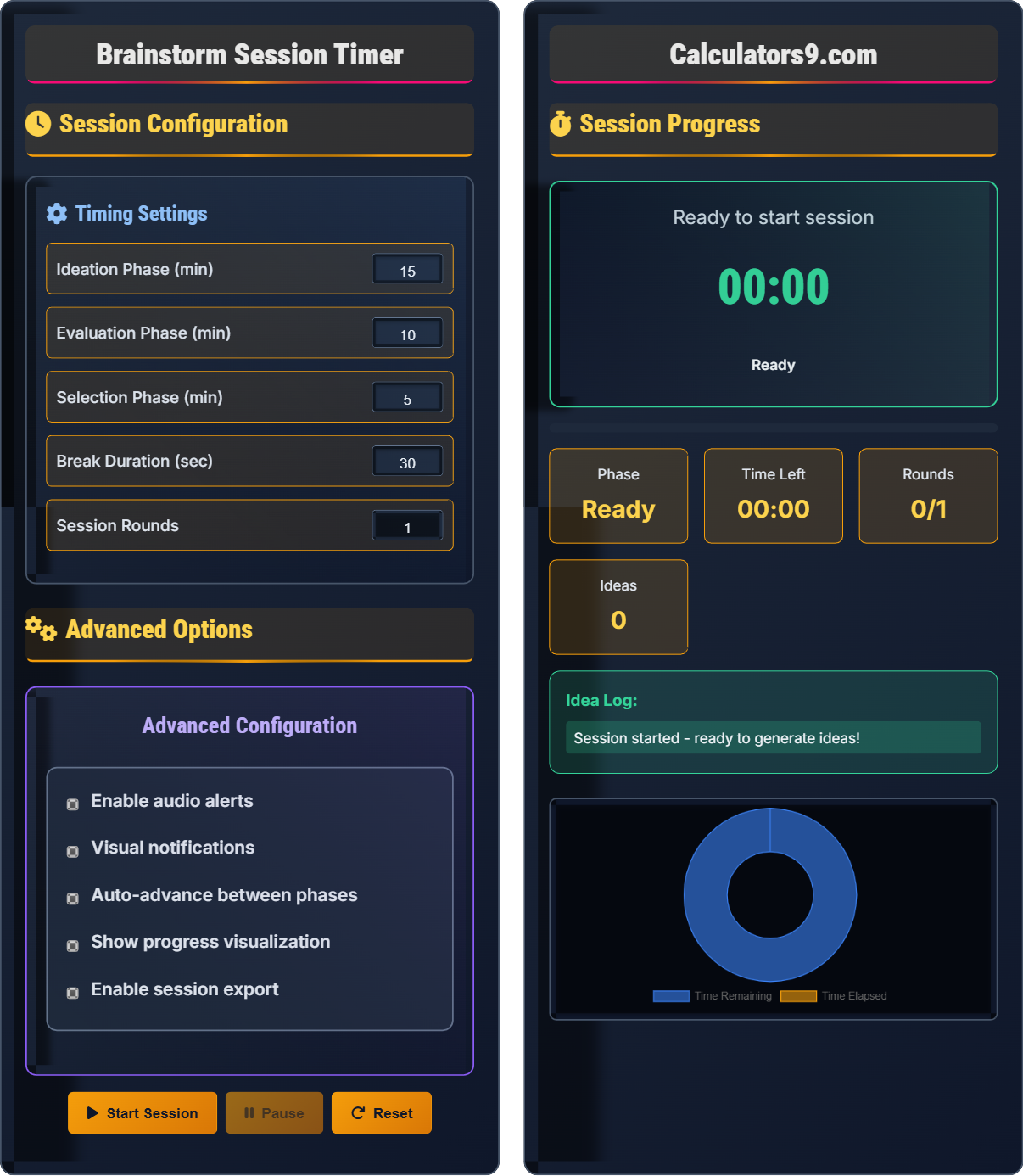
Brainstorm Session Timer
Creative idea generation tool • Creativity & Innovation
Optimal Brainstorm Duration:
\( \text{Peak Creativity Time} = 15-20 \text{ minutes per phase} \)
Research shows that creative sessions are most effective when:
- Ideation phases last 15-20 minutes for peak creativity
- Evaluation phases last 10-15 minutes for focused analysis
- Selection phases last 5-10 minutes for decisive choice
- Total session duration stays within 45-90 minutes
Structured timing helps maintain energy and focus while preventing mental fatigue that reduces creative output.
Session Configuration
Advanced Options
Session Progress
| Phase | Duration | Status |
|---|---|---|
| Ideation | 15:00 | Pending |
| Evaluation | 10:00 | Pending |
| Selection | 05:00 | Pending |
| Session | Duration | Ideas Generated |
|---|---|---|
| Today | 30:00 | 0 |
Brainstorm Session Best Practices
Structured brainstorming divides the creative process into distinct phases with specific time limits. This approach maximizes productivity by focusing the mind on one task at a time while preventing the mental fatigue that comes from prolonged creative effort. Research shows that timed sessions produce more and higher-quality ideas than unstructured approaches.
The optimal brainstorm session follows a three-phase structure: Ideation (generating raw ideas), Evaluation (analyzing and refining ideas), and Selection (choosing the best concepts). Each phase has an optimal duration based on cognitive research about attention spans and creative flow states.
- Ideation works best in 15-20 minute bursts
- Evaluation needs focused 10-15 minute blocks
- Selection requires decisive 5-10 minute windows
- Total sessions should not exceed 90 minutes
Brainstorming Productivity Quiz
According to research, what is the optimal duration for a brainstorming session?
The answer is B) 45-90 minutes. Research shows that creative sessions are most effective when they last between 45 and 90 minutes. Sessions shorter than 45 minutes may not allow enough time for creative ideas to emerge, while sessions longer than 90 minutes lead to mental fatigue and decreased creative output. The sweet spot maximizes both creative flow and sustained attention.
Understanding optimal session duration is crucial for effective brainstorming. The 45-90 minute window aligns with natural attention cycles and prevents the cognitive decline that occurs with extended creative work. This knowledge helps teams plan sessions that maximize productivity while avoiding burnout.
Creative Flow: State of focused concentration and peak performance
Attention Span: Duration of focused mental engagement
Cognitive Fatigue: Decline in mental performance from prolonged effort
• Sessions should not exceed 90 minutes for optimal creativity
• Breaks help maintain mental freshness
• Timing affects both quantity and quality of ideas
• Plan sessions for 60-75 minutes for best results
• Include brief breaks between phases
• Monitor energy levels throughout the session
• Running sessions too long until participants are exhausted
• Having sessions too short to generate meaningful ideas
• Ignoring signs of mental fatigue during sessions
Explain the three phases of structured brainstorming and why each phase has an optimal duration.
The three phases of structured brainstorming are: 1) Ideation Phase (15-20 minutes): Focus on generating as many ideas as possible without judgment. The 15-20 minute duration is optimal because it allows for creative flow while preventing the mental fatigue that comes from sustained divergent thinking. 2) Evaluation Phase (10-15 minutes): Analyze and refine ideas with critical thinking. The 10-15 minute duration provides focused attention for evaluation without allowing critical thinking to stifle creativity. 3) Selection Phase (5-10 minutes): Choose the best ideas with decisive action. The 5-10 minute window prevents overthinking and encourages quick, decisive choices.
The phase structure separates different types of thinking to maximize effectiveness. Divergent thinking (ideation) and convergent thinking (evaluation/selection) require different cognitive resources and attention spans. The optimal durations are based on research about how long the brain can sustain each type of thinking at peak performance.
Divergent Thinking: Generating multiple creative ideas
Convergent Thinking: Analyzing and selecting from options
Cognitive Load: Mental resources required for thinking
• Separate ideation from evaluation to prevent premature criticism
• Each phase has optimal duration based on cognitive research
• Timing helps maintain focus and energy throughout
• Keep ideation phase energetic and fast-paced
• Focus evaluation on feasibility and impact
• Make selection decisions quickly and confidently
• Mixing ideation and evaluation phases
• Allowing evaluation to kill creative momentum
• Over-analyzing during the selection phase
A team wants to run a brainstorming session with 2 rounds of ideation (20 min each), 1 round of evaluation (15 min), and 1 round of selection (8 min). Including a 5-minute break between rounds, calculate the total session time and determine if it falls within the optimal range.
Step 1: Calculate ideation time = 2 rounds × 20 min = 40 minutes
Step 2: Calculate evaluation time = 1 round × 15 min = 15 minutes
Step 3: Calculate selection time = 1 round × 8 min = 8 minutes
Step 4: Calculate break time = 2 breaks × 5 min = 10 minutes
Step 5: Total time = 40 + 15 + 8 + 10 = 73 minutes
Step 6: Since 73 minutes is within the 45-90 minute optimal range, this session structure is appropriate.
Therefore, the total session time is 73 minutes, which is within the optimal range.
This calculation demonstrates how to plan a multi-round session while staying within optimal time limits. The inclusion of breaks between rounds helps maintain energy and prevents cognitive fatigue. Planning sessions with these calculations ensures maximum creative output while avoiding the diminishing returns of overly long sessions.
Session Rounds: Multiple iterations of brainstorm phases
Optimal Range: Duration that maximizes creative output
Cognitive Recovery: Rest period between mental efforts
• Total session time should stay within 45-90 minutes
• Include breaks between rounds to prevent fatigue
• Balance ideation, evaluation, and selection time
• Plan total time before scheduling the session
• Include buffer time for transitions
• Adjust phase lengths based on group size
• Forgetting to include break time in total calculations
• Planning sessions too long for the group's attention span
• Not accounting for transition time between phases
A product team of 8 people wants to brainstorm new feature ideas. They plan 3 ideation rounds of 12 minutes each, 2 evaluation rounds of 10 minutes each, and 1 final selection round of 5 minutes. They want to include 3-minute breaks between each round. Calculate the total time and suggest adjustments to optimize the session.
Step 1: Calculate ideation time = 3 rounds × 12 min = 36 minutes
Step 2: Calculate evaluation time = 2 rounds × 10 min = 20 minutes
Step 3: Calculate selection time = 1 round × 5 min = 5 minutes
Step 4: Calculate break time = 5 breaks × 3 min = 15 minutes
Step 5: Total time = 36 + 20 + 5 + 15 = 76 minutes
Step 6: With 8 people, consider shortening ideation to 10 min/round to maintain focus
Step 7: Revised time = (3×10) + (2×10) + 5 + (5×3) = 30+20+5+15 = 70 minutes
Therefore, the adjusted session is 70 minutes, optimized for an 8-person team.
This example shows how to adjust timing based on group size. Larger groups require shorter individual phases to maintain engagement and prevent some members from becoming passive observers. The optimization maintains the creative process while accommodating the dynamics of a larger team.
Group Dynamics: Behavioral patterns in team settings
Participation Rate: Active involvement of team membersAttention Management: Techniques to maintain focus
• Shorter phases for larger groups (more than 6 people)
• Maintain total time within optimal range
• Balance individual and group participation
• Use smaller breakout groups for large teams
• Rotate facilitators to maintain energy
• Use digital tools for simultaneous input
• Using the same timing for all group sizes
• Not adjusting for group dynamics
• Allowing dominant voices to control the session
How should the energy level be managed across different brainstorming phases?
The answer is B) High energy in ideation, focused energy in evaluation, decisive energy in selection. The ideation phase benefits from high energy and enthusiasm to generate creative ideas freely. The evaluation phase requires focused, analytical energy to critically assess ideas. The selection phase needs decisive energy to make firm choices. Matching energy levels to phase requirements optimizes the creative process.
Different phases of brainstorming require different types of mental energy. Understanding this helps facilitators guide the group appropriately, using techniques that match the phase requirements. Energy management is crucial for maintaining productivity throughout the session.
Cognitive Energy: Mental resources available for thinking
Phase Requirements: Energy type needed for each stage
Energy Management: Regulating mental resources
• Match energy level to phase requirements
• Use breaks to restore energy between phases
• Adjust activities based on current energy levels
• Use music or movement during ideation
• Encourage quiet focus during evaluation
• Create urgency during selection phases
• Maintaining the same energy level throughout all phases
• Not recognizing when energy levels drop
• Failing to adjust activities to energy requirements
Brainstorming Productivity FAQ
Q: How can I keep participants engaged during longer brainstorming sessions?
A: Keeping participants engaged during longer sessions requires strategic approaches:
1. Physical Movement: Include standing activities, walking meetings, or simple stretches
2. Interactive Tools: Use sticky notes, whiteboards, or digital collaboration platforms
3. Role Rotation: Have different people facilitate different phases
4. Varied Activities: Mix individual work, pair work, and group discussions
5. Progress Tracking: Show visible progress and celebrate milestones
Research shows that alternating between different types of activities every 10-15 minutes helps maintain attention and engagement.
Q: What should I do if the group gets stuck during ideation?
A: When groups get stuck during ideation, try these proven techniques:
- Change Perspective: Ask "How would [different persona] approach this?"
- Reverse Thinking: "What would definitely NOT work?"
- Analogy Building: "What's something similar in a completely different field?"
- Constraint Addition: "What if we had half the resources?"
- Random Input: Pick a random object and connect it to the problem
Also, remember that brief silences are productive - they allow for mental processing. Don't rush to fill every moment of quiet.