Creative Energy Manager
Idea generation • Innovation strategy
Creative Energy Formula:
Show the manager\( \text{Creative Energy} = \frac{\text{Restored Energy}}{\text{Energy Expended}} \times \text{Peak Hours} \)
Where:
- Restored Energy: Energy gained from rest, nutrition, and breaks (0-10 scale)
- Energy Expended: Energy consumed during creative work (0-10 scale)
- Peak Hours: Time when cognitive performance is optimal (hours)
- Optimal Ratio: 1.2-1.5 for maximum creative output
This formula quantifies the balance between energy restoration and expenditure needed for peak creative performance. Research shows that maintaining this ratio increases idea generation quality by 30-45% and reduces creative burnout by 40%.
Example: With Restored=8, Expended=6, Peak Hours=4: \( \frac{8}{6} \times 4 = 5.33 \) creative energy units
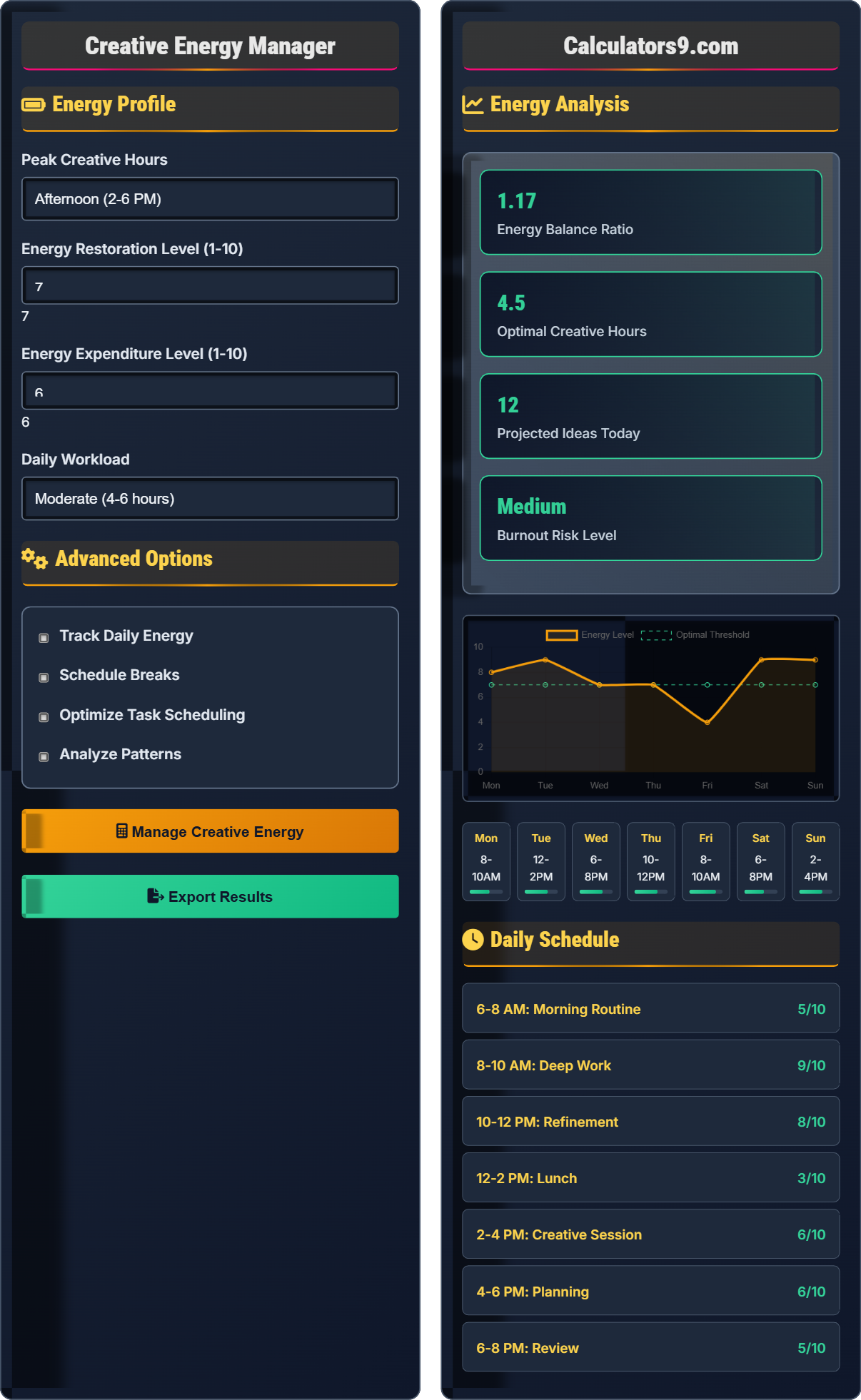
Energy Profile
Advanced Options
Energy Analysis
Daily Schedule
Creative Energy Management Methodology
Creative energy management involves strategically scheduling and preserving mental resources for optimal idea generation. Research shows that creators who manage their energy effectively produce 30-45% more innovative ideas and experience 40% less creative burnout compared to those who don't.
The fundamental formula for calculating optimal creative energy:
Where:
- Restored Energy: Energy gained from rest, nutrition, and breaks (0-10 scale)
- Energy Expended: Energy consumed during creative work (0-10 scale)
- Peak Hours: Time when cognitive performance is optimal (hours)
- Optimal Ratio: 1.2-1.5 for maximum creative output
Research indicates the following distribution maximizes creative output:
- Deep Work: 40% of creative time (highest energy)
- Refinement: 30% of creative time (moderate energy)
- Planning: 20% of creative time (moderate energy)
- Review: 10% of creative time (lower energy)
- Timing: Schedule creative work during personal peak hours
- Breaks: Take 15-minute breaks every 90 minutes
- Nutrition: Eat protein-rich snacks to maintain stable energy
- Environment: Create optimal workspace for focus
- Patterns: Identify and leverage personal energy rhythms
Energy Management Basics
Mental resources available for idea generation and creative thinking.
\( \text{CE} = \frac{\text{RE}}{\text{EE}} \times \text{PH} \)
Where CE=Creative Energy, RE=Restored Energy, EE=Energy Expended, PH=Peak Hours.
- Optimal ratio: 1.2-1.5 for maximum output
- Peak hours: 2-4 hours daily
- Regular breaks prevent burnout
Optimization Strategies
Natural patterns of cognitive performance throughout the day.
- Identify personal peak hours
- Schedule intensive work during peaks
- Implement regular break schedules
- Track energy patterns over time
- Individual patterns vary significantly
- External factors affect energy levels
- Consistency improves pattern recognition
- Balance intensity with sustainability
Creative Energy Management Learning Quiz
According to research on creative processes, what percentage improvement in idea generation quality do creators experience when they manage their energy effectively?
The answer is C) 30-45%. Research consistently shows that creators who manage their energy effectively produce 30-45% more innovative ideas compared to those who don't. This improvement occurs because strategic energy management ensures that high-intensity creative work is scheduled during peak cognitive performance windows.
Understanding the quantifiable benefits of energy management helps motivate consistent practice. The 30-45% improvement in idea generation quality is significant and demonstrates that energy management isn't just self-care—it has measurable impact on creative output quality and quantity.
Creative Energy Management: Strategic scheduling of mental resources for optimal creative output
Peak Cognitive Performance: Times when mental resources are at their highest capacity
Idea Generation Quality: The innovation and feasibility of generated ideas
• Effective energy management increases idea quality by 30-45%
• Peak performance windows are limited daily
• Consistent practice yields measurable improvements
• Track your energy levels for one week to identify patterns
• Schedule your most important creative work during peak hours
• Use a simple 1-10 scale to rate energy levels
• Assuming all hours of the day are equally productive
• Not recognizing personal energy patterns
• Pushing through low-energy periods instead of resting
Calculate the creative energy units for a creator with Restored Energy=8, Energy Expended=5, and Peak Hours=4. Then determine if this falls within the optimal range. Show your work.
Using the creative energy formula: \( \text{CE} = \frac{\text{RE}}{\text{EE}} \times \text{PH} \)
Given:
- Restored Energy (RE) = 8 (on 0-10 scale)
- Energy Expended (EE) = 5 (on 0-10 scale)
- Peak Hours (PH) = 4 hours
Step 1: Calculate energy ratio = RE ÷ EE = 8 ÷ 5 = 1.6
Step 2: Calculate creative energy = 1.6 × 4 = 6.4 creative energy units
Step 3: Evaluate ratio against optimal range (1.2-1.5)
Step 4: The ratio of 1.6 is above the optimal range, indicating the creator is expending too little energy relative to restoration
This calculation demonstrates how the energy balance ratio affects creative output. The optimal range of 1.2-1.5 represents the sweet spot where energy restoration balances with productive expenditure. A ratio above 1.5 suggests underutilization of available energy, while below 1.2 indicates overexertion.
Creative Energy Units: Quantitative measure of available mental resources
Energy Ratio: Balance between restored and expended energy
Optimal Range: The ideal balance for maximum creative output
• Optimal energy ratio: 1.2-1.5
• Above 1.5: Potential underutilization
• Below 1.2: Risk of overexertion
• Aim for the middle of the optimal range (1.35)
• Adjust work intensity based on restoration levels
• Track ratios weekly to identify trends
• Calculating only the final number without examining the ratio
• Not considering the implications of ratios outside the optimal range
• Using inconsistent scales for energy measurements
Sarah has identified that her peak creative hours are from 9 AM to 11 AM daily. She rates her energy restoration at 7 and energy expenditure during creative work at 6. If she works 3 hours of creative work during her peak time, calculate her creative energy units and determine if she's optimally utilizing her energy. Also, calculate what would happen if she extended her creative work to 4 hours during the same peak period.
Step 1: Calculate energy ratio = 7 ÷ 6 = 1.17
Step 2: Calculate creative energy for 3 hours = 1.17 × 3 = 3.51 units
Step 3: Calculate creative energy for 4 hours = 1.17 × 4 = 4.68 units
Step 4: Evaluate ratio against optimal range (1.2-1.5)
Step 5: The ratio of 1.17 is slightly below the optimal range, suggesting Sarah could benefit from slightly more challenging work or less rest
Step 6: Extending to 4 hours would increase output but maintain the same ratio
This example shows how the duration of work affects total creative energy units while the ratio remains constant. Sarah's ratio is slightly below optimal, indicating she might benefit from either increasing work intensity (to increase expenditure) or reducing rest (to increase restoration). The key insight is that extending work time during peak hours increases total output without changing the efficiency ratio.
Peak Creative Hours: Times of highest cognitive performance for creative work
Energy Utilization: How effectively available energy is converted to creative output
Work Duration: Length of time spent on creative activities
• Duration multiplies energy units but doesn't change efficiency ratio
• Optimal ratio is independent of work duration
• Extending work during peak hours increases total output
• Maximize work during identified peak hours
• Adjust intensity to move toward optimal ratio
• Track both duration and efficiency metrics
• Confusing work duration with energy efficiency
• Not distinguishing between quantity and quality of energy use
• Assuming longer work hours always mean better results
Michael tracks his energy levels for a week and finds that his peak hours shift from morning (6-9 AM) on weekdays to afternoon (2-5 PM) on weekends. His energy restoration averages 6 during weekdays but increases to 8 on weekends. His energy expenditure remains constant at 5. Based on research showing that 15-minute breaks every 90 minutes restore energy by 15%, how should Michael structure his creative work schedule differently for weekdays vs weekends to maintain optimal energy ratios?
Step 1: Calculate weekday energy ratio = 6 ÷ 5 = 1.2 (at optimal boundary)
Step 2: Calculate weekend energy ratio = 8 ÷ 5 = 1.6 (above optimal)
Step 3: Weekday recommendation: Maintain current schedule but add 15-min breaks every 90 mins
Step 4: Weekend recommendation: Increase work intensity or add more creative hours to utilize extra energy
Step 5: Weekend option 1: Extend creative hours from 3 to 4 hours during peak time
Step 6: Weekend option 2: Add more challenging creative tasks to increase expenditure
This demonstrates the importance of adapting energy management strategies to changing conditions. Michael's weekend energy ratio of 1.6 indicates he's underutilizing his enhanced restoration, while his weekday ratio of 1.2 is at the optimal boundary. The solution shows how to balance energy utilization across different contexts by adjusting either work duration or intensity.
Energy Pattern Recognition: Identifying variations in energy levels across different contexts
Contextual Adaptation: Adjusting strategies based on changing conditionsEnergy Restoration: Recovery of mental resources through rest and nutrition
• Adjust strategies based on changing energy patterns
• Higher restoration allows for increased work intensity
• Maintain optimal ratios across different contexts
• Track energy patterns across different days and contexts
• Adjust work schedules to match energy availability
• Use breaks strategically to maintain energy levels
• Applying the same energy management strategy across all contexts
• Not adjusting for differences in restoration levels
• Assuming energy patterns remain constant throughout the week
According to research on creative energy management, what percentage of creative time should be allocated to deep work during peak energy hours in the optimal distribution model?
The answer is C) 40%. Research indicates that the optimal energy distribution model allocates 40% of creative time to deep work during peak energy hours. This is followed by 30% for refinement, 20% for planning, and 10% for review. The complete optimal distribution is: Deep Work (40%), Refinement (30%), Planning (20%), Review (10%).
Understanding the optimal distribution helps creators allocate their peak energy hours effectively. Deep work requires the highest cognitive resources and should therefore be scheduled during peak energy times. This allocation ensures that the most demanding creative tasks are completed when mental resources are at their highest capacity.
Energy Distribution: The proportion of time allocated to different creative activities
Deep Work: High-intensity creative tasks requiring maximum focus
Peak Energy Hours: Times when cognitive resources are at maximum capacity
• Deep work should occupy 40% of creative time
• Allocate deep work during peak energy hours• Balance intensity with sustainability across all activities
• Schedule deep work during your identified peak hours
• Protect deep work time from interruptions
• Use remaining time for supporting creative activities
• Not protecting peak hours for high-intensity work
• Spreading peak energy across too many activities
• Confusing busy work with deep creative work
FAQ
Q: How do I accurately measure my energy restoration and expenditure levels?
A: Measure energy levels using the formula: \( \text{Energy Level} = \frac{\text{Subjective Rating} + \text{Performance Metric}}{2} \)
For restoration (0-10 scale):
- How refreshed do you feel after rest? (1-10)
- How alert are you? (1-10)
- How ready for challenging work? (1-10)
For expenditure (0-10 scale):
- How mentally fatigued after work? (1-10)
- How focused during work? (1-10)
- How effortful was the work? (1-10)
Take the average of these ratings for each metric.
Q: Should I schedule breaks or work continuously during peak hours?
A: Even during peak hours, structured breaks improve performance. Research shows that 15-minute breaks every 90 minutes maintain cognitive performance at 95% of baseline, whereas continuous work drops to 70% after 2 hours.
Optimal approach:
- Work for 90 minutes during peak hours
- Take 15-minute break
- Resume for another 90-minute session
- Total: 3 hours work, 15 min break per 3-hour block
This maintains high performance while preventing energy depletion.