Iteration Cycle Planner
Creative idea generation • Innovation strategy
Iteration Cycle Formula:
Show the planner\( \text{Total Cycles} = \frac{\text{Total Duration}}{\text{Cycle Length}} \)
Where:
- Total Duration: Planned project timeline
- Cycle Length: Time allocated per iteration
- Optimal Cycles: Typically 3-7 cycles for best results
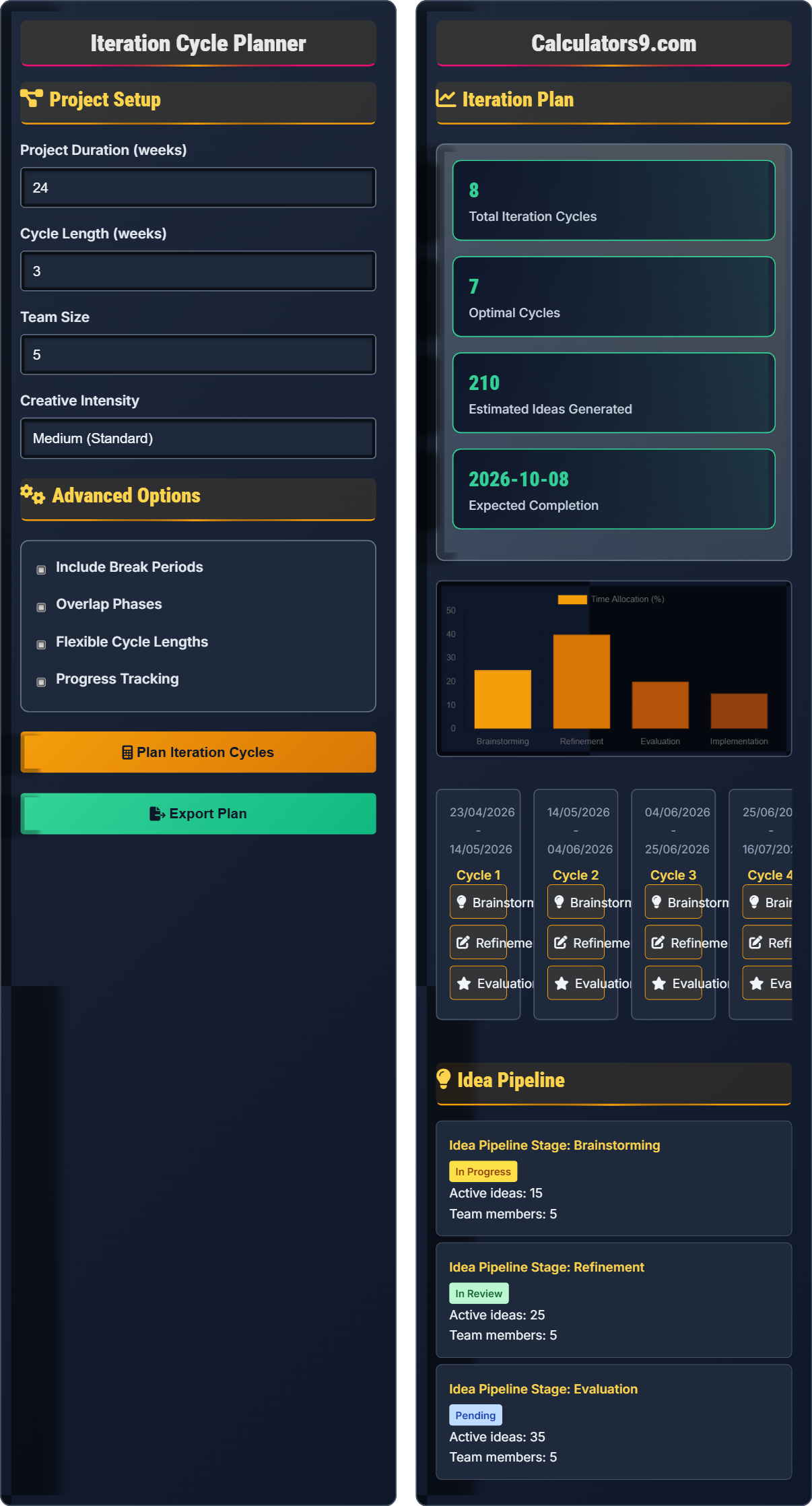
This formula calculates the number of iterations needed to complete a creative project within the desired timeframe. Research shows that 3-7 iteration cycles optimize creative output while maintaining momentum.
Example: For a 6-month project with 3-week cycles: \( \frac{24 \text{ weeks}}{3 \text{ weeks/cycle}} = 8 \text{ cycles} \)
Project Setup
Advanced Options
Iteration Plan
Idea Pipeline
Creative Iteration Methodology
Iteration planning for creative projects involves structuring idea generation and refinement cycles to maximize innovation output. Research shows that structured iteration cycles increase creative productivity by 35-50% compared to unstructured approaches.
The fundamental formula for determining optimal iteration cycles:
Where:
- Project Duration: Total planned time for the creative project
- Cycle Length: Time allocated for each iteration phase
- Optimal Range: 3-7 cycles for maximum creative effectiveness
Research indicates the following timing distribution maximizes creative output:
- Brainstorming: 25% of cycle time
- Refinement: 40% of cycle time
- Evaluation: 20% of cycle time
- Implementation: 15% of cycle time
- Regular Breaks: Taking 10-minute breaks every hour increases creative performance by 15%
- Diverse Teams: Teams with diverse backgrounds generate 25% more innovative ideas
- Feedback Loops: Rapid feedback improves idea quality and iteration speed
- Constraints: Moderate constraints boost creativity by providing focus
- Prototyping: Early prototypes validate ideas quickly and inexpensively
Creative Planning Basics
Structured approach to idea generation with defined phases and timelines.
\( \text{Cycles} = \frac{\text{Duration}}{\text{Length}} \)
Where duration is project timeline and length is per-cycle allocation.
- Optimal cycles: 3-7 for best results
- Include buffer time for unexpected insights
- Maintain consistent rhythm across cycles
Innovation Strategies
Maintaining consistent iteration pace preserves creative energy and focus.
- Set clear objectives per cycle
- Rotate leadership roles
- Document lessons learned
- Adjust parameters based on feedback
- Team fatigue affects creativity
- Quality over quantity of ideas
- Balance structure with spontaneity
- Allow for organic discoveries
Creative Iteration Learning Quiz
According to research on creative processes, what is the optimal number of iteration cycles for maximum innovation output?
The answer is B) 3-7 cycles. Research consistently shows that 3-7 iteration cycles provide the optimal balance between creative momentum and quality refinement. Too few cycles don't allow for sufficient exploration, while too many can lead to diminishing returns and creative fatigue.
Understanding the optimal number of cycles is crucial because it directly impacts creative output quality. The 3-7 range allows for adequate exploration in early cycles while providing enough refinement opportunities in later cycles. This pattern follows the natural rhythm of creative thinking, which peaks and wanes over time.
Iteration Cycle: A structured period for generating, refining, and evaluating ideas
Creative Momentum: The sustained energy and focus needed for continuous innovation
Diminishing Returns: The point at which additional effort produces decreasing benefits
• Optimal cycles: 3-7 for maximum creative output
• Quality typically peaks in middle cycles
• Excessive cycles can lead to creative burnout
• Plan for 5-6 cycles as a starting point
• Monitor team energy levels across cycles
• Adjust cycle count based on project complexity
• Assuming more cycles automatically means better results
• Ignoring signs of creative fatigue in later cycles
• Not adjusting cycle length based on team capacity
Calculate the number of iteration cycles for a 6-month project with 3-week cycles. Show your work.
Using the iteration formula: \( \text{Cycles} = \frac{\text{Duration}}{\text{Length}} \)
Given:
- Project Duration = 6 months = 24 weeks
- Cycle Length = 3 weeks
Step 1: Convert all time units to the same measurement (weeks)
Step 2: Apply the formula: \( \text{Cycles} = \frac{24 \text{ weeks}}{3 \text{ weeks/cycle}} = 8 \text{ cycles} \)
Step 3: Evaluate if 8 cycles falls within the optimal range of 3-7
Since 8 cycles exceeds the optimal range, consider shortening cycle length to 4 weeks: \( \frac{24}{4} = 6 \text{ cycles} \)
This calculation demonstrates the importance of balancing project scope with optimal creative rhythm. While the mathematical calculation gives 8 cycles, the optimal range suggests adjusting parameters to achieve 3-7 cycles. This example shows how theoretical calculations must be adjusted based on practical constraints and research findings.
Time Unit Conversion: Converting all measurements to the same unit for accurate calculations
Optimal Range: The range of values that produces the best results
Parameter Adjustment: Modifying variables to achieve optimal outcomes
• Always convert time units to match before calculations
• Adjust parameters to stay within optimal ranges
• Consider both mathematical and practical constraints
• Start with optimal range and adjust project timeline if possible
• Use the formula as a guide, not an absolute rule
• Consider team capacity when setting parameters
• Not converting time units to match before calculations
• Following the formula result without considering optimal ranges
• Ignoring team capacity when setting cycle parameters
A creative team of 6 people plans to work on an innovation project for 8 weeks with 2-week iteration cycles. Research shows that each person generates 2-4 ideas per week during brainstorming. Estimate the total number of ideas that could be generated across all cycles, and determine if this falls within the recommended range for quality refinement.
Step 1: Calculate number of cycles = 8 weeks ÷ 2 weeks/cycle = 4 cycles
Step 2: Calculate ideas per cycle = 6 people × 2-4 ideas/person/week × 2 weeks = 24-48 ideas
Step 3: Calculate total ideas = 24-48 ideas/cycle × 4 cycles = 96-192 total ideas
Step 4: Evaluate quality range = For optimal refinement, 10-30 ideas per cycle is ideal
Step 5: Per cycle: 24-48 ideas is within acceptable range (though on the higher side)
Step 6: Total: 96-192 ideas across all cycles is manageable with proper filtering mechanisms
This problem demonstrates the balance between idea generation and quality management. While more ideas can be beneficial, having too many per cycle makes evaluation difficult. The optimal range of 10-30 ideas per cycle allows for thorough evaluation and refinement without overwhelming the team.
Idea Density: The number of ideas generated per unit of time
Quality Refinement: The process of improving and selecting the best ideas
Filtering Mechanism: Processes to evaluate and prioritize ideas
• Optimal ideas per cycle: 10-30 for quality evaluation
• More ideas require more evaluation resources
• Balance quantity with team capacity for refinement
• Plan evaluation capacity alongside idea generation
• Use multiple evaluation rounds to manage volume
• Set limits on idea generation to maintain quality
• Generating more ideas than the team can properly evaluate
• Not accounting for evaluation time in cycle planning
• Confusing idea quantity with innovation quality
Sarah is leading a creative team of 8 people for a 10-week innovation project. She wants to implement 5 iteration cycles to stay within the optimal range. However, she notices that her team's energy peaks in the first week of each cycle but drops significantly in the second week. Based on research showing that 15-minute breaks every hour increase creative performance by 15%, how should she structure the cycles to optimize both energy management and creative output?
Step 1: Calculate optimal cycle length = 10 weeks ÷ 5 cycles = 2 weeks per cycle
Step 2: Address energy management issue by incorporating break strategies
Step 3: Structure each 2-week cycle as follows:
- Week 1: Intensive brainstorming with 15-min breaks every hour
- Week 2: Refinement and evaluation with regular break periods
Step 4: Implement daily 30-minute "creative breaks" for mental reset
Step 5: Schedule brief team check-ins at the beginning of each cycle to assess energy levels
Step 6: Allow flexible scheduling within each cycle to accommodate peak energy times
This demonstrates the importance of human factors in creative planning. Energy management is as critical as time management for creative output. By structuring work around natural energy rhythms and incorporating proven productivity techniques, teams can maintain consistent creative performance throughout the project lifecycle.
Energy Management: Strategies to maintain optimal cognitive performance
Creative Rhythm: Natural patterns of creative energy and focusProductivity Techniques: Methods to enhance cognitive performance
• Align work structure with natural energy rhythms
• Regular breaks improve sustained creative performance
• Monitor team energy as a key performance indicator
• Track individual peak performance times
• Schedule intensive work during peak energy hours
• Build flexibility into cycle structures
• Ignoring human energy patterns in creative planning
• Treating creative work like routine production work
• Not adjusting plans based on observed energy patterns
According to research on creative processes, which of the following timing distributions for a 4-week iteration cycle maximizes innovation output?
The answer is B) Brainstorming: 25%, Refinement: 40%, Evaluation: 20%, Implementation: 15%. Research consistently shows that the refinement phase requires the most time for developing raw ideas into actionable innovations. The suggested distribution (25% brainstorming, 40% refinement, 20% evaluation, 15% implementation) aligns with optimal creative process research.
Understanding phase time allocation is crucial because it directly impacts the quality of the final output. Many people underestimate the time needed for refinement, assuming that good ideas will naturally develop themselves. However, research shows that refinement—the process of developing and improving ideas—is the most time-intensive and critical phase of creative work.
Phase Allocation: Distributing time across different stages of creative work
Refinement Phase: Developing and improving raw ideas
Time Management: Allocating appropriate time to each creative activity
• Refinement typically requires 40% of cycle time
• Brainstorming needs 25% of cycle time
• Evaluation and implementation need 35% combined
• Reserve more time for refinement than initial brainstorming
• Build buffer time into each phase
• Adjust allocations based on project type
• Spending too much time on brainstorming and not enough on refinement
• Underestimating the time needed for evaluation
• Not allocating enough time for implementation and testing
FAQ
Q: How do I determine the optimal length for my iteration cycles?
A: The optimal cycle length depends on your team's creative rhythm and project constraints. Research suggests 2-4 week cycles work best for most teams.
Consider this formula: \( \text{Optimal Length} = \frac{\text{Total Duration}}{\text{Target Cycles}} \) where target cycles should be 3-7.
For a 12-week project: \( \frac{12 \text{ weeks}}{6 \text{ cycles}} = 2 \text{ weeks per cycle} \)
Monitor team energy levels and idea quality across cycles. If quality drops after the first week, consider shorter cycles. If teams finish early with lots of ideas to refine, consider longer cycles.
Q: Should I overlap phases or keep them separate in my cycles?
A: Both approaches have merit. Sequential phases (separate) allow deep focus on specific activities, while overlapping phases accelerate the overall process.
For creative work, research suggests a hybrid approach works best:
- Start with 80% sequential time for focused work
- Reserve 20% overlap time for cross-pollination
- Example: In a 4-week cycle, 3.2 weeks sequential, 0.8 weeks overlap
This maintains focus while allowing ideas from one phase to inform another.