Crypto Portfolio Tracker
Cryptocurrency investment management • 2026 data
Crypto Portfolio Value Formula:
Show the tracker\( PV = \sum_{i=1}^{n} (Q_i \times P_i) \)
Where:
- \( PV \) = Portfolio Value
- \( Q_i \) = Quantity of cryptocurrency i
- \( P_i \) = Current price of cryptocurrency i
- \( n \) = Number of different cryptocurrencies in portfolio
This formula calculates the total value of a cryptocurrency portfolio.
Profit/Loss: \( PL = PV - \sum_{i=1}^{n} (Q_i \times B_i) \)
Where \( B_i \) is the buying price of cryptocurrency i.
Example: For 1 BTC at $45,000, 5 ETH at $3,000, 100 ADA at $0.50:
\( PV = (1 \times 45000) + (5 \times 3000) + (100 \times 0.50) \)
\( PV = 45000 + 15000 + 50 = 60,050 \)
Therefore, portfolio value is $60,050.
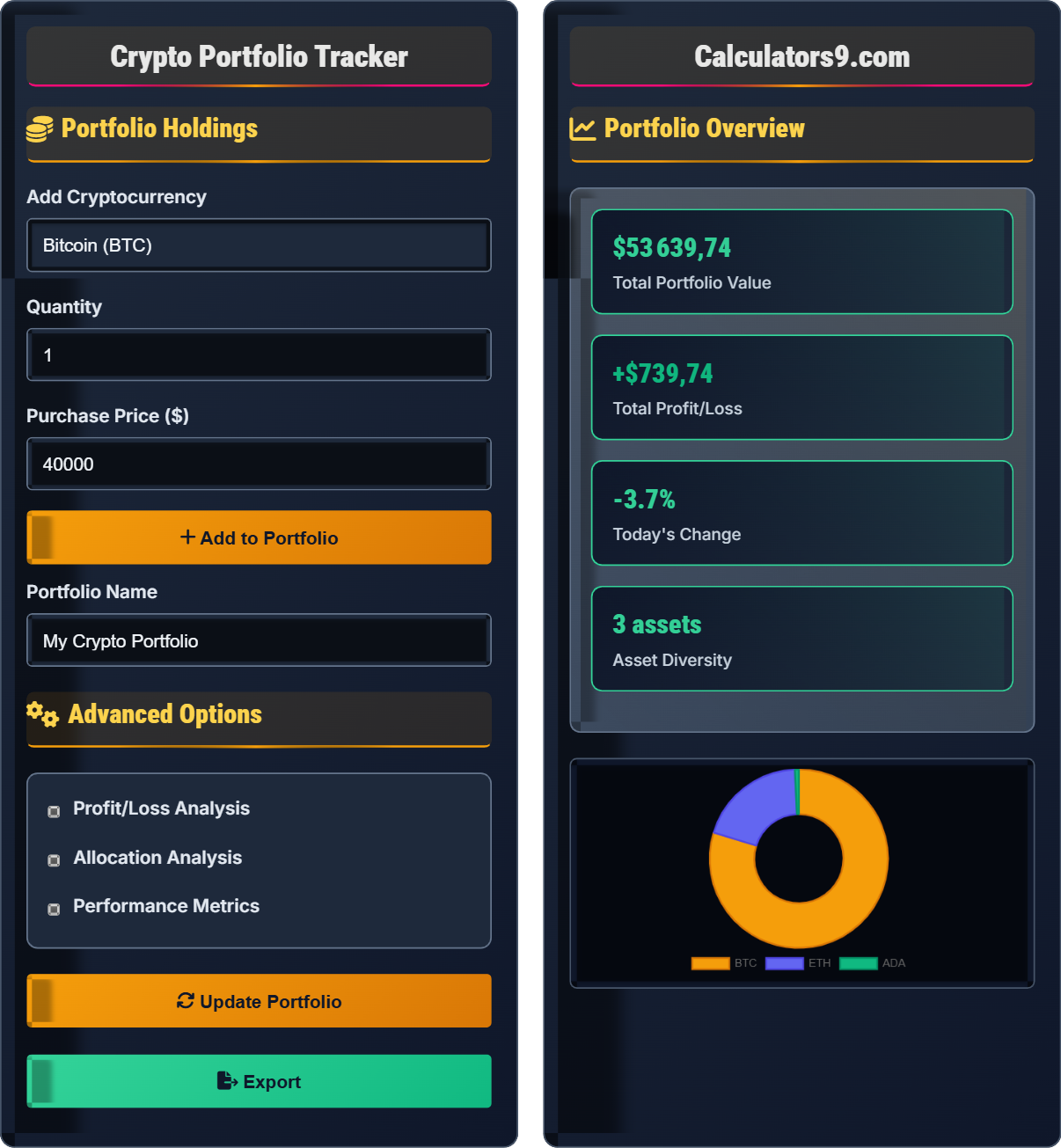
Portfolio Holdings
Advanced Options
Portfolio Overview
| Asset | Quantity | Price | Value | Profit/Loss |
|---|
| Metric | Value | Change |
|---|
Comprehensive Crypto Portfolio Guide
Cryptocurrency portfolio management involves tracking multiple digital assets, analyzing performance, and optimizing allocation. Effective portfolio management balances risk and reward while considering market volatility and diversification.
Crypto portfolio value is calculated by multiplying holdings by current prices:
Profit/loss is calculated by comparing current value to cost basis.
Effective crypto portfolio strategies include:
- Blue Chip Holdings: Major coins like BTC and ETH
- Growth Tokens: Emerging projects with potential
- Stablecoins: Pegged to stable assets for risk management
- DeFi Tokens: Decentralized finance ecosystem
- NFT/Tokens: Digital collectibles and gaming assets
- Never Invest More Than You Can Lose: Crypto markets are highly volatile
- Diversify Across Asset Classes: Don't put all funds in one coin
- Use Dollar-Cost Averaging: Invest regularly to reduce timing risk
- Secure Your Private Keys: Use hardware wallets for large holdings
- Stay Informed: Follow market news and regulatory developments
Crypto Portfolio Basics
Total value of all cryptocurrency holdings.
\( PV = \sum_{i=1}^{n} (Q_i \times P_i) \)
Where PV=portfolio value, Qi=quantity, Pi=price.
- Track cost basis for profit calculations
- Diversification reduces risk
- Markets are highly volatile
Strategies
Maximize returns with strategic allocation.
- Define risk tolerance
- Set allocation targets
- Regular rebalancing
- Monitor performance
- Regulatory changes impact crypto
- Security is paramount
- Market cycles are normal
- Emotions drive decisions
Crypto Portfolio Learning Quiz
How is the total value of a cryptocurrency portfolio calculated?
The answer is B) By multiplying quantity held by current price for each asset and summing. The portfolio value formula is PV = Σ(Qi × Pi), where Qi is the quantity of each cryptocurrency and Pi is its current price. This gives the total market value of all holdings.
This question tests understanding of the fundamental portfolio valuation method. Each holding must be valued individually at current market prices, then summed to get the total portfolio value. This differs from cost basis calculations which track purchase prices.
Portfolio Value: Total market value of all holdings
Current Price: Real-time market value of an asset
Quantity: Amount of cryptocurrency held
• Value each asset separately at current market prices
• Sum all individual values for total portfolio value
• Prices change constantly, so value fluctuates
• Track quantities precisely including decimals
• Use reliable price feeds for accuracy
• Update regularly to reflect market changes
• Confusing cost basis with current value
• Forgetting to include all holdings
• Using outdated price data
Calculate the portfolio value for 1 BTC at $45,000, 5 ETH at $3,000, and 100 ADA at $0.50. Show your work.
Using the portfolio value formula: PV = Σ(Qi × Pi)
Bitcoin: 1 × $45,000 = $45,000
Ethereum: 5 × $3,000 = $15,000
Cardano: 100 × $0.50 = $50
Total Portfolio Value = $45,000 + $15,000 + $50 = $60,050
This calculation demonstrates how to value a diversified crypto portfolio. Each asset is valued separately based on current market prices, then summed. Note that even small amounts of many different coins can add up to significant value.
Market Value: Current price at which an asset trades
Diversification: Spreading investments across different assets
Portfolio Valuation: Determining total worth of all holdings• Multiply quantity by current price for each asset
• Sum all individual values for total
• Include all holdings regardless of size
• Organize holdings by asset for clarity
• Use spreadsheet for complex portfolios
• Include small holdings that add up
• Forgetting to include smaller holdings
• Using purchase prices instead of current prices
• Arithmetic errors with decimals
Sarah bought 2 BTC at $35,000 each and 10 ETH at $2,500 each. Current prices are $45,000 for BTC and $3,000 for ETH. What is her total profit/loss?
Cost Basis:
BTC: 2 × $35,000 = $70,000
ETH: 10 × $2,500 = $25,000
Total Cost Basis = $70,000 + $25,000 = $95,000
Current Value:
BTC: 2 × $45,000 = $90,000
ETH: 10 × $3,000 = $30,000
Total Current Value = $90,000 + $30,000 = $120,000
Profit/Loss = $120,000 - $95,000 = $25,000 gain
This example shows how to calculate profit/loss by comparing current market value to cost basis. The profit is positive because both BTC and ETH appreciated in value. This calculation helps investors understand their realized gains.
Cost Basis: Total amount spent to acquire an asset
Realized Gain/Loss: Profit/loss when asset is sold
Unrealized Gain/Loss: Current value vs. cost basis
• Cost basis = Quantity × Purchase Price
• Profit/Loss = Current Value - Cost Basis
• Positive value = gain, negative = loss
• Track purchase dates and prices
• Calculate for each asset separately
• Consider tax implications
• Confusing cost basis with current value
• Forgetting to account for all purchases
• Not considering fees in cost basis
Mike has a portfolio of 100% Bitcoin. His friend John has 50% Bitcoin, 30% Ethereum, and 20% Cardano. If Bitcoin drops 20% while Ethereum rises 10% and Cardano rises 15%, who has the better portfolio performance?
Mike's portfolio (100% BTC):
Value drops by 20% (1.00 - 0.20 = 0.80)
Final value = 80% of original
John's portfolio:
BTC: 50% × 0.80 = 40%
ETH: 30% × 1.10 = 33%
ADA: 20% × 1.15 = 23%
Total = 40% + 33% + 23% = 96%
John's portfolio declines by only 4% while Mike's declines by 20%.
This demonstrates the power of diversification. When one asset performs poorly, others may perform well, reducing overall portfolio volatility. Diversification spreads risk across different assets and market segments.
Diversification: Spreading investments across different assets
Correlation: How assets move in relation to each other
Portfolio Volatility: Degree of variation in portfolio value
• Diversification reduces risk without sacrificing returns
• Assets don't always move together
• Correlation can change over time
• Don't over-diversify (15-20 assets max)
• Consider correlation between assets
• Rebalance periodically
• Concentrating too much in one asset
• Not rebalancing when allocations drift
• Diversifying across similar assets
Which of the following is the most important risk management principle in crypto investing?
The answer is B) Never invest more than you can afford to lose. Cryptocurrency markets are extremely volatile and unpredictable. This fundamental principle protects investors from financial ruin and emotional distress if investments decline significantly.
This addresses the fundamental risk management principle in crypto investing. The market can experience dramatic swings, and even well-researched investments can lose significant value. Protecting capital is more important than chasing returns.
Volatility: Degree of price fluctuations
Capital Protection: Preserving invested money
Risk Tolerance: Amount of risk one can accept
• Crypto markets are highly volatile
• Never invest money needed for essentials
• Risk management comes before returns
• Start with small amounts to learn
• Keep emergency funds separate
• Diversify and rebalance regularly
• Investing money needed for living expenses
• Following FOMO without research
• Not having an exit strategy
FAQ
Q: How do I calculate my crypto portfolio value?
A: Use the formula: \( PV = \sum_{i=1}^{n} (Q_i \times P_i) \) where Qi is quantity of each crypto and Pi is current price.
For example, with 1 BTC at $45,000, 5 ETH at $3,000, and 100 ADA at $0.50:
\( PV = (1 \times 45000) + (5 \times 3000) + (100 \times 0.50) = 60,050 \)
Always use current market prices for accurate valuation.
Q: How important is diversification in crypto portfolios?
A: Diversification is crucial in crypto due to high volatility. A well-diversified portfolio might include:
- Blue Chip: 40-60% (BTC, ETH)
- Mid Cap: 20-30% (SOL, ADA, DOT)
- Small Cap: 10-20% (Emerging projects)
- Stablecoins: 5-15% (Risk management)
Studies show diversified crypto portfolios have 30-50% lower volatility than concentrated positions while maintaining similar long-term returns.