Crypto Prediction Market Odds Tool
Calculate betting odds • Web3 tool
Prediction Market Formulas:
Show Calculator\( P = \frac{1}{O} \times 100 \)
Where:
- \( P \) = Implied probability (%)
- \( O \) = Decimal odds
For American odds:
- If positive: \( P = \frac{100}{O + 100} \times 100 \)
- If negative: \( P = \frac{|O|}{|O| + 100} \times 100 \)
Expected Value: \( EV = (P_{win} \times Win\_Amount) - (P_{lose} \times Loss\_Amount) \)
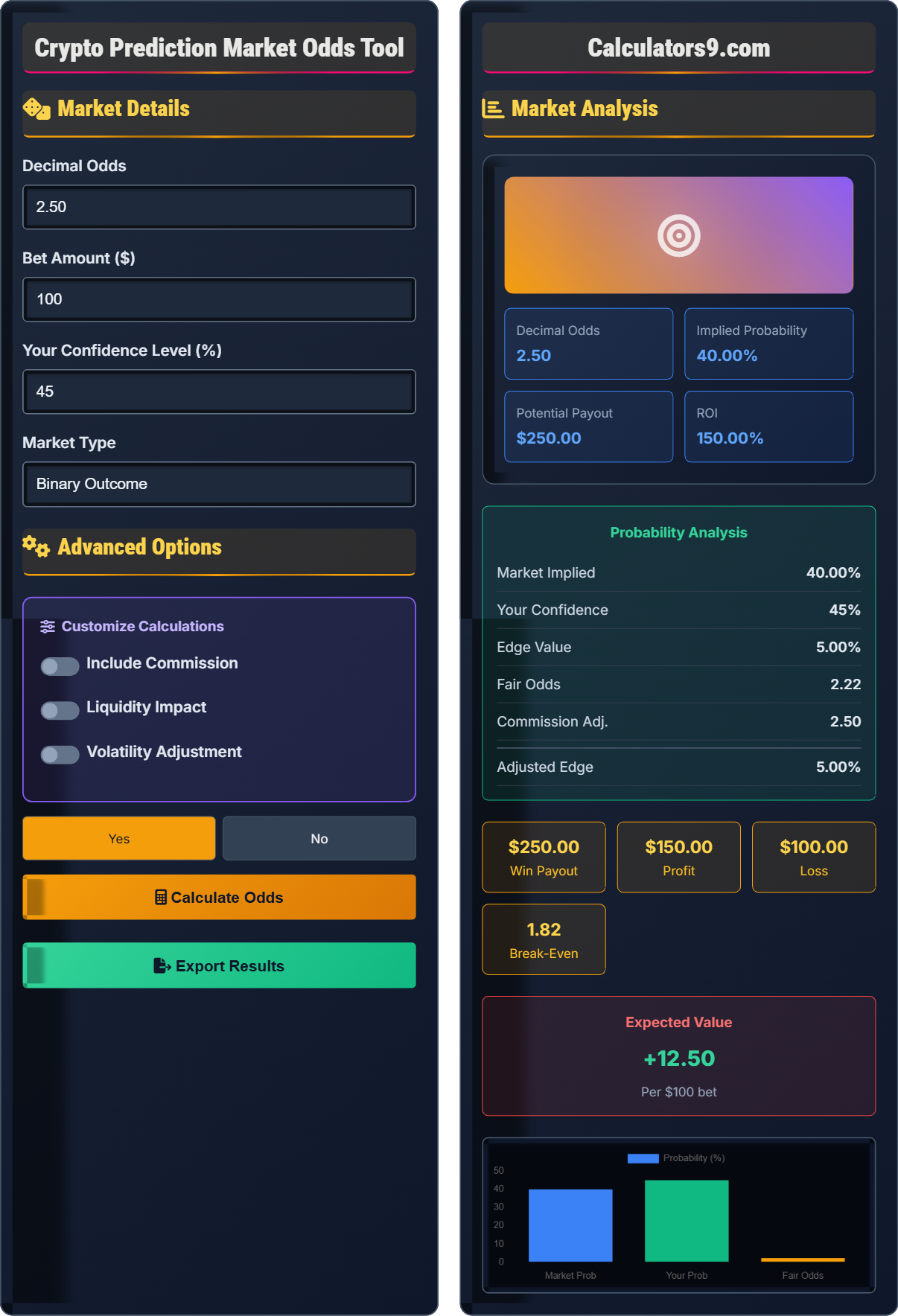
Example: For odds of 2.50 (decimal), implied probability is:
\( P = \frac{1}{2.50} \times 100 = 40\% \)
Thus, the market implies a 40% chance of the outcome occurring.
Market Details
Advanced Options
Market Analysis
Prediction Market Basics
Prediction markets allow trading on the outcome of future events. Prices reflect the market's belief about the probability of outcomes occurring.
\(P = \frac{1}{O} \times 100\)
Where P=probability, O=decimal odds.
- Lower odds = higher probability
- Higher odds = lower probability
- Markets aren't always efficient
- Edge = advantage over market
Trading Strategies
Look for discrepancies between market implied probability and your own analysis.
- Estimate true probability
- Compare to market odds
- Calculate expected value
- Place bets with positive EV
- Market efficiency varies
- Commission reduces profits
- Liquidity affects pricing
- Volatility impacts outcomes
Prediction Market Learning Quiz
What does a decimal odd of 3.00 represent in terms of implied probability?
The answer is C) 33.33%. Using the formula \(P = \frac{1}{O} \times 100\), where P is probability and O is decimal odds: \(P = \frac{1}{3.00} \times 100 = 33.33\%\). This means the market believes there's a 33.33% chance of the outcome occurring.
Understanding the relationship between odds and implied probability is fundamental to prediction market trading. The inverse relationship means lower odds correspond to higher probabilities, and vice versa. This conversion allows traders to assess whether the market's assessment aligns with their own analysis.
Decimal Odds: Odds expressed as a decimal representing payout per unit bet
Implied Probability: Probability suggested by market odds
Market Efficiency: How accurately prices reflect true probabilities
• Decimal odds include the original stake
• Lower odds mean higher probability
• Market odds may not reflect true probability
• Use: P = 1/O × 100 for conversions
• Compare market prob to your assessment
• Look for positive expected value
• Confusing decimal odds with fractional odds
• Not accounting for commission fees
• Assuming market odds are always correct
If Bitcoin is trading at $50,000 and a prediction market offers 2.00 odds that it will exceed $60,000 in 30 days, what is the implied probability and potential payout for a $200 bet?
Using the formula: \(P = \frac{1}{O} \times 100\)
Given: O = 2.00
Step 1: Calculate implied probability: P = 1/2.00 × 100 = 50%
Step 2: Calculate potential payout: Payout = Bet Amount × Decimal Odds
Step 3: Payout = $200 × 2.00 = $400
Step 4: Calculate profit: Profit = Payout - Stake = $400 - $200 = $200
Therefore, the implied probability is 50% and the potential payout is $400.
This calculation shows how prediction markets price uncertain events. The 50% implied probability suggests the market views the outcome as equally likely to occur or not occur. The 2:1 payout ratio means winning bets double the stake. Traders look for discrepancies between market probability and their own assessment.
Stake: Amount wagered on the outcome
Payout: Total amount returned if bet wins
Profit: Net gain after subtracting stake
• Payout includes original stake
• Profit = Payout - Stake
• Decimal odds show total return per unit
• Remember: Payout = Stake × Decimal Odds
• Profit = Stake × (Decimal Odds - 1)
• Compare implied prob to your assessment
• Confusing payout with profit
• Forgetting that decimal odds include stake
• Not accounting for fees in calculations
Sarah believes there's a 60% chance that Ethereum will reach $5,000 in 60 days. A prediction market offers 1.80 odds for this outcome. If she bets $1,000, what is the expected value of this bet?
Step 1: Calculate market implied probability: P_market = 1/1.80 × 100 = 55.56%
Step 2: Sarah's assessment: P_sarah = 60%
Step 3: Potential payout = $1,000 × 1.80 = $1,800
Step 4: Potential profit = $1,800 - $1,000 = $800
Step 5: Expected Value = (P_sarah × Profit) - ((1-P_sarah) × Stake)
Step 6: EV = (0.60 × $800) - (0.40 × $1,000) = $480 - $400 = $80
Therefore, the expected value of the bet is +$80.
This example demonstrates positive expected value betting. Sarah's confidence (60%) exceeds the market's implied probability (55.56%), creating an opportunity. The positive EV of $80 indicates that on average, this bet would be profitable over many repetitions. This is the foundation of profitable betting.
Expected Value: Average outcome if bet repeated many times
Positive EV: Profitable bet over long term
Negative EV: Unprofitable bet over long term• Positive EV = profitable long-term
• Negative EV = unprofitable long-term
• Find edge through superior analysis
• EV = (Win Prob × Win Amount) - (Lose Prob × Lose Amount)
• Look for market inefficiencies
• Bet only with positive EV
• Not calculating expected value before betting
• Confusing confidence with probability
• Forgetting to account for losses in EV
John places a $500 bet on a prediction market with 2.20 odds. The platform charges a 3% commission on winnings. What is his actual return if the bet wins? How does this affect his expected value if he believes the true probability is 45%? (Hint: Calculate net payout after commission)
Step 1: Calculate gross payout = $500 × 2.20 = $1,100
Step 2: Calculate commission = ($1,100 - $500) × 0.03 = $600 × 0.03 = $18
Step 3: Calculate net payout = $1,100 - $18 = $1,082
Step 4: Calculate net profit = $1,082 - $500 = $582
Step 5: Calculate EV = (0.45 × $582) - (0.55 × $500) = $261.90 - $275 = -$13.10
Therefore, John's net payout is $1,082 and his EV is -$13.10 due to the commission.
This example shows how commissions significantly impact profitability. Even though John had positive EV without fees, the 3% commission turned his bet into a negative EV proposition. This demonstrates why commission rates are critical in prediction market trading and why they should always be factored into calculations.
Gross Payout: Payout before fees/commissions
Net Payout: Payout after fees/commissions
Commission: Fee charged by platform
• Commissions reduce net profits
• Always factor in fees for EV calculations
• Lower fees = higher profitability
• Calculate net payout: Gross × (1 - commission rate)
• Factor commissions into EV calculations
• Compare commission rates across platforms
• Forgetting to account for commissions
• Calculating commission on total payout instead of profit
• Not adjusting EV for fees
Which of the following best describes a successful prediction market strategy?
The answer is C) Find positive expected value opportunities. A successful strategy involves identifying situations where your assessment of probability differs favorably from the market's implied probability. This creates an "edge" where your expected value is positive, leading to long-term profitability.
Successful prediction market trading requires finding market inefficiencies. This happens when the market's implied probability doesn't match the true probability of an outcome. By consistently betting on positive EV opportunities, traders can achieve long-term profitability despite individual losses. This requires research, analysis, and discipline.
Market Edge: Advantage over market pricing
Expected Value: Long-term average outcome
Market Inefficiency: Mispricing opportunity
• Consistently bet only positive EV
• Research thoroughly before betting
• Manage bankroll responsibly
• Develop expertise in specific markets
• Track performance and adjust strategy
• Never chase losses
• Betting without positive EV
• Not tracking performance
• Emotional decision-making
FAQ
Q: How do I calculate the implied probability from decimal odds?
A: The formula is: \(P = \frac{1}{O} \times 100\), where \(P\) is the implied probability and \(O\) is the decimal odds.
For example, if the decimal odds are 2.50:
\(P = \frac{1}{2.50} \times 100 = 40\%\)
This means the market believes there's a 40% chance of the outcome occurring. This conversion is essential for comparing market expectations with your own analysis.
Q: What is expected value and why is it important in prediction markets?
A: Expected Value (EV) is the average outcome if you placed the same bet many times. Formula: \(EV = (P_{win} \times Win\_Amount) - (P_{lose} \times Loss\_Amount)\).
For example, with 45% win probability, $200 profit on win, and $100 loss on loss:
\(EV = (0.45 \times 200) - (0.55 \times 100) = 90 - 55 = +\$35\)
Positive EV indicates profitability over time. This is the foundation of successful betting strategies.