Crypto Tax Calculator
Cryptocurrency tax reporting • 2026 data
Crypto Capital Gains Formula:
Show the calculator\( CG = (SP - BP) \times Q \)
Where:
- \( CG \) = Capital Gains
- \( SP \) = Sale Price
- \( BP \) = Basis Price (purchase price)
- \( Q \) = Quantity Sold
This formula calculates the taxable gain or loss from selling cryptocurrency.
Short-term vs Long-term: Assets held >1 year = Long-term (0-20% tax), ≤1 year = Short-term (10-37% tax).
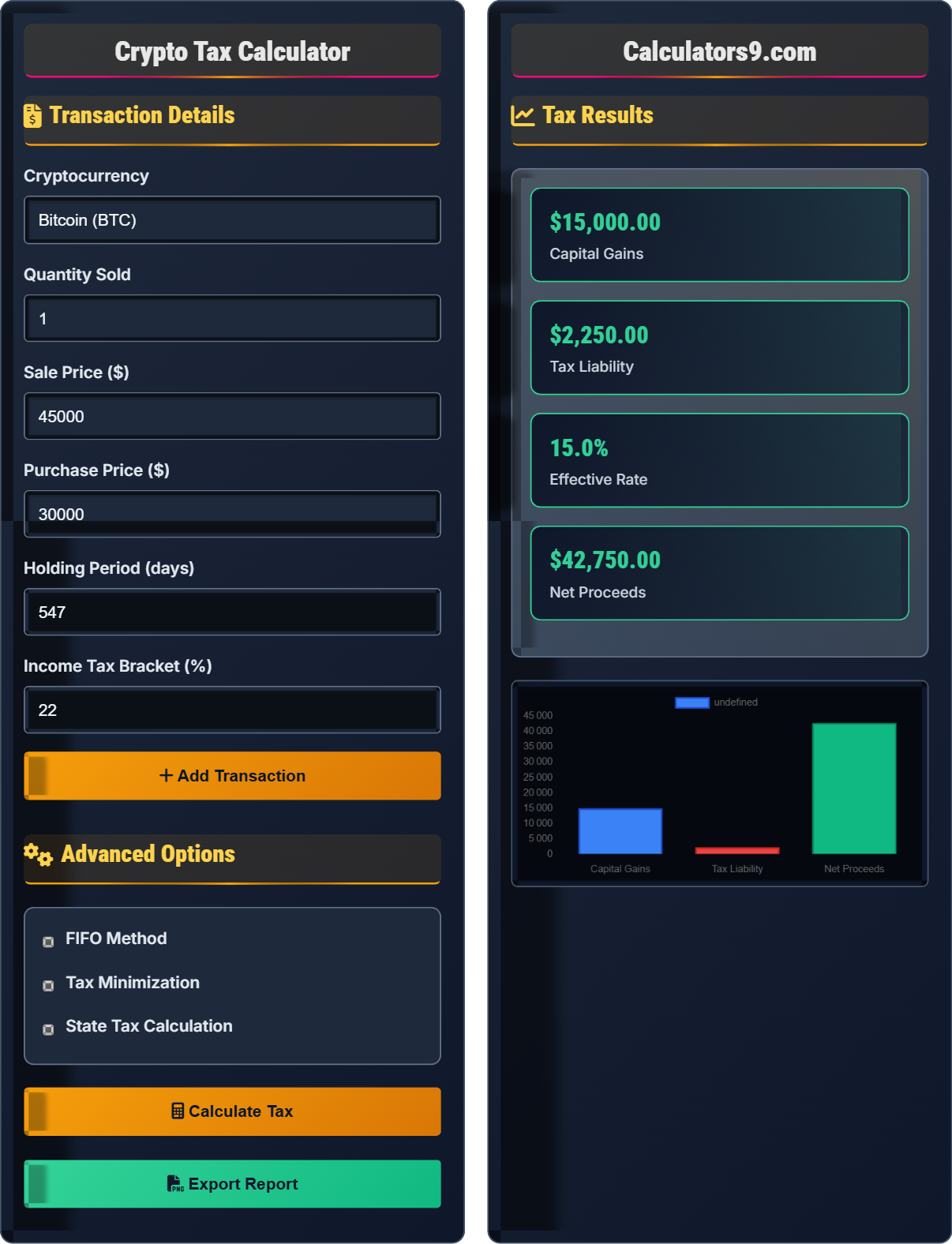
Example: Bought 1 BTC at $30,000, sold at $45,000 after 18 months:
\( CG = (45000 - 30000) \times 1 = 15,000 \)
Since held >1 year, taxed at long-term rate (e.g., 15%): $15,000 × 0.15 = $2,250 tax.
Transaction Details
Advanced Options
Tax Results
| Asset | Quantity | Sale Price | Purchase Price | Gain/Loss |
|---|
| Item | Amount | Rate |
|---|
Comprehensive Crypto Tax Guide
Cryptocurrency transactions are taxable events in most jurisdictions. The IRS treats crypto as property, subject to capital gains tax. Every sale, exchange, or use of crypto to purchase goods triggers a taxable event.
Capital gains are calculated by subtracting the cost basis from the sale proceeds:
Tax rates depend on holding period and income level.
Capital gains tax rates depend on holding period:
- Short-term: 10-37% (assets held ≤1 year)
- Long-term: 0-20% (assets held >1 year)
- Income Thresholds: Rates vary based on income level
- State Tax: Additional rates may apply by state
- Self-Employment Tax: Applies to mining/staking income
- Tax-Loss Harvesting: Sell losing positions to offset gains
- Long-term Holding: Qualify for lower tax rates
- Charitable Giving: Donate appreciated assets to avoid tax
- Retirement Accounts: Hold crypto in tax-advantaged accounts
- Cost Basis Method: Choose FIFO, LIFO, or average cost
Crypto Tax Basics
Profit from selling cryptocurrency above purchase price.
\( CG = (SP - BP) \times Q \)
Where CG=capital gains, SP=sale price, BP=purchase price, Q=quantity.
- Crypto treated as property by IRS
- Every transaction is taxable
- Hold >1 year for lower rates
Strategies
Minimize tax liability with strategic planning.
- Track all transactions
- Use tax-loss harvesting
- Hold for long-term rates
- Consider charitable donations
- Record keeping is essential
- Software can automate calculations
- Consult tax professionals
- Stay updated on regulations
Crypto Tax Learning Quiz
How does the IRS classify cryptocurrency for tax purposes?
The answer is B) Property. The IRS classifies cryptocurrency as property for tax purposes, which means it's subject to capital gains tax. This classification affects how transactions are reported and taxed.
This fundamental concept affects all crypto taxation. As property, each transaction triggers a taxable event. Unlike currency exchanges which may be tax-free, crypto-to-crypto exchanges are taxable. Understanding this classification is crucial for proper tax reporting.
Property Classification: Treatment of crypto as asset rather than currency
Taxable Event: Transaction that triggers tax obligation
Capital Gains: Profit from selling property above purchase price
• Crypto is property, not currency
• Every transaction is potentially taxable
• Cost basis must be tracked
• Keep detailed records of all transactions
• Understand property classification implications
• Consult tax professionals for complex situations
• Treating crypto like currency
• Not reporting crypto-to-crypto exchanges
• Failing to track cost basis
Calculate the capital gains for selling 2 BTC that were purchased at $35,000 each and sold at $45,000 each. Show your work.
Using the capital gains formula: CG = (SP - BP) × Q
Where:
- SP = $45,000 (sale price)
- BP = $35,000 (purchase price)
- Q = 2 (quantity sold)
Step 1: Calculate gain per unit = $45,000 - $35,000 = $10,000
Step 2: Calculate total gain = $10,000 × 2 = $20,000
Therefore, capital gains are $20,000.
This calculation shows the basic method for determining capital gains. The formula applies to any crypto asset. The gain is the difference between what you sold for and what you paid, multiplied by the quantity sold.
Cost Basis: Purchase price of the asset
Sale Proceeds: Amount received from selling
Capital Gain: Profit from selling an asset• Subtract purchase price from sale price
• Multiply by quantity sold
• Positive value = gain, negative = loss
• Track purchase date and price
• Consider fees in cost basis
• Calculate for each transaction
• Forgetting to include fees in cost basis
• Not tracking all transactions
• Confusing cost basis with current price
Sarah bought 1 ETH at $2,000 and sold it at $3,000. If she held it for 11 months, what tax rate applies? If she held it for 13 months, what rate would apply? Assume she's in the 22% income tax bracket.
For 11 months (≤1 year): Short-term capital gains rate applies, which is the same as ordinary income tax rate.
Tax = ($3,000 - $2,000) × 0.22 = $1,000 × 0.22 = $220
For 13 months (>1 year): Long-term capital gains rate applies.
For income in 22% bracket, long-term rate is typically 15%.
Tax = $1,000 × 0.15 = $150
By waiting 2 more months, Sarah saves $70 in taxes.
This demonstrates the significant tax advantage of holding crypto for more than one year. The difference between short-term rates (22% in this case) and long-term rates (15%) can result in substantial tax savings.
Short-term Gains: Assets held ≤1 year (taxed at ordinary income rate)
Long-term Gains: Assets held >1 year (lower tax rates)
Tax Brackets: Different rates for different income levels
• ≤1 year = Short-term rates (higher)
• >1 year = Long-term rates (lower)
• Holding period is critical for tax planning
• Plan sales around 1-year anniversary
• Consider long-term holding for tax benefits
• Track exact purchase dates
• Selling just before 1-year mark
• Not understanding holding period rules
• Confusing tax brackets with capital gains rates
Mike has two positions: 1 BTC bought at $50,000 (now worth $40,000) and 1 ETH bought at $2,000 (now worth $3,000). If he sells the BTC at a loss and the ETH at a gain, what is his net capital gain/loss? How does this affect his taxes?
BTC Position:
Gain/Loss = $40,000 - $50,000 = -$10,000 (loss)
ETH Position:
Gain/Loss = $3,000 - $2,000 = $1,000 (gain)
Net Capital Gain/Loss = -$10,000 + $1,000 = -$9,000 (net loss)
Mike has a $9,000 net capital loss, which can offset other gains or up to $3,000 of ordinary income.
This demonstrates tax-loss harvesting, where investors sell losing positions to offset gains. Capital losses can offset capital gains dollar-for-dollar, and up to $3,000 of ordinary income annually. Excess losses carry forward to future years.
Tax-Loss Harvesting: Selling losing investments to offset gains
Capital Loss: Loss from selling an asset below purchase price
Loss Carryforward: Unused losses applied to future tax years
• Losses offset gains first
• Up to $3,000 can offset ordinary income
• Excess losses carry forward indefinitely
• Harvest losses near year-end
• Avoid wash sale rules
• Track losses for carryforward
• Not utilizing losses to offset gains
• Forgetting about $3,000 limit
• Triggering wash sale violations
Which cost basis method is most commonly used for crypto transactions?
The answer is B) First-In, First-Out (FIFO). FIFO assumes that the first coins purchased are the first ones sold. This is the default method for crypto transactions unless the taxpayer can specifically identify which coins were sold.
Cost basis methods determine which coins' purchase price is used when calculating gains. FIFO typically results in higher taxes in rising markets (selling older, lower-cost coins first). Specific identification allows taxpayers to choose which coins to sell, offering the most tax optimization.
Cost Basis Method: Way to determine purchase price of sold coins
FIFO: First coins in are first coins out
Specific ID: Choose which specific coins to sell
• FIFO is default method
• Specific ID requires detailed records
• Must be documented before sale
• Document specific ID before selling
• Consider market conditions when choosing method
• Keep detailed records for all transactions
• Not documenting specific ID elections
• Using wrong cost basis method
• Failing to track purchase dates
FAQ
Q: How do I calculate capital gains on crypto sales?
A: Use the formula: \( CG = (SP - BP) \times Q \) where SP=sale price, BP=buying price, Q=quantity.
For example, selling 1 BTC at $45,000 bought at $30,000:
\( CG = (45000 - 30000) \times 1 = 15,000 \)
If held >1 year, tax at long-term rate (e.g., 15%): $15,000 × 0.15 = $2,250 tax.
Keep detailed records of purchase dates and prices for accurate calculations.
Q: What's the difference between short-term and long-term crypto taxes?
A: The difference is significant:
- Short-term: ≤1 year holding period, taxed at ordinary income rate (10-37%)
- Long-term: >1 year holding period, taxed at preferential rate (0-20%)
For someone in the 22% bracket:
Short-term: $10,000 gain × 22% = $2,200 tax
Long-term: $10,000 gain × 15% = $1,500 tax
Waiting just one day longer saves $700 in taxes!