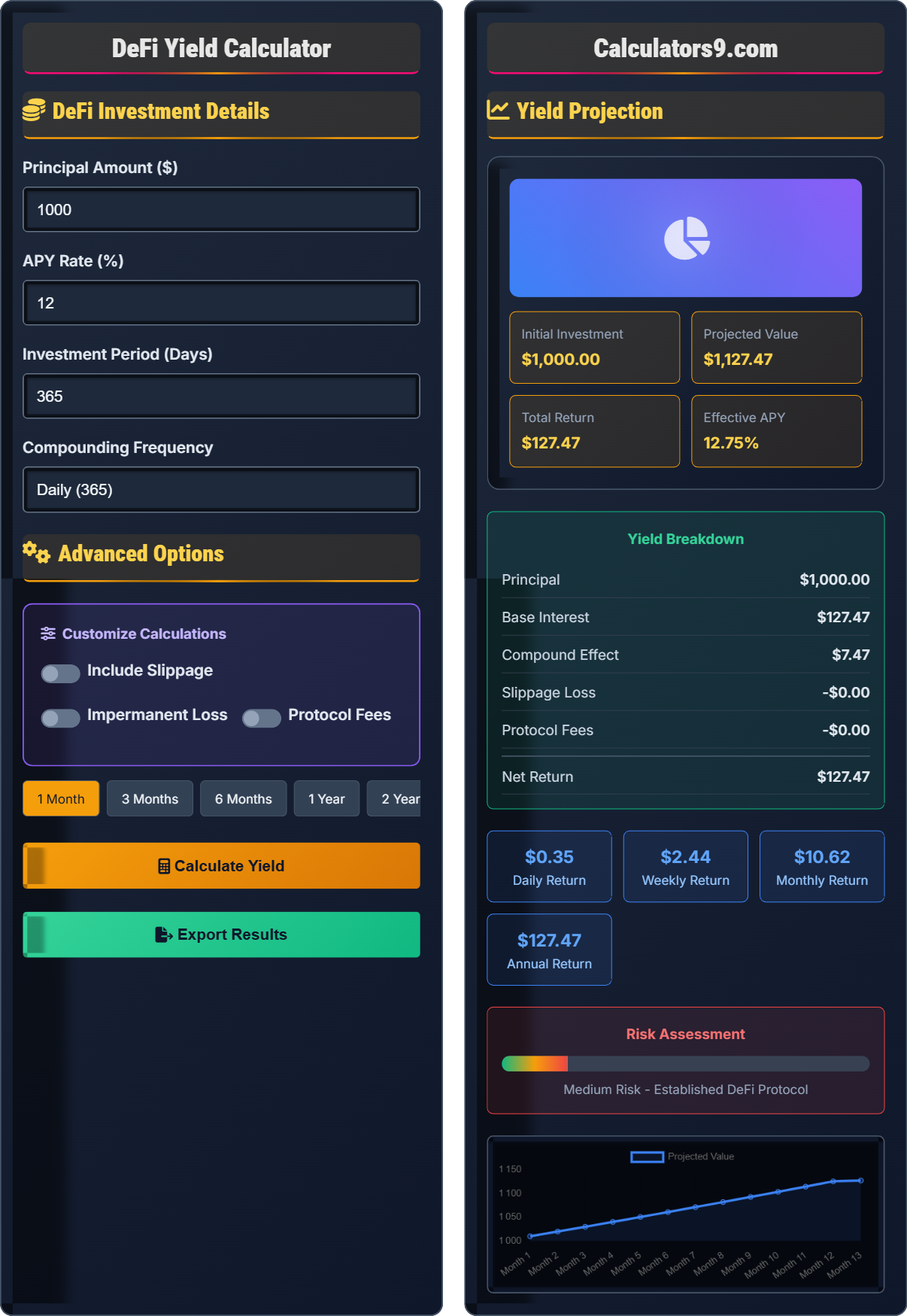
DeFi Yield Calculator
Calculate APY returns • Web3 tool
DeFi Yield Formula:
Show Calculator\( A = P(1 + \frac{r}{n})^{nt} \)
Where:
- \( A \) = Final amount including interest
- \( P \) = Principal investment amount
- \( r \) = Annual interest rate (decimal)
- \( n \) = Number of times interest is compounded per year
- \( t \) = Time the money is invested for (years)
This formula calculates compound interest returns in DeFi protocols. For continuous compounding: \( A = Pe^{rt} \)
Example: Investing $1,000 at 12% APY compounded daily for 1 year:
\( A = 1000(1 + \frac{0.12}{365})^{365 \times 1} \)
\( A = 1000(1 + 0.0003287)^{365} = 1000(1.1275) = \$1,127.50 \)
Thus, the investor earns $127.50 in yield.
DeFi Investment Details
Advanced Options
Yield Projection
DeFi Yield Basics
DeFi yield refers to returns earned through decentralized finance protocols by providing liquidity, staking tokens, or participating in yield farming activities.
\(A = P(1 + \frac{r}{n})^{nt}\)
Where A=final amount, P=principal, r=rate, n=compounding frequency, t=time.
- Higher compounding = higher returns
- APY includes compounding effect
- Risk varies by protocol
- Impermanent loss possible
Yield Strategies
Choose protocols with optimal risk-reward ratios and reinvest yields for compounding growth.
- Monitor compounding frequency
- Assess protocol risks
- Diversify investments
- Track impermanent loss
- Smart contract risks
- Market volatility
- Liquidity requirements
- Tax implications
DeFi Yield Learning Quiz
What does APY stand for in DeFi contexts?
The answer is A) Annual Percentage Yield. APY represents the real rate of return earned on an investment, taking into account the effect of compounding interest. Unlike APR (Annual Percentage Rate), APY reflects the actual growth of your investment over a year.
Understanding APY is fundamental to DeFi investing because it accounts for compound interest, which is how most DeFi protocols reward investors. The compounding effect means you earn interest on your interest, leading to exponential growth over time.
APY: Annual Percentage Yield - actual rate of return with compounding
APR: Annual Percentage Rate - simple interest rate without compounding
Compounding: Earning interest on both principal and previously earned interest
• APY is always higher than APR when compounding occurs more than once per year
• More frequent compounding increases APY
• APY provides a more accurate picture of returns
• Remember: APY includes compounding, APR does not
• Daily compounding yields higher APY than annual
• Compare APYs to evaluate DeFi opportunities
• Confusing APR with APY
• Underestimating compounding effects
• Not accounting for compounding frequency
If you invest $5,000 in a DeFi protocol offering 8% APY compounded daily, what will be the value of your investment after 2 years? Show your work.
Using the compound interest formula: \(A = P(1 + \frac{r}{n})^{nt}\)
Given:
- P = $5,000 (principal)
- r = 0.08 (8% annual rate)
- n = 365 (daily compounding)
- t = 2 (years)
Step 1: Calculate periodic rate: r/n = 0.08/365 = 0.000219
Step 2: Calculate total periods: nt = 365 × 2 = 730
Step 3: Apply formula: A = $5,000(1 + 0.000219)^730
Step 4: Calculate: A = $5,000(1.000219)^730 = $5,000(1.1735) = $5,867.50
Therefore, the investment will be worth $5,867.50 after 2 years.
This calculation demonstrates the power of daily compounding in DeFi. The slight advantage over simple interest compounds significantly over longer periods. The formula accounts for the fact that interest is added to the principal daily, allowing the next day's interest to be calculated on a larger amount.
Principal: Initial investment amount
Compounding Frequency: How often interest is calculated and added
Time Period: Duration of investment
• More frequent compounding increases final value
• Longer investment periods amplify compounding effects
• Small differences in APY compound over time
• Use the formula: A = P(1 + r/n)^(nt)
• Convert percentages to decimals (8% = 0.08)
• Count compounding periods carefully
• Forgetting to convert percentage to decimal
• Miscounting compounding periods
• Confusing daily vs annual compounding calculations
Sarah deposits $10,000 into a liquidity pool earning 15% APY. However, she experiences 3% impermanent loss over the year. If the pool compounds weekly, what is her actual return after accounting for impermanent loss?
Step 1: Calculate base return with compounding
A = $10,000(1 + 0.15/52)^(52×1) = $10,000(1.002885)^52 = $11,618.34
Step 2: Apply impermanent loss: $11,618.34 × (1 - 0.03) = $11,618.34 × 0.97 = $11,269.79
Step 3: Calculate actual return: $11,269.79 - $10,000 = $1,269.79
Step 4: Calculate effective APY: ($1,269.79/$10,000) × 100 = 12.70%
Therefore, Sarah's actual return is $1,269.79 (12.70% APY) after impermanent loss.
This example illustrates the important concept of impermanent loss in DeFi liquidity provision. Even though the protocol advertised a 15% APY, the actual return was lower due to price divergence between paired assets. Investors must consider all factors affecting returns, not just stated yields.
Impermanent Loss: Loss due to price divergence in liquidity pools
Liquidity Pool: Pool of tokens providing trading liquidity
Price Divergence: Difference in price movement between paired assets
• Impermanent loss affects liquidity providers
• It's temporary if prices revert to original ratio
• High volatility increases impermanent loss risk
• Research historical price correlations
• Consider stablecoin pairs to minimize risk
• Factor impermanent loss into yield calculations
• Ignoring impermanent loss in yield projections
• Not considering correlation between paired assets
• Confusing advertised APY with actual returns
John invests $2,500 in a DeFi protocol with 10% APY compounded daily. The protocol charges a 0.5% withdrawal fee and 1% management fee annually. What is his net return after 1 year? (Hint: Calculate base return, subtract fees, then determine net gain)
Step 1: Calculate base return: A = $2,500(1 + 0.10/365)^365 = $2,500(1.1052) = $2,763.00
Step 2: Calculate management fee: $2,763.00 × 0.01 = $27.63
Step 3: Calculate value after management fee: $2,763.00 - $27.63 = $2,735.37
Step 4: Calculate withdrawal fee: $2,735.37 × 0.005 = $13.68
Step 5: Calculate final value: $2,735.37 - $13.68 = $2,721.69
Step 6: Calculate net return: $2,721.69 - $2,500 = $221.69
Therefore, John's net return after all fees is $221.69.
This calculation highlights the significant impact of fees on DeFi investment returns. While the protocol offered a 10% APY, various fees reduced the actual return to 8.87%. Investors must carefully analyze all associated costs when evaluating DeFi opportunities.
Management Fee: Annual fee charged by protocol managers
Withdrawal Fee: Fee charged when withdrawing funds
Net Return: Actual profit after all deductions
• All fees reduce net returns
• Compound fees over time
• Transparent protocols disclose all fees
• Read fee structures carefully
• Calculate net APY after fees
• Compare total cost across protocols
• Not accounting for all protocol fees
• Confusing fee timing and calculation order
• Underestimating cumulative fee impact
Which of the following is the MOST important consideration when evaluating DeFi yield opportunities?
The answer is C) Risk-reward balance and protocol security. While high APY is attractive, sustainable returns require evaluating the underlying risks, including smart contract vulnerabilities, impermanent loss, market volatility, and protocol governance. Security audits and risk assessment are crucial for protecting capital.
Successful DeFi investing requires balancing potential returns with risk management. Protocols offering extremely high yields often carry proportionally higher risks. Investors should evaluate the sustainability of yields, security measures, and overall risk profile rather than focusing solely on advertised APY figures.
Risk-Reward Ratio: Relationship between potential returns and associated risks
Smart Contract Audit: Security review of code governing DeFi protocols
Capital Preservation: Protecting initial investment principal
• Higher yields often indicate higher risks
• Security audits don't guarantee safety
• Diversification reduces portfolio risk
• Research protocol team and track record
• Check for third-party security audits
• Assess TVL and trading volume trends
• Chasing highest APY without risk assessment
• Not diversifying across protocols
• Ignoring smart contract risks
FAQ
Q: How does compounding frequency affect my DeFi returns?
A: Compounding frequency significantly impacts returns in DeFi. The formula is: \(A = P(1 + \frac{r}{n})^{nt}\), where \(n\) is the compounding frequency.
For example, with $1,000 at 12% APY:
- Annual: \(A = 1000(1 + \frac{0.12}{1})^{1} = \$1,120\)
- Daily: \(A = 1000(1 + \frac{0.12}{365})^{365} = \$1,127.50\)
Daily compounding yields $7.50 more than annual due to interest-on-interest effects.
Q: What is impermanent loss and how does it affect liquidity providers?
A: Impermanent loss occurs when the price ratio of tokens in a liquidity pool diverges from when they were deposited. LPs lose potential gains compared to holding tokens independently.
Formula: \(IL = 2\sqrt{xy}/(\frac{x+y}{2}) - 1\), where x and y are price ratios.
For example, if ETH doubles while USDC stays constant in an ETH-USDC pool, the LP earns less than simply holding ETH. The loss is "impermanent" because it disappears if prices revert to original ratios.