Gas Fee Estimator
Cryptocurrency transaction fees • 2026 data
Gas Fee Formula:
Show the calculator\( GF = GL \times GP \times GPF \)
Where:
- \( GF \) = Gas Fee
- \( GL \) = Gas Limit
- \( GP \) = Gas Price
- \( GPF \) = Gas Price Factor (adjustment for network conditions)
This formula calculates the cost of executing a transaction on a blockchain network.
Example: For a simple token transfer with gas limit of 21,000, gas price of 20 gwei, and network factor of 1.2:
\( GF = 21000 \times 20 \times 1.2 = 504,000 \) gwei
\( GF = 0.000504 \) ETH (since 1 ETH = 10^18 wei)
At $2,000/ETH, the fee would be $1.01.
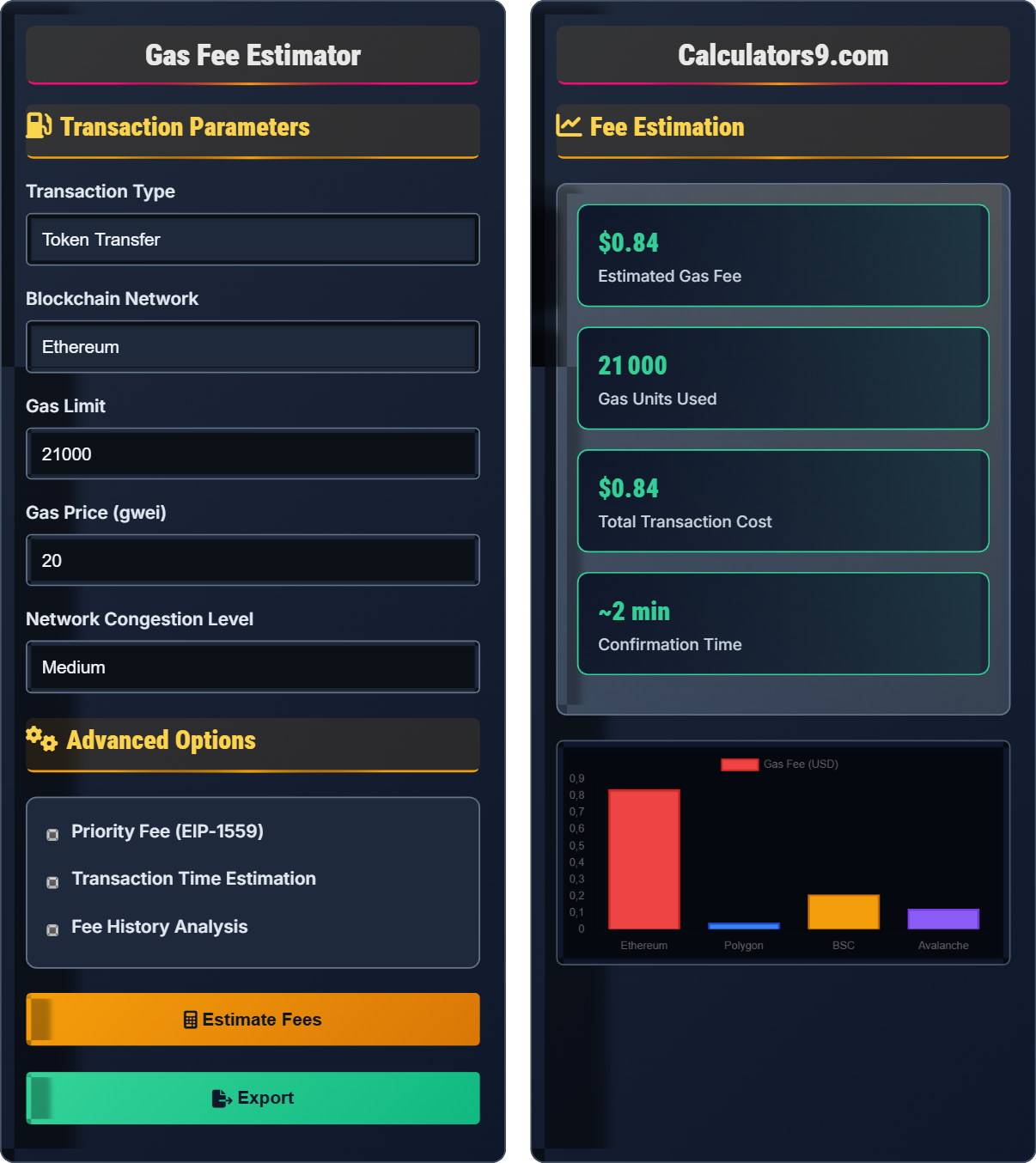
Transaction Parameters
Advanced Options
Fee Estimation
| Component | Value | Cost |
|---|
| Network | Gas Price | Fee Level |
|---|
Comprehensive Gas Fee Guide
Gas fees are payments made by users to compensate for the computing energy required to process and validate transactions on a blockchain network. These fees ensure network security and prevent spam.
Gas fees are calculated using gas limits and gas prices:
On networks with EIP-1559, fees include base fee and priority fee.
Typical gas fees across different networks:
- Ethereum: $1-100+ depending on congestion
- Polygon: $0.01-0.50 (significantly cheaper)
- BSC: $0.05-2.00 (low-medium fees)
- Avalanche: $0.10-5.00 (fast, affordable)
- Layer 2s: $0.01-1.00 (much cheaper)
- Time Transactions: Execute during low-congestion periods
- Use Layer 2: Polygon, Arbitrum, Optimism for cheaper fees
- Batch Operations: Combine multiple actions in one transaction
- Monitor Gas Prices: Use tools to find optimal times
- Choose Right Network: Select based on use case and fees
Gas Fee Basics
Payment for blockchain transaction processing.
\( GF = GL \times GP \times GPF \)
Where GF=fee, GL=limit, GP=price, GPF=factor.
- Higher congestion = higher fees
- Complex transactions cost more
- Layer 2 networks are cheaper
Strategies
Reduce transaction costs strategically.
- Monitor network congestion
- Choose optimal transaction time
- Use Layer 2 networks
- Batch multiple operations
- Speed vs. cost trade-off
- Network security matters
- Transaction urgency affects timing
- Alternative networks available
Gas Fee Estimation Learning Quiz
What are gas fees in cryptocurrency transactions?
The answer is B) Payment for computational resources on blockchain. Gas fees compensate for the computational energy required to process and validate transactions on blockchain networks. They ensure network security and prevent spam attacks.
Gas fees represent the cost of using blockchain network resources. Just like paying for electricity to power computers, gas fees pay for the computational work required to execute transactions and smart contracts. This mechanism incentivizes miners/validators and prevents network abuse.
Gas Fee: Payment for blockchain transaction processing
Computational Resources: Computing power required for transactions
Network Security: Prevention of spam and abuse
• Gas fees ensure network security
• They prevent spam transactions
• Higher complexity = higher fees
• Simple transfers cost less than smart contracts
• Monitor network congestion
• Consider Layer 2 networks
• Confusing gas fees with exchange fees
• Not understanding the purpose
• Ignoring network alternatives
Calculate the gas fee for a transaction with gas limit of 50,000 and gas price of 15 gwei. Show your work.
Using the gas fee formula: GF = GL × GP
Where:
- GL = 50,000 (gas limit)
- GP = 15 (gas price in gwei)
Step 1: Calculate fee in gwei = 50,000 × 15 = 750,000 gwei
Step 2: Convert to ETH = 750,000 ÷ 1,000,000,000 = 0.00075 ETH
At $2,000/ETH, fee = 0.00075 × $2,000 = $1.50
This calculation shows the basic method for determining gas fees. The gas limit represents the maximum computational steps allowed, while gas price is the amount paid per unit. Multiplying them gives the total fee.
Gas Limit: Maximum computational steps allowed
Gas Price: Amount paid per gas unit
Gwei: Unit of measurement (1 gwei = 10^9 wei)
• Fee = Gas Limit × Gas Price
• Higher gas price = faster processing
• Gas limit prevents infinite loops
• Wallets often estimate gas limits
• Adjust gas price for priority
• Complex contracts need higher limits
• Forgetting unit conversions
• Setting gas limit too low
• Confusing gas price with gas limit
Sarah wants to transfer tokens during high network congestion. Her usual gas price is 20 gwei, but during high congestion it increases to 80 gwei. If her transaction has a gas limit of 45,000, how much more expensive is the transaction during high congestion?
Normal Conditions:
Fee = 45,000 × 20 = 900,000 gwei = 0.0009 ETH
High Congestion:
Fee = 45,000 × 80 = 3,600,000 gwei = 0.0036 ETH
Difference = 0.0036 - 0.0009 = 0.0027 ETH
At $2,000/ETH, difference = 0.0027 × $2,000 = $5.40
The transaction costs $5.40 more during high congestion.
This demonstrates how network congestion dramatically increases transaction costs. During busy periods, users compete for block space by offering higher gas prices, causing fees to spike. Planning transactions for low-congestion times can save significant costs.
Network Congestion: High volume of pending transactions
Gas Auction: Competition for block inclusion
Priority Fees: Additional payment for faster processing
• Congestion increases gas prices
• Fees can increase exponentially
• Time of day affects congestion
• Avoid peak hours when possible
• Use gas tracking tools
• Consider Layer 2 alternatives
• Not checking network conditions
• Ignoring gas price fluctuations
• Paying premium unnecessarily
Mike pays $15 for an Ethereum transaction. The same transaction on Polygon costs 1/100th of the Ethereum fee. How much does the Polygon transaction cost? What percentage is saved?
Polygon Fee = $15 ÷ 100 = $0.15
Savings Amount = $15 - $0.15 = $14.85
Savings Percentage = ($14.85 ÷ $15) × 100 = 99%
The Polygon transaction costs $0.15, saving 99% compared to Ethereum.
This illustrates the significant cost savings of Layer 2 solutions. Polygon and other Layer 2 networks offer much cheaper transactions by processing them off the main Ethereum chain and settling in batches, dramatically reducing costs.
Layer 2: Scaling solutions built on main blockchain
Cost Efficiency: Significantly lower transaction fees
Batch Processing: Multiple transactions settled together
• Layer 2 networks are much cheaper
• Security model differs from main chain
• Savings can be 90%+
• Use Layer 2 for frequent transactions
• Check bridge security
• Verify network compatibility
• Not considering Layer 2 alternatives
• Ignoring security differences
• Assuming all networks are equal
What does EIP-1559 introduce to Ethereum gas fees?
The answer is B) Base fee and priority fee structure. EIP-1559 introduced a new fee market mechanism that includes a base fee (burned) and a priority fee (paid to miners), making fees more predictable and reducing waste.
EIP-1559 revolutionized Ethereum's fee structure by introducing a base fee that's burned (reducing ETH supply) and a priority fee for miners. This creates more predictable fees and reduces overpayment while improving network economics.
EIP-1559: Ethereum Improvement Proposal 1559
Base Fee: Minimum fee burned with each transaction
Priority Fee: Tip to miners for faster processing
• Base fee is burned permanently
• Priority fee incentivizes miners
• More predictable fee structure
• Understand both base and priority fees
• EIP-1559 makes fees more predictable
• Some gas is permanently burned
• Confusing old and new fee structures
• Not understanding base fee burn
• Assuming all networks use EIP-1559
FAQ
Q: How do I calculate gas fees for Ethereum transactions?
A: Use the formula: \(GF = GL \times GP\) where GL=gas limit, GP=gas price.
For a simple transfer with 21,000 gas limit at 20 gwei:
\(GF = 21000 \times 20 = 420,000\) gwei
\(GF = 0.00042\) ETH (since 1 ETH = 10^18 wei)
At $2,000/ETH, fee = $0.84. With EIP-1559, add priority fee for faster processing.
Q: What's the difference between Layer 1 and Layer 2 gas fees?
A: Layer 1 (Ethereum mainnet) fees are typically $1-100+ due to high demand and limited capacity. Layer 2 solutions (Polygon, Arbitrum, Optimism) offer much cheaper fees:
- Ethereum: $1-100+ per transaction
- Polygon: $0.01-0.50 (99%+ savings)
- Arbitrum: $0.05-2.00 (90%+ savings)
- Optimism: $0.10-1.00 (90%+ savings)
Layer 2s achieve savings through batching transactions and settling on mainnet in bulk.