NFT Royalty Calculator
Calculate creator earnings • Web3 tool
NFT Royalty Formula:
Show Calculator\( R = S \times \frac{r}{100} \)
Where:
- \( R \) = Royalty amount received by creator
- \( S \) = Sale price of NFT
- \( r \) = Royalty percentage (set by creator)
This formula calculates the earnings creators receive whenever their NFT is resold on a marketplace. Typical royalty rates range from 2.5% to 10% of the sale price.
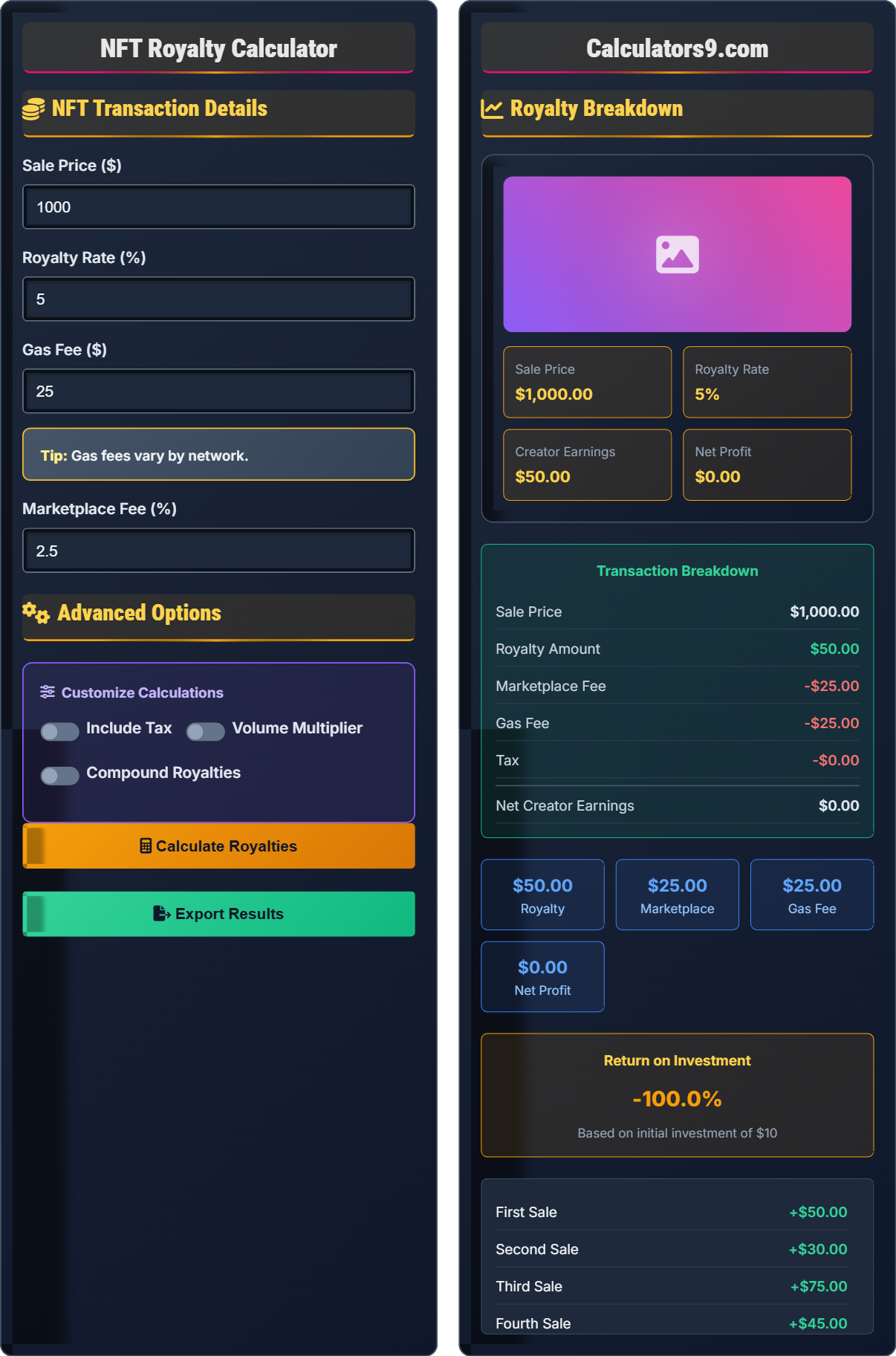
Example: For an NFT sold at $1,000 with a 5% royalty rate:
\( R = 1000 \times \frac{5}{100} = 1000 \times 0.05 = \$50 \)
Thus, the original creator receives $50 from the resale transaction.
NFT Transaction Details
Advanced Options
Royalty Breakdown
NFT Royalty Basics
NFT royalties are automated payments that go to the original creator whenever their NFT is resold. These smart contract-based payments ensure creators continue earning from their work beyond the initial sale.
\(R = S \times \frac{r}{100}\)
Where R=royalty amount, S=sale price, r=royalty percentage.
- Royalties are set during minting
- Typical rates: 2.5% - 10%
- Not all marketplaces support
- Smart contract enforced
Web3 Strategies
Set optimal royalty rates and choose marketplaces that support ongoing creator revenue.
- Research marketplace policies
- Consider competitive rates
- Factor in gas fees
- Plan for volume discounts
- Higher rates may reduce sales
- Some platforms don't enforce
- Tax implications vary
- Smart contract security
NFT Royalty Learning Quiz
What percentage of the sale price do NFT creators typically receive as royalties?
The answer is B) 2.5% - 10%. NFT creators typically set royalty rates between 2.5% and 10% of the resale price when minting their NFTs. This range balances the need to earn ongoing revenue with the desire to keep resales attractive to collectors.
Understanding typical royalty ranges is crucial for both creators and collectors. Too high a rate may discourage resales, while too low a rate means creators miss out on ongoing revenue. The 2.5%-10% range represents industry consensus on reasonable compensation for original creators.
NFT Royalties: Automatic payments to original creators when NFTs are resold
Smart Contract: Self-executing contract with terms directly written into code
Resale: Subsequent sale of an NFT after the initial purchase
• Royalty rates are set during minting and cannot be changed
• Most marketplaces honor the royalty settings
• Some platforms don't enforce royalties
• Research marketplace policies before setting rates
• Consider starting with 5% as a balanced option
• Factor in gas fees when determining optimal rates
• Setting rates too high, deterring collectors
• Setting rates too low, missing earning opportunities
• Not researching marketplace royalty enforcement
If an NFT is resold for $2,500 and the original creator set a 7% royalty rate, how much will the creator earn from this resale? Show your work.
Using the NFT royalty formula: \(R = S \times \frac{r}{100}\)
Given:
- S = $2,500 (sale price)
- r = 7% (royalty rate)
Step 1: Convert percentage to decimal: 7% = 0.07
Step 2: Apply formula: R = $2,500 × 0.07
Step 3: Calculate: R = $175
Therefore, the creator will earn $175 from this resale.
This calculation demonstrates the direct relationship between sale price and royalty earnings. The higher the resale value, the greater the royalty payment to the original creator. This incentivizes creators to build valuable communities around their work.
Royalty Amount: The actual dollar amount earned by the creator
Sale Price: The price at which the NFT is resold
Royalty Rate: Percentage set by creator during minting
• Royalties are calculated on the sale price, not original price
• The rate is set permanently during minting
• Payments are automatic through smart contracts
• Remember: R = S × (r/100)
• Convert percentage to decimal for calculations
• Higher-value NFTs generate more royalties
• Forgetting to convert percentage to decimal
• Using original minting price instead of resale price
• Calculating on gross instead of net sale amount
Sarah creates an NFT collection with a 5% royalty rate. One of her NFTs is initially sold for $500, then resold for $1,200, and finally resold again for $2,000. How much total will Sarah earn in royalties from these resales?
Step 1: First resale royalty = $1,200 × 5% = $1,200 × 0.05 = $60
Step 2: Second resale royalty = $2,000 × 5% = $2,000 × 0.05 = $100
Step 3: Total royalties = $60 + $100 = $160
Note: The initial $500 sale doesn't generate royalties for Sarah since it was the original purchase.
Therefore, Sarah will earn $160 in total royalties from the resales.
This example shows how multiple resales can generate significant ongoing revenue for creators. Each resale triggers the royalty payment mechanism, providing passive income streams. The increasing resale values demonstrate the potential for exponential earnings growth.
Multiple Resales: Sequential sales of the same NFT to different owners
Passive Income: Earnings received without active work
Value Appreciation: Increase in NFT value over time
• Royalties only apply to resales, not original purchases
• Each resale generates a separate royalty payment
• Total earnings accumulate over multiple resales
• Calculate each resale separately
• Remember: only resales generate royalties
• Track resales to monitor earnings
• Including original purchase in royalty calculations
• Adding all sale prices before applying rate
• Forgetting that each resale is independent
John sells his NFT for $1,500 with a 6% royalty rate. The marketplace charges a 2.5% fee on the sale. If John also pays $30 in gas fees, what is his net profit after all deductions? (Hint: Calculate royalty, marketplace fee, subtract gas, then find net profit)
Step 1: Calculate royalty payment = $1,500 × 6% = $1,500 × 0.06 = $90
Step 2: Calculate marketplace fee = $1,500 × 2.5% = $1,500 × 0.025 = $37.50
Step 3: Calculate total deductions = $90 + $37.50 + $30 = $157.50
Step 4: Calculate net profit = $1,500 - $157.50 = $1,342.50
Therefore, John's net profit after all deductions is $1,342.50.
This calculation shows the importance of understanding all fees involved in NFT transactions. Creators need to consider not just royalties but also marketplace fees and gas costs when evaluating profitability. The example demonstrates how multiple deductions impact net earnings.
Marketplace Fee: Commission charged by NFT platforms
Gas Fee: Network transaction fee for blockchain operations
Net Profit: Earnings after all deductions
• Royalties are paid to original creators, not sellers
• Marketplace fees are typically paid by sellers
• Gas fees apply to all blockchain transactions
• Always account for all fees when pricing NFTs
• Consider timing sales during low gas fee periods
• Factor marketplace fees into your pricing strategy
• Confusing who pays royalties vs marketplace fees
• Forgetting to include gas fees in calculations
• Not distinguishing between seller and creator earnings
Which of the following is the BEST strategic approach for setting NFT royalty rates?
The answer is C) Set 5-8% balancing earnings and resale activity. This range allows creators to earn meaningful royalties while keeping resales attractive to collectors. Rates that are too high can discourage trading, while rates that are too low may not provide adequate compensation for creators.
Setting optimal royalty rates requires understanding market dynamics. The 5-8% range represents a strategic balance between creator compensation and market liquidity. Successful NFT projects often find this sweet spot that satisfies both creators and collectors.
Market Liquidity: Ease with which NFTs can be bought and sold
Strategic Pricing: Setting rates based on market research and goals
Value Proposition: Balance of benefits to all stakeholders
• Royalty rates cannot be changed after minting
• Higher rates may reduce resale activity
• Market research informs optimal rate selection
• Research successful collections in your niche
• Consider the value proposition for collectors
• Factor in marketplace policies and competition
• Setting rates based solely on maximum possible
• Ignoring the impact on resale activity
• Not researching market standards
FAQ
Q: How do NFT royalties work and why are they important for creators?
A: NFT royalties are automated payments programmed into smart contracts that ensure original creators earn a percentage of the sale price whenever their NFTs are resold. This creates a sustainable income stream for artists.
For example, if you set a 5% royalty rate and your NFT sells for $1,000, you earn $50 automatically. The formula is: \(R = S \times \frac{r}{100}\), where \(R\) is the royalty amount, \(S\) is the sale price, and \(r\) is the royalty percentage.
This system revolutionizes digital art economics by providing ongoing compensation similar to physical art markets, where artists traditionally don't benefit from resales.
Q: What factors should I consider when buying NFTs with high royalty rates?
A: When buying NFTs with high royalty rates, consider the project's long-term value proposition and utility. High royalties (above 8-10%) can impact resale liquidity since future buyers factor in these costs.
- Project Quality: Strong communities and utility can justify higher royalties
- Liquidity: Higher rates may reduce trading volume
- Utility: Benefits like access rights may offset royalty costs
Remember, royalties are paid by the buyer, so they're factored into the purchase decision.