Staking Reward Calculator
Cryptocurrency staking rewards • 2026 data
Staking Reward Formula:
Show the calculator\( R = P \times \left(1 + \frac{r}{n}\right)^{nt} - P \)
Where:
- \( R \) = Total rewards earned
- \( P \) = Principal amount staked
- \( r \) = Annual percentage yield (APY)
- \( n \) = Compounding frequency per year
- \( t \) = Time in years
This formula calculates compound staking rewards.
Simple Interest: \( R = P \times r \times t \)
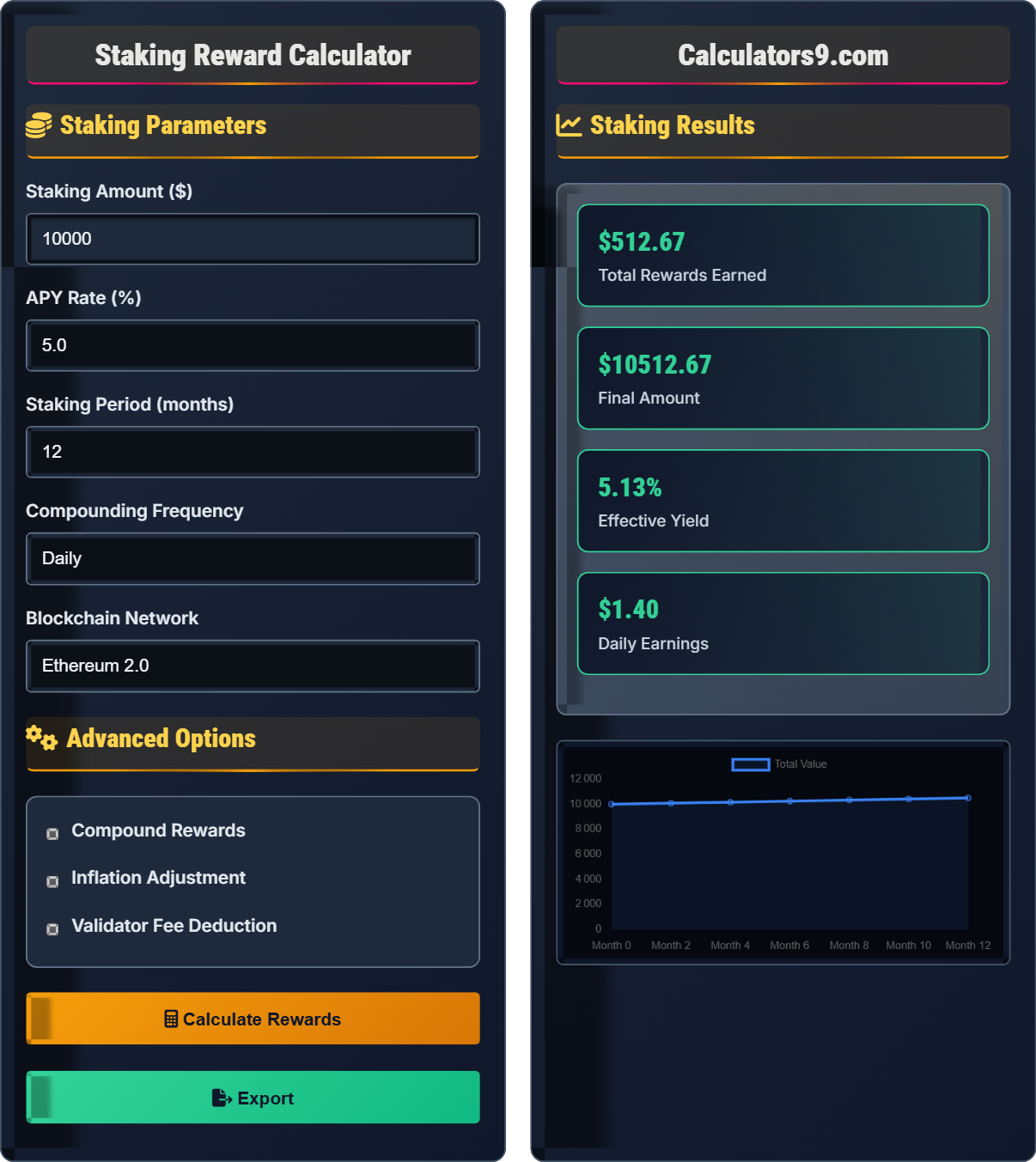
Example: Stake $10,000 at 5% APY compounded daily for 1 year:
\( R = 10000 \times \left(1 + \frac{0.05}{365}\right)^{365 \times 1} - 10000 \)
\( R = 10000 \times (1.000136986)^{365} - 10000 = 512.67 \)
Therefore, total rewards are $512.67.
Staking Parameters
Advanced Options
Staking Results
| Period | Principal | Rewards | Total |
|---|
| Metric | Value | Details |
|---|
Comprehensive Staking Guide
Cryptocurrency staking involves locking tokens to support network operations and earn rewards. Validators verify transactions and maintain blockchain security in exchange for staking rewards.
Staking rewards are calculated using compound interest formulas:
Effective yield depends on compounding frequency and network parameters.
Leading staking platforms with current yields:
- Ethereum: 4-6% APY, 32 ETH minimum stake
- Solana: 6-8% APY, low minimum stake
- Cardano: 4-5% APY, 0 minimum stake
- Polkadot: 10-15% APY, DOT staking
- Cosmos: 15-20% APY, ATOM staking
- Research Validators: Choose reputable operators
- Understand Lock-ups: Know withdrawal restrictions
- Consider Fees: Factor in validator commission
- Monitor Performance: Track uptime and rewards
- Diversify: Spread stakes across networks
Staking Basics
Earn rewards by supporting blockchain networks.
\( R = P \times \left(1 + \frac{r}{n}\right)^{nt} - P \)
Where R=rewards, P=principal, r=rate, n=frequency, t=time.
- Compounding increases returns
- Lock-up periods apply
- Validator fees reduce earnings
Strategies
Maximize returns with strategic staking.
- Research network parameters
- Choose reliable validators
- Consider compounding options
- Monitor performance regularly
- Network security is important
- Minimum stake requirements vary
- Withdrawal restrictions apply
- Market volatility affects value
Staking Reward Learning Quiz
What is the primary purpose of cryptocurrency staking?
The answer is B) To support network operations and earn rewards. Staking involves locking tokens to participate in network consensus and validation, helping secure the blockchain while earning rewards.
This question tests the fundamental understanding of staking. Staking is a Proof of Stake (PoS) mechanism where participants lock up tokens to support network security and operations. This differs from mining (Proof of Work) and simple token storage.
Staking: Locking tokens to support blockchain operations
Proof of Stake: Consensus mechanism using staked tokens
Network Validation: Verifying and securing transactions
• Staking supports network security
• Participants earn rewards for support
• Tokens are locked during staking
• Research the network before staking
• Understand lock-up periods
• Choose reputable validators
• Confusing staking with mining
• Not understanding lock-up periods
• Ignoring validator reputation
Calculate the rewards for staking $10,000 at 5% APY compounded daily for 1 year. Show your work.
Using the compound interest formula: R = P × (1 + r/n)^(nt) - P
Where:
- P = $10,000 (principal)
- r = 0.05 (5% APY)
- n = 365 (daily compounding)
- t = 1 (year)
Step 1: Calculate periodic rate = r/n = 0.05/365 = 0.000136986
Step 2: Calculate exponent = n×t = 365×1 = 365
Step 3: Calculate (1 + periodic rate)^exponent = (1.000136986)^365 = 1.051267
Step 4: Calculate final amount = $10,000 × 1.051267 = $10,512.67
Step 5: Calculate rewards = $10,512.67 - $10,000 = $512.67
This calculation demonstrates compound interest in staking. Daily compounding means rewards are added to the principal daily, increasing the base amount for future reward calculations. This creates exponential growth over time.
Compound Interest: Interest earned on both principal and previous interest
APY: Annual Percentage Yield including compounding
Periodic Rate: Interest rate applied per compounding period
• Higher compounding frequency = higher returns
• Rewards are added to principal
• Growth accelerates over time
• Daily compounding is better than annual
• Longer staking periods increase returns
• Use calculators for complex scenarios
• Using simple interest instead of compound
• Forgetting to subtract principal
• Incorrect compounding frequency
Sarah stakes $5,000 at 6% APY for 2 years. If rewards are compounded monthly, how much more does she earn compared to annual compounding?
Annual Compounding:
Final Amount = $5,000 × (1 + 0.06/1)^(1×2) = $5,000 × (1.06)^2 = $5,618.00
Rewards = $5,618.00 - $5,000 = $618.00
Monthly Compounding:
Final Amount = $5,000 × (1 + 0.06/12)^(12×2) = $5,000 × (1.005)^24 = $5,635.80
Rewards = $5,635.80 - $5,000 = $635.80
Difference = $635.80 - $618.00 = $17.80
Sarah earns $17.80 more with monthly compounding.
This example shows how compounding frequency affects returns. More frequent compounding adds interest to the principal more often, accelerating growth. While the difference may seem small, it becomes significant over larger amounts and longer periods.
Compounding Frequency: How often interest is added to principal
Exponential Growth: Increasing returns over time
Interest on Interest: Earning returns on previous earnings
• More frequent compounding = higher returns
• Difference increases with time
• Larger amounts amplify differences
• Choose higher compounding frequencies
• Longer periods maximize compounding
• Larger stakes increase differences
• Not considering compounding frequency
• Underestimating compounding effects
• Assuming all APY is equal
Mike stakes $10,000 at 8% APY compounded daily. His validator charges 10% commission. What are his net annual rewards after fees?
First, calculate gross rewards (1 year):
Gross Final Amount = $10,000 × (1 + 0.08/365)^(365×1) = $10,000 × 1.083287 = $10,832.87
Gross Rewards = $10,832.87 - $10,000 = $832.87
Validator Fee = $832.87 × 0.10 = $83.29
Net Rewards = $832.87 - $83.29 = $749.58
Mike's net annual rewards are $749.58 after validator fees.
This demonstrates how validator fees reduce actual returns. Fees are typically a percentage of the rewards earned, not the principal. When comparing staking options, it's important to consider net returns after fees rather than advertised APY.
Validator Fee: Commission charged by staking service
Net Returns: Actual earnings after feesGross Returns: Earnings before fees
• Fees reduce net returns
• Compare net APY, not gross
• Lower fees = higher net returns
• Calculate net returns after fees
• Compare validators by net yield
• Consider performance vs. fees
• Ignoring validator fees
• Comparing gross APY only
• Not calculating net returns
Which of the following is a significant risk in cryptocurrency staking?
The answer is B) Illiquidity during lock-up periods. Staking typically requires locking tokens for specific periods during which they cannot be accessed, creating liquidity risk. Additionally, token value can decrease while staked.
Staking involves several risks including illiquidity, slashing penalties, and market risk. Lock-up periods prevent access to funds, and token price volatility can result in losses even with positive staking rewards. Understanding these risks is crucial for staking decisions.
Illiquidity: Inability to access funds immediately
Lock-up Period: Time before funds can be withdrawn
Slashing: Penalty for validator misbehavior
• Staked tokens are locked
• Market risk still applies
• Research validator reliability
• Understand lock-up terms
• Diversify staking across networks
• Consider liquidity needs
• Not understanding lock-up periods
• Ignoring market risk
• Failing to research validators
FAQ
Q: How do I calculate staking rewards with compounding?
A: Use the compound interest formula: \( R = P \times \left(1 + \frac{r}{n}\right)^{nt} - P \) where P=principal, r=rate, n=frequency, t=time.
For $10,000 at 5% APY compounded daily for 1 year:
\( R = 10000 \times \left(1 + \frac{0.05}{365}\right)^{365 \times 1} - 10000 = 512.67 \)
Daily compounding adds interest to principal daily, increasing future rewards.
Q: What are the differences between staking networks?
A: Staking networks differ in APY, minimum stakes, and lock-up periods:
- Ethereum: 4-6% APY, 32 ETH minimum, variable lock-up
- Solana: 6-8% APY, low minimum, flexible unstaking
- Cardano: 4-5% APY, no minimum, 20-day epoch
- Polkadot: 10-15% APY, DOT staking, bonding period
APY varies based on network parameters, inflation rates, and validator participation.