Gold Price Calculator
Convert Gold Prices by Weight & Currency
Gold Price Formula:
Show the calculatorTo calculate gold value:
Gold Value = Weight × (Price per Unit Weight)
Where price per unit weight is typically quoted per troy ounce.
Common conversion factors:
- 1 Troy Ounce = 31.1035 grams
- 1 Pennyweight = 1.55517 grams
- 1 Gram = 0.032151 troy ounces
- 1 Kilogram = 32.1507 troy ounces
Example: To find the value of 10 grams of gold at $2000/oz:
10g × (1 troy oz / 31.1035g) × $2000/troy oz = $643.01
This ensures accurate gold valuations for any weight unit.
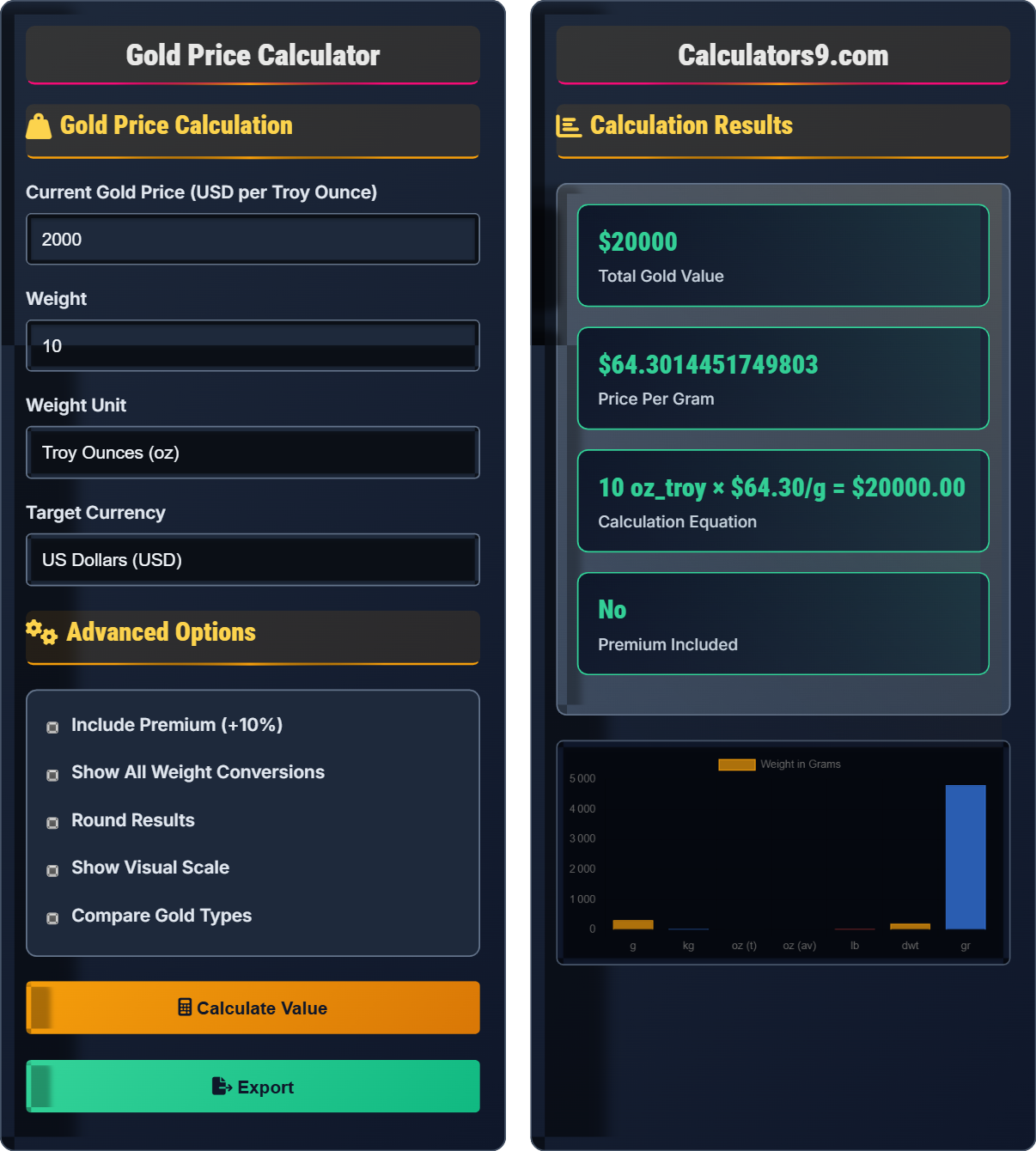
Gold Price Calculation
Advanced Options
Calculation Results
| Unit | Equivalent Weight |
|---|---|
| Troy Ounces | 0.322 |
| Grams | 10.00 |
| Kilograms | 0.010 |
| Pennyweights | 6.430 |
| Avoirdupois Ounces | 0.353 |
Gold Valuation Guide
Gold prices fluctuate based on global economic conditions, inflation, currency values, and geopolitical events. The London Bullion Market Association (LBMA) sets the benchmark price for gold. Gold is typically priced per troy ounce (31.1035g) in international markets.
Gold uses the troy weight system, which differs from the avoirdupois system used for most other goods. One troy ounce equals 31.1035 grams, while one avoirdupois ounce equals 28.3495 grams. This difference is crucial for accurate calculations.
When valuing gold, consider: purity (karat rating), current spot price, dealer premiums, liquidity, and authenticity. Physical gold has additional costs like storage and insurance. Gold futures and ETFs offer exposure without physical ownership.
Gold Conversion Basics
Chemical element Au, valued for rarity, durability, and use as currency.
Value = Weight × (Spot Price / Reference Weight)
Where weight is converted to reference unit (troy ounce).
- Always use troy ounces for gold
- Account for purity in karat gold
- Verify spot price accuracy
- Consider market premiums
Gold Investment Strategies
Physical gold, ETFs, mining stocks, futures, or certificates.
- Research current spot prices
- Verify authenticity of physical gold
- Consider storage and insurance
- Understand tax implications
- Gold doesn't generate income
- Price volatility can be high
- Storage costs apply to physical gold
- Liquidity varies by form
Gold Valuation Learning Quiz
How many grams are in one troy ounce?
The answer is B) 31.10 grams. One troy ounce equals exactly 31.1035 grams. This is different from the avoirdupois ounce (28.35 grams) used for most other commodities. The troy system is used exclusively for precious metals.
The troy weight system originated in medieval France and England. It's specifically designed for precious metals and gemstones. Understanding the difference between troy and avoirdupois systems is crucial for accurate gold calculations. One troy pound has 12 troy ounces, while one avoirdupois pound has 16 avoirdupois ounces.
Troy Ounce: 31.1035 grams, used for precious metals
Avoirdupois Ounce: 28.3495 grams, used for general goods
Spot Price: Current market price for immediate delivery
• 1 troy oz = 31.1035 g
• 1 avoirdupois oz = 28.3495 g
• Always verify gold weight system
• Remember: Troy ounces are heavier than avoirdupois
• Use troy ounces for gold calculations
• Check purity for karat gold
• Confusing troy and avoirdupois ounces
• Forgetting to account for purity
• Using outdated spot prices
A jeweler has 50 grams of 18-karat gold. If the current spot price is $1,950 per troy ounce, what is the pure gold value of this item? Show your work and explain the conversion process step by step.
Step 1: Convert grams to troy ounces: 50g ÷ 31.1035g/oz = 1.6075 troy oz
Step 2: Calculate pure gold content: 18K ÷ 24K = 0.75 (75% pure)
Step 3: Calculate pure gold weight: 1.6075 troy oz × 0.75 = 1.2056 troy oz
Step 4: Calculate value: 1.2056 troy oz × $1,950/oz = $2,350.92
The pure gold value of the 50g 18K item is $2,350.92.
When calculating the value of karat gold, you must first determine the pure gold content. The karat system measures purity: 24K is 100% pure, 18K is 75% pure (18/24), and 14K is 58.3% pure (14/24). Always convert weight to troy ounces first, then apply the purity factor to find the pure gold weight before multiplying by the spot price.
Karat: Purity measurement for gold (24K = 100% pure)
Spot Price: Current market price for immediate delivery
Alloy: Gold mixed with other metals for strength
• Karat = (Pure gold parts / 24) × 100%
• Always convert to troy ounces for gold
• Apply purity factor to weight, not value
• Remember: 18K = 75% pure gold
• 14K = 58.3% pure gold
• 10K = 41.7% pure gold
• Forgetting to account for purity
• Using avoirdupois instead of troy ounces
• Applying purity to the final value instead of weight
FAQ
Q: What's the difference between gold spot price and retail price?
A: The gold spot price is the current market price for immediate delivery of pure gold, traded in bulk quantities. The retail price includes additional costs:
1. Dealer markup: Typically 2-8% above spot
2. Manufacturing costs: For minting coins or bars
3. Transportation: Insurance and shipping
4. Liquidity premium: For rare or collectible items
For example, if spot price is $2000/oz, a 1 oz gold coin might retail for $2100-2150/oz. The spot price reflects commodity value, while retail price includes dealer services.
Q: How do I calculate the gold value in a piece of jewelry?
A: To calculate gold value in jewelry:
1. Find the weight: Weigh the item on a precise scale
2. Identify purity: Check hallmark (14K, 18K, 24K, etc.)
3. Calculate pure gold: Weight × (Karat / 24)
4. Apply spot price: Pure weight × Current spot price
For example: 10g 14K ring = 10g × (14/24) = 5.83g pure gold
At $2000/oz: 5.83g × ($2000/31.1035g) = $374.86
Note: This is the metal value only - craftsmanship and design add additional value.