Inflation Converter
Convert money across time periods • Historical value
Inflation Conversion Formula:
Show the calculator\( FV = PV \times \left(\frac{CPI_{target}}{CPI_{base}}\right) \)
Where:
- \( FV \) = Future Value (converted amount)
- \( PV \) = Present Value (original amount)
- \( CPI_{target} \) = Consumer Price Index for target year
- \( CPI_{base} \) = Consumer Price Index for base year
This formula converts monetary amounts between different time periods by accounting for changes in purchasing power due to inflation.
Example: To convert $100 from 2000 to 2020 value:
Assuming CPI in 2000 = 172.2, CPI in 2020 = 258.8
Future Value:
\( FV = 100 \times \left(\frac{258.8}{172.2}\right) \approx 150.29 \)
Thus, $100 in 2000 is equivalent to approximately $150.29 in 2020.
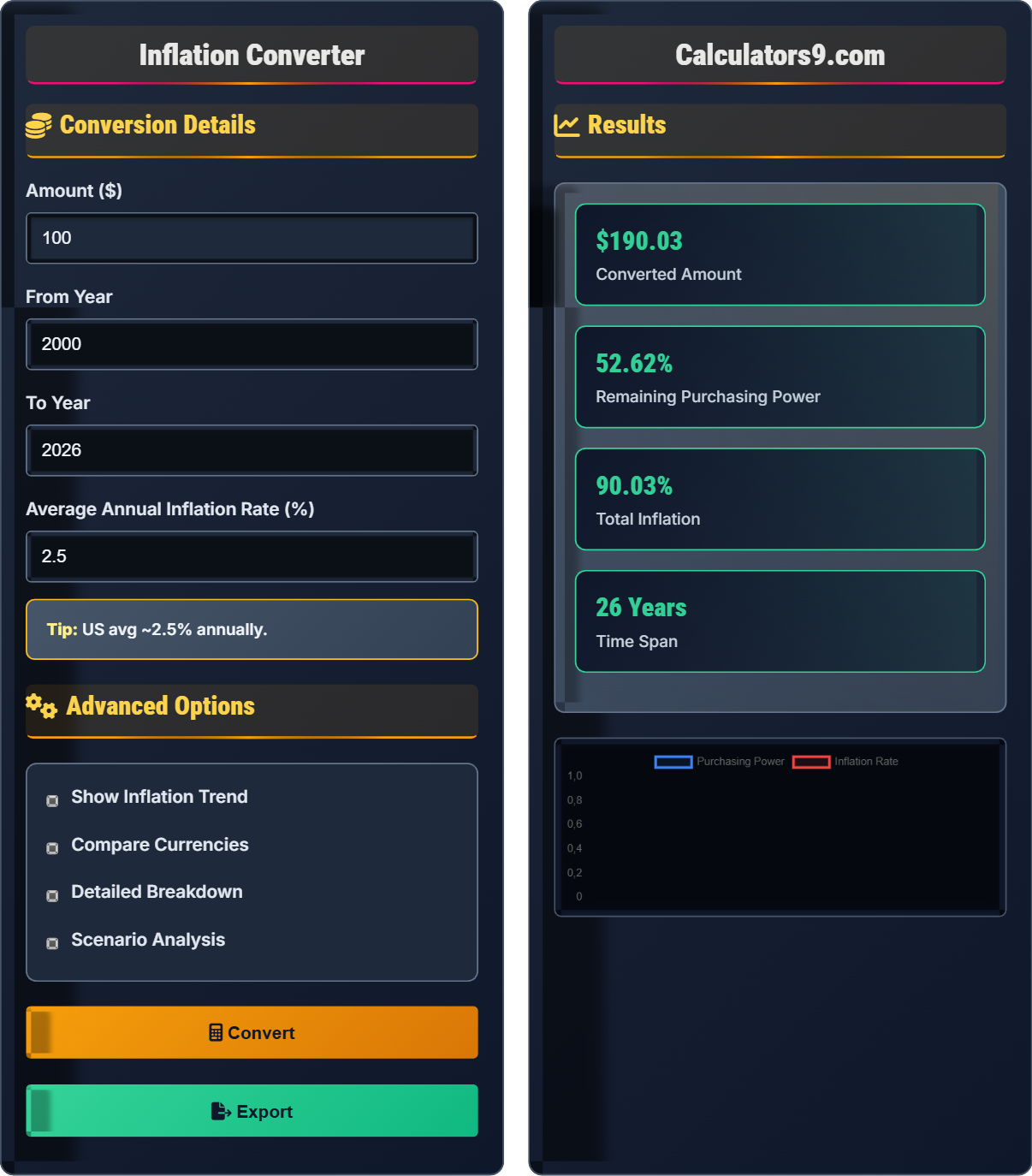
Conversion Details
Advanced Options
Results
| Year | Original | Adjusted | CPI |
|---|
| Scenario | Low Inflation (1%) | Standard (2.5%) | High Inflation (5%) |
|---|
Comprehensive Inflation Guide
Inflation is the rate at which the general level of prices for goods and services rises over time, leading to a decrease in the purchasing power of money. It represents how much more expensive a set of goods and services becomes during a particular period, usually measured annually. The Consumer Price Index (CPI) is the most commonly used measure to track inflation.
The standard inflation conversion calculation uses the following formula:
Where:
- \(FV\) = Future Value (amount in target year)
- \(PV\) = Present Value (amount in base year)
- \(CPI_{target}\) = Consumer Price Index for target year
- \(CPI_{base}\) = Consumer Price Index for base year
Inflation affects various aspects of the economy:
- Purchasing Power: Reduces the value of money over time
- Savings: Erodes the real value of cash savings
- Investments: Affects returns on fixed-income investments
- Debt: Benefits borrowers (repay with less valuable money) but hurts lenders
- Invest in Inflation-Protected Securities: TIPS adjust for inflation automatically
- Diversify Investments: Include assets that historically outpace inflation
- Real Estate: Property values often rise with inflation
- Stock Market: Equities typically provide inflation protection over time
- Regular Adjustments: Monitor and adjust financial plans based on inflation trends
Inflation Basics
Rise in prices reducing purchasing power of money.
\(FV = PV\frac{CPI_{target}}{CPI_{base}}\)
Where FV=future value, PV=present value, CPI indices.
- Inflation reduces purchasing power over time
- Compound effect accelerates over longer periods
- Small differences matter over decades
Strategies
Real value of money considering inflation effects.
- Invest in inflation-protected securities
- Hold real assets (property, commodities)
- Diversify portfolio
- Regular financial plan reviews
- CPI measures average consumer basket
- Individual inflation rates vary
- Historical trends don't guarantee future
- Geographic differences exist
Inflation Learning Quiz
If $100 in 2000 had the same purchasing power as $150 in 2020, what happened to the purchasing power of money over this 20-year period?
The answer is B) It decreased by 33.3%. If $100 in 2000 equals $150 in 2020, then the purchasing power of $100 in 2020 is equivalent to $66.67 in 2000 terms ($100 ÷ 1.5). Therefore, the purchasing power decreased by 33.3% (1 - 0.6667 = 0.3333).
Understanding purchasing power changes is crucial for financial planning. When calculating purchasing power loss, we compare what money could buy in the past versus now. The key insight is that inflation makes each dollar worth less over time, reducing what we can purchase with the same nominal amount.
Purchasing Power: The amount of goods or services that can be bought with a unit of currency
Inflation: Sustained increase in general price levels
Consumer Price Index (CPI): Measure tracking price changes over time
• Inflation reduces purchasing power over time
• Higher inflation rates cause faster purchasing power decline
• Compound effect accelerates over longer periods
• Remember: Inflation erodes value, deflation increases it
• Use the rule of 72 to estimate doubling time: 72 ÷ inflation rate
• Confusing nominal values with real values adjusted for inflation
• Forgetting the compound effect of inflation over time
Sarah wants to know how much $1,000 she earned in 2010 would be worth in 2025 dollars. The average annual inflation rate between 2010 and 2025 was 2.8%. Calculate the equivalent amount in 2025 dollars and explain the purchasing power change.
To calculate the equivalent amount in 2025 dollars:
Using the compound interest formula: Future Value = Present Value × (1 + r)^n
Where:
- Present Value = $1,000
- r = 0.028 (2.8% annual inflation rate)
- n = 15 years (2025 - 2010)
Future Value = $1,000 × (1 + 0.028)^15
Future Value = $1,000 × (1.028)^15
Future Value = $1,000 × 1.518
Future Value ≈ $1,518
Therefore, $1,000 in 2010 would need to be $1,518 in 2025 to have the same purchasing power. The purchasing power of the original $1,000 has decreased by approximately 34.1% (1 - 1000/1518).
This problem demonstrates the compounding effect of inflation over time. The calculation shows how a seemingly modest 2.8% annual inflation rate can significantly erode purchasing power over a 15-year period. The exponential nature of compound growth means that inflation effects accelerate over longer timeframes.
Compound Growth: Growth where interest is earned on both principal and accumulated interest
Purchasing Power: The quantity of goods or services that can be purchased with a given amount of money
Present Value: Current worth of a future sum of money
• Use compound interest formula for multi-year calculations
• (1 + r)^n accounts for exponential growth
• Small differences in rate amplify over time
• The Rule of 72 gives approximate doubling time: 72 ÷ 2.8 ≈ 25.7 years
• For quick estimates, multiply annual rate by number of years
• Using simple interest instead of compound interest
• Forgetting to convert percentage to decimal (2.8% = 0.028)
• Miscounting the number of years in the calculation
FAQ
Q: How does inflation affect long-term financial planning and retirement savings?
A: Inflation significantly impacts long-term financial planning by eroding the purchasing power of money over time. For example, if inflation averages 3% annually, $1 million today will only have the purchasing power of approximately $554,000 in 20 years.
For retirement planning specifically, consider this scenario: If you estimate needing $50,000 annually in today's dollars to maintain your lifestyle, and expect 2.5% average inflation over 30 years until retirement, you'll actually need about $104,500 per year in retirement to maintain the same purchasing power.
Mathematically, if \( FV \) is the future amount needed, \( PV \) is today's needs, \( r \) is the inflation rate, and \( n \) is the number of years:
\( FV = PV \times (1 + r)^n \)
So, \( FV = 50,000 \times (1 + 0.025)^{30} \approx 50,000 \times 2.098 = 104,900 \)
This is why financial planners emphasize investing in assets that historically outpace inflation, such as stocks and real estate, rather than keeping large sums in low-interest savings accounts.
Q: What's the difference between nominal and real returns, and why does it matter for investors?
A: Nominal returns are the stated investment returns without adjusting for inflation, while real returns account for the effects of inflation. The relationship is expressed as:
\( \text{Real Return} = \text{Nominal Return} - \text{Inflation Rate} \)
For example, if your investment earned 7% in a year when inflation was 3%, your nominal return is 7% but your real return is only 4%. This means your purchasing power increased by 4%, not 7%.
Real returns are critical because they represent your actual increase in purchasing power. A 5% nominal return during 6% inflation actually results in a -1% real return, meaning you've lost purchasing power despite having more money nominally.
For long-term wealth building, investors should focus on achieving positive real returns consistently. This is why Treasury Inflation-Protected Securities (TIPS) and equities (over long periods) are favored for inflation protection, as they tend to provide positive real returns over time.