Purchasing Power Calculator
Calculate money value over time • Inflation impact
Purchasing Power Formula:
Show the calculator\( PP_t = PP_0 \times \left(\frac{CPI_0}{CPI_t}\right) \)
Where:
- \( PP_t \) = Purchasing Power at time t
- \( PP_0 \) = Initial Purchasing Power
- \( CPI_0 \) = Consumer Price Index at base time
- \( CPI_t \) = Consumer Price Index at time t
This formula calculates how the value of money changes over time due to inflation, showing what amount of money in the future will buy the same goods as a given amount today.
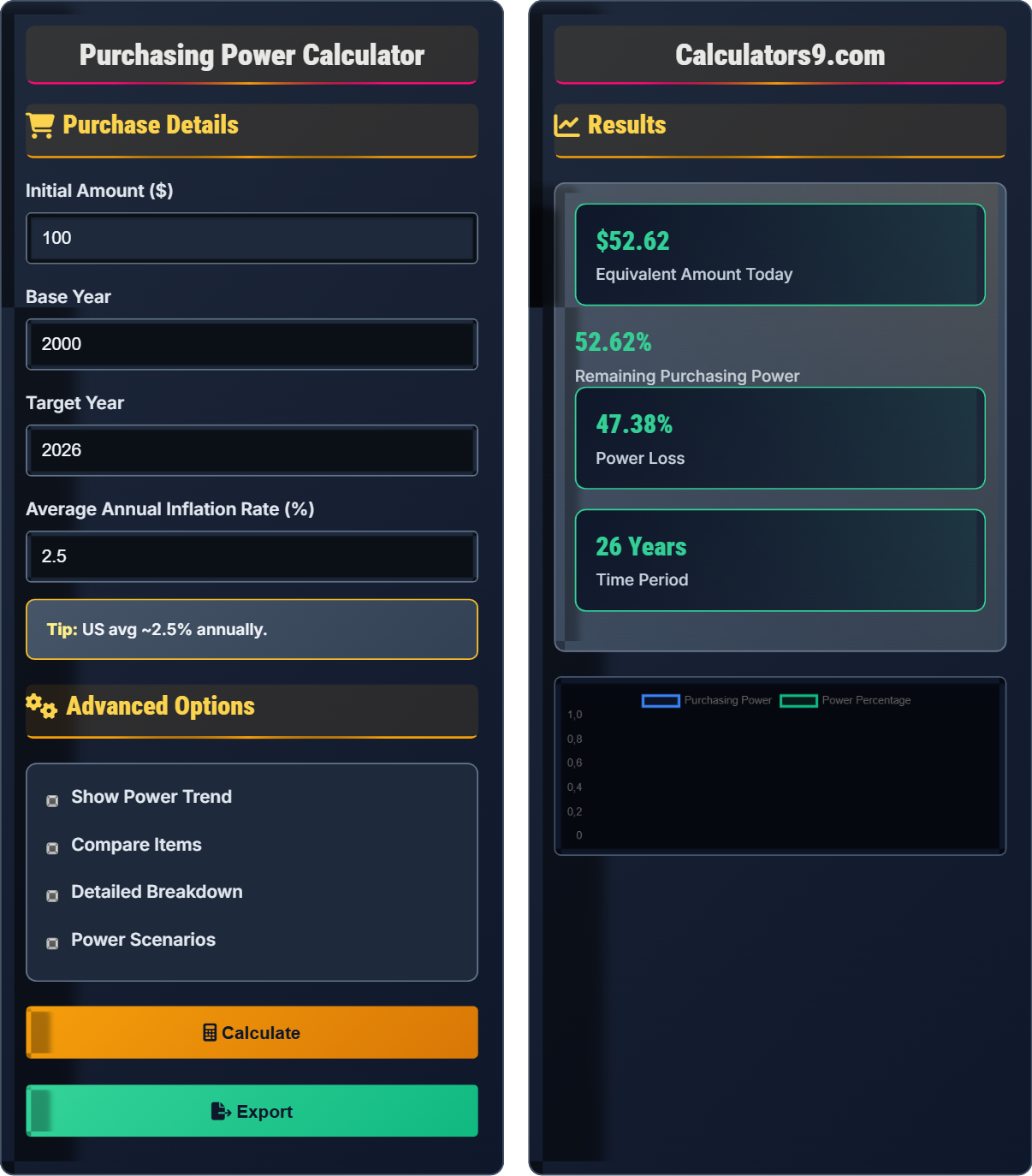
Example: To find the purchasing power of $100 in 2026 compared to 2000:
Assuming CPI in 2000 = 172.2, CPI in 2026 = 275.0
Purchasing Power:
\( PP_{2026} = 100 \times \left(\frac{172.2}{275.0}\right) \approx 62.62 \)
Thus, $100 in 2000 has the same purchasing power as approximately $62.62 in 2026.
Purchase Details
Advanced Options
Results
| Year | Amount | Power | Index |
|---|
| Scenario | Low Inflation (1%) | Standard (2.5%) | High Inflation (5%) |
|---|
Comprehensive Purchasing Power Guide
Purchasing power refers to the value of a currency expressed in terms of the amount of goods or services that one unit of money can buy. It is the real value of money, adjusted for inflation or deflation, and reflects the actual buying capacity of money over time. As inflation rises, the purchasing power of money falls because each unit of currency buys fewer goods and services.
The standard purchasing power calculation uses the following formula:
Where:
- \(PP_t\) = Purchasing Power at target time
- \(PP_0\) = Initial Purchasing Power
- \(CPI_0\) = Consumer Price Index at base time
- \(CPI_t\) = Consumer Price Index at target time
Purchasing power is measured using several key indicators:
- Consumer Price Index (CPI): Tracks changes in the price of a basket of consumer goods and services
- Purchasing Power Parity (PPP): Compares different countries' currencies through a "basket of goods" approach
- Real GDP: Economic output adjusted for inflation
- Real Wage Growth: Wage increases adjusted for inflation
- Invest in Real Assets: Property, commodities, and infrastructure that typically appreciate with inflation
- Inflation-Protected Securities: TIPS and similar instruments that adjust principal with inflation
- Equity Investments: Stocks historically provide inflation protection over long periods
- Productive Assets: Investments that generate income streams that grow with inflation
- Diversification: Spread investments across asset classes and geographies
Power Basics
Value of currency in terms of goods/services it can buy.
\(PP_t = PP_0\frac{CPI_0}{CPI_t}\)
Where PP=purchasing power, CPI=price index.
- Inflation reduces purchasing power over time
- Compound effect accelerates over longer periods
- Small differences matter over decades
Strategies
Maintaining value despite inflation effects.
- Invest in real assets (property, commodities)
- Hold inflation-protected securities
- Diversify portfolio
- Focus on income-generating assets
- CPI measures average consumer basket
- Individual experiences vary
- Historical trends don't guarantee future
- Geographic differences exist
Purchasing Power Learning Quiz
If the purchasing power of $100 in 2000 is equivalent to $60 in 2020, what percentage of its original value has been lost?
The answer is A) 40%. If $100 in 2000 equals $60 in 2020 in terms of purchasing power, the power has decreased by $40. To find the percentage loss: ($100 - $60) ÷ $100 × 100% = 40%. The remaining purchasing power is 60% of the original value.
Understanding purchasing power loss is crucial for financial planning. The calculation involves comparing the original value to the reduced value. The formula is: (Original - Reduced) ÷ Original × 100%. This gives us the percentage that has been lost over time due to inflation.
Purchasing Power: The amount of goods or services that can be bought with a unit of currency
Inflation: Sustained increase in general price levels
Power Loss: Reduction in currency's buying capacity
• Power loss = (Original - Current) ÷ Original × 100%
• Higher inflation rates cause faster power loss
• Compound effect accelerates over longer periods
• Remember: Power loss + Remaining power = 100%
• Use the rule of 72 to estimate halving time: 72 ÷ inflation rate
• Confusing power loss with remaining power percentage
• Forgetting to divide by the original amount
Maria invested $5,000 in 2015 when the CPI was 237.0. In 2025, the CPI is expected to be 280.0. Calculate the purchasing power of her investment in 2025 dollars and determine what amount in 2025 would have the same purchasing power as her original investment.
To calculate the purchasing power in 2025 dollars:
Using the purchasing power formula: \(PP_t = PP_0 \times \frac{CPI_0}{CPI_t}\)
Where:
- \(PP_0\) = $5,000 (initial amount)
- \(CPI_0\) = 237.0 (CPI in 2015)
- \(CPI_t\) = 280.0 (CPI in 2025)
Purchasing Power in 2025 = $5,000 × (237.0 ÷ 280.0)
Purchasing Power in 2025 = $5,000 × 0.8464
Purchasing Power in 2025 ≈ $4,232.14
To find the equivalent amount in 2025 dollars: Equivalent Amount = Original Amount × (CPI_t ÷ CPI_0)
Equivalent Amount = $5,000 × (280.0 ÷ 237.0) ≈ $5,907.17
Therefore, Maria's $5,000 in 2015 has the same purchasing power as approximately $4,232.14 in 2025, and she would need $5,907.17 in 2025 to have the same purchasing power as her original investment.
This problem demonstrates the dual nature of purchasing power calculations. We can determine either how much future money has the same purchasing power as our original amount (deflating), or how much future money is needed to match the original purchasing power (inflating). Both calculations are essential for understanding inflation's impact on investments.
Deflation: Calculating past value in current dollars
Inflation: Calculating current value in past dollars
Consumer Price Index (CPI): Measure tracking price changes over time
• Deflate by multiplying by (CPI_base ÷ CPI_target)
• Inflate by multiplying by (CPI_target ÷ CPI_base)
• Always use the correct CPI values for each period
• Remember: If CPI increases, purchasing power decreases
• Cross-check: If purchasing power decreases, equivalent amount increases
• Reversing the numerator and denominator in the fraction
• Confusing deflation with inflation calculations
• Using incorrect CPI values for the wrong time periods
FAQ
Q: How does purchasing power affect retirement planning and long-term savings?
A: Purchasing power is the most critical factor in retirement planning because it determines whether your savings will maintain their value over time. For example, if you estimate needing $50,000 annually in today's dollars to maintain your lifestyle, and expect 2.5% average inflation over 30 years until retirement, you'll actually need about $104,500 per year in retirement to maintain the same purchasing power.
The mathematical relationship is: \(FV = PV \times (1 + r)^n\), where \(FV\) is the future amount needed, \(PV\) is today's needs, \(r\) is the inflation rate, and \(n\) is the number of years.
So, \(FV = 50,000 \times (1 + 0.025)^{30} \approx 50,000 \times 2.098 = 104,900\).
This is why retirement planners emphasize investing in assets that historically outpace inflation, such as stocks and real estate, rather than keeping large sums in low-interest savings accounts where purchasing power erodes annually.
Q: What are some practical ways to protect purchasing power during periods of high inflation?
A: During high inflation periods, several strategies can help preserve purchasing power:
1. Invest in Real Assets: Property, commodities, and real estate typically maintain value during inflationary periods because their prices rise with general price levels.
2. Consider TIPS (Treasury Inflation-Protected Securities): These bonds adjust their principal value based on the Consumer Price Index, providing direct inflation protection.
3. Focus on Variable Income Assets: Stocks of companies with pricing power can pass increased costs to consumers, maintaining profitability.
4. Reduce Fixed-Rate Debt: Inflation benefits borrowers since they repay loans with cheaper dollars. However, avoid taking on new fixed-rate debt at high rates.
5. Shorten Duration of Fixed Income: Keep bond maturities short so proceeds can be reinvested at higher rates as they mature.
Remember that while these strategies help preserve purchasing power, they also carry risks that should be evaluated within your overall financial plan.