Compliance Gap Calculator
Regulatory assessment & gap analysis • 2026 edition
Compliance Gap Formula:
Show Calculator\( G = \frac{NR - AR}{NR} \times 100 \)
Where:
- \( G \) = Gap percentage (compliance shortfall)
- \( NR \) = Number of required controls/requirements
- \( AR \) = Number of actually implemented requirements
Additional factors for comprehensive gap analysis:
- Priority weighting based on risk impact
- Implementation maturity levels (Not Started, In Progress, Implemented)
- Regulatory deadline proximity
- Cost of compliance implementation
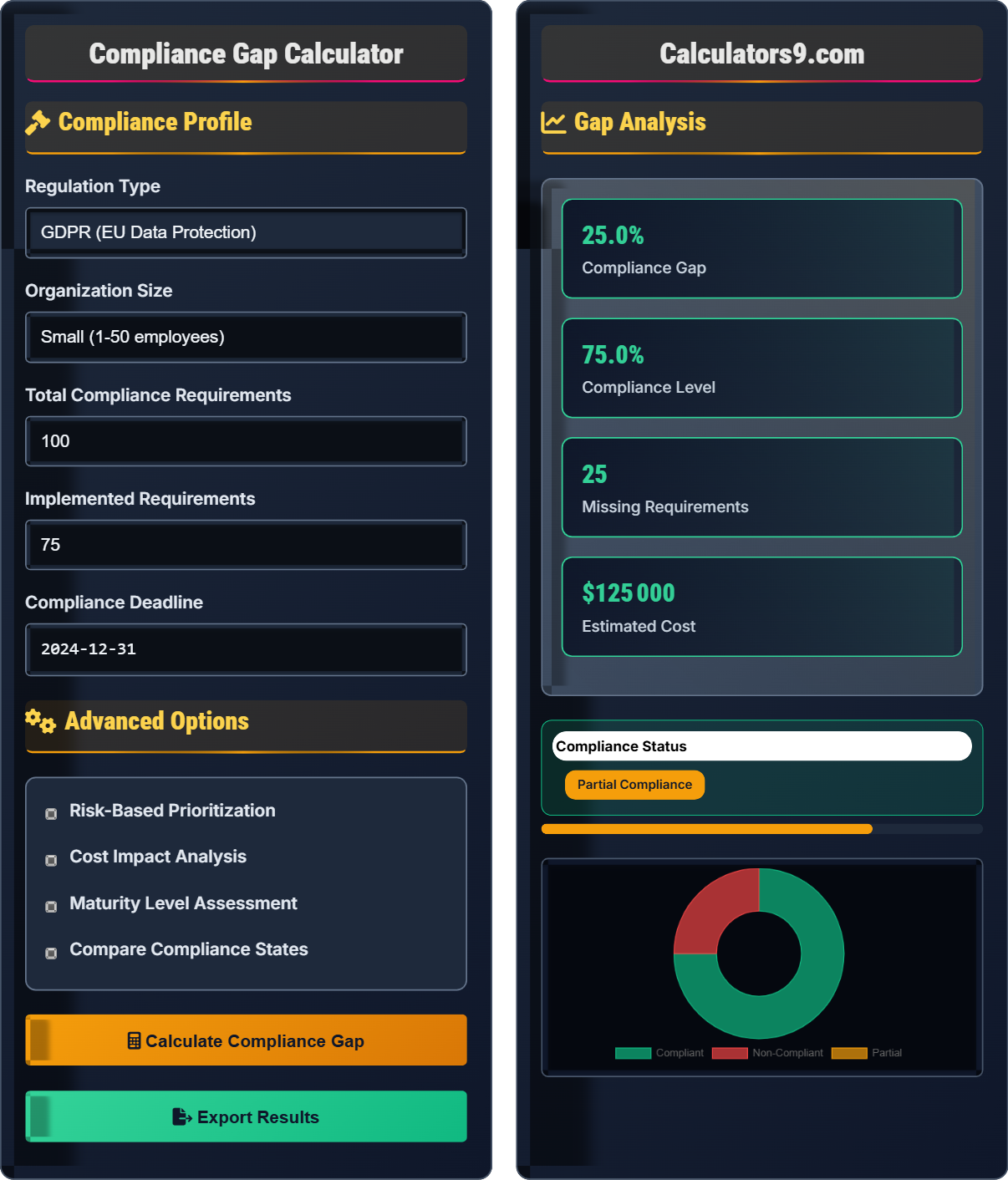
Example: For a regulation with 100 requirements where 75 are implemented:
\( G = \frac{100 - 75}{100} \times 100 = 25\% \)
The organization has a 25% compliance gap, meaning 25% of requirements are not yet implemented.
Compliance Profile
Advanced Options
Gap Analysis
| Metric | Value | Status |
|---|---|---|
| Total Requirements | 100 | Complete |
| Implemented | 75 | Good |
| Missing | 25 | Attention Needed |
Comprehensive Compliance Planning Guide
Compliance gap analysis is a systematic review process that compares an organization's current security and operational practices against regulatory requirements. It identifies discrepancies between current state and compliance obligations, enabling organizations to prioritize remediation efforts. Gap analysis is essential for maintaining regulatory compliance and avoiding penalties.
The basic compliance gap calculation is:
Where:
- \(G\) = Gap percentage
- \(NR\) = Number of required controls
- \(AR\) = Number of actually implemented controls
Compliance gaps typically fall into these categories:
- Policy Gaps: Missing or inadequate documentation
- Technical Gaps: Insufficient security controls
- Process Gaps: Inadequate procedures or workflows
- Training Gaps: Insufficient staff awareness
- Monitoring Gaps: Lack of oversight mechanisms
- Prioritization: Address high-risk gaps first
- Resource Allocation: Assign appropriate budget and personnel
- Timeline Development: Create realistic implementation schedules
- Progress Tracking: Monitor remediation progress
- Continuous Monitoring: Maintain compliance over time
Compliance Fundamentals
Systematic comparison of current practices vs regulatory requirements.
\( G = \frac{NR - AR}{NR} \times 100 \)
Where G=gap, NR=required, AR=actual.
- Regular gap assessments are required
- High-risk gaps need immediate attention
- Continuous monitoring is essential
Security Planning
Strategic approach to regulatory compliance and security planning.
- Identify applicable regulations
- Map requirements to controls
- Assess current state
- Identify gaps
- Plan remediation
- Regulatory deadlines
- Resource availability
- Business impact
- Cost-benefit analysis
Compliance Gap Analysis Learning Quiz
Which regulation primarily governs healthcare data privacy and security in the United States?
The answer is B) HIPAA. The Health Insurance Portability and Accountability Act (HIPAA) is the primary U.S. regulation governing healthcare data privacy and security. It establishes national standards for protecting individually identifiable health information and applies to healthcare providers, health plans, and healthcare clearinghouses. HIPAA requires administrative, physical, and technical safeguards to protect electronic protected health information (ePHI).
Students must understand the specific scope of different compliance frameworks. GDPR governs data protection in the EU, PCI DSS covers payment card data, SOX relates to financial reporting, and HIPAA specifically addresses healthcare information. Each regulation has distinct requirements, penalties, and enforcement mechanisms that organizations must understand to maintain compliance.
HIPAA: Health Insurance Portability and Accountability Act
ePHI: Electronic Protected Health Information
Safeguards: Administrative, physical, and technical protections
• HIPAA applies to healthcare organizations
• Requires three types of safeguards
• Violations can result in significant penalties
• Remember: Healthcare = HIPAA
• Think of PHI protection requirements
• Consider breach notification rules
• Confusing HIPAA with other privacy regulations
• Not understanding the scope of covered entities
• Overlooking the technical safeguards requirements
Calculate the compliance gap percentage for an organization that has implemented 85 out of 120 required controls. Show your work.
Using the formula: \( G = \frac{NR - AR}{NR} \times 100 \)
Where:
- NR = 120 (total required controls)
- AR = 85 (actually implemented controls)
Step 1: Calculate missing controls = NR - AR = 120 - 85 = 35
Step 2: Calculate gap ratio = 35 ÷ 120 = 0.2917
Step 3: Convert to percentage = 0.2917 × 100 = 29.17%
Step 4: Round to nearest whole number = 29%
The organization has a 29% compliance gap.
This calculation demonstrates how to quantify compliance shortfalls. The gap percentage provides a clear metric for tracking progress and prioritizing remediation efforts. A 29% gap indicates that nearly one-third of required controls are missing, which represents a significant compliance risk that needs to be addressed.
Compliance Gap: Percentage of requirements not met
Required Controls: Mandatory security measures from regulationsImplemented Controls: Actual security measures in place
• Gap percentage ranges from 0% to 100%
• Lower percentages indicate better compliance
• Always round to appropriate precision
• Remember: Gap = (Missing / Total) × 100
• Always verify your subtraction order
• Check that result is between 0% and 100%
• Reversing the numerator and denominator
• Forgetting to multiply by 100 for percentage
• Arithmetic errors in the calculation
A financial institution has identified a 15% compliance gap in their SOX controls. They have 200 total requirements and the average cost to implement each missing control is $7,500. If they face a penalty of $10,000 per missing control in case of an audit failure, calculate the total cost of remediation versus the potential penalty cost. What is the ROI of implementing the missing controls?
Calculate missing requirements:
- Total requirements = 200
- Gap percentage = 15%
- Missing requirements = 200 × 0.15 = 30
Calculate remediation cost:
- Missing controls = 30
- Cost per control = $7,500
- Total remediation cost = 30 × $7,500 = $225,000
Calculate potential penalty cost:
- Missing controls = 30
- Penalty per control = $10,000
- Total penalty cost = 30 × $10,000 = $300,000
Calculate ROI:
- Penalty avoided = $300,000
- Cost of remediation = $225,000
- Net benefit = $300,000 - $225,000 = $75,000
- ROI = ($75,000 ÷ $225,000) × 100 = 33.3%
The remediation cost is $225,000, potential penalty is $300,000, and ROI is 33.3%.
This example demonstrates the financial justification for compliance remediation. The 33.3% ROI shows that investing in compliance improvements is financially beneficial, as it avoids higher penalty costs. Organizations should consider both direct remediation costs and potential penalty exposure when planning compliance activities. The calculation helps justify compliance investments to stakeholders.
Return on Investment (ROI): Financial benefit relative to cost
Compliance Penalty: Financial sanctions for non-compliance
Cost-Benefit Analysis: Evaluating investment value
• Calculate both remediation and penalty costs
• Consider opportunity costs of non-compliance
• Factor in reputational damage
• Quantify compliance benefits in financial terms
• Include indirect costs in calculations
• Calculate ROI to justify investments
• Not considering the full cost of non-compliance
• Focusing only on direct remediation costs
• Forgetting to calculate potential penalties
An organization has identified 50 missing compliance requirements. They categorize these as: 10 critical, 15 high-risk, 15 medium-risk, and 10 low-risk. If they can only address 30 requirements this year due to resource constraints, which requirements should they prioritize and what percentage of their compliance gap will remain? Assume they address requirements in order of risk level.
Prioritized requirements by risk level:
- Critical: 10 requirements
- High-risk: 15 requirements
- Medium-risk: 5 requirements (to reach 30 total)
- Low-risk: 0 requirements
Requirements addressed: 10 + 15 + 5 = 30
Requirements remaining: 50 - 30 = 20
Calculate remaining gap:
- Original gap: 50 missing requirements
- Remaining gap: 20 missing requirements
- Percentage remaining: (20 ÷ 50) × 100 = 40%
The organization will address 60% of their compliance gap (30 of 50 missing requirements), leaving 40% unaddressed.
This problem demonstrates risk-based prioritization in compliance management. By addressing the highest-risk requirements first, the organization maximizes risk reduction within their resource constraints. This approach ensures that the most critical compliance gaps are closed first, providing the greatest security and regulatory benefit for the investment made.
Risk-Based Prioritization: Addressing highest-risk items first
Resource Constraints: Limited budget, time, or personnel
Maximum Risk Reduction: Optimal use of limited resources
• Address critical risks first
• Consider resource limitations
• Maximize risk reduction per dollar spent
• Rank requirements by risk level
• Allocate resources to highest priorities
• Plan for remaining gaps in future cycles
• Not prioritizing by risk level
• Distributing resources equally across all requirements
• Not calculating remaining gap percentage
Which of the following is NOT a recommended practice for maintaining ongoing compliance after gap remediation?
The answer is C) Annual compliance certification only. Relying solely on annual certifications is insufficient for maintaining ongoing compliance. Regulations and threats evolve continuously, requiring regular monitoring and assessment. Organizations need continuous or frequent periodic assessments, not just annual check-ups, to ensure sustained compliance and quickly identify new gaps that may emerge.
Students must understand that compliance is not a one-time achievement but an ongoing process. Continuous monitoring, regular assessments, and adaptive policies are essential for maintaining compliance as regulations evolve and new threats emerge. Annual certification alone cannot address the dynamic nature of compliance requirements and business operations.
Continuous Monitoring: Ongoing assessment of compliance status
Compliance Maintenance: Sustained adherence to requirements
Periodic Assessment: Regular evaluation of compliance state
• Compliance requires ongoing attention
• Regular assessments identify emerging gaps
• Static compliance leads to violations
• Implement continuous monitoring systems
• Schedule regular compliance reviews
• Update policies as regulations change
• Thinking compliance is a one-time event
• Not implementing ongoing monitoring
• Failing to adapt to regulatory changes
FAQ
Q: How often should organizations perform compliance gap assessments?
A: The frequency of compliance gap assessments should align with risk and regulatory requirements:
Quarterly Assessments: For high-risk environments or organizations subject to strict regulations like PCI DSS, HIPAA, or financial services regulations. These organizations often have tight compliance windows and face significant penalties.
Semi-Annual Assessments: For medium-risk organizations with stable regulatory environments. This provides a good balance between continuous monitoring and resource allocation.
Annual Assessments: For low-risk environments or as part of formal audit cycles. However, even annual assessments should be supplemented with continuous monitoring tools.
Event-Driven Assessments: Triggered by regulatory changes, security incidents, significant business changes, or organizational restructuring.
Additionally, consider:
- Regulatory Deadlines: Align assessments with reporting periods
- Business Changes: Major system implementations or acquisitions
- Threat Evolution: Changes in the threat landscape
- Resource Availability: Budget and personnel constraints
The key is to maintain continuous visibility of compliance status while efficiently allocating resources.
Q: What are the most effective strategies for prioritizing compliance gap remediation?
A: Effective prioritization of compliance gap remediation should follow a multi-dimensional approach:
1. Risk-Based Prioritization:
- Impact Assessment: Evaluate potential business impact of non-compliance (financial penalties, operational disruption, reputation damage)
- Probability Analysis: Assess likelihood of regulatory enforcement or security incidents
- Regulatory Priority: Focus on areas with active regulatory scrutiny
2. Resource Optimization:
- Quick Wins: Address gaps that provide significant compliance improvement with minimal effort
- Common Controls: Implement controls that address multiple requirements simultaneously
- Dependency Mapping: Address foundational gaps that enable other controls
3. Business Alignment:
- Operational Criticality: Prioritize gaps in mission-critical systems
- Customer Impact: Focus on gaps affecting customer data or services
- Competitive Advantage: Leverage compliance as a business differentiator
4. Regulatory Timelines:
- Imminent Deadlines: Address gaps with near-term compliance dates
- Phase-In Requirements: Plan for staged implementation of complex requirements
- Emerging Regulations: Prepare for new or updated compliance obligations
Combine these factors into a weighted scoring model that enables objective prioritization and stakeholder communication.