Encryption Strength Calculator
Cybersecurity risk assessment • 2026 edition
Encryption Strength Formula:
Show Calculator\( T = \frac{C^n}{R} \)
Where:
- \( T \) = Time to crack (in seconds)
- \( C \) = Character set size (e.g., 26 for lowercase letters, 95 for printable ASCII)
- \( n \) = Password length
- \( R \) = Attempts per second (attacks per second)
This formula estimates the time required for a brute force attack to crack an encrypted password or key. The strength increases exponentially with password length and character diversity.
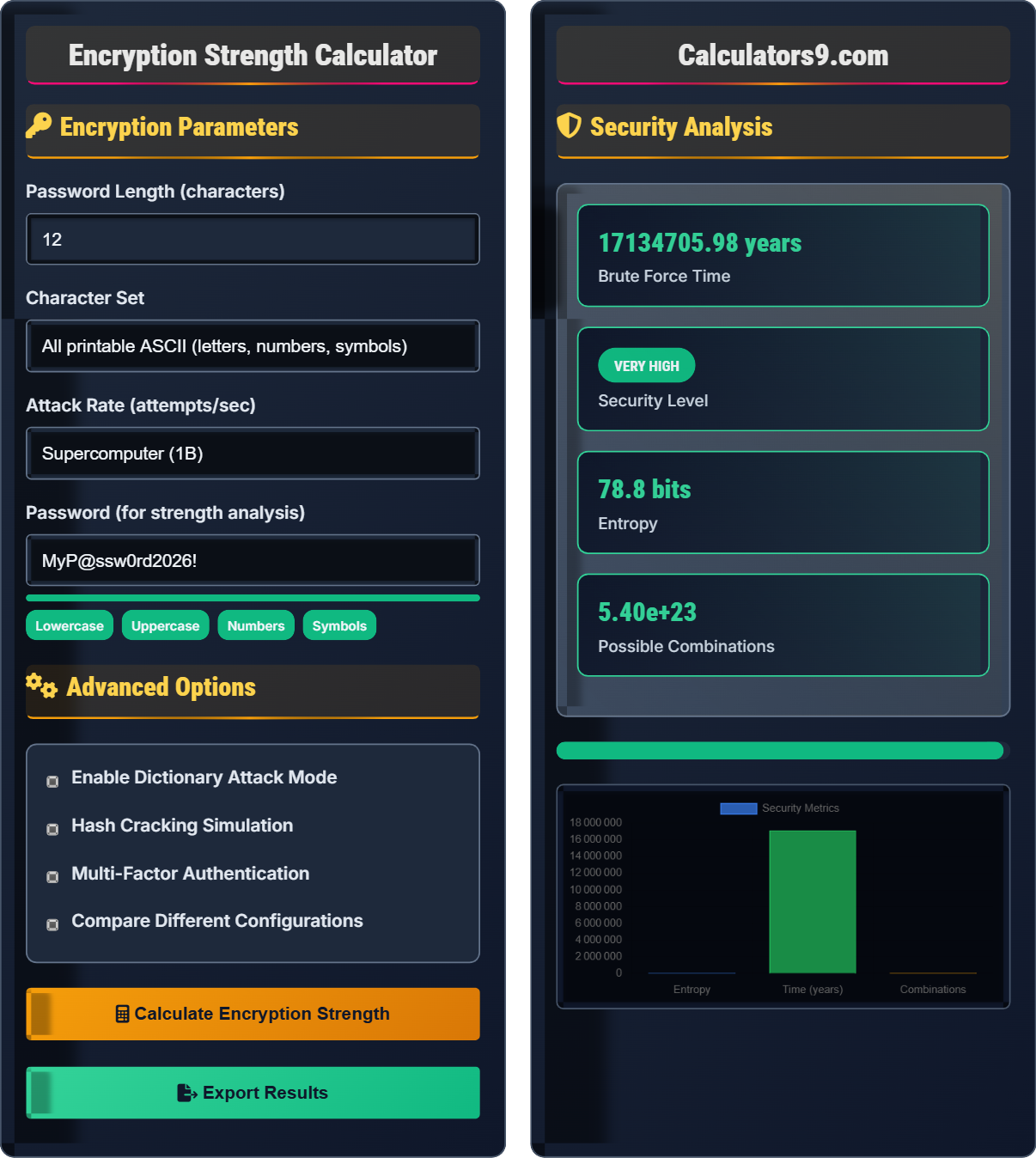
Example: For a 12-character password with mixed case letters, numbers, and symbols (\( C = 95 \)), against a system capable of 1 billion attempts per second (\( R = 10^9 \)):
\( T = \frac{95^{12}}{10^9} \approx 5.4 \times 10^{17} \) seconds
This equals approximately 17 million years to crack through brute force.
Encryption Parameters
Advanced Options
Security Analysis
| Parameter | Value | Impact |
|---|---|---|
| Password Length | 12 characters | Exponential effect |
| Character Set | 95 characters | Exponential effect |
| Attack Rate | 1B/sec | Linear effect |
Use mixed case, numbers, and symbols
Implement MFA for critical systems
Change passwords every 90 days
Comprehensive Encryption Security Guide
Encryption strength refers to the effectiveness of an encryption algorithm and key in protecting data from unauthorized access. It depends on key length, algorithm complexity, and resistance to various attack vectors. Strong encryption makes brute force attacks computationally infeasible within reasonable timeframes.
The time required for a brute force attack is calculated as:
Where:
- \(T\) = Time to crack (seconds)
- \(C\) = Character set size
- \(n\) = Password length
- \(R\) = Attempts per second
Effective encryption security depends on multiple factors:
- Key Length: Longer keys exponentially increase security
- Algorithm Strength: Resistance to known attacks
- Implementation Quality: Proper coding prevents side-channel attacks
- Key Management: Secure storage and rotation practices
- Use 12+ character passwords: Minimum recommended length
- Enable MFA: Adds layer of protection beyond passwords
- Regular updates: Keep encryption software current
- Secure protocols: Use TLS 1.3, SSH 2.0, etc.
- Key rotation: Change keys periodically
Encryption Fundamentals
Measure of resistance to unauthorized decryption.
\(T = \frac{C^n}{R}\)
Where T=time, C=charset, n=length, R=rate.
- Length exponentially affects security
- Diversity increases security
- Algorithms evolve over time
Security Planning
Regular evaluation of encryption effectiveness.
- Assess current encryption
- Estimate brute force time
- Plan upgrades
- Implement MFA
- Quantum computing threats
- Regulatory compliance
- User convenience
- Cost-benefit analysis
Encryption Security Learning Quiz
Which factor has the greatest impact on encryption strength?
The answer is B) Password length. According to the encryption strength formula \(T = \frac{C^n}{R}\), password length (n) appears in the exponent, making it the most impactful factor. Increasing password length by just one character multiplies the possible combinations by the character set size (C). For example, going from 8 to 9 characters with a 95-character set increases possible combinations from 6.6e+15 to 6.3e+17 - a 95x improvement!
This demonstrates the exponential nature of encryption strength. While character diversity (C) also affects security exponentially, length (n) has the most dramatic impact because it's the exponent. Students should understand that a longer but simpler password (like "correcthorsebatterystaple") is often stronger than a short complex one ("Tr0ub4dor&3").
Character Set (C): The pool of available characters (e.g., a-z, A-Z, 0-9, symbols)
Exponential Growth: Growth where the rate is proportional to the function's current value
Brute Force Attack: Trying every possible combination until the correct one is found
• Length has exponential impact (n is the exponent)
• Character diversity also has exponential impact
• Attack rate has linear impact (denominator)
• Remember: Length is the exponent in the formula
• Each additional character multiplies possibilities by the charset size
• Long passphrases are often stronger than short complex passwords
• Underestimating the impact of length vs complexity
• Thinking special characters alone make passwords strong
• Confusing linear and exponential relationships
Calculate the brute force time for an 8-character password using only lowercase letters (26 characters) against an attack rate of 1 million attempts per second. Show your work.
Using the formula: \(T = \frac{C^n}{R}\)
Given:
- C = 26 (lowercase letters)
- n = 8 (password length)
- R = 1,000,000 (attempts per second)
Step 1: Calculate possible combinations = \(C^n = 26^8 = 208,827,064,576\)
Step 2: Calculate time = \(\frac{208,827,064,576}{1,000,000} = 208,827.06\) seconds
Step 3: Convert to hours = \(\frac{208,827.06}{3,600} = 58\) hours
Therefore, it would take approximately 58 hours to crack this password through brute force.
This calculation demonstrates how quickly password strength can degrade with short lengths, even with a reasonable character set. The exponential nature means that adding just one more character (making it 9 characters) would increase the time by a factor of 26 (to about 38 days). This illustrates why minimum password lengths continue to increase in security standards.
Brute Force Time: Estimated time to crack a password by trying all possible combinations
Exponential Function: A function where the variable appears as an exponent
Attempts per Second: The rate at which an attacker can test password guesses
• Always convert final time to human-readable units
• Remember that actual attacks may be faster with optimizations
• The formula assumes uniform distribution of passwords
• Use scientific notation for large numbers
• Convert seconds to minutes/hours/days for better understanding
• Remember: \(26^8\) is 26×26×26×26×26×26×26×26
• Forgetting to divide by the attack rate
• Miscounting the number of characters in the set
• Not converting the final time to appropriate units
An organization currently uses 6-character passwords with lowercase letters only (26 characters). They want to upgrade to 10-character passwords with mixed case letters and numbers (62 characters). If attackers can make 100 million attempts per second, how much more secure is the new system compared to the old one?
Old system: \(C = 26, n = 6, R = 100,000,000\)
Old combinations = \(26^6 = 308,915,776\)
Old time = \(\frac{308,915,776}{100,000,000} = 3.09\) seconds
New system: \(C = 62, n = 10, R = 100,000,000\)
New combinations = \(62^{10} = 8.39 \times 10^{17}\)
New time = \(\frac{8.39 \times 10^{17}}{100,000,000} = 8.39 \times 10^9\) seconds
New time in years = \(\frac{8.39 \times 10^9}{31,536,000} = 266\) years
Improvement factor = \(\frac{8.39 \times 10^9}{3.09} = 2.71 \times 10^9\) (2.7 billion times more secure)
This example dramatically illustrates the exponential improvement in security when both length and character diversity increase. The organization goes from a password that could be cracked in seconds to one that would take centuries. This is why security policies increasingly mandate longer, more complex passwords.
Security Improvement Factor: Ratio comparing the security of two systems
Character Diversity: Including different types of characters (uppercase, lowercase, numbers, symbols)
Exponential Scaling: Security grows exponentially with length and diversity
• Calculate both systems separately before comparing
• Express improvement as a ratio or percentage
• Convert large time values to human-readable units
• Use scientific notation for large numbers
• Calculate improvement factor: \(\frac{\text{New Time}}{\text{Old Time}}\)
• Remember: Both length AND diversity improve security exponentially
• Forgetting to account for both length and character diversity improvements
• Making calculation errors with very large numbers
• Not converting final answers to appropriate time units
If a current supercomputer can make 1 billion attempts per second, but quantum computers in the future could make 1 trillion attempts per second, how much would this reduce the effective security of a 12-character password using all printable ASCII characters (95)? Would a 14-character password provide equivalent security to the original 12-character password against classical computers?
Current system: \(C = 95, n = 12, R = 10^9\)
Time = \(\frac{95^{12}}{10^9} = \frac{5.4 \times 10^{23}}{10^9} = 5.4 \times 10^{14}\) seconds
Time in years = \(\frac{5.4 \times 10^{14}}{31,536,000} = 17,000,000\) years
Quantum system: \(C = 95, n = 12, R = 10^{12}\)
Time = \(\frac{95^{12}}{10^{12}} = \frac{5.4 \times 10^{23}}{10^{12}} = 5.4 \times 10^{11}\) seconds
Time in years = \(\frac{5.4 \times 10^{11}}{31,536,000} = 17,000\) years
Reduction: From 17 million to 17 thousand years (1,000x less secure)
14-character password against quantum: Time = \(\frac{95^{14}}{10^{12}} = \frac{4.9 \times 10^{27}}{10^{12}} = 4.9 \times 10^{15}\) seconds
Time in years = \(\frac{4.9 \times 10^{15}}{31,536,000} = 155,000,000\) years
Yes, the 14-character password provides significantly more security than the original 12-character password against classical computers.
This demonstrates the quantum computing threat to current encryption. However, it also shows how increasing password length can counteract increased computational power. The exponential nature of the formula means that adding just a few characters can restore security margins even against quantum computers.
Quantum Computing: Computational approach using quantum mechanical phenomena to solve certain problems faster
Security Margin: The buffer between current capabilities and what's needed to crack encryption
Computational Power: The rate at which operations can be performed
• Quantum computers don't make all problems faster - only specific ones
• Increasing length exponentially counters increased computational power
• Security planning must consider future technological advances
• Prepare for quantum-resistant cryptography
• Longer passwords remain effective defense
• Regular security assessments are essential
• Assuming quantum computers will crack everything instantly
• Not accounting for the exponential nature of security improvements
• Thinking current security measures will remain sufficient indefinitely
Which statement about multi-factor authentication (MFA) and encryption strength is TRUE?
The answer is B) MFA adds another layer of security beyond encryption. Multi-factor authentication doesn't directly strengthen encryption algorithms, but it adds additional verification layers (something you know, have, and/or are) that make unauthorized access significantly more difficult. Even if an attacker cracks the password, they still need the second factor to gain access.
Students must understand that MFA and encryption serve complementary security purposes. Encryption protects data at rest and in transit, while MFA protects account access. They work together in a defense-in-depth strategy. MFA doesn't make passwords less important - it adds an additional barrier that must be overcome by attackers.
Multi-Factor Authentication (MFA): Security system requiring multiple verification methods
Defense-in-Depth: Layered security approach with multiple protective measures
Authentication Factor: Something you know, have, or are (knowledge, possession, inherence)
• MFA complements but doesn't replace encryption
• MFA adds verification layers beyond passwords
• Strong passwords remain important even with MFA
• Use MFA wherever possible
• Combine strong passwords with MFA
• Regularly review MFA settings
• Thinking MFA eliminates the need for strong passwords
• Confusing authentication with encryption
• Assuming MFA makes accounts completely secure
FAQ
Q: How does password entropy relate to encryption strength?
A: Password entropy measures the unpredictability of a password and is calculated as:
\(H = L \times \log_2(N)\)
Where \(H\) is entropy in bits, \(L\) is password length, and \(N\) is the size of the character set.
Higher entropy means more possible combinations, which directly increases the time required for brute force attacks. For example, a password with 40 bits of entropy would take \(2^{40}\) attempts to crack in the worst case, while one with 80 bits would take \(2^{80}\) attempts - a difference of over a trillion times more effort.
Security experts recommend at least 60 bits of entropy for general use and 80+ bits for sensitive applications.
Q: What's the difference between symmetric and asymmetric encryption in terms of strength?
A: Symmetric and asymmetric encryption have different strength characteristics:
- Symmetric (AES): Uses the same key for encryption and decryption. A 128-bit AES key provides 128 bits of security, meaning \(2^{128}\) attempts to brute force.
- Asymmetric (RSA): Uses public/private key pairs. A 2048-bit RSA key provides roughly 112 bits of security due to mathematical vulnerabilities, not 2048 bits.
In general, symmetric encryption provides equivalent security with shorter key lengths. This is why AES-256 (256-bit key) is considered more secure than RSA-2048 (2048-bit key). Symmetric encryption is also much faster computationally.