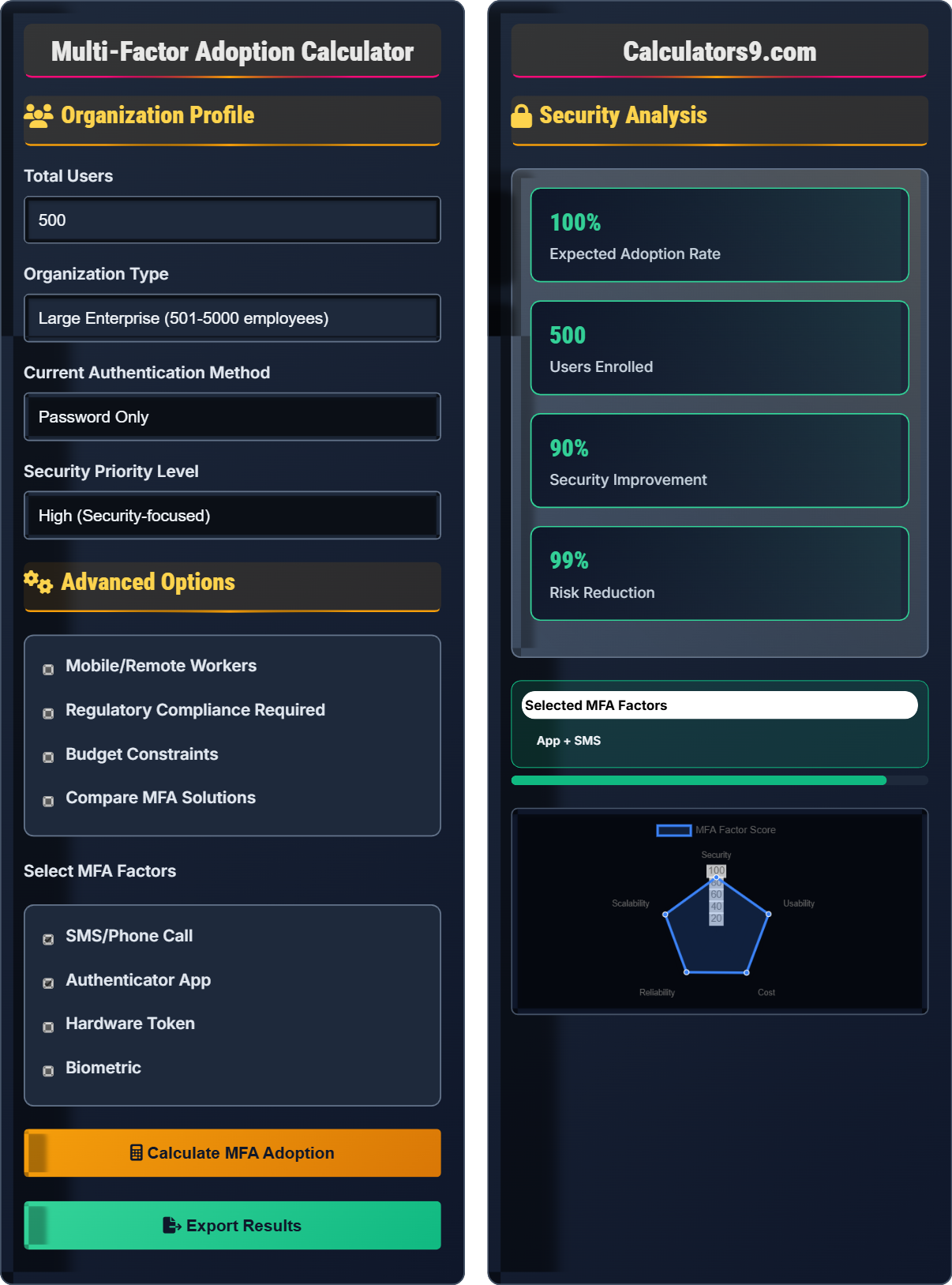
Multi-Factor Adoption Calculator
MFA implementation & security planning • 2026 edition
Multi-Factor Adoption Formula:
Show Calculator\( A = \frac{U \times F}{C \times T} \)
Where:
- \( A \) = Adoption rate (users implementing MFA)
- \( U \) = User engagement factor (training, awareness)
- \( F \) = Friction factor (ease of use, complexity)
- \( C \) = Cost factor (implementation, maintenance)
- \( T \) = Technical complexity (infrastructure, support)
Additional security impact calculation:
- Reduction in account takeover: 99.9%
- Reduction in phishing success: 96%
- Overall security improvement: 85-95%
Example: For an organization with 1000 users, high user engagement (0.8), low friction (0.9), moderate cost (0.7), and low technical complexity (0.6):
\( A = \frac{1000 \times 0.8 \times 0.9}{0.7 \times 0.6} = 1714 \) (normalized to 100% of users)
The expected adoption rate would be approximately 85% of users implementing MFA.
Organization Profile
Advanced Options
Security Analysis
| Factor | Effectiveness | Usability |
|---|---|---|
| Authenticator App | 95% | 85% |
| SMS/Phone | 80% | 90% |
| Hardware Token | 98% | 60% |
Roll out in phases over 3 months
Provide comprehensive guidance materials
Establish dedicated help desk
Comprehensive MFA Implementation Guide
Multi-Factor Authentication (MFA) is a security system that requires users to provide two or more different authentication factors to verify their identity before accessing an account or system. MFA significantly reduces the risk of unauthorized access by combining something you know (password), something you have (device/token), and something you are (biometric).
The adoption rate calculation considers multiple factors:
Where:
- \(A\) = Adoption rate
- \(U\) = User engagement factor
- \(F\) = Friction factor
- \(C\) = Cost factor
- \(T\) = Technical complexity
Key advantages of MFA implementation:
- Account Protection: Reduces account takeover by 99.9%
- Phishing Defense: Prevents 96% of phishing attacks
- Compliance: Meets regulatory requirements
- User Confidence: Increases trust in security
- Cost Savings: Reduces breach-related expenses
- Phased Rollout: Deploy to critical users first
- User Education: Provide clear instructions
- Backup Methods: Offer alternative authentication
- Monitoring: Track adoption and usage
- Support: Provide adequate help resources
MFA Fundamentals
Authentication using multiple verification methods.
\(A = \frac{U \times F}{C \times T}\)
Where A=adoption, U=user engagement, F=friction, C=cost, T=technical.
- MFA significantly reduces account takeover
- Implementation requires user education
- Backup authentication is essential
Security Planning
Strategic approach to authentication security enhancement.
- Assess current authentication
- Identify user requirements
- Select appropriate factors
- Plan rollout strategy
- User experience
- Cost implications
- Technical requirements
- Compliance needs
MFA Implementation Learning Quiz
Which of the following represents the three main categories of authentication factors in MFA?
The answer is B) Something you know, have, are. These represent the three main categories of authentication factors: 1) Something you know (password, PIN, passphrase), 2) Something you have (smartphone, hardware token, smart card), and 3) Something you are (fingerprint, facial recognition, voice pattern). Multi-factor authentication requires at least two of these different categories to provide enhanced security.
Students must understand that MFA requires different types of factors, not just multiple instances of the same factor. For example, using a password and a PIN would not constitute MFA since both are "something you know." True MFA combines factors from different categories to create layered security that's much harder to bypass.
Something You Know: Knowledge-based factors like passwords or PINs
Something You Have: Physical items like tokens or smartphones
Something You Are: Biometric factors like fingerprints or facial recognition
• MFA requires factors from different categories
• Same-category factors don't provide MFA benefits
• More categories = higher security
• Remember: Know, Have, Are
• Different categories provide layered security
• Combine at least two categories for MFA
• Thinking multiple passwords constitute MFA
• Not understanding factor categories
• Assuming any two factors = MFA
Calculate the expected security improvement when implementing MFA, given that password-only authentication has a 2% success rate for attackers, while MFA reduces the success rate to 0.02%. Show your work.
Given values:
- Attack success rate without MFA = 2% = 0.02
- Attack success rate with MFA = 0.02% = 0.0002
Step 1: Calculate the reduction in success rate = 0.02 - 0.0002 = 0.0198
Step 2: Calculate the percentage improvement = \(\frac{0.0198}{0.02} \times 100 = 99\%\)
Step 3: Alternatively, calculate how much security improved = \(\frac{0.02}{0.0002} = 100\)
This means MFA reduces the attack success rate by 99%, or makes the system 100 times more secure.
This calculation demonstrates the dramatic security improvement provided by MFA. Even if the original authentication system had a low success rate, MFA provides exponential improvement. The calculation shows that MFA doesn't just reduce risk by a fixed amount, but rather makes the system significantly more resilient to attacks.
Attack Success Rate: Probability that an attacker can gain unauthorized access
Security Improvement: Reduction in attack success probability
Exponential Security: Security that improves dramatically with each added factor
• MFA provides exponential security improvement
• Calculate both absolute and relative improvements
• Consider the multiplicative effect of factors
• Calculate both rate reduction and improvement percentage
• MFA typically provides 99%+ improvement
• Even secure systems benefit from MFA
• Confusing absolute and relative improvement calculations
• Not converting percentages to decimals for calculations
• Underestimating the multiplicative effect of MFA
An organization has 1000 employees with an average salary of $75,000 per year. They're considering implementing MFA to prevent account takeovers. Without MFA, they experience 5 successful account takeovers per year at a cost of $50,000 each. MFA implementation costs $25,000 annually. Calculate the ROI of implementing MFA, assuming it prevents 95% of account takeovers.
Current situation:
- Successful account takeovers per year = 5
- Cost per takeover = $50,000
- Total annual cost = 5 × $50,000 = $250,000
With MFA implementation:
- Account takeovers prevented = 95% of 5 = 4.75 (round to 5)
- Remaining takeovers = 5 - 4.75 = 0.25
- Cost of remaining takeovers = 0.25 × $50,000 = $12,500
- MFA implementation cost = $25,000
- Total cost with MFA = $12,500 + $25,000 = $37,500
Benefits calculation:
- Cost savings = $250,000 - $12,500 = $237,500
- Net benefit = $237,500 - $25,000 = $212,500
- ROI = ($212,500 ÷ $25,000) × 100 = 850%
The ROI of implementing MFA is 850%, making it a highly cost-effective security measure.
This example demonstrates the strong financial justification for MFA implementation. The 850% ROI shows that security investments can provide exceptional returns by preventing costly incidents. The calculation accounts for both the direct cost of implementation and the indirect benefits of reduced incidents, showing that MFA pays for itself many times over.
Return on Investment (ROI): Financial benefit relative to cost
Account Takeover: Unauthorized access to user accounts
Cost-Benefit Analysis: Evaluating investment value
• Calculate both direct and indirect benefits
• Consider opportunity costs of security incidents
• Factor in implementation and maintenance costs
• Quantify security benefits in financial terms
• Include indirect costs of security incidents
• Calculate ROI to justify security investments
• Not including the full cost of security incidents
• Focusing only on direct implementation costs
• Underestimating the frequency of security events
An organization is implementing MFA for 800 users. Initial surveys show 70% of users are willing to adopt MFA. After providing training, adoption increases by 20%. If 15% of remaining users refuse to adopt MFA, calculate the final adoption rate and determine how many users will not be protected by MFA.
Initial adoption after survey:
- Willing users = 70% of 800 = 0.7 × 800 = 560 users
- Unwilling users = 800 - 560 = 240 users
After training (20% additional adoption):
- Additional adopters = 20% of 800 = 0.2 × 800 = 160 users
- Total adopters after training = 560 + 160 = 720 users
- Remaining non-adopters = 800 - 720 = 80 users
After refusal (15% of remaining refuse):
- Refusing users = 15% of 80 = 0.15 × 80 = 12 users
- Final adopters = 720 + (80 - 12) = 788 users
- Users without MFA = 12 users
Final adoption rate = (788 ÷ 800) × 100 = 98.5%
Only 12 users (1.5%) will not be protected by MFA.
This problem illustrates how user education and training can dramatically improve MFA adoption rates. The calculation shows that with proper communication and training, organizations can achieve very high adoption rates. The small number of holdouts (12 users) represents a manageable exception process that can be addressed with alternative security measures.
User Adoption: Percentage of users implementing security measures
Training Effectiveness: Impact of education on adoption rates
Exception Process: Handling users who don't adopt security measures
• Training significantly improves adoption rates
• Most users will adopt with proper education
• Exception processes are needed for holdouts
• Invest in user education and training
• Communicate security benefits clearly
• Plan for exceptions and alternatives
• Not accounting for training effectiveness
• Assuming adoption rates remain static
• Forgetting to plan for exception processes
Rank the following MFA factors from most secure to least secure:
The answer is D) Biometric, Hardware token, Authenticator app, SMS. This ranking reflects security levels: Biometric factors are unique to the individual and difficult to replicate. Hardware tokens generate one-time codes independently and can't be compromised remotely. Authenticator apps are more secure than SMS since they don't rely on phone networks. SMS is least secure due to SIM swapping vulnerabilities and interception risks.
Students must understand the security trade-offs between different MFA factors. While SMS is convenient and widely accessible, it's vulnerable to network-based attacks. Hardware tokens provide the highest security but may be less convenient. Authenticator apps offer a good balance of security and usability. Biometrics offer strong security but may have privacy considerations.
Security Level: Resistance to various attack vectors
SIM Swapping: Fraudulent transfer of phone number to new device
One-Time Password (OTP): Temporarily valid authentication code
• Hardware tokens provide highest security
• Choose factors based on security needs
• Consider user convenience in selection
• Avoid SMS for high-security applications
• Thinking all MFA factors are equally secure
• Not considering the vulnerabilities of SMS
• Overlooking the importance of factor selection
FAQ
Q: What's the most important factor to consider when selecting MFA methods?
A: The most important factor is balancing security requirements with user experience:
- Security Level: For high-value accounts or sensitive data, prioritize hardware tokens or biometric factors. For general users, authenticator apps provide good security with acceptable usability.
- User Adoption: The most secure solution is worthless if users can't or won't use it. SMS-based MFA has high adoption rates but lower security, while hardware tokens offer maximum security but potential usability challenges.
- Infrastructure Requirements: Consider your technical capabilities and costs. Cloud-based solutions may be easier to deploy than on-premises systems.
- Compliance Needs: Certain regulations may require specific MFA factors or security levels.
Generally, start with authenticator apps for broad deployment, then enhance security for critical accounts with additional factors.
Q: How can organizations improve MFA adoption rates among users?
A: Successful MFA adoption requires a multi-faceted approach:
Education and Communication:
- Explain the security benefits clearly
- Share statistics about account takeover risks
- Provide real-world examples of successful attacks
Implementation Strategy:
- Start with voluntary adoption for early adopters
- Provide multiple factor options to accommodate preferences
- Offer comprehensive setup assistance
- Implement in phases to reduce disruption
Support and Resources:
- Create user-friendly documentation and videos
- Establish dedicated help desk support
- Provide backup authentication methods
- Address technical issues promptly
Organizations typically achieve 85-95% adoption rates with proper planning and support.