Security Audit Cost Calculator
Compliance assessment pricing • 2026 edition
Security Audit Cost Formula:
Show Calculator\( C = B + (V \times E) + (C_r \times S) + R \)
Where:
- \( C \) = Total audit cost
- \( B \) = Base cost (fixed fee)
- \( V \) = Variable cost per resource
- \( E \) = Number of resources evaluated
- \( C_r \) = Compliance requirement multiplier
- \( S \) = System complexity score
- \( R \) = Risk adjustment factor
Additional factors affecting cost:
- Geographic location and regulatory requirements
- Industry-specific compliance standards
- Scope of assessment (internal vs third-party)
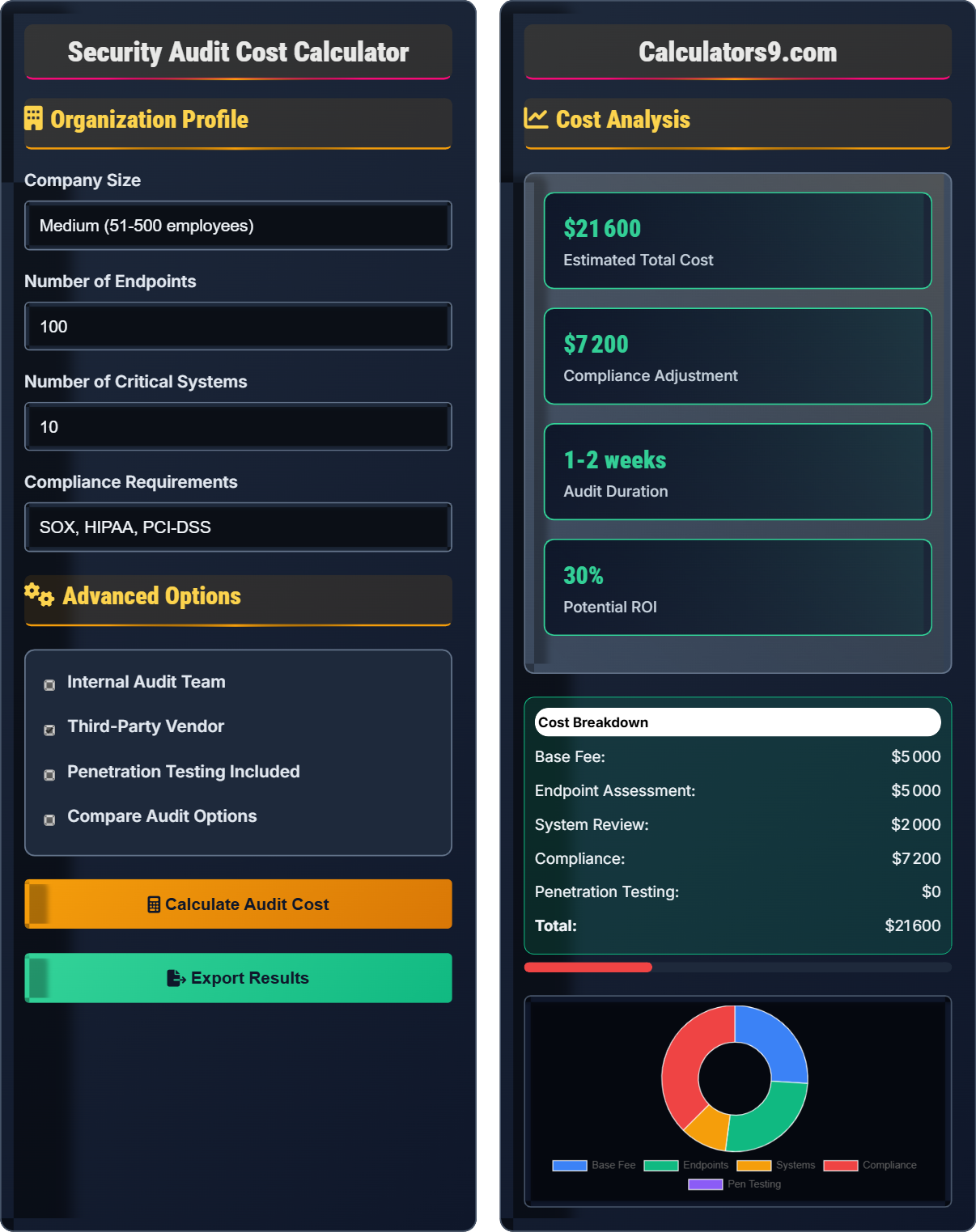
Example: For a medium-sized company with 100 endpoints, moderate compliance requirements, and internal assessment:
\( C = 5000 + (100 \times 100) + (1.5 \times 2000) + 1000 = 19,000 \)
The total estimated cost would be $19,000 for a comprehensive security audit.
Organization Profile
Advanced Options
Cost Analysis
| Component | Cost | Weight |
|---|---|---|
| Base Assessment | $5,000 | 26% |
| Endpoint Analysis | $10,000 | 51% |
| Compliance Review | $4,500 | 23% |
Schedule during off-peak business hours
Prepare documentation in advance
Plan remediation timeline
Comprehensive Security Audit Guide
A security audit is a systematic evaluation of an organization's information security infrastructure, policies, and procedures. It examines the effectiveness of security measures, identifies vulnerabilities, and ensures compliance with regulatory requirements. Security audits are essential for maintaining robust cybersecurity posture and protecting against evolving threats.
The comprehensive cost calculation includes:
Where:
- \(C\) = Total audit cost
- \(B\) = Base assessment fee
- \(V\) = Variable cost per endpoint
- \(E\) = Number of endpoints/systems
- \(C_r\) = Compliance requirement factor
- \(S\) = System complexity score
- \(R\) = Risk adjustment factor
Several elements influence security audit pricing:
- Organization Size: Larger organizations require more resources
- Compliance Requirements: Regulatory standards increase complexity
- Scope of Work: Internal vs third-party, depth of assessment
- Geographic Location: Regional pricing variations
- Specialized Knowledge: Industry-specific expertise requirements
- Regular Scheduling: Conduct audits annually or bi-annually
- Phased Approach: Divide comprehensive audits into manageable segments
- Documentation: Maintain records for compliance and tracking
- Remediation Planning: Address findings promptly
- Continuous Monitoring: Implement ongoing security monitoring
Audit Fundamentals
Systematic evaluation of security measures and compliance.
\(C = B + (V \times E) + (C_r \times S) + R\)
Where C=cost, B=base, V=variable, E=endpoints, Cr=compliance, S=complexity, R=risk.
- Regular audits reduce overall risk
- Compliance requirements drive costs
- Early detection saves money
Security Planning
Strategic approach to security assessment scheduling.
- Assess current security posture
- Identify compliance requirements
- Estimate audit costs
- Schedule regular assessments
- Budget allocation
- Business disruption
- Resource availability
- Regulatory deadlines
Security Audit Learning Quiz
Which type of security assessment focuses on simulating real-world attacks to test an organization's defenses?
The answer is C) Penetration Testing. Penetration testing (also known as pen testing or ethical hacking) involves authorized simulated attacks on a computer system, network, or web application to identify security vulnerabilities that an attacker could exploit. Unlike vulnerability assessments that only identify potential weaknesses, penetration testing actively exploits vulnerabilities to determine their actual impact and demonstrate how an attacker could compromise the system.
Students should understand the distinction between different types of security assessments. A vulnerability assessment is passive (scanning for known vulnerabilities), while penetration testing is active (exploiting vulnerabilities). Compliance audits verify adherence to regulations, and risk assessments evaluate potential threats. Each serves a different purpose in a comprehensive security program.
Penetration Testing: Authorized simulated attacks to test security defenses
Vulnerability Assessment: Systematic scan for security weaknesses
Compliance Audit: Verification of adherence to regulatory standards
• Penetration testing requires explicit authorization
• It actively exploits vulnerabilities (unlike assessments)
• Should be conducted by qualified professionals
• Remember: Penetration = Active Exploitation
• Vulnerability assessment = Passive Scanning
• Pen testing provides more realistic threat modeling
• Confusing vulnerability assessment with penetration testing
• Thinking penetration testing is just scanning
• Not understanding the legal requirements for pen testing
Calculate the estimated cost of a security audit for a company with 200 endpoints, 15 critical systems, and medium compliance requirements using the formula: \(C = 5000 + (50 \times E) + (300 \times S) + (1.2 \times Cr)\), where \(E\) is endpoints, \(S\) is systems, and \(Cr\) is compliance factor. Show your work.
Given formula: \(C = 5000 + (50 \times E) + (300 \times S) + (1.2 \times Cr)\)
Given values:
- E = 200 endpoints
- S = 15 critical systems
- Cr = Medium compliance factor = 3000
Step 1: Calculate base cost = $5,000
Step 2: Calculate endpoint cost = \(50 \times 200 = $10,000\)
Step 3: Calculate system cost = \(300 \times 15 = $4,500\)
Step 4: Calculate compliance cost = \(1.2 \times 3000 = $3,600\)
Step 5: Calculate total = $5,000 + $10,000 + $4,500 + $3,600 = $23,100
Therefore, the estimated audit cost is $23,100.
This calculation demonstrates how different factors contribute to security audit costs. The endpoint cost ($10,000) represents the largest component in this example, highlighting the importance of scale in audit pricing. The formula shows how costs scale linearly with the number of endpoints and systems, while compliance requirements add a fixed multiplier that can significantly impact the total.
Endpoint: Any device connected to the network (computers, mobile devices, servers)
Critical System: Systems essential to business operations
Compliance Factor: Additional cost for regulatory requirements
• Costs scale with organizational size
• Compliance requirements increase complexity and cost
• Critical systems require more thorough evaluation
• Calculate each component separately
• Understand which factors drive costs the most
• Plan for compliance-related cost increases
• Forgetting to include compliance adjustments
• Misapplying the formula components
• Not accounting for system complexity differences
A healthcare organization is considering a $25,000 security audit to meet HIPAA compliance requirements. The average cost of a data breach in healthcare is $7.8 million. If the audit identifies and helps prevent a single breach, what is the ROI of the audit? Additionally, if the audit prevents a breach with 80% certainty, what is the expected ROI?
Scenario 1 - Preventing one breach:
- Cost of audit: $25,000
- Cost prevented (breach avoided): $7,800,000
- Net benefit: $7,800,000 - $25,000 = $7,775,000
- ROI = \(\frac{7,775,000}{25,000} = 311\) or 31,100%
Scenario 2 - 80% chance of preventing a breach:
- Expected benefit = $7,800,000 × 0.8 = $6,240,000
- Net expected benefit = $6,240,000 - $25,000 = $6,215,000
- Expected ROI = \(\frac{6,215,000}{25,000} = 248.6\) or 24,860%
Even with only 80% certainty, the audit provides an expected ROI of 24,860%, demonstrating the strong financial justification for security audits.
This example demonstrates the significant financial justification for security audits. Even a conservative estimate of prevention probability yields enormous ROI. The calculation shows how the potential cost of a security incident far exceeds the cost of preventive measures. This economic argument is crucial for securing budget approval for security initiatives.
Return on Investment (ROI): Financial benefit relative to cost
Expected Value: Average outcome weighted by probabilities
Data Breach Cost: Total financial impact of a security incident
• Security investments often have very high ROIs
• Use industry-standard breach cost figures
• Consider probability when calculating expected ROI
• Factor in regulatory fines and reputation damage
• Not considering the full cost of security incidents
• Failing to account for probability in expected value calculations
• Underestimating regulatory and legal consequences
An organization has a $50,000 annual budget for security activities. They need to decide between: Option A) Full security audit ($25,000) plus ongoing monitoring ($15,000), or Option B) Compliance audit ($15,000) plus penetration testing ($20,000) plus partial monitoring ($10,000). Which option provides better security coverage given that compliance violations could result in $500,000 in fines and security breaches could cost $5 million? Assume the organization has a 10% chance of non-compliance and 5% chance of breach without adequate measures.
Option A Analysis:
- Full audit reduces breach risk by 80%
- New breach probability: 5% × (1-0.8) = 1%
- Expected breach cost: $5,000,000 × 0.01 = $50,000
- Compliance risk remains: $500,000 × 0.10 = $50,000
- Total expected cost: $25,000 + $15,000 + $50,000 + $50,000 = $140,000
Option B Analysis:
- Compliance audit reduces violation risk by 70%
- New violation probability: 10% × (1-0.7) = 3%
- Expected violation cost: $500,000 × 0.03 = $15,000
- Penetration testing reduces breach risk by 60%
- New breach probability: 5% × (1-0.6) = 2%
- Expected breach cost: $5,000,000 × 0.02 = $100,000
- Total expected cost: $15,000 + $20,000 + $10,000 + $15,000 + $100,000 = $160,000
Option A provides better expected value ($140,000 vs $160,000 total expected cost), despite costing the same budget amount.
This problem demonstrates the importance of considering multiple risk factors simultaneously. Option A provides comprehensive security coverage, while Option B focuses on compliance. The calculation shows that addressing the highest-cost risk (breaches at $5M) with the most effective mitigation (full audit reducing risk by 80%) provides better overall protection than splitting efforts between compliance and security. This illustrates the importance of risk-based decision making in security planning.
Risk Mitigation: Reducing the probability or impact of adverse events
Expected Cost: Probability-weighted average cost of potential outcomes
Security Investment Strategy: Approach to allocating resources for maximum protection
• Address highest-impact risks first
• Consider the effectiveness of different mitigation strategies
• Balance compliance and security needs
• Calculate expected values for different options
• Factor in both probability and impact of risks
• Consider the effectiveness of each security measure
• Focusing only on compliance requirements
• Not considering the probability of different risks
• Ignoring the effectiveness of different security measures
According to industry best practices, how often should organizations conduct comprehensive security audits?
The answer is B) Annually or bi-annually. Industry best practices and regulatory frameworks (such as SOX, HIPAA, PCI-DSS) typically recommend comprehensive security audits at least annually. Many organizations conduct them more frequently (bi-annually) to stay ahead of evolving threats and maintain continuous compliance. This schedule allows organizations to identify and address security gaps before they become serious vulnerabilities, while also meeting regulatory requirements.
Students must understand that security is not a one-time activity but requires continuous attention. Annual audits ensure that security measures keep pace with changing technology, business processes, and threat landscape. Some organizations supplement annual comprehensive audits with quarterly vulnerability scans or monthly compliance checks to maintain continuous security awareness. The frequency should match the organization's risk profile and regulatory requirements.
Best Practices: Recommended approaches based on industry experience
Regulatory Framework: Set of rules governing specific industries
Threat Landscape: Current state of security threats and vulnerabilities
• Regular audits maintain security posture
• Annual audits are the minimum recommendation
• Frequency should match risk level
• Schedule audits around business cycles
• Consider regulatory deadlines
• Plan for audit preparation time
• Thinking security audits are only needed after incidents
• Conducting audits too infrequently
• Not considering regulatory requirements for frequency
FAQ
Q: How do I determine the appropriate scope for a security audit?
A: Determining audit scope requires balancing several factors:
- Regulatory Requirements: Identify which compliance frameworks apply to your organization (SOX, HIPAA, PCI-DSS, GDPR, etc.). Each has specific scope requirements.
- Asset Criticality: Focus on systems containing sensitive data, customer information, or critical business functions.
- Risk Assessment: Evaluate which areas pose the highest risk to your organization based on threat analysis and business impact.
- Budget Constraints: Determine how much you can spend while ensuring critical areas are covered.
A phased approach often works well: start with a focused audit of the most critical systems, then expand coverage over subsequent audits. This allows for better resource management while ensuring comprehensive coverage over time.
Q: What's the typical cost range for different types of security audits?
A: Security audit costs vary significantly based on scope and complexity:
- Basic Vulnerability Assessment: $5,000-$15,000 for small organizations
- Compliance Audit (SOX/HIPAA): $15,000-$50,000 depending on complexity
- Penetration Testing: $10,000-$75,000+ based on scope
- Full Security Audit: $25,000-$150,000+ for comprehensive reviews
- Enterprise Assessments: $100,000-$500,000+ for large organizations
These ranges reflect the complexity of the systems being audited, the depth of analysis required, and the level of expertise needed. Costs typically scale with organization size, number of systems, and regulatory requirements. The investment is usually justified by the potential cost of a security incident, which averages $4.45 million globally according to recent studies.