API Call Cost Calculator
Optimize API expenses • 2026 edition
API Call Cost Formula:
Show the calculator\( \text{Total Cost} = \text{Free Tier} + \sum_{i=1}^{n} (\text{Tier}_i \times \text{Rate}_i) \)
Where:
- Free Tier = Included calls at no cost
- Tieri = Number of calls in pricing tier i
- Ratei = Cost per call in tier i
- n = Number of pricing tiers
For stepped pricing models:
\( C = \begin{cases} 0 & \text{if } N \leq F \\ (N - F) \times R & \text{if } N > F \text{ and flat rate} \\ \sum_{i} \min(\text{Tier Size}_i, \text{Remaining Calls}_i) \times \text{Rate}_i & \text{if tiered pricing} \end{cases} \)
Where:
- C = Total cost
- N = Total API calls
- F = Free tier allowance
- R = Flat rate per call
This formula accounts for various pricing models including free tiers, flat rates, and tiered pricing structures.
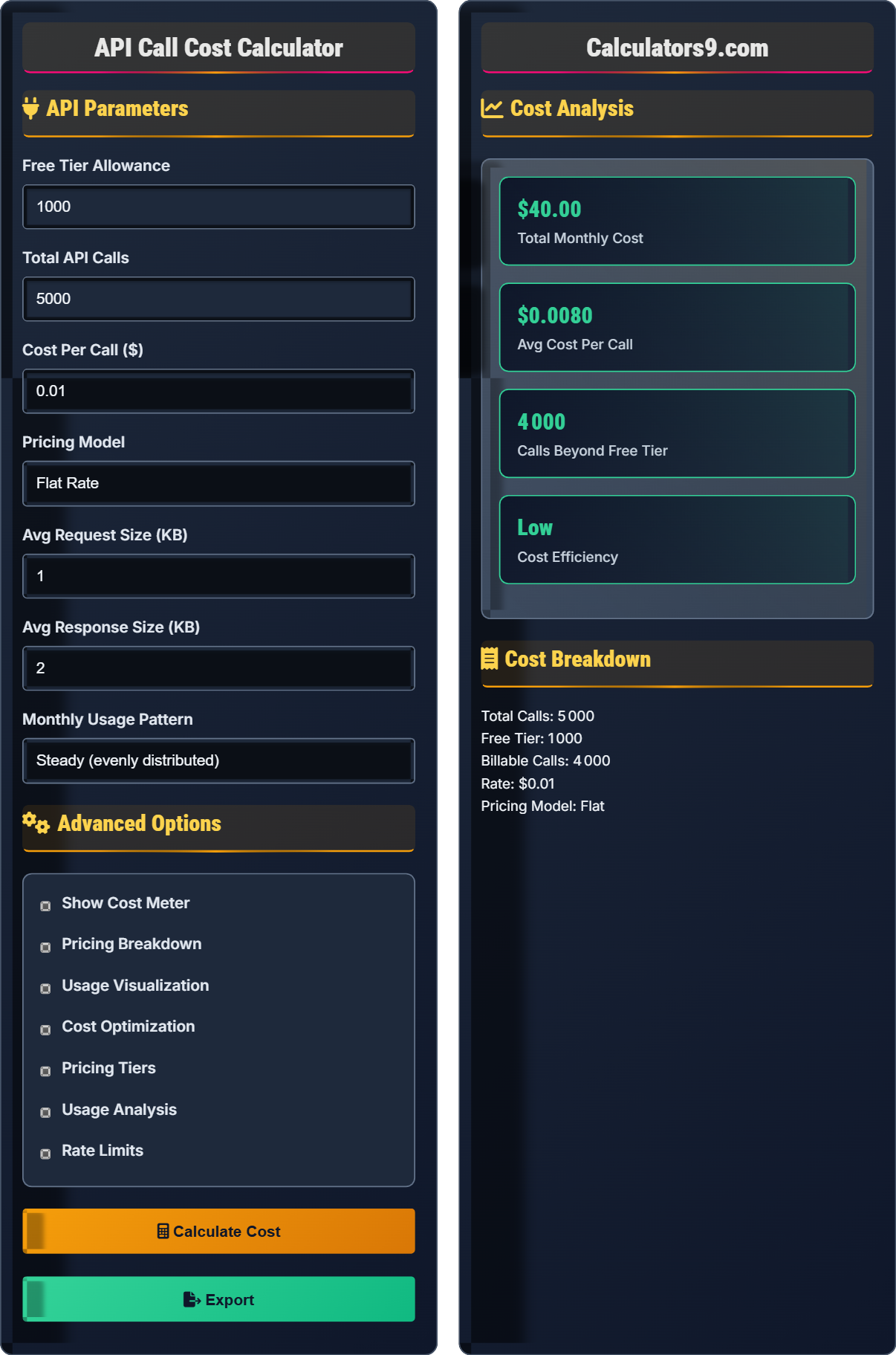
Example: With 1000 free calls, 5000 total calls, and tiered pricing ($0.01 for calls 1001-5000, $0.008 for calls 5001+):
Calls beyond free tier = 5000 - 1000 = 4000
Cost = 4000 × $0.01 = $40.00
API Parameters
Advanced Options
Cost Analysis
Cost Breakdown
API Cost Fundamentals
API cost refers to the expenses incurred when making requests to external services, typically based on usage volume and pricing models established by service providers.
\( \text{Total Cost} = \text{Free Tier} + \sum_{i=1}^{n} (\text{Tier}_i \times \text{Rate}_i) \)
Where Total Cost=total monthly expense, Free Tier=included calls, Tieri=calls in tier i, Ratei=cost per call in tier i.
- Free tiers reduce overall costs significantly
- Tiered pricing offers discounts for higher volumes
- Rate limits affect usage patterns
- Caching can reduce API call costs
Pricing Models
Different pricing structures include flat rates, tiered pricing, volume discounts, and subscription models for optimal cost management.
- Flat Rate: Fixed cost per call
- Tiered: Decreasing cost per call at higher volumes
- Volume: Discounted rates for bulk usage
- Subscription: Fixed monthly fee with included calls
- Choose model based on usage patterns
- Consider growth projections
- Implement usage monitoring
- Optimize call efficiency
API Cost Learning Quiz
Which pricing model typically offers the lowest cost per call as usage volume increases?
The answer is B) Tiered pricing. Tiered pricing models offer decreasing costs per call as you move into higher usage tiers. For example, the first 1,000 calls might cost $0.01 each, but calls 10,000+ might cost $0.005 each, making the average cost per call decrease with volume.
Tiered pricing incentivizes higher usage by offering economies of scale. The marginal cost decreases as volume increases, making it attractive for applications with growing API usage. This model benefits both providers (higher total revenue) and consumers (lower per-unit costs).
Tiered Pricing: Cost structure with decreasing rates at higher volumes
Economies of Scale: Cost advantages from increased production volumeCost Per Unit: Expense for each individual API call
• Tiered pricing offers volume discounts
• Average cost decreases with higher usage
• Marginal cost varies by tier
• Plan usage to take advantage of lower tiers
• Consider growth projections when selecting plans
• Monitor usage to avoid unexpected tier jumps
• Not accounting for tier boundaries
• Assuming constant cost per call in tiered models
• Not considering usage growth patterns
Calculate the monthly cost for an API with the following tiered pricing: Free tier of 1,000 calls, then $0.01 per call for 1,001-5,000 calls, $0.008 per call for 5,001-10,000 calls, and $0.005 per call for 10,001+ calls. If you make 8,000 calls per month, what is the total cost?
Step 1: Calculate usage in each tier
Free tier: 1,000 calls (cost: $0)
Tier 1 (1,001-5,000): 4,000 calls at $0.01 each
Tier 2 (5,001-8,000): 3,000 calls at $0.008 each
Tier 3 (10,001+): 0 calls
Step 2: Calculate cost for each tier
Tier 1 cost: 4,000 × $0.01 = $40.00
Tier 2 cost: 3,000 × $0.008 = $24.00
Tier 3 cost: 0 × $0.005 = $0.00
Step 3: Calculate total cost
Total cost = $0 + $40.00 + $24.00 + $0.00 = $64.00
Therefore, the total monthly cost is $64.00.
This calculation demonstrates how tiered pricing works by applying different rates to different portions of usage. The key is to calculate the number of calls in each tier separately and then apply the appropriate rate. This approach allows for precise cost estimation in tiered models.
Tier Boundary: The limit of each pricing tier
Marginal Rate: Cost per unit in a specific tier
Accumulated Cost: Total cost across all tiers
• Calculate usage in each tier separately
• Apply the rate for each specific tier
• Sum costs across all applicable tiers
• Keep track of tier boundaries
• Calculate marginal costs for budgeting
• Plan usage to optimize tier positioning
• Applying the highest tier rate to all calls
• Not properly calculating tier boundaries
• Forgetting to account for free tiers
A company makes 12,000 API calls per month at $0.01 per call. The API provider offers a subscription plan for $100/month with 15,000 included calls. Should the company switch to the subscription model, and what would be the monthly savings?
Step 1: Calculate current monthly cost
Current cost = 12,000 calls × $0.01/call = $120.00
Step 2: Calculate subscription cost
Subscription cost = $100.00 (includes 15,000 calls)
Step 3: Calculate potential savings
Savings = Current cost - Subscription cost
Savings = $120.00 - $100.00 = $20.00 per month
Step 4: Evaluate the decision
Yes, the company should switch to the subscription model as it saves $20.00 per month while providing more included calls.
Therefore, switching saves $20.00 per month.
This example demonstrates how to evaluate different pricing models by comparing total costs. The subscription model provides economies of scale when usage is predictable and consistent. The decision should consider both immediate cost savings and future usage growth.
Subscription Model: Fixed fee with included usage
Break-Even Analysis: Point where different models cost the sameCost Comparison: Evaluating different pricing options
• Compare total costs across models
• Consider usage patterns and growth
• Factor in included allowances
• Calculate break-even points for different models
• Consider usage volatility when choosing models
• Factor in administrative overhead differences
• Not considering all components of total cost
• Ignoring usage growth projections
• Focusing only on per-unit costs
A service makes 50,000 API calls per month at $0.005 per call. If implementing caching reduces API calls by 30%, what is the monthly cost reduction? What if the cache hit rate is only 20%?
Scenario 1: 30% cache hit rate
Original calls: 50,000
Reduced calls: 50,000 × (1 - 0.30) = 35,000
Original cost: 50,000 × $0.005 = $250.00
New cost: 35,000 × $0.005 = $175.00
Cost reduction: $250.00 - $175.00 = $75.00
Scenario 2: 20% cache hit rate
Reduced calls: 50,000 × (1 - 0.20) = 40,000
New cost: 40,000 × $0.005 = $200.00
Cost reduction: $250.00 - $200.00 = $50.00
Therefore, a 30% cache hit rate saves $75.00/month, while 20% saves $50.00/month.
This example shows the direct relationship between cache effectiveness and API cost reduction. The calculation demonstrates how even modest improvements in cache hit rates can generate significant cost savings, especially at scale. This principle applies to other optimization strategies as well.
Cache Hit Rate: Percentage of requests served from cache
Cost Avoidance: Money saved by reducing API usage
Scale Effects: Magnified impact at higher volumes
• Cost savings are proportional to usage reduction
• Higher volumes amplify optimization benefits
• Cache effectiveness directly impacts costs
• Implement caching for frequently accessed data
• Monitor cache hit rates regularly
• Optimize TTL settings for maximum efficiency
• Not measuring actual cache effectiveness
• Setting inappropriate TTL values
• Not considering cache invalidation costs
Which of the following is the most effective strategy to manage API costs while respecting rate limits?
The answer is B) Distribute calls evenly throughout the day. Even distribution helps avoid hitting rate limits while maintaining steady performance. This approach also allows for better cost predictability and prevents service disruptions that could result from rate limiting violations.
Rate limiting is designed to protect API infrastructure and ensure fair usage. Distributing calls evenly maximizes utilization while staying within limits. This approach also helps maintain consistent performance and avoids the costs associated with rate limit violations, such as retries and failures.
Rate Limiting: Restrictions on API call frequency
Request Distribution: Spreading calls over time
Throttling: Automatic rate limiting enforcement
• Respect rate limits to avoid service disruptions
• Distribute usage for optimal performance
• Plan around rate limit constraints
• Implement exponential backoff for retries
• Use request queuing for smooth distribution
• Monitor rate limit headers for proactive management
• Bursting requests beyond rate limits
• Not handling rate limit responses properly
• Ignoring rate limit policies
FAQ
Q: How do I calculate API costs with tiered pricing?
A: The formula is: \( \text{Total Cost} = \sum_{i=1}^{n} (\text{Calls in Tier}_i \times \text{Rate}_i) \).
For example, with 8,000 calls and tiers:
- 0-1,000: Free
- 1,001-5,000: $0.01 per call
- 5,001-10,000: $0.008 per call
Calculation:
0 calls × $0.00 = $0.00
4,000 calls × $0.01 = $40.00
3,000 calls × $0.008 = $24.00
Total: $64.00
Q: What are the most effective ways to reduce API costs?
A: Most effective strategies include:
- Caching: Store frequently accessed data locally
- Batching: Combine multiple requests into single calls
- Rate Optimization: Distribute calls evenly
- Model Selection: Choose appropriate pricing model
- Monitoring: Track usage to identify optimization opportunities
Focus on the highest-volume endpoints first for maximum impact.