Encryption Tool
AES, RSA & crypto algorithms • 2026 standards
Cryptographic Algorithms:
Encrypt/Decrypt DataAES Encryption: Advanced Encryption Standard, symmetric key algorithm using 128, 192, or 256-bit keys.
RSA Encryption: Asymmetric algorithm based on prime factorization difficulty.
Key Formulas:
- AES Rounds: 10 (128-bit), 12 (192-bit), 14 (256-bit)
- RSA Key Generation: n=p*q, φ(n)=(p-1)(q-1), e*d≡1 mod φ(n)
- Security Strength: AES-256 ≈ RSA-3072 bits
Algorithm Comparison:
- AES: Fast, symmetric, for bulk data encryption
- RSA: Slower, asymmetric, for key exchange/digital signatures
- ChaCha20-Poly1305: Stream cipher, fast, resistant to side-channel attacks
Best Practices: Use AES-256 for data encryption, RSA-4096 for key exchange, and proper key management. Always use authenticated encryption modes like GCM.
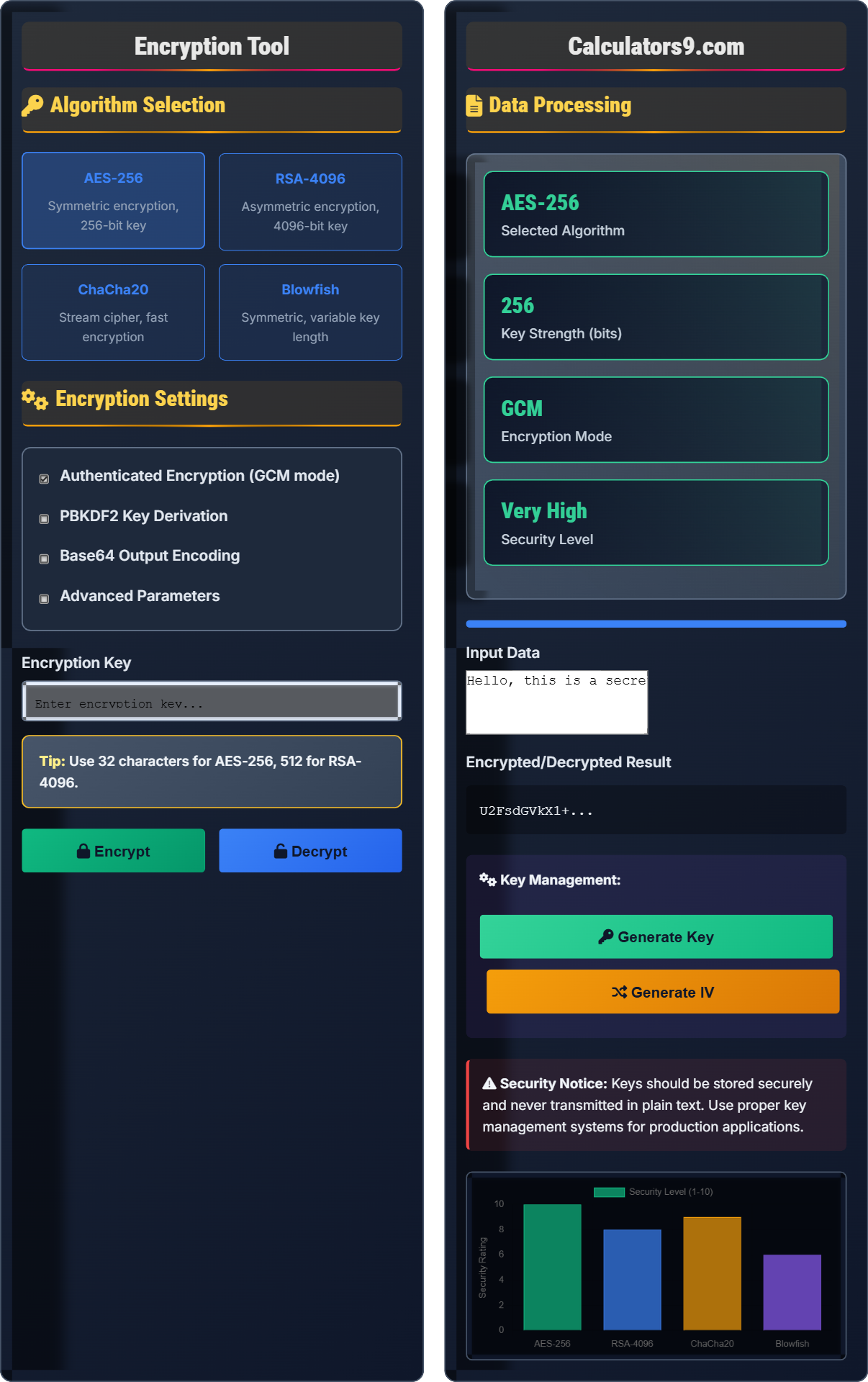
Algorithm Selection
Encryption Settings
Data Processing
| Parameter | Value | Description |
|---|---|---|
| Algorithm | AES-256 | Advanced Encryption Standard |
| Mode | GCM | Galois/Counter Mode |
| Key Size | 256 bits | Quantum-resistant |
| Security | Authenticated | Protects against tampering |
| Algorithm | Speed | Security |
|---|---|---|
| AES-256 | Fast | Very High |
| RSA-4096 | Slow | High |
| ChaCha20 | Very Fast | High |
| Blowfish | Fast | Medium |
Cryptographic Fundamentals
Symmetric encryption uses the same key for encryption and decryption (AES, ChaCha). Asymmetric encryption uses public/private key pairs (RSA, ECC).
14 rounds of substitution, permutation, and mixing. Each round applies S-box, ShiftRows, MixColumns, and AddRoundKey transformations.
- Use authenticated encryption (GCM, CCM)
- Never reuse IVs with the same key
- Implement proper key management
- Combine with secure protocols (TLS)
Implementation Best Practices
Use PBKDF2, scrypt, or Argon2 to derive keys from passwords. These functions add computational overhead to resist brute-force attacks.
- Use RSA to encrypt AES key
- Use AES for bulk data encryption
- Combine speed and security advantages
- Always use authenticated encryption
- Validate inputs before processing
- Implement proper error handling
- Follow established cryptographic standards
Cryptography Learning Quiz
Which encryption algorithm provides the highest security level for data at rest?
The answer is B) AES-256. AES-256 provides 256 bits of security, which is considered quantum-resistant and provides the highest security level among the options. AES-128 offers 128 bits of security, RSA-2048 provides approximately 112 bits of security equivalent, and DES is obsolete with only 56 bits of effective security.
Security strength is measured in bits, representing the computational effort required to break the encryption. Each additional bit doubles the difficulty. AES-256 is considered the gold standard for symmetric encryption and is recommended for protecting highly sensitive data.
Security Bits: Measure of computational difficulty to break encryption
Quantum Resistance: Expected to remain secure against quantum computer attacks
Symmetric Encryption: Uses same key for encryption and decryption
• AES-256 is the current standard for high-security applications
• DES is obsolete and should not be used
• Key size directly correlates with security strength
• Remember: AES-256 > AES-128 > RSA-2048 in terms of security bits
• Use AES-256 for classified/sensitive data
• Double key size = quadruple security effort
• Assuming RSA with larger key is always more secure than AES
• Confusing key size with security equivalence between algorithms
• Not understanding that DES is completely insecure
Calculate the number of rounds in AES encryption for 128-bit, 192-bit, and 256-bit keys. Explain why more rounds are needed for longer keys.
AES rounds:
- AES-128: 10 rounds
- AES-192: 12 rounds
- AES-256: 14 rounds
More rounds are needed for longer keys because:
1. Longer keys provide more potential attack paths
2. Additional rounds increase diffusion and confusion
3. More rounds make cryptanalysis more difficult
4. Each round adds non-linearity and mixing to the encryption process
The number of rounds in AES is carefully chosen to balance security and performance. Each round consists of four operations: SubBytes, ShiftRows, MixColumns, and AddRoundKey. The extra rounds for longer keys provide additional security margin against potential attacks.
Rounds: Iterations of encryption transformations
Diffusion: Spreading influence of each plaintext bit over many ciphertext bits
Confusion: Making relationship between key and ciphertext as complex as possible
• AES rounds: 10 (128-bit), 12 (192-bit), 14 (256-bit)
• More rounds increase security but decrease performance
• Round count is standardized for each key size
• Remember: 10, 12, 14 rounds for 128, 192, 256-bit keys
• Each round adds another layer of security
• AES is designed to be resistant to all known attacks
• Confusing round counts between different AES key sizes
• Not understanding why more rounds are needed for longer keys
• Assuming that more rounds always mean better security
A system uses hybrid encryption: RSA-4096 to encrypt an AES-256 key, then AES-256-GCM to encrypt the actual data. If the data is 1MB in size, calculate the total encryption time if RSA encryption takes 0.1 seconds and AES encryption takes 0.001 seconds per KB. Also calculate the security benefits of this approach.
Performance calculation:
RSA encryption time: 0.1 seconds (for key)
AES encryption time: 1024 KB × 0.001 sec/KB = 1.024 seconds
Total encryption time: 0.1 + 1.024 = 1.124 seconds
Security benefits:
1. RSA provides secure key exchange without sharing the AES key
2. AES provides fast bulk encryption of large data
3. Combines the security of asymmetric with the speed of symmetric
4. Allows for secure communication without pre-shared keys
Hybrid encryption leverages the strengths of both asymmetric and symmetric algorithms. RSA is slow but enables secure key exchange, while AES is fast for bulk data encryption. This approach is used in TLS, PGP, and other secure communication protocols.
Hybrid Encryption: Combining asymmetric and symmetric encryption
Key Exchange: Securely sharing encryption keys between parties
Bulk Encryption: Encrypting large amounts of data efficiently
• RSA for key exchange, AES for bulk data is standard practice
• Performance trade-offs must consider both algorithms
• Security benefits often outweigh performance costs
• Remember: RSA for keys, AES for data
• Hybrid encryption is used in HTTPS/TLS
• Always consider both performance and security
• Attempting to encrypt large data directly with RSA
• Not understanding the performance differences between algorithms
• Forgetting that RSA is much slower than AES
An application uses AES-256-GCM with a 96-bit initialization vector (IV). If the same key is used for 1000 encryptions, calculate the probability of IV collision. Explain why IV reuse is dangerous in GCM mode and how to prevent it.
IV collision probability:
For 96-bit IV (2^96 possible values) and 1000 encryptions:
Using birthday paradox approximation: P ≈ n²/(2×N)
P ≈ 1000²/(2×2⁹⁶) ≈ 10⁶/(2×7.9×10²⁸) ≈ 6.3×10⁻²⁴
Probability is extremely low, but not zero.
Dangers of IV reuse in GCM:
1. Loss of confidentiality - attackers can recover plaintext
2. Loss of authenticity - allows forgery attacks
3. Complete security breakdown
Prevention methods:
1. Use random IVs for each encryption
2. Implement IV counters or timestamps
3. Store IV with encrypted data
IV reuse in GCM mode leads to catastrophic security failures. Unlike other modes where IV reuse might only leak information about same-prefix plaintexts, GCM mode completely breaks both confidentiality and authenticity when IVs are reused. This is why proper IV management is critical.
Initialization Vector (IV): Random value used to randomize encryption
Collision: Two encryptions using the same IV with same key
Birthday Paradox: Probability of collisions increases quadratically with samples
• Never reuse IVs with the same key in GCM mode
• IVs should be unique, not necessarily secret
• GCM mode requires strict IV uniqueness guarantees
• Use random 96-bit IVs for GCM mode
• Store IV with ciphertext (it's not secret)
• IV reuse in GCM = complete security failure
• Assuming IV reuse is safe in all encryption modes
• Not understanding the catastrophic consequences in GCM
• Treating IVs as secret values
Which of the following is NOT a benefit of authenticated encryption modes like GCM?
The answer is C) Non-repudiation. Authenticated encryption modes like GCM provide:
• Confidentiality: Protects data from unauthorized access
• Authentication: Verifies the sender's identity
• Integrity: Detects if data has been tampered with
Non-repudiation requires digital signatures and is not provided by encryption modes alone.
It's important to distinguish between different security properties. While authenticated encryption provides confidentiality, authentication, and integrity, non-repudiation requires additional mechanisms like digital signatures with certificate authorities to prove who created the message.
Confidentiality: Protection against unauthorized disclosure
Authentication: Verification of source identity
Integrity: Assurance data hasn't been modified
Non-repudiation: Proof of origin and delivery
• Authenticated encryption = confidentiality + integrity + authentication
• Non-repudiation requires additional signature mechanisms
• Always use authenticated encryption for sensitive data
• Remember: CIA triad (Confidentiality, Integrity, Authentication)
• Use GCM, CCM, or EAX for authenticated encryption
• Non-repudiation requires PKI infrastructure
• Confusing authentication with authorization
• Assuming encryption provides non-repudiation
• Not understanding the difference between security properties
FAQ
Q: What's the difference between AES-256 and RSA-4096 encryption?
A: The main differences:
AES-256: Symmetric encryption, same key for encrypt/decrypt, very fast, 256-bit security.
RSA-4096: Asymmetric encryption, public/private key pair, slower, ~256-bit security equivalent.
Use AES-256 for bulk data encryption, RSA-4096 for key exchange or digital signatures. AES is based on substitution-permutation networks, while RSA relies on the difficulty of factoring large prime numbers.
Q: Why is authenticated encryption important?
A: Authenticated encryption (like AES-GCM) provides three critical properties:
- Confidentiality: Data remains secret
- Integrity: Data hasn't been tampered with
- Authentication: Data came from legitimate source
Without authentication, attackers can modify ciphertext to create valid-looking but fraudulent plaintext. This is why authenticated encryption modes like GCM are essential for secure communications.