Password Generator
Secure password creation • 2026 standards
Password Security Formulas:
Show the generatorEntropy Calculation: \( H = L \times \log_2(N) \)
Where:
- \( H \) = Entropy (bits of security)
- \( L \) = Password length
- \( N \) = Size of character set
Character Set Sizes:
- Lowercase letters: 26 (a-z)
- Uppercase letters: 26 (A-Z)
- Digits: 10 (0-9)
- Special characters: 32 (!@#$%^&* etc.)
- All printable ASCII: 95
Examples:
- 8-character lowercase: \( H = 8 \times \log_2(26) = 37.6 \) bits
- 12-character mixed: \( H = 12 \times \log_2(94) = 78.6 \) bits
- 16-character complex: \( H = 16 \times \log_2(94) = 104.8 \) bits
For robust security, aim for at least 80 bits of entropy. Longer passwords with diverse character sets provide exponentially stronger security against brute-force attacks.
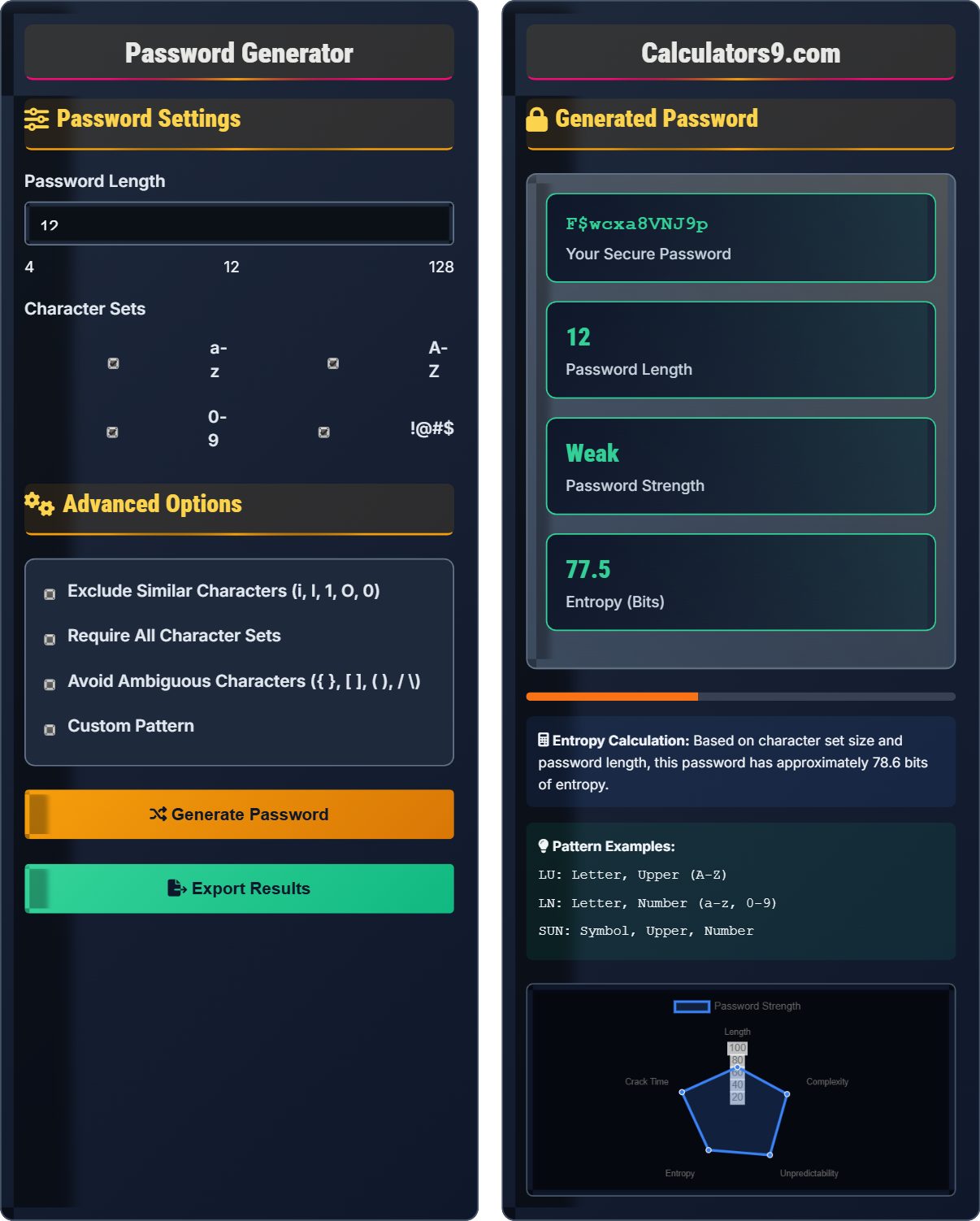
Password Settings
Advanced Options
Generated Password
| Generated | Length | Strength | Copy |
|---|---|---|---|
| X9#mK2$pL8@w | 12 | Strong |
| Aspect | Value | Recommendation |
|---|---|---|
| Length | 12 | Good (≥12 recommended) |
| Complexity | High | Excellent |
| Entropy | 78.6 bits | Strong (>80 ideal) |
| Crack Time | ~10 years | Secure |
Password Security Fundamentals
A strong password combines length, complexity, and unpredictability. Modern security guidelines emphasize length over complexity, recommending passphrases of 12+ characters.
\(H = L \times \log_2(N)\)
Where H=entropy, L=length, N=character set size. Higher entropy = stronger password.
- Minimum 12 characters (preferably 16+)
- Mix of character types
- Avoid dictionary words
- Unique for each account
Best Practices
Use password managers to generate and store unique, complex passwords for all accounts.
- Use strong passwords as first factor
- Add 2FA/3FA for additional security
- Backup authentication methods
- Change passwords after breaches
- Don't reuse passwords
- Enable breach alerts
- Regular security audits
Password Security Learning Quiz
Which of the following passwords has the highest entropy (assuming standard character sets)?
The answer is B) CorrectHorseBatteryStaple (25 chars). Although this password uses only lowercase letters (N=26), its length (L=25) gives it higher entropy than shorter passwords with larger character sets. Using the entropy formula H = L × log₂(N):
A) H = 11 × log₂(94) ≈ 72.6 bits (mixed chars)
B) H = 25 × log₂(26) ≈ 118.9 bits (lowercase only)
C) H = 12 × log₂(94) ≈ 79.2 bits (mixed chars)
D) H = 10 × log₂(10) ≈ 33.2 bits (digits only)
This demonstrates that length contributes significantly to password strength.
This question highlights the importance of password length in security. While complexity (character variety) is important, length provides exponential security gains. The entropy formula shows that each additional character multiplies the search space by the size of the character set, making longer passwords exponentially harder to crack.
Entropy: Measure of password unpredictability in bits
Character Set: Range of possible characters (lowercase, uppercase, digits, symbols)
Search Space: Total possible combinations for a password
• Length provides exponential security improvements
• Complexity adds security but length is more impactful
• Entropy measures actual security, not perceived complexity
• Remember: Long passwords are stronger than complex short ones
• Use passphrases with 4+ random words
• Aim for 80+ bits of entropy for strong security
• Believing that adding one symbol makes a weak password strong
• Thinking complex passwords are always better than long passwords
• Not understanding the exponential impact of length on security
Calculate the entropy of a 16-character password that uses all printable ASCII characters (95 total). Show your work and explain why this level of entropy is considered secure.
Using the entropy formula: H = L × log₂(N)
Given:
- L = 16 (password length)
- N = 95 (all printable ASCII characters)
Step 1: Calculate log₂(95)
log₂(95) = ln(95)/ln(2) ≈ 4.565/0.693 ≈ 6.58
Step 2: Calculate entropy
H = 16 × 6.58 ≈ 105.3 bits
This level of entropy is considered secure because:
• Brute-force attack would require 2^105 attempts on average
• Current computing power cannot crack this in reasonable time
• Quantum computers would still require significant resources
• Exceeds the 80-bit minimum recommendation for security
The logarithmic relationship in the entropy formula means that each additional character increases security multiplicatively rather than additively. This is why longer passwords provide exponentially better protection. At 105 bits of entropy, the password space is so large that even with massive computational resources, a brute-force attack would take millions of years.
Brute-Force Attack: Systematic attempt to guess password by trying all possibilities
Logarithmic Scale: Scale where each increment represents multiplication
Search Space: Total number of possible password combinations
• Entropy grows logarithmically with character set size
• Linear increase in length creates exponential security gain
• 80+ bits considered minimum for strong security
• Remember: 2^10 = 1,024, 2^20 = 1M, 2^30 = 1B
• Use online calculators to verify entropy calculations
• Consider future computing advances when setting entropy targets
• Confusing linear and exponential growth in security
• Misapplying logarithm rules in entropy calculations
• Not accounting for the full character set size
A company implements a new password policy requiring 12-character passwords with at least one character from each of four sets: lowercase, uppercase, digits, and symbols. If the IT department estimates that 10,000 passwords are attempted per second, how long would it take to crack a randomly generated password meeting these requirements? Assume the full 95-character set is available. Calculate both the theoretical maximum and practical minimum times.
First, calculate the entropy of a 12-character password with 95 possible characters:
H = 12 × log₂(95) = 12 × 6.58 ≈ 79.0 bits
Total possible combinations: 95^12 ≈ 5.4 × 10^23
Theoretical maximum time (trying all combinations):
(5.4 × 10^23) ÷ (10,000 attempts/sec) = 5.4 × 10^19 seconds
= 1.7 × 10^12 years (much longer than the age of the universe!)
Practical minimum time (average case, 50% of search space):
(5.4 × 10^23) ÷ 2 ÷ (10,000 attempts/sec) = 8.5 × 10^18 seconds
= 2.7 × 10^11 years
Even with the requirement constraint (ensuring all character sets), the password remains extremely secure.
This example demonstrates why properly implemented password policies provide excellent security. Even with a modest 12-character length, the sheer size of the password space makes brute-force attacks computationally infeasible. The astronomical timeframes illustrate the effectiveness of exponential security measures against linear computational improvements.
Search Space: Total number of possible password combinations
Attack Rate: Number of password attempts per unit time
Brute-Force Time: Time needed to try all possible combinations
• Average crack time is 50% of maximum time
• Exponential growth in password space defeats linear computing gains
• Real-world attacks may use optimized strategies beyond pure brute force
• Remember: 95^12 is an enormous number
• Use scientific notation for large calculations
• Compare against age of universe (≈14 billion years) for perspective
• Forgetting to account for all character sets in entropy calculation
• Confusing maximum and average case attack times
• Not appreciating the scale of exponential security improvements
A password manager generates unique 16-character passwords for each account using all 95 printable ASCII characters. If a user has 50 accounts and the master password has 120 bits of entropy, analyze the security implications. How does the security of individual account passwords compare to the master password? What happens to security if the master password is compromised?
Individual account password entropy:
H = 16 × log₂(95) = 16 × 6.58 ≈ 105.3 bits
Comparative analysis:
• Individual passwords: 105.3 bits of entropy
• Master password: 120 bits of entropy
• Individual passwords are very strong (exceeds 80-bit recommendation)
• Master password is even stronger (120 > 105.3)
If master password is compromised:
• All 50 account passwords become accessible to attacker
• Individual password strength becomes irrelevant
• Security model shifts from "120 bits" to "0 bits"
This demonstrates why the master password must be exceptionally strong and protected by additional factors like biometrics or hardware keys.
This problem illustrates the concept of security "chokepoints." While individual account passwords are individually very strong, the system's security ultimately depends on the master password. This is why password managers recommend extremely strong master passwords and often add additional authentication layers. The security of the entire system is determined by its weakest link.
Chokepoint: Single point of failure in a security system
Master Password: Primary key to access password manager
Security Chain: Concept that system security equals weakest component
• Master password must be stronger than any individual password
• Additional security layers protect against master password compromise
• Password manager security is only as strong as the master password
• Use passphrase with 4+ random words for master password
• Enable biometric or hardware authentication for password managers
• Regularly audit and rotate master passwords
• Assuming that strong individual passwords protect against master password compromise
• Not recognizing the centralized risk of password managers
• Underestimating the importance of master password strength
Which of the following password policies would provide the strongest security while maintaining usability?
The answer is C) 16 characters, any printable ASCII, no restrictions. This policy provides the highest entropy while maintaining usability:
A) H = 8 × log₂(94) ≈ 52.6 bits (too short)
B) H = 12 × log₂(62) ≈ 71.4 bits (good length, limited charset)
C) H = 16 × log₂(94) ≈ 105.3 bits (best entropy)
D) H = 10 × log₂(94) ≈ 65.8 bits (short with complexity requirements)
Modern security research shows that length provides more security than complexity requirements, and overly restrictive policies can lead to predictable patterns that reduce effective entropy.
This question reflects current security best practices that favor longer passwords over complex ones. Research by NIST and other organizations has shown that password complexity requirements often backfire by forcing users to create predictable patterns. A longer password without restrictions is typically more secure than a shorter one with complex requirements.
Password Policy: Rules governing acceptable passwords
Usability: Ease of creating and remembering passwords
Security-Usability Tradeoff: Balance between security and convenience
• Length provides more security than complexity
• Overly complex requirements can reduce security
• Passphrases are often more secure and usable than complex passwords
• Follow NIST SP 800-63B guidelines for password policies
• Encourage passphrases over complex passwords
• Focus on entropy rather than arbitrary complexity rules
• Believing that complexity requirements automatically improve security
• Not understanding the entropy differences between policies
• Assuming that more restrictions equal better security
FAQ
Q: How long should my passwords be for maximum security?
A: For maximum security, aim for 16+ characters. Here's the math:
Using the entropy formula \( H = L \times \log_2(N) \):
- 12 characters (mixed): \( H = 12 \times \log_2(94) \approx 79 \) bits
- 16 characters (mixed): \( H = 16 \times \log_2(94) \approx 105 \) bits
- 20 characters (mixed): \( H = 20 \times \log_2(94) \approx 132 \) bits
Security experts recommend 80+ bits for strong passwords, but 100+ bits provides future-proofing. Each additional character multiplies the search space by ~94 (for mixed charset), exponentially increasing security. For your master password, aim for 120+ bits of entropy.
Q: Should I implement password complexity requirements for my application?
A: Modern security guidance suggests focusing on length over complexity. According to NIST SP 800-63B:
- Minimum 8 characters (but recommend 12+)
- Maximum 64+ characters to allow passphrases
- Don't require specific character types
- Check against known compromised passwords
Complexity requirements often backfire by forcing predictable patterns like "Password1!" instead of encouraging longer, more random passwords. Instead, focus on password length and checking against known breach databases.