BSA for Chemo Calculator
Body Surface Area Dosing Calculator • Oncology Tools
BSA Formulas:
Show CalculatorThe Body Surface Area (BSA) is used to calculate chemotherapy dosages. Multiple formulas exist:
- DuBois Formula: BSA = 0.007184 × Weight^0.425 × Height^0.725
- Mosteller Formula: BSA = √(Height × Weight / 3600)
- Haycock Formula: BSA = 0.024265 × Weight^0.5378 × Height^0.3964
- Boyd Formula: BSA = 0.0333 × Weight^(0.6157-0.0188×log10(Weight)) × Height^0.3
Where weight is in kg and height is in cm. BSA is expressed in m².
Example: For a patient weighing 70kg and 170cm tall:
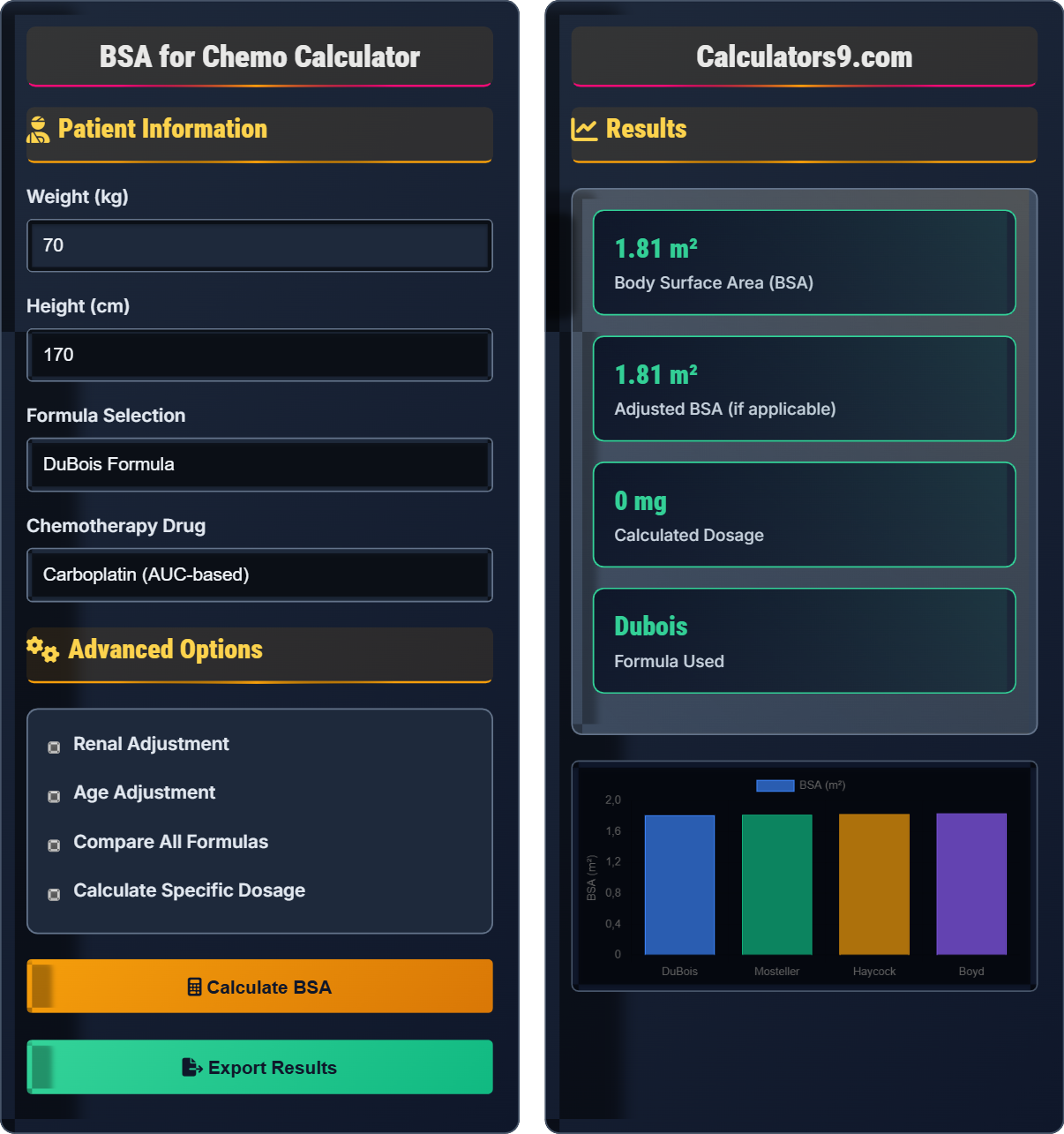
DuBois: BSA = 0.007184 × 70^0.425 × 170^0.725 ≈ 1.81 m²
Mosteller: BSA = √(170 × 70 / 3600) ≈ 1.80 m²
These values determine appropriate chemotherapy dosing for optimal therapeutic effect.
Patient Information
Advanced Options
Results
| Parameter | Value | Unit |
|---|---|---|
| Weight | 70.0 | kg |
| Height | 170.0 | cm |
| BSA | 1.81 | m² |
| Formula | DuBois | - |
| Formula | BSA | Difference |
|---|---|---|
| DuBois | 1.81 | 0.00 |
| Mosteller | 1.80 | -0.01 |
| Haycock | 1.80 | -0.01 |
| Boyd | 1.80 | -0.01 |
BSA in Chemotherapy
Body Surface Area (BSA) is a measure of the total surface area of the human body, used in medicine to standardize drug dosing, particularly for chemotherapy agents. It accounts for both weight and height to provide a more accurate dosing parameter than weight alone.
Multiple formulas exist for calculating BSA, each with specific advantages:
- DuBois Formula: Most commonly used in clinical practice
- Mosteller Formula: Simplest to calculate, good for bedside use
- Haycock Formula: More accurate for pediatric patients
- Boyd Formula: Accounts for body composition differences
- Standardizes chemotherapy dosing across patients
- Reduces toxicity in smaller patients
- Ensures adequate dosing in larger patients
- Minimizes interpatient variability in drug exposure
BSA & Chemotherapy Dosing Quiz
Which of the following is the correct formula for the Mosteller method of BSA calculation?
The answer is B) BSA = √(H × W / 3600). The Mosteller formula is the simplest BSA calculation method, using the square root of height (cm) times weight (kg) divided by 3600. This formula is popular because it's easy to calculate at the bedside and provides reliable results.
The Mosteller formula is particularly useful in clinical settings where quick calculations are needed. Its simplicity makes it less prone to calculation errors compared to more complex formulas. The division by 3600 is necessary to convert the units properly to square meters.
BSA: Body Surface Area - total surface area of the human body
Mosteller Formula: A simplified method for calculating BSA
Chemotherapy Dosing: Standardizing drug doses based on patient size
• Mosteller formula: BSA = √(Height × Weight / 3600)
• Height in centimeters, weight in kilograms
• Result expressed in square meters (m²)
• Remember: Square root of (height × weight) divided by 3600
• Quick check: Normal adult BSA is approximately 1.7-2.0 m²
• Useful for bedside calculations
• Forgetting to divide by 3600
• Using incorrect units (e.g., pounds instead of kg)
• Confusing height measurements (cm vs inches)
Calculate the BSA for a patient who weighs 75kg and is 175cm tall using the DuBois formula. Show your work and explain the significance of the result in chemotherapy dosing.
Using the DuBois formula: BSA = 0.007184 × Weight^0.425 × Height^0.725
Given:
- Weight = 75kg
- Height = 175cm
Step 1: Calculate Weight^0.425 = 75^0.425 = 4.86
Step 2: Calculate Height^0.725 = 175^0.725 = 42.74
Step 3: Multiply: BSA = 0.007184 × 4.86 × 42.74 = 1.49 m²
The calculated BSA of 1.49 m² would be used to determine appropriate chemotherapy dosages for this patient.
The DuBois formula accounts for both weight and height in a non-linear way, recognizing that body surface area doesn't scale linearly with weight alone. The exponents (0.425 for weight, 0.725 for height) reflect the different contributions of these parameters to total surface area.
DuBois Formula: BSA = 0.007184 × W^0.425 × H^0.725
Exponent: The power to which a number is raised
Non-linear Scaling: Proportional relationships that don't follow simple multiplication
• Use exact weight in kg and height in cm
• Apply correct exponents (0.425 for weight, 0.725 for height)
• Final unit is m²
• Use scientific calculator for exponent calculations
• Double-check units before calculation
• Verify result makes clinical sense
• Incorrectly applying exponents
• Using wrong units (lbs instead of kg)
• Mathematical errors in complex calculations
A patient has been prescribed Docetaxel at 75 mg/m². The patient's BSA has been calculated as 1.65 m² using the Mosteller formula. Calculate the total dose to be administered and explain why BSA is important for this drug.
Step 1: Calculate total dose = Dosage per m² × BSA
Step 2: Total dose = 75 mg/m² × 1.65 m² = 123.75 mg
Step 3: Round to practical dose = 124 mg
BSA is important for Docetaxel because it's a cytotoxic agent with a narrow therapeutic index. Using BSA ensures the patient receives an appropriate amount of drug based on their body size, minimizing toxicity while maintaining efficacy.
Docetaxel is a taxane chemotherapy agent that requires precise dosing to balance efficacy with toxicity. The mg/m² dosing convention allows for standardized administration across patients of different sizes. Larger patients receive proportionally higher doses to achieve similar systemic exposure.
Docetaxel: A taxane chemotherapy agent used for various cancers
Narrow Therapeutic Index: Small difference between effective and toxic doses
Cytotoxic Agent: Drug that kills rapidly dividing cells
• Total dose = Dose per m² × BSA
• Round to appropriate measurement increment
• Verify calculated dose against institutional guidelines
• Always double-check BSA calculation before dosing
• Consider institutional dose limits
• Account for patient-specific factors
• Forgetting to multiply by BSA
• Using incorrect BSA value
• Not accounting for patient-specific contraindications
A patient with mild renal impairment (CrCl = 50 mL/min) needs Carboplatin therapy. The patient's BSA is 1.72 m², and the target AUC is 5. Calculate the Carboplatin dose using the Calvert formula, adjusting for renal function. Explain why renal adjustment is critical for Carboplatin.
Step 1: Calculate normal Carboplatin dose using Calvert formula: Dose = AUC × (GFR + 25)
Step 2: For normal GFR (assumed 70 mL/min): Dose = 5 × (70 + 25) = 475 mg
Step 3: Adjust for renal impairment: Reduce dose by ~25% for CrCl = 50 mL/min
Step 4: Adjusted dose = 475 × 0.75 = 356 mg
Step 5: Actual dose = 356 mg for BSA of 1.72 m²
Renal adjustment is critical for Carboplatin because it's primarily eliminated by the kidneys. In renal impairment, the drug accumulates causing severe myelosuppression.
Carboplatin dosing differs from other chemotherapies because it uses AUC (Area Under the Curve) rather than mg/m². The Calvert formula incorporates renal function to prevent drug accumulation and toxicity. This personalized approach maximizes efficacy while minimizing nephrotoxicity.
Carboplatin: Platinum-based chemotherapy agent
Calvert Formula: Dose = AUC × (GFR + 25)
AUC: Area under the concentration-time curve
• Carboplatin dosing is AUC-based, not mg/m²
• Always adjust for renal function
• Monitor for myelosuppression
• Use creatinine clearance for dose adjustment
• Consider alternative agents in severe renal impairment
• Monitor CBC closely during treatment
• Using mg/m² dosing instead of AUC
• Not adjusting for renal function
• Underestimating myelosuppression risk
Which BSA formula is most appropriate for a pediatric patient weighing 25kg and measuring 120cm tall?
The answer is C) Haycock Formula. The Haycock formula is specifically validated for pediatric populations and provides more accurate BSA calculations for children compared to other formulas. Studies have shown that the Haycock formula performs better in pediatric patients across different age groups and body compositions.
Children have different body proportions compared to adults, with relatively larger heads and smaller limbs. The Haycock formula accounts for these anatomical differences, providing more accurate BSA calculations that lead to safer and more effective chemotherapy dosing in pediatric patients.
Pediatric Population: Patients typically under 18 years old
Validation: Clinical testing to confirm accuracy
Anatomical Differences: Variations in body proportions
• Use Haycock formula for pediatric patients
• Consider age-appropriate dosing modifications
• Validate BSA calculation in pediatric populations
• Use Haycock for patients under 18 years old
• Double-check measurements in children
• Consider weight-based dosing in some cases
• Using adult formulas for pediatric patients
• Not accounting for developmental differences
• Inaccurate measurements in children
FAQ
Q: Why is BSA important in chemotherapy dosing and which formula is most commonly used?
A: BSA (Body Surface Area) is critical in chemotherapy dosing because it standardizes drug delivery across patients of different sizes, helping to achieve consistent systemic exposure. The goal is to minimize toxicity in smaller patients while ensuring adequate dosing in larger patients.
The DuBois formula is most commonly used in clinical practice: BSA = 0.007184 × W^0.425 × H^0.725, where W is weight in kg and H is height in cm. This formula accounts for both weight and height in a physiologically meaningful way.
For example, if a patient weighs 70kg and is 170cm tall:
BSA = 0.007184 × 70^0.425 × 170^0.725 = 0.007184 × 4.75 × 42.43 ≈ 1.81 m²
If the drug dosage is 100mg/m², the total dose would be 1.81 × 100 = 181mg.
Q: Should we always adjust chemotherapy doses for patients with renal impairment?
A: No, not all chemotherapy agents require renal adjustment, but several do, including Carboplatin, Methotrexate, Cisplatin, Ifosfamide, and Bleomycin. The need for adjustment depends on the drug's elimination pathway.
For Carboplatin specifically, the Calvert formula incorporates renal function: Dose = AUC × (GFR + 25), where GFR is glomerular filtration rate. In patients with reduced kidney function, the dose must be reduced to prevent drug accumulation and severe myelosuppression.
For example, if a patient has a GFR of 50 mL/min and target AUC is 5, the dose would be: 5 × (50 + 25) = 375 mg, compared to 5 × (70 + 25) = 475 mg for normal renal function.