Medication Dosage Calculator
Clinical dosing tool • 2026 healthcare
Patient Information
Medication Parameters
Advanced Options
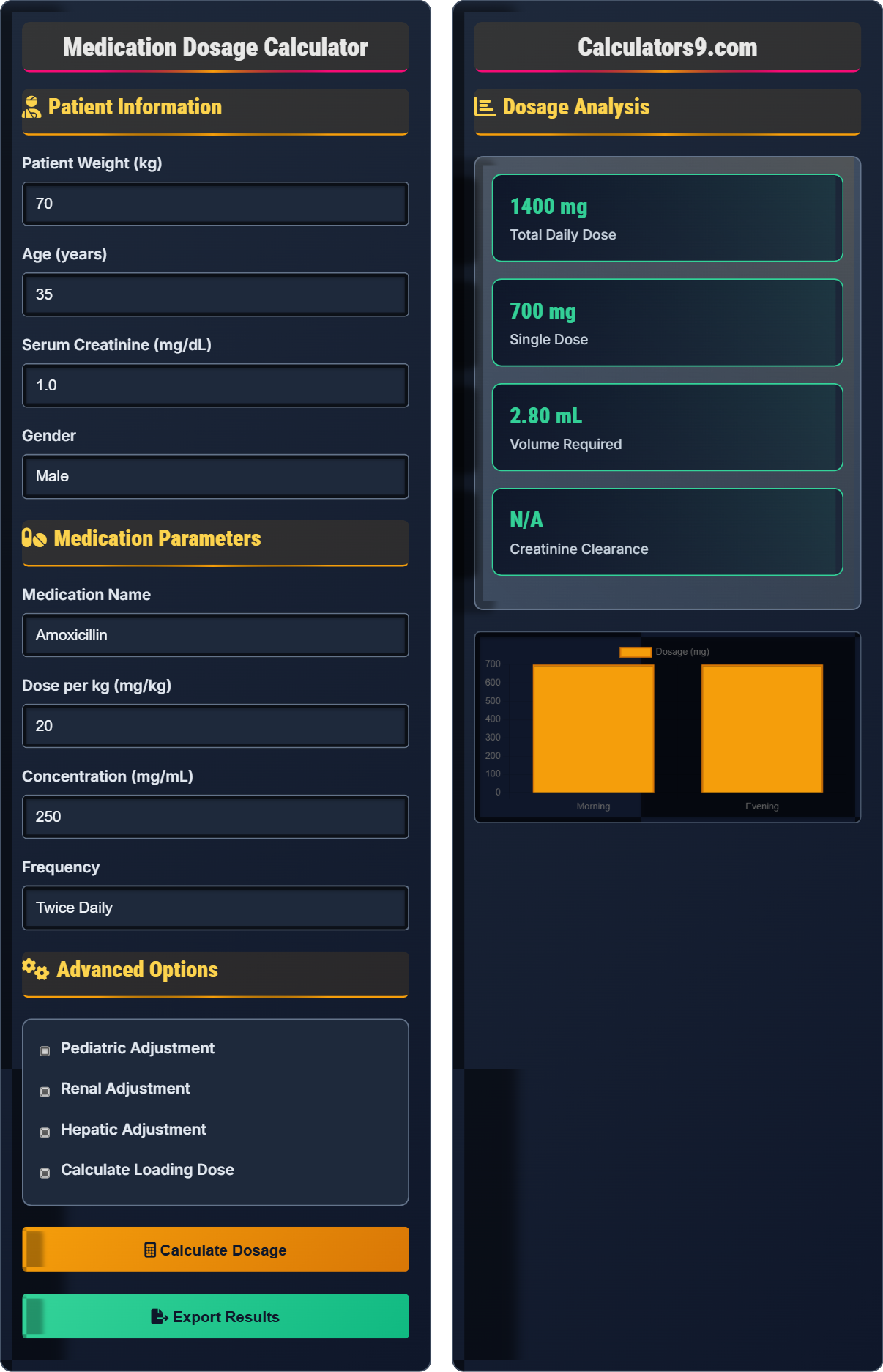
Dosage Analysis
| Time | Dose | Volume | Notes |
|---|---|---|---|
| 8:00 AM | 700 mg | 2.8 mL | Oral |
| 8:00 PM | 700 mg | 2.8 mL | Oral |
| Adjustment | Factor | Applied | New Dose |
|---|---|---|---|
| Renal Function | 1.0x | Yes | 1400 mg |
| Pediatric | 0.8x | No | 1400 mg |
| Weight-Based | Normal | Yes | 1400 mg |
| Frequency | 2x daily | Yes | 700 mg/dose |
Comprehensive Drug Dosage Guide
Drug dosage calculations are critical for patient safety and therapeutic efficacy. The fundamental formula is: Dose = Weight × Dose per kg. However, adjustments are often needed based on patient factors, organ function, and specific medication properties. Clinical calculations must account for age, renal function, hepatic function, and drug interactions.
The basic formula for weight-based dosing is:
For concentration-based calculations: Volume (mL) = Dose (mg) / Concentration (mg/mL)
For medications cleared by kidneys, calculate Creatinine Clearance (CrCl) using Cockcroft-Gault:
- Men: CrCl = [(140 - age) × weight × 1.23] / serum_creatinine
- Women: CrCl = Men's value × 0.85
- Dosage Adjustment: Reduce dose proportionally to CrCl
- Double-Check: Verify all calculations
- Maximum Doses: Never exceed recommended maximums
- Minimum Doses: Ensure therapeutic levels
- Drug Interactions: Consider concurrent medications
- Monitoring: Plan for therapeutic drug monitoring
Medical Dosage Learning Quiz
A 12kg child needs amoxicillin at 40mg/kg/day divided twice daily. What is the single dose?
First calculate total daily dose: 12kg × 40mg/kg = 480mg/day
Then divide by frequency: 480mg ÷ 2 = 240mg per dose
The answer is A) 240mg.
This problem demonstrates the two-step process for pediatric dosing. First, calculate the total daily dose based on weight. Then, divide by the number of doses per day to get the single dose amount. The key is to distinguish between daily dose (40mg/kg/day) and single dose (what's given at each administration). Pediatric dosing requires careful attention to weight units and frequency.
Daily Dose: Total amount administered per day
Single Dose: Amount given at each administration
Frequency: Number of times per day medication is given
• Total daily dose = weight × mg/kg/day
• Single dose = daily dose ÷ frequency
• Always verify pediatric dosing ranges
• Remember: dose per kg is for total daily amount
• Check pediatric maximums for safety
• Calculate volume last (dose ÷ concentration)
• Giving total daily dose instead of single dose
• Forgetting to divide by frequency
• Using pounds instead of kilograms
A patient with CrCl of 30 mL/min needs vancomycin normally dosed at 15mg/kg every 12 hours. Calculate the adjusted dose for this patient with impaired renal function.
For CrCl 30 mL/min, vancomycin dosing should be reduced by 50%
Adjusted dose = 15mg/kg × 0.50 = 7.5mg/kg every 24 hours
Instead of 12-hour intervals, extend to 24-hour intervals
Example for 70kg patient: 70 × 7.5 = 525mg every 24 hours
This example shows how renal function affects drug dosing. Vancomycin is primarily eliminated by the kidneys, so decreased renal function requires both dose reduction and extended intervals. The CrCl of 30 mL/min indicates significant renal impairment (normal is >90 mL/min), requiring 50% dose reduction and extended dosing intervals. This prevents drug accumulation and toxicity.
Creatinine Clearance (CrCl): Kidney function indicator
Renal Impairment: Reduced kidney function affecting drug clearance
Dialysis: Treatment for severe renal failure
• Adjust both dose and frequency for renal drugs
• Calculate CrCl for all patients
• Monitor trough levels for narrow therapeutic drugs
• Use Cockcroft-Gault formula for CrCl
• Consider ideal body weight for obese patients
• Extend intervals before reducing dose
• Only reducing dose without extending intervals
• Using actual instead of ideal body weight
• Not adjusting for all renal medications
A 65kg patient needs a loading dose of digoxin at 10mcg/kg. The available concentration is 0.25mg/mL. Calculate the loading dose in mg and the volume needed.
Loading dose = 65kg × 10mcg/kg = 650mcg
Convert to mg: 650mcg ÷ 1000 = 0.65mg
Volume needed = 0.65mg ÷ 0.25mg/mL = 2.6mL
The loading dose is 0.65mg requiring 2.6mL of solution.
This problem demonstrates loading dose calculations with unit conversions. Loading doses are used to rapidly achieve therapeutic levels, often followed by maintenance doses. The key challenge is correctly converting between micrograms and milligrams (1000mcg = 1mg). Digoxin has a narrow therapeutic window, making precise calculations critical for patient safety.
Loading Dose: Initial dose to achieve therapeutic levels
Maintenance Dose: Ongoing dose to maintain levels
Narrow Therapeutic Window: Small range between efficacy and toxicity
• Loading doses = weight × mcg/kg
• Convert units before calculating volume
• Always verify narrow therapeutic drugs
• Remember: 1000mcg = 1mg
• Calculate loading dose separately from maintenance
• Consider IV push vs infusion for rapid loading
• Forgetting unit conversions (mcg to mg)
• Calculating volume with wrong units
• Not considering drug's therapeutic window
A medication is ordered at 250mg but available as 500mg/2mL. How much should be administered?
First calculate concentration: 500mg ÷ 2mL = 250mg/mL
Then calculate volume: 250mg ÷ 250mg/mL = 1.0mL
Alternatively: (Ordered ÷ Available) × Volume = (250 ÷ 500) × 2 = 1.0mL
The answer is A) 1.0 mL.
This problem tests concentration calculations, a fundamental skill in medication administration. The concentration is 250mg/mL (500mg in 2mL). To find the volume needed, divide the ordered amount by the concentration. This is a direct application of the formula: Volume = Dose ÷ Concentration. Always verify that units are consistent before calculating.
Concentration: Amount of drug per volume (mg/mL)
Available Strength: Drug amount in provided volume
Diluent: Liquid used to dissolve or dilute medication
• Concentration = drug amount ÷ volume
• Volume = ordered amount ÷ concentration
• Always check concentration before calculating
• Use ratio method: (ordered/available) × volume
• Cross-verify with concentration method
• Always double-check calculations
• Confusing total amount with concentration
• Not converting between different units
• Forgetting to verify calculation with cross-check
A 75kg patient with CrCl of 25mL/min needs gentamicin at 5mg/kg/day divided every 24 hours (normally given every 8 hours). Calculate the adjusted dose and explain the rationale.
Normal dose: 75kg × 5mg/kg = 375mg/day
Renal adjustment: 375mg every 24 hours (instead of 125mg every 8 hours)
Rationale: Gentamicin is nephrotoxic and primarily renally cleared. With CrCl of 25mL/min (severe impairment), dosing frequency must be extended to prevent accumulation and toxicity. The total daily dose may be reduced by 25-50% in severe renal impairment.
This example demonstrates the complexity of adjusting doses for nephrotoxic medications. Gentamicin has both efficacy and safety concerns requiring careful monitoring. The adjustment involves both reducing the total daily dose and extending the dosing interval. This prevents peak levels from becoming toxic while ensuring trough levels don't fall below therapeutic. Aminoglycosides like gentamicin require therapeutic drug monitoring.
Nephrotoxic: Damaging to kidney function
Peak/Trough Levels: Maximum/minimum drug concentrationsAminoglycosides: Class of antibiotics with renal toxicity
• Adjust both dose and frequency for nephrotoxic drugs
• Monitor peak/trough levels for aminoglycosides
• Consider concurrent nephrotoxic agents
• Use extended-interval dosing protocols for aminoglycosides
• Calculate ideal body weight for obese patients
• Consider alternative agents in severe renal impairment
• Not extending intervals for nephrotoxic drugs
• Using actual body weight for obese patients
• Not monitoring drug levels when indicated
Dosage Fundamentals
Amount of medication to be administered. Formula: Dose = Weight × Dose per kg. Critical for patient safety.
Weight-based (most common), BSA-based, age-based, or fixed dosing. Always verify with institutional guidelines.
- Never exceed maximum recommended doses
- Adjust for organ dysfunction
- Verify calculations with second party
- Consider patient-specific factors
Safety Protocols
Right patient, right drug, right dose, right route, right time. Essential for preventing medication errors.
- Calculate dose independently
- Verify with another professional
- Check patient allergies
- Confirm drug compatibility
- Document administration
- High-alert medications require extra caution
- Renal/hepatic adjustments are critical
- Pediatric dosing requires special attention
- Always consider drug interactions
FAQ
Q: How often should I recalculate patient weights?
A: Recalculate for all pediatric patients, significant weight changes (>5%), and high-risk medications. For adults, recent weight (within 24 hours) is sufficient for most calculations.
Q: Should I use actual or ideal body weight?
A: Use actual body weight for most medications. Use ideal body weight for hydrophilic drugs (aminoglycosides, digoxin) in obese patients. Adjust based on drug properties and clinical guidelines.