Affiliate Commission Calculator
Earnings & performance analysis • 2026 e-commerce
Affiliate Program Details
Advanced Options
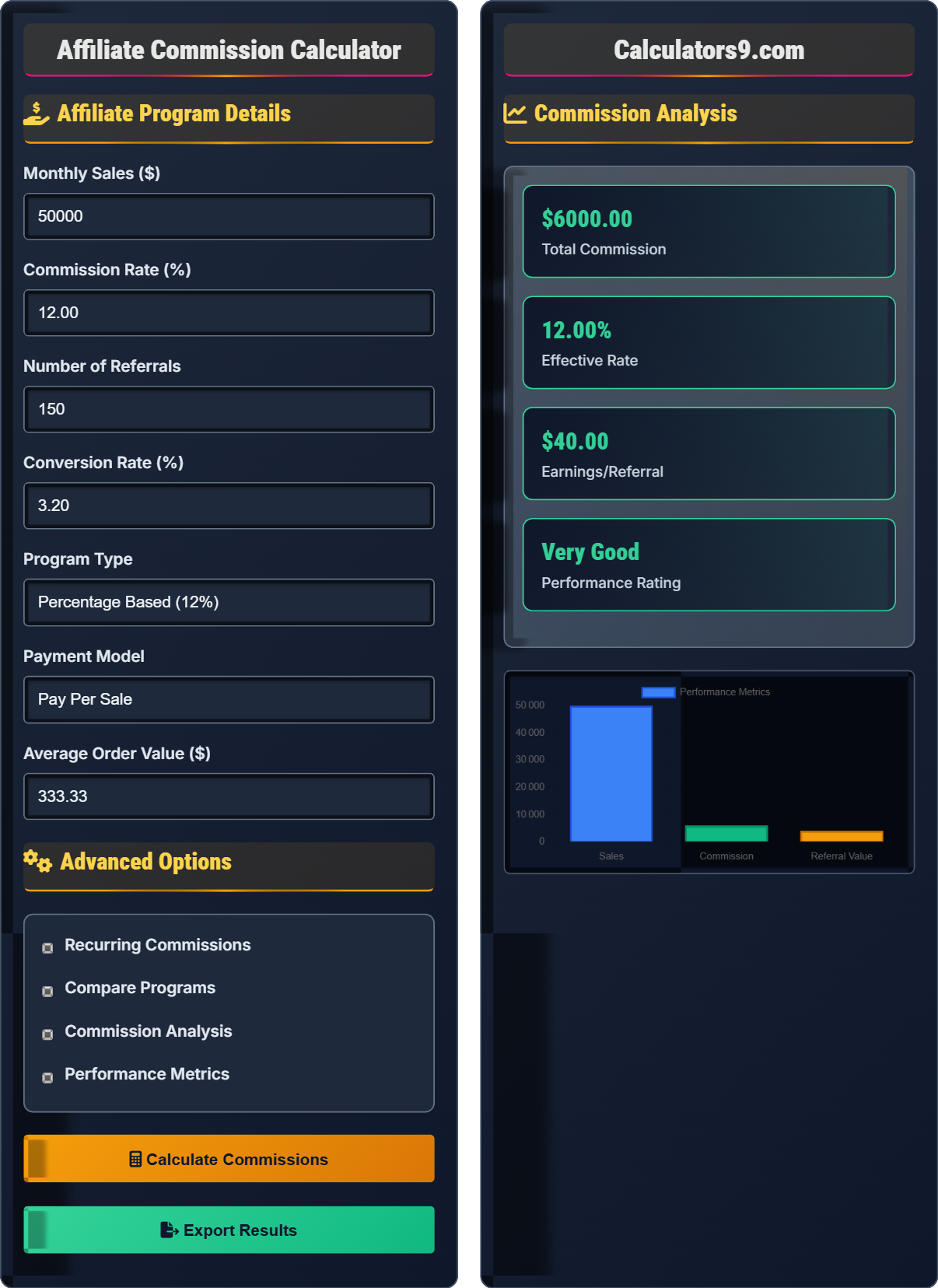
Commission Analysis
| Component | Value | Rate | Description |
|---|
| Metric | Current | Industry Average | Rating |
|---|
Comprehensive Affiliate Commission Guide
Affiliate commission is a performance-based payment structure where businesses reward affiliates for driving sales, leads, or other desired actions. It's a cornerstone of e-commerce marketing, enabling businesses to expand their reach while only paying for actual results. Commissions are typically calculated as a percentage of sales or a fixed amount per conversion.
The fundamental commission calculation uses this formula:
Where:
- \(Commission\) = Total earnings for affiliate
- \(Sales\) = Total value of sales generated
- \(Rate\) = Commission percentage as decimal
Commission rates vary significantly by industry:
- Physical Products: 5-15% (electronics: 1-8%, fashion: 8-12%)
- Digital Products: 20-50% (higher margins allow higher commissions)
- Services: 10-25% (consulting, SaaS, subscriptions)
- Travel: 3-10% (hotels, flights, vacation packages)
- Financial: $50-200 per lead (credit cards, loans, insurance)
- Education: 10-30% (courses, certifications, tutoring)
Successful affiliate programs maintain 10-15% average commission rates with clear tracking.
- Tiered Incentives: Increase commission rates with higher sales volumes
- Seasonal Promotions: Boost rates during peak periods
- Exclusive Deals: Higher rates for top-performing affiliates
- Retargeting: Commission for bringing back abandoned customers
- Multi-Level: Commission for recruiting other affiliates
Affiliate Commission Learning Quiz
Which commission model is most suitable for high-ticket SaaS products?
The answer is B) Percentage of monthly recurring revenue. SaaS products generate ongoing revenue, so percentage-based recurring commissions (typically 20-50% of monthly revenue) provide sustainable earnings for affiliates while aligning with the business model. This incentivizes affiliates to promote long-term customer relationships.
Commission models should align with the business model. SaaS companies have recurring revenue streams, making percentage-based recurring commissions ideal. The affiliate earns ongoing commissions as long as the customer remains subscribed, creating long-term value. This differs from one-time purchases where percentage-based on initial sale works better.
Recurring Commission: Ongoing payments for subscription services
SaaS: Software as a Service - subscription-based model
Monthly Recurring Revenue (MRR): Predictable monthly income
• Align commission model with business model
• Recurring commissions for recurring revenue
• Consider lifetime value of customers
• Match commission structure to product type
• Consider customer lifetime value
• Balance profitability with affiliate motivation
• Using fixed rates for recurring revenue models
• Not considering customer lifetime value
• Setting rates too low to attract quality affiliates
Calculate the commission for an affiliate who generates $25,000 in sales with a 15% commission rate. Show your work.
Step 1: Convert percentage to decimal
15% = 0.15
Step 2: Apply commission formula
Commission = Sales × Rate
Commission = $25,000 × 0.15 = $3,750
The affiliate would earn $3,750 in commission.
This demonstrates the basic commission calculation with percentage-based rates. The formula is straightforward: multiply the total sales value by the commission rate. This example shows a healthy 15% commission rate, which is common for many e-commerce businesses and provides strong incentive for affiliates.
Commission Rate: Percentage of sales paid to affiliate
Commission: Earnings paid to affiliateSales Value: Total revenue generated by affiliate
• Commission = Sales × Rate
• Convert percentage to decimal for calculation
• Verify calculations for accuracy
• Remember: Sales × Rate = Commission
• Always convert percentage to decimal
• Round to nearest cent for monetary values
• Forgetting to convert percentage to decimal
• Calculating on gross instead of net sales
• Not accounting for returns/refunds
An affiliate program offers tiered commissions: 8% for sales up to $10,000, 12% for sales $10,001-$25,000, and 15% for sales above $25,000. If an affiliate generates $30,000 in sales, what is their total commission?
Step 1: Calculate commission for first tier (up to $10,000)
Commission₁ = $10,000 × 0.08 = $800
Step 2: Calculate commission for second tier ($10,001-$25,000)
Amount in tier 2 = $25,000 - $10,000 = $15,000
Commission₂ = $15,000 × 0.12 = $1,800
Step 3: Calculate commission for third tier (above $25,000)
Amount in tier 3 = $30,000 - $25,000 = $5,000
Commission₃ = $5,000 × 0.15 = $750
Step 4: Calculate total commission
Total Commission = $800 + $1,800 + $750 = $3,350
The total commission is $3,350.
This example demonstrates tiered commission structures that incentivize higher performance. Each tier applies only to the sales within that range, not the entire amount. This progressive structure rewards top-performing affiliates while maintaining profitability for the business. The affiliate earns more per dollar as they reach higher sales thresholds.
Tiered Commission: Increasing rates with higher sales volumes
Progressive Structure: Higher rates for better performance
Volume Incentive: Reward for increased sales
• Apply each rate only to sales within that tier
• Don't apply highest rate to all sales
• Calculate each tier separately
• Calculate each tier separately
• Track which tier applies to each sale amount
• Use tiered structures to motivate performance
• Applying highest rate to entire sales amount
• Not properly segmenting by tier
• Miscalculating tier boundaries
An affiliate generates 120 referrals with a 2.5% conversion rate and $400 average order value. Their commission rate is 10%. Calculate their total sales, commission earned, and average earnings per referral.
Step 1: Calculate total sales
Conversions = 120 referrals × 0.025 = 3 conversions
Total Sales = 3 × $400 = $1,200
Step 2: Calculate total commission
Commission = $1,200 × 0.10 = $120
Step 3: Calculate average earnings per referral
Earnings per Referral = $120 ÷ 120 = $1.00
Step 4: Calculate effective commission per conversion
Commission per Conversion = $120 ÷ 3 = $40.00
Total sales: $1,200, Commission: $120, Earnings per referral: $1.00.
This example shows how multiple metrics interact in affiliate performance analysis. With a low conversion rate (2.5%) and modest commission rate (10%), the affiliate earns $1 per referral. However, successful conversions generate $40 each. This demonstrates the importance of conversion rate optimization for affiliate success.
Conversion Rate: Percentage of referrals that convert to sales
Average Order Value: Mean purchase amount
Earnings Per Referral: Commission divided by referrals
• Sales = Conversions × Average Order Value
• Conversions = Referrals × Conversion Rate
• Commission = Sales × Rate
• Track conversion rates by traffic source
• Calculate earnings per referral metric
• Focus on improving conversion rates
• Confusing referrals with conversions
• Not accounting for conversion rate
• Calculating commission on referrals instead of sales
What is the typical commission rate range for e-commerce affiliate programs?
The answer is B) 5-15%. The typical range for e-commerce affiliate programs is 5-15%, with most programs falling between 8-12%. Digital products often offer higher rates (20-50%) due to higher margins, while physical products with lower margins typically offer 5-10%.
Commission rates reflect the product margins and value proposition. E-commerce businesses with 20-40% gross margins can typically afford 5-15% commissions while maintaining profitability. Higher rates are possible for high-margin products or when affiliates provide significant value beyond simple traffic generation.
Commission Rate: Percentage paid to affiliates
Gross Margin: Revenue minus cost of goods sold
Industry Benchmark: Standard rate for comparison
• Commission rates should align with margins
• Compare to industry benchmarks
• Consider lifetime customer value
• Research competitor commission rates
• Consider tiered structures for motivation
• Balance affiliate motivation with profitability
• Setting rates too high without considering margins
• Not researching industry standards
• Offering rates that don't motivate affiliates
Commission Fundamentals
Commission rate, tiered structures, performance metrics, and payment models.
\(Commission = Sales \times Rate\)
\(Earnings\ per\ Referral = \frac{Total\ Commission}{Number\ of\ Referrals}\)
\(Effective\ Rate = \frac{Total\ Commission}{Total\ Sales} \times 100\)
- Commission rates should reflect product margins
- Track conversion rates by affiliate
- Consider lifetime customer value
Optimization Strategies
Tiered incentives, seasonal promotions, exclusive deals, and performance bonuses.
- Set competitive rates for your industry
- Implement tiered commission structures
- Provide marketing materials
- Offer recurring commissions for subscriptions
- Align rates with profit margins
- Consider affiliate lifetime value
- Track performance by channel
- Regular rate reviews and updates
FAQ
Q: What's a good commission rate?
A: For e-commerce: 8-12%. Digital products: 20-30%. Physical products: 5-10%. Consider your margins and competitor rates. 15%+ for high-ticket items. Focus on profitability.
Q: How do I track affiliate performance?
A: Use affiliate tracking software (Post Affiliate Pro, Impact, Refersion). Track clicks, conversions, conversion rates, and earnings per click. Monitor by source, device, and geographic region. Set up attribution models.