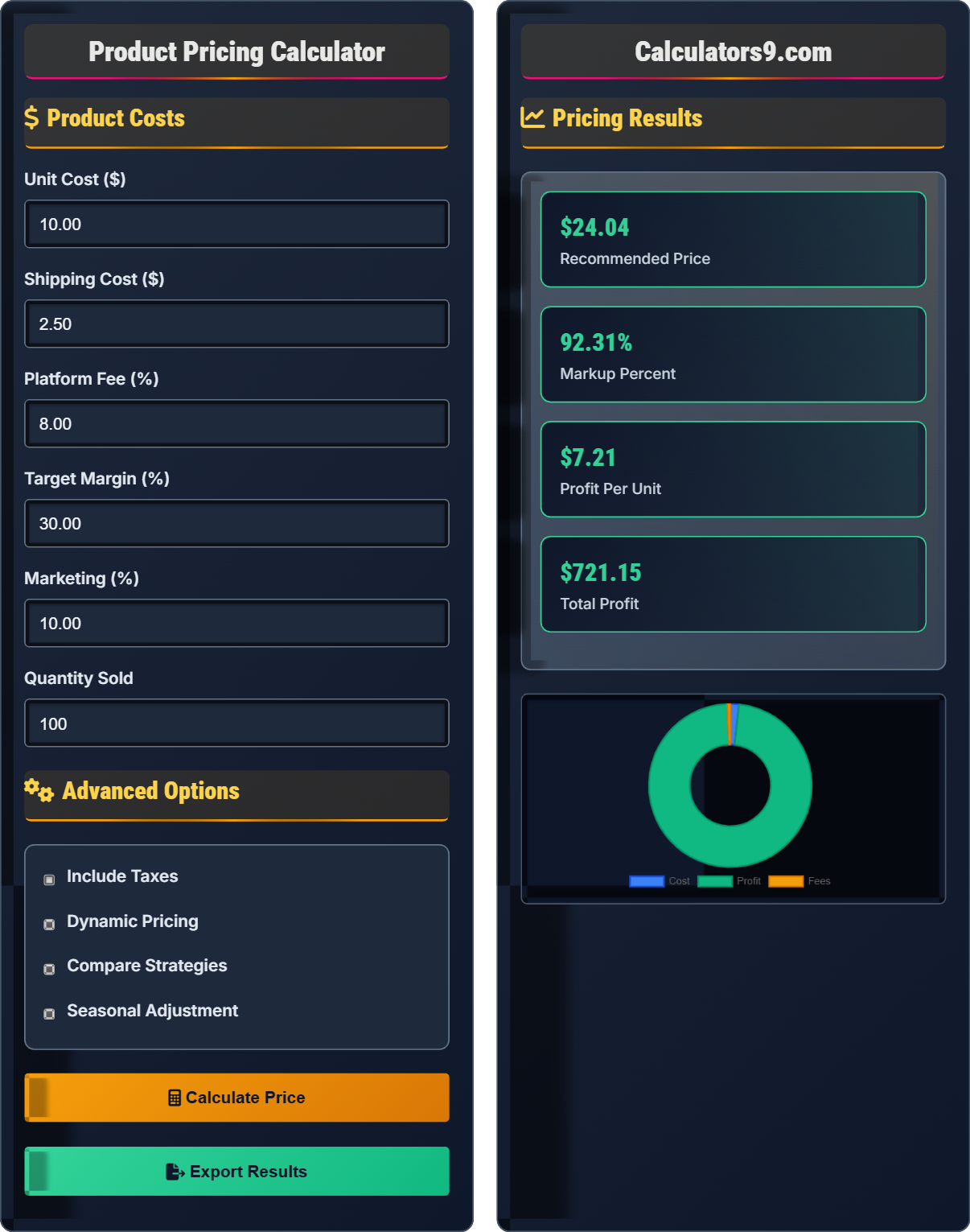
Product Pricing Calculator
Profit & margin optimization • 2026 e-commerce
Product Costs
Advanced Options
Pricing Results
| Cost Component | Amount | % of Price |
|---|
| Scenario | Price | Profit | Margin |
|---|
Comprehensive Product Pricing Guide
Product pricing is the process of determining the value customers will pay for a product. Effective pricing balances profitability with market demand, competition, and perceived value. It's a critical factor in e-commerce success, directly impacting revenue, profit margins, and competitive positioning.
The fundamental pricing calculations use these formulas:
Where:
- \(Price\) = Final selling price
- \(Total\ Cost\) = Unit cost + all additional costs
- \(Target\ Margin\) = Desired profit margin as decimal
- \(Markup\) = Percentage added to cost
- \(Margin\) = Percentage of profit from sales
Accurate pricing requires accounting for all costs:
- Direct Costs: Raw materials, labor, manufacturing
- Indirect Costs: Shipping, packaging, storage
- Platform Fees: Amazon (15%), eBay (10%), Shopify (2.9%)
- Marketing: Ads, influencer partnerships, SEO
- Taxes: VAT, sales tax, import duties
- Overhead: Admin, software, returns processing
Most successful e-commerce businesses aim for 20-30% net profit margins after all costs.
- Test different price points: A/B testing shows optimal pricing for maximum revenue
- Bundling products: Increase perceived value and average order value
- Seasonal adjustments: Raise prices during high-demand periods
- Freemium model: Offer basic version free, premium paid
- Subscription pricing: Recurring revenue with predictable cash flow
Product Pricing Learning Quiz
What is the difference between markup and margin in product pricing?
The answer is B) Markup is based on cost, margin is based on selling price. Markup = (Selling Price - Cost) / Cost × 100, while Margin = (Selling Price - Cost) / Selling Price × 100. For example, if cost is $10 and selling price is $15: markup = 50% but margin = 33.3%.
This distinction is crucial for accurate pricing. Many businesses confuse these terms, leading to incorrect pricing and profitability calculations. Markup is calculated on the cost basis, while margin is calculated on the selling price basis. Because the denominator is different, the percentages will differ for the same dollar amount of profit.
Markup: Percentage added to cost to get selling price
Margin: Percentage of selling price that is profit
Cost: Total expense to produce or acquire the product
• Markup = (Price - Cost) / Cost × 100
• Margin = (Price - Cost) / Price × 100
• For same profit, markup % > margin %
• Remember: Markup on cost, Margin on selling price
• Use the mnemonic "MAC" (Markup Against Cost)
• Always clarify which metric you're discussing with stakeholders
• Using markup and margin interchangeably
• Calculating markup when margin was intended
• Not accounting for the different bases (cost vs. selling price)
If a product costs $25 to produce and you want a 40% markup, what should be the selling price? Show your work.
Step 1: Calculate markup amount = Cost × Markup%
Markup amount = $25 × 0.40 = $10
Step 2: Calculate selling price = Cost + Markup amount
Selling price = $25 + $10 = $35
Alternatively: Selling price = $25 × (1 + 0.40) = $25 × 1.40 = $35
The selling price should be $35 with a 40% markup on cost.
This calculation demonstrates the straightforward approach to cost-plus pricing. By adding a percentage of the cost to the original cost, we arrive at the selling price. This method ensures that all costs are covered and provides the desired profit margin. It's particularly useful for businesses with stable cost structures.
Cost-Plus Pricing: Adding a markup percentage to the total cost
Markup: Percentage added to cost to determine selling price
Selling Price: Amount charged to the customer
• Selling price = Cost × (1 + Markup%)
• Always verify calculations with simple examples
• Consider market conditions beyond pure math
• Remember: (Cost × (1 + Markup%)) gives selling price
• Double-check by calculating back from selling price to cost
• Factor in all costs, not just production costs
• Adding markup percentage directly to cost (e.g., $25 + 40 = $65)
• Confusing markup with margin calculations
• Forgetting to include all cost components
A company produces a widget with a unit cost of $12. Additional costs include $3 shipping, 10% platform fee on the selling price, and 5% marketing budget. If the company wants a 25% profit margin on the final selling price, what should the selling price be?
Let P = Selling Price
Step 1: Calculate total costs as a percentage of selling price
Variable costs = Unit cost + Shipping = $12 + $3 = $15
Fixed costs as % of price = Platform fee (10%) + Marketing (5%) = 15%
Step 2: Apply the margin formula
Profit margin = (P - Total Costs) / P
0.25 = (P - ($15 + 0.15P)) / P
0.25 = (P - $15 - 0.15P) / P
0.25 = (0.85P - $15) / P
0.25P = 0.85P - $15
$15 = 0.85P - 0.25P
$15 = 0.60P
P = $15 / 0.60 = $25
The selling price should be $25 to achieve a 25% profit margin.
This problem demonstrates the complexity of real-world pricing where costs are both fixed dollar amounts and percentages of the selling price. The key insight is recognizing that platform fees and marketing costs depend on the final selling price, creating an equation that must be solved algebraically rather than through simple multiplication.
Profit Margin: Percentage of selling price that represents profit
Variable Costs: Costs that change with production volume
Percentage-Based Costs: Costs calculated as a percentage of selling price
• When costs depend on selling price, set up an equation to solve
• Always account for all cost components
• Verify final price meets margin targets
• Represent unknown selling price as a variable (P)
• Express all costs in terms of P when needed
• Always verify your answer by working backwards
• Treating percentage-based costs as fixed dollar amounts
• Not accounting for costs that depend on the selling price
• Forgetting to verify that the calculated price achieves the target margin
A retailer has a product with a total cost of $8 and wants to maintain a 30% profit margin. Competitors are selling similar products for $12-$15. If the retailer prices at the market average ($13.50), what will be their actual profit margin? Should they adjust their pricing strategy?
Step 1: Calculate price needed for 30% margin
Required price = Cost / (1 - Target Margin)
Required price = $8 / (1 - 0.30) = $8 / 0.70 = $11.43
Step 2: Calculate actual margin at market price
Actual margin = (Market Price - Cost) / Market Price
Actual margin = ($13.50 - $8) / $13.50 = $5.50 / $13.50 = 40.74%
Step 3: Strategic recommendation
At $13.50, the retailer achieves 40.74% margin, exceeding their 30% target. They could potentially lower price to $11.43 to match their target margin while staying competitive, or keep the higher margin as a buffer against price wars.
This example illustrates the balance between target profitability and market realities. The retailer has a favorable position with 40.74% margin compared to their 30% target, providing flexibility. They can choose to compete on price while maintaining healthy profits, or maintain higher margins as a competitive advantage. This demonstrates the importance of understanding market dynamics alongside cost structures.
Competitive Pricing: Setting prices based on competitor rates
Market Average: Mean price of similar products in the market
Strategic Flexibility: Ability to adjust pricing based on competitive position
• Always know your minimum viable price
• Understand competitor pricing before setting your own
• Balance profitability with market competitiveness
• Research competitors regularly (prices change frequently)
• Calculate your break-even point to understand pricing floor
• Consider non-price factors (quality, service, brand) when competing
• Ignoring competitor pricing when setting prices
• Focusing only on costs without considering market conditions
• Not adjusting for value proposition differences
Which of the following is the MOST important consideration for e-commerce pricing?
The answer is B) Covering all costs and achieving target profit. While market considerations are important, a business cannot survive if it doesn't cover its costs and achieve profitability. This forms the foundation of any sustainable pricing strategy. After ensuring profitability, businesses can then consider competitive positioning and psychological factors.
Profitability is the bedrock of any sustainable business model. Without covering costs and achieving profit, a business cannot continue operating regardless of how competitive its prices are. However, pricing purely based on costs without market awareness leads to missed opportunities or uncompetitive positions. The most successful approach balances cost coverage with market positioning.
Cost Coverage: Ensuring prices exceed all associated costs
Profitability: Achieving target profit margins
Market Positioning: How prices compare to competitors
• Always calculate total cost before setting price
• Know your minimum viable price point
• Balance profitability with market competitiveness
• Start with cost-plus pricing as a baseline
• Then adjust for market conditions and value proposition
• Monitor competitor prices but don't follow blindly
• Setting prices below cost to gain market share
• Ignoring indirect costs in pricing calculations
• Not adjusting prices as costs change
Pricing Fundamentals
Markup: percentage added to cost. Margin: percentage of profit from sale.
\(Price = \frac{Cost}{1 - Margin}\)
\(Markup = \frac{Price - Cost}{Cost} \times 100\)
\(Margin = \frac{Price - Cost}{Price} \times 100\)
- Always calculate total costs before pricing
- Target margins: 20-30% for e-commerce
- Consider market conditions
Optimization Strategies
Include direct costs, platform fees, shipping, marketing, and overhead.
- Cost-plus pricing
- Competitive analysis
- Value-based pricing
- Dynamic adjustments
- Know your break-even point
- Factor in seasonality
- Monitor competitor prices
- Test different price points
FAQ
Q: What's a good profit margin?
A: For e-commerce, aim for 20-30% net profit margin. After all costs including platform fees, shipping, and marketing. Some categories allow higher margins.
Q: How often should I review prices?
A: Review quarterly at minimum. More frequently for volatile markets. Adjust for cost changes, competitor moves, and seasonal demand.