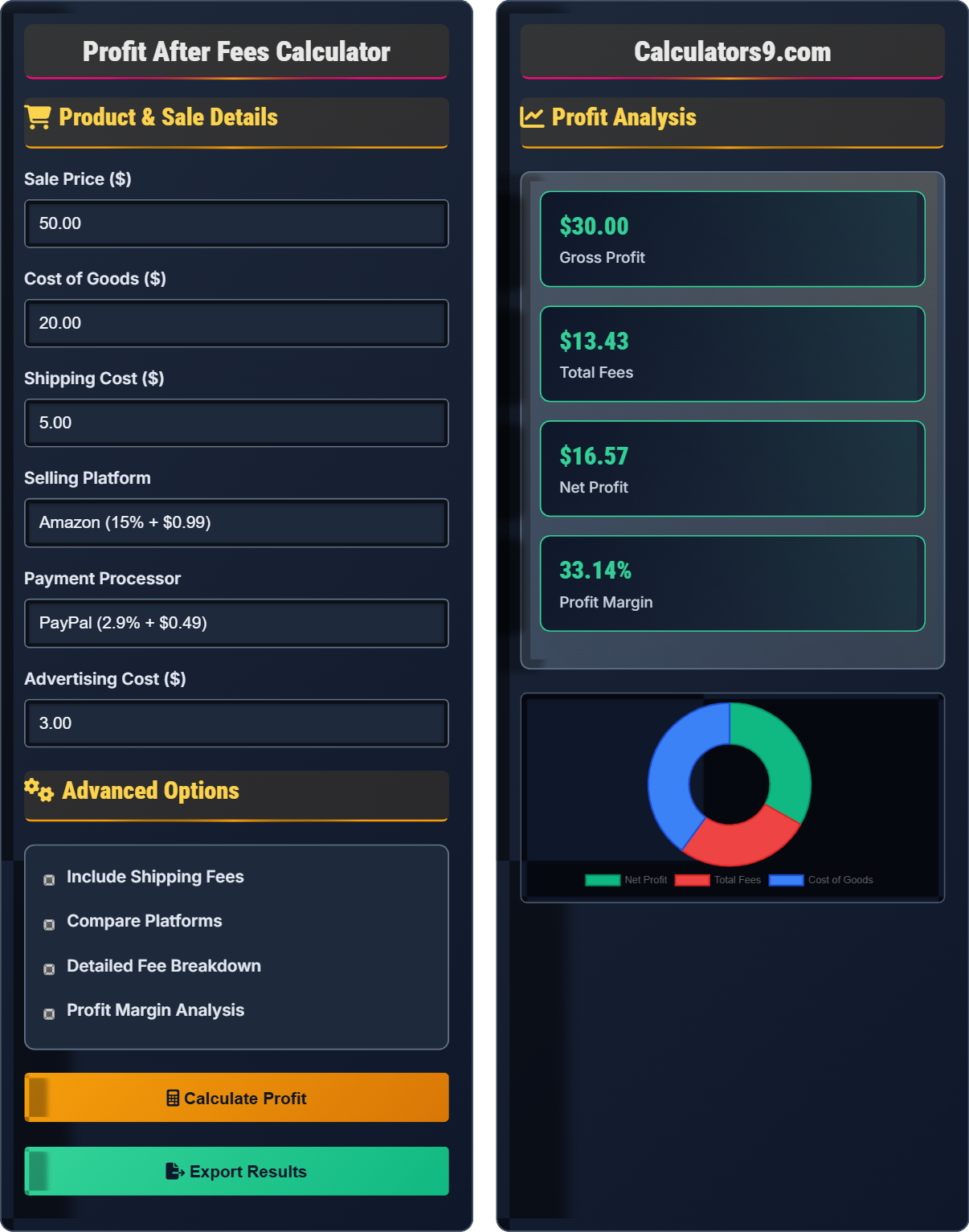
Profit After Fees Calculator
Earnings & cost analysis • 2026 e-commerce
Product & Sale Details
Advanced Options
Profit Analysis
| Fee Type | Rate | Amount | Description |
|---|
| Scenario | Profit | Margin | Change |
|---|
Comprehensive Profit After Fees Guide
Profit after fees is the net earnings from a sale after deducting all associated costs including marketplace fees, payment processing, advertising, and operational expenses. Understanding this metric is crucial for e-commerce success and pricing strategy.
The fundamental profit calculation uses this formula:
Where:
- \(Sale\ Price\) = Amount received from customer
- \(Cost\ of\ Goods\) = Product cost + Direct expenses
- \(Marketplace\ Fees\) = Platform commissions and fees
- \(Payment\ Fees\) = Credit card and processor charges
- \(Other\ Costs\) = Advertising, shipping, returns, etc.
Additional expenses that affect net profit:
- Storage Fees: Monthly charges for inventory storage
- Return Processing: Restocking and inspection costs
- Advertising: Promoted listings, PPC campaigns
- Chargebacks: Disputed transactions and fees
- Accounting: Bookkeeping and tax preparation
- Software: Inventory management, analytics tools
Most successful e-commerce businesses plan for 15-25% additional costs beyond basic fees.
- Volume Discounts: Negotiate lower rates with high volume
- Multi-Channel Approach: Diversify across platforms
- Efficient Fulfillment: Reduce shipping and handling costs
- Dynamic Pricing: Adjust prices based on competition
- Customer Retention: Higher lifetime value offsets acquisition costs
Profit After Fees Learning Quiz
Which fee structure is most favorable for a high-value, low-volume product?
The answer is B) Fixed per-item fees. For high-value, low-volume products, percentage-based fees become more expensive as the product value increases. Fixed fees remain constant regardless of price, making them more favorable for expensive items. For example, a $100 item with 15% fee = $15, while a $1000 item with 15% fee = $150.
Fee structures have different impacts depending on product price points. Percentage-based fees scale with revenue, while fixed fees remain constant. Understanding this relationship helps in platform selection and pricing strategy. High-value products benefit from fixed fee structures, while low-value items may benefit from percentage-based fees.
Percentage-Based Fee: Calculated as a percentage of sale price
Fixed Fee: Set dollar amount per transaction
Volume Discount: Reduced rates for high transaction volumes
• Percentage fees increase with product value
• Fixed fees remain constant regardless of price
• Consider both fee types in combination
• Calculate effective rate for different price points
• Consider total cost of ownership
• Factor in hidden fees beyond stated rates
• Not considering fee impact on different price points
• Ignoring hidden or additional fees
• Failing to recalculate as prices change
Calculate the total fees for a $75 sale on Amazon FBA with Stripe payment processing. Amazon charges 15% + $0.99, Stripe charges 2.9% + $0.30. Show your work.
Step 1: Calculate Amazon fees
Referral fee = $75 × 0.15 = $11.25
Per-item fee = $0.99
Total Amazon fees = $11.25 + $0.99 = $12.24
Step 2: Calculate Stripe fees
Processing fee = ($75 × 0.029) + $0.30 = $2.175 + $0.30 = $2.48
Step 3: Calculate total fees
Total fees = $12.24 + $2.48 = $14.72
The total fees are $14.72.
This demonstrates how multiple fee layers accumulate. Amazon charges both percentage and fixed fees, while Stripe adds its own processing fees. The total fee percentage ($14.72/$75 = 19.63%) exceeds the individual percentages due to the additive effect of multiple fee structures.
Referral Fee: Commission charged by marketplace
Per-Item Fee: Fixed charge per transaction
Processing Fee: Payment gateway charges
• Calculate each fee type separately
• Add all fees to get total cost
• Consider compound effects of multiple fees
• Calculate fees before setting prices
• Use fee calculators for complex structures
• Consider bundling to reduce per-item costs
• Forgetting fixed per-item fees
• Not accounting for payment processing fees
• Incorrectly combining percentage fees
A seller has a product that sells for $40 with $15 cost of goods. On Amazon, fees are 15% + $0.99. On Etsy, fees are 6.5% + $0.20 + 3% processing. Which platform yields higher profit? Calculate the difference.
Step 1: Calculate Amazon profit
Amazon fees: ($40 × 0.15) + $0.99 = $6.00 + $0.99 = $6.99
Gross profit: $40 - $15 = $25
Net profit: $25 - $6.99 = $18.01
Step 2: Calculate Etsy profit
Etsy transaction fee: ($40 × 0.065) + $0.20 = $2.60 + $0.20 = $2.80
Etsy processing fee: $40 × 0.03 = $1.20
Total Etsy fees: $2.80 + $1.20 = $4.00
Net profit: $25 - $4.00 = $21.00
Step 3: Compare
Etsy yields $21.00 vs Amazon's $18.01
Difference: $21.00 - $18.01 = $2.99
Etsy yields $2.99 more profit.
This example shows how different fee structures can significantly impact profitability. Despite Amazon having a lower percentage rate (15% vs 6.5% + 3%), the fixed per-item fee and higher processing rate make Etsy more profitable for this price point. This highlights the importance of calculating actual costs rather than just comparing percentages.
Transaction Fee: Fee charged per sale
Processing Fee: Payment gateway charges
Net Profit Comparison: Actual earnings comparison
• Calculate actual dollar amounts, not just percentages
• Consider all fee components
• Compare net results across platforms
• Create fee comparison templates
• Test different price points
• Factor in sales volume assumptions
• Comparing only percentage rates
• Ignoring fixed per-item fees
• Not considering payment processing costs
A business processes $100K in sales monthly with 3% platform fees. If they negotiate a 0.5% reduction in fees, how much does this save annually? What percentage improvement is this to their bottom line?
Step 1: Calculate current monthly fees
Current fees = $100,000 × 0.03 = $3,000
Step 2: Calculate new monthly fees
New rate = 3% - 0.5% = 2.5%
New fees = $100,000 × 0.025 = $2,500
Step 3: Calculate monthly and annual savings
Monthly savings = $3,000 - $2,500 = $500
Annual savings = $500 × 12 = $6,000
Step 4: Calculate percentage improvement
Improvement = ($500 ÷ $3,000) × 100 = 16.67%
They save $6,000 annually, representing a 16.67% improvement in fee-related expenses.
This demonstrates the significant impact of negotiating lower fees, especially at scale. A seemingly small 0.5% reduction results in substantial savings when applied to large volumes. The percentage improvement (16.67%) is much higher than the rate reduction (0.5%) because it's calculated on the original fee amount, not the total revenue.
Volume Negotiation: Securing better rates with higher volume
Fee Reduction Impact: Leverage of small rate changes at scale
Percentage Improvement: Relative gain in efficiency
• Small fee reductions have large impacts at scale
• Calculate percentage improvements on original costs
• Negotiate rates when approaching volume thresholds
• Track fee trends over time
• Negotiate before reaching new tiers
• Consider switching platforms for better rates
• Underestimating impact of small fee changes
• Not negotiating at appropriate volume levels
• Calculating improvements on wrong base
What is the most effective way to reduce fees as a percentage of revenue?
The answer is C) Negotiate lower rates. While increasing prices can help offset fees, negotiating lower rates directly reduces the percentage impact on revenue. Fixed fees become proportionally smaller as revenue increases, but negotiated percentage rates provide the most scalable solution for reducing fee percentages.
Fee optimization strategies have different impacts on the percentage of revenue consumed by fees. Negotiating lower rates directly reduces the percentage, while other strategies may only shift the burden. Volume-based negotiations often yield the best results, as providers are willing to reduce rates for guaranteed business volume.
Fee Percentage: Fees as percentage of total revenue
Rate Negotiation: Discussing better terms with providersVolume Leverage: Using sales volume as negotiation tool
• Negotiate rates before reaching new volume tiers
• Compare total cost of ownership
• Consider service quality with fee rates
• Prepare volume projections for negotiations
• Benchmark against competitors
• Consider multi-year contracts for stability
• Accepting initial rates without negotiation
• Not tracking fee rate changes over time
• Focusing only on lowest rates without considering service
Fee Fundamentals
Percentage fees, fixed fees, transaction fees, processing fees, and hidden costs.
\(Net\ Profit = Sale\ Price - Cost - Fees\)
\(Profit\ Margin = \frac{Net\ Profit}{Sale\ Price} \times 100\)
\(Total\ Fees = \sum(All\ Individual\ Fees)\)
- Calculate all fee components
- Consider compound fee effects
- Track fees as percentage of revenue
Optimization Strategies
Volume negotiations, platform diversification, efficient fulfillment, and strategic pricing.
- Negotiate rates at volume thresholds
- Diversify across platforms
- Calculate fees before pricing
- Track fee trends monthly
- Service quality vs. cost trade-offs
- Volume requirements for better rates
- Contract terms and exit clauses
- Impact on customer experience
FAQ
Q: How much should I expect to pay in fees?
A: Typically 15-25% of revenue for major platforms. Amazon: 15%+, eBay: 12-15%, payment processors: 2-4%. Add storage, advertising, and other costs for total impact.
Q: When should I negotiate better rates?
A: Negotiate before hitting volume thresholds. Most providers offer better rates at $10K, $50K, $100K+ monthly volumes. Prepare your case with volume projections and competitor rates.