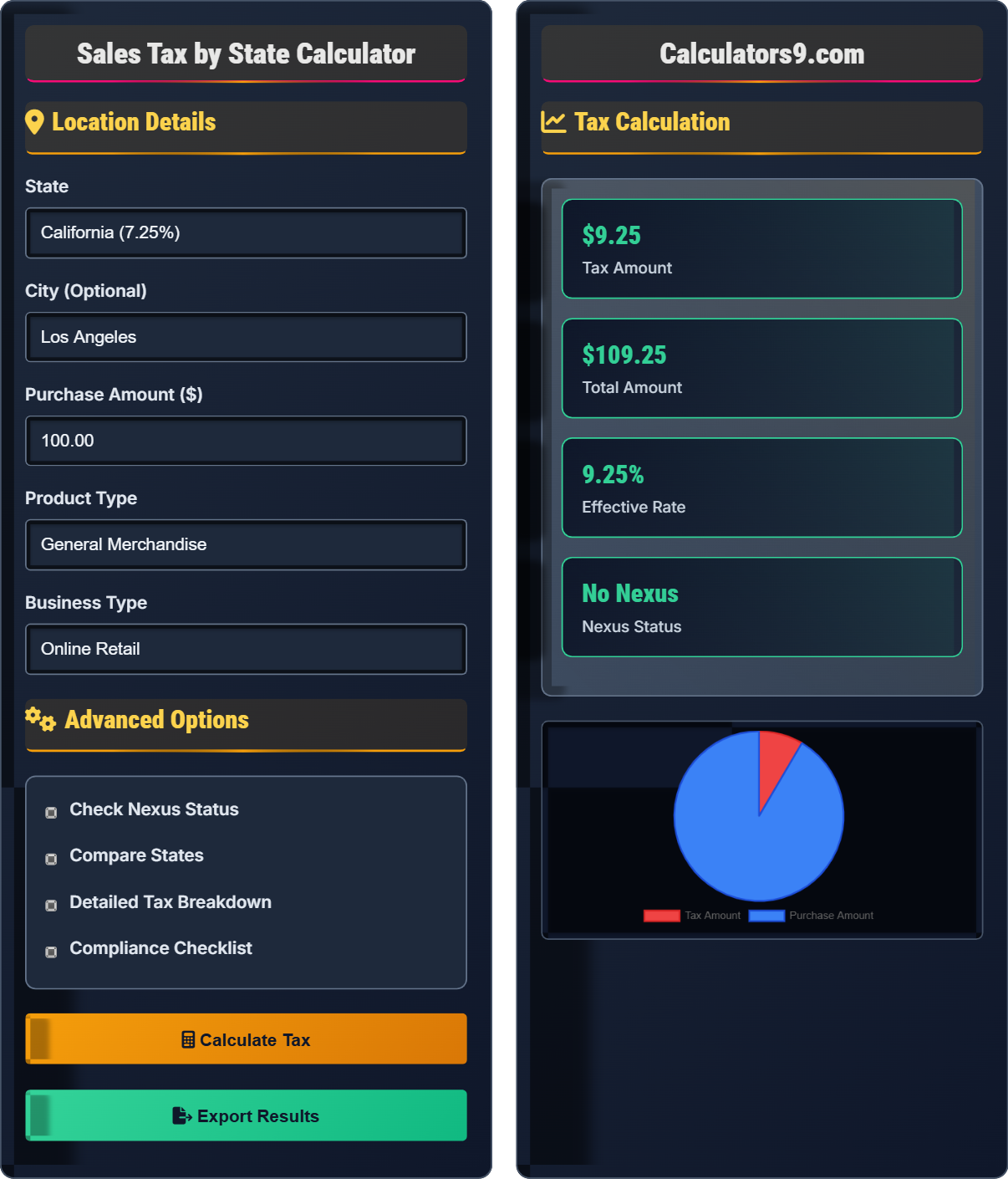
Sales Tax by State Calculator
Rates & compliance optimization • 2026 e-commerce
Location Details
Advanced Options
Tax Calculation
| Component | Rate | Amount | Description |
|---|
| Requirement | Status | Action Needed | Deadline |
|---|
Comprehensive Sales Tax Guide
Sales tax is a consumption tax imposed by state and local governments on the sale of goods and services. It's collected by retailers and remitted to tax authorities. Rates vary by state, locality, and product type. E-commerce businesses must navigate complex nexus rules and compliance requirements.
The fundamental sales tax calculation uses this formula:
Where:
- \(Tax\) = Sales tax amount to collect
- \(Purchase\ Amount\) = Taxable transaction amount
- \(Tax\ Rate\) = Combined state, county, and city rate
Physical presence rules determine tax collection obligations:
- Physical Nexus: Office, warehouse, employees, or equipment in state
- Economic Nexus: $100,000 in sales OR 200+ transactions annually
- Click-Through Nexus: Affiliate marketing relationships
- Marketplace Nexus: Sales through platforms like Amazon/Etsy
- Temporary Presence: Trade shows, pop-ups, and temporary events
- Threshold Changes: Vary by state; monitor updates regularly
After South Dakota v. Wayfair (2018), economic nexus applies to remote sellers in most states.
- Automated Systems: Use tax automation software for real-time calculations
- Regular Reviews: Quarterly nexus assessments and rate updates
- Professional Help: Consult tax professionals for complex situations
- Documentation: Maintain detailed records of all transactions
- Software Solutions: Integrate with e-commerce platforms for seamless compliance
Sales Tax Learning Quiz
What triggers economic nexus for sales tax collection?
The answer is B) $100K in sales OR 200+ transactions annually. Economic nexus rules, established after South Dakota v. Wayfair (2018), require remote sellers to collect tax when they meet either threshold. Some states have different thresholds (e.g., $500K sales).
Economic nexus fundamentally changed how remote sellers handle sales tax. Before Wayfair, physical presence was required. Now, substantial economic activity triggers collection obligations. The $100K/200 transaction rule is a federal guideline, but states can set their own thresholds.
Nexus: Connection between business and state requiring tax collection
Economic Nexus: Sales volume/transaction threshold for tax collection
Wayfair Decision: Supreme Court ruling allowing economic nexus
• Trigger is $100K sales OR 200+ transactions annually
• Applies retroactively to previous sales
• Thresholds vary by state
• Track sales by state monthly
• Monitor different state thresholds
• Start compliance before reaching threshold
• Ignoring economic nexus requirements
• Not tracking sales by state
• Delaying compliance until threshold exceeded
Calculate the sales tax for a $250 purchase in New York City (combined rate 8.25%). Show your work.
Step 1: Convert percentage to decimal
8.25% = 0.0825
Step 2: Calculate tax amount
Tax = Purchase Amount × Tax Rate
Tax = $250 × 0.0825 = $20.625
Step 3: Round to nearest cent
Tax = $20.63
The sales tax is $20.63.
This demonstrates the basic sales tax calculation with rounding rules. New York City's combined rate includes state (4%), city (4.25%), and additional local taxes. Always round tax amounts to the nearest cent as required by law.
Combined Rate: State + Local tax rates
Rounding Rules: Nearest cent for tax calculations
Local Tax: County and city additions to state rate
• Multiply purchase amount by tax rate
• Round tax to nearest cent
• Collect tax at point of sale
• Remember: Amount × Rate = Tax
• Always use exact decimal conversion
• Verify local rates for accuracy
• Forgetting to convert percentage to decimal
• Incorrect rounding of tax amounts
• Using only state rate instead of combined rate
An e-commerce business has $120K in sales in California and 180 transactions in Texas ($80K sales). Does the business need to collect sales tax in both states? Explain.
Step 1: Evaluate California nexus
California: $120K sales > $100K threshold → NEXUS ESTABLISHED
Must collect California sales tax on all CA sales.
Step 2: Evaluate Texas nexus
Texas: $80K sales < $100K threshold
Texas: 180 transactions < 200 threshold → NO NEXUS
Step 3: Conclusion
Must collect tax in California only. No obligation in Texas based on current activity. However, Texas has a $500K sales threshold for economic nexus, which hasn't been met.
This example shows how nexus rules apply independently to each state. California has the standard $100K/200 transaction threshold, while Texas has a higher $500K sales threshold. Businesses must evaluate nexus state-by-state, not cumulatively.
State-by-State: Nexus evaluated separately for each state
Threshold Evaluation: Meet either sales OR transaction threshold
Compliance Scope: Only collect where nexus exists
• Nexus rules apply independently by state
• Thresholds vary by state
• Collect tax only where nexus exists
• Track sales and transactions separately by state
• Monitor state-specific thresholds
• Use automation for multi-state compliance
• Applying nexus rules cumulatively across states
• Assuming all states have same thresholds
• Collecting tax where no nexus exists
A business sells clothing ($50) and food items ($30) in New York. New York exempts most food items but charges 4% state tax on clothing. What is the total tax owed? Assume no local taxes apply.
Step 1: Identify taxable items
Clothing: $50 (taxable at 4%)
Food: $30 (exempt from sales tax)
Step 2: Calculate tax on taxable items
Tax = $50 × 0.04 = $2.00
Step 3: Calculate total
Total tax = $2.00
Total amount = $50 + $30 + $2.00 = $82.00
The total tax owed is $2.00.
This demonstrates how product-specific exemptions affect tax calculations. Different product categories have different tax treatment within the same jurisdiction. Businesses must correctly classify items and apply appropriate rates/exemptions.
Taxable Item: Subject to sales tax collection
Exempt Item: Not subject to sales tax
Product Classification: Categorizing items for tax purposes
• Apply tax only to taxable items
• Verify exemption rules by state
• Classify items correctly
• Maintain product classification system
• Research state-specific exemptions
• Use tax software for complex classifications
• Applying tax to exempt items
• Missing product-specific exemptions
• Incorrect item classification
What is the most important factor for sales tax compliance?
The answer is B) Accurate rate application and record keeping. Proper compliance requires applying correct tax rates to transactions and maintaining detailed records. Undercharging tax is as serious as overcharging, and inadequate records create audit risks.
Compliance is about accuracy, not minimizing tax burden. Applying wrong rates (too high or too low) creates liability. Detailed records protect businesses during audits and demonstrate good faith compliance efforts. Automation tools help ensure accuracy across multiple jurisdictions.
Compliance: Meeting all legal tax collection and reporting requirements
Record Keeping: Maintaining transaction documentation
Audit Trail: Documentation supporting tax calculations
• Apply correct rates to each transaction
• Maintain detailed records
• File timely returns
• Automate tax calculations
• Keep transaction records for 3-7 years
• Reconcile tax collections monthly
• Applying wrong tax rates
• Inadequate record keeping
• Missing filing deadlines
Tax Fundamentals
Nexus, combined rates, exemptions, compliance, and filing requirements.
\(Tax = Amount × Rate\)
Where Rate is combined state + local tax rate.
Round to nearest cent.
- Collect tax where nexus exists
- Apply correct rates by location
- Maintain detailed records
Compliance Strategies
Automation, monitoring, professional assistance, and systematic record keeping.
- Use tax automation software
- Monitor nexus thresholds
- Classify products correctly
- File returns timely
- State-specific rules vary
- Thresholds change periodically
- Exemptions are complex
- Penalties can be severe
FAQ
Q: When do I need to start collecting sales tax?
A: Generally when you meet nexus thresholds: $100K sales or 200+ transactions in a state annually. Some states have lower thresholds. Start collecting before reaching the threshold to avoid back tax liability.
Q: How often should I file sales tax returns?
A: Frequency depends on sales volume: Monthly (high volume), Quarterly (medium), Annually (low volume). Check each state's requirements. Penalties for late filing can be severe.